
Recently, PBS paid us a visit for an upcoming segment to be airing as apart of a PBS Quest episode. The air date is still TBD, but in the mean time here’s a link to a quick preview from the journalist and videographer, Michael Werner.
Identifying crow dieases: Avian pox
Recently, I received an email from someone in distress over an obviously sick crow in their yard. They sent some photos and were wondering about the cause of the crusty areas around the bill and eyes. Although I am by no means an expert in avian diseases, there’s one that’s easy to identify and by far the most common I see in the field so I feel it’s appropriate to provide a brief description of it here.

Bird with a likely avian pox infection as identified by the whitish/pink lesions around the exposed skin. Photo c/o D. Wright
Avian pox is a common disease affecting birds across many different orders including songbirds, raptors and game birds. It’s caused by the avipoxvirus of which there are at least 3 different strains. There’s multiple modes of transmission but it’s most often spread by mosquitoes which is why it’s observed more commonly in the spring and summer months. It can also be spread via direct transmission or indirectly through inhalation of dander, feather debris or sharing contaminated food or water sources (a good reminder to regularly clean feeders and bird baths).
There are two types of avian pox: wet and dry. Wet pox affects the mouth, throat, trachea and lungs and is most likely to be fatal because it can eventually cause suffocation. Dry pox infections are easy to identify because they result in visible lesions and scarring on the non feathered areas of the bird. In the early stages small yellow, white or pink blisters form which become large raised areas that eventually burst. This results in the formation of crusty scabs that, on crows, will appear brown or black. As long as the the bird’s ability to feed isn’t influenced by the location of the scabbing the lesions will generally heal in 2-4 weeks. The general health of the bird before the infection, and the presence of any secondary infections that result from the open lesions will influence the bird’s likelihood of survival.

The pox covered feet of a crow fatally weakened by this disease. c/o Sarah Ramirez
If you notice pox infected birds at your feeder(s) the best way to protect your visitors is to stop feeding them. This may seem cruel or counterproductive since sick birds need access to consist food sources to fight the infection, but providing food bonanzas concentrate birds and increases the risk of transmission to healthy individuals. Depending on your situation you may be able to provide food to the individual without worry of creating contact between multiple birds.
Please leave a message in the comments if you have high quality photos of your infected birds and would be willing to let me use them in this post. Thank you!
Filed under Crow disease, Crow life history
Notes from the field: That golden moment
I am a huge fan of podcastes of all kinds. Especially when I’m working a pair of very “avoidy” birds and I’m basically in for several hours of watching an unchanging pile of food on the ground, an earbud with a good story is the key to maintaining my focus on the sidewalk, rooftops and trees for any incoming birds. One of my favorite podcasts is The Story Collider which describes itself as “stories about how science touches people’s lives”. I highly recommend it for both science geeks and non-scientists alike, but I imagine it resonates deeper with those who feel engaged with science on a more regular basis. A common theme of these stories is “the golden moment”, and whatever that may mean for the storyteller. Which got me thinking: What’s my golden moment?
Conducting research in an urban environment, especially a study as conspicuous as mine, has it’s benefits and drawbacks. Drawbacks include: Confrontation over the study itself, people or pets unknowingly interfering with experiments, sometimes unpleasant or slightly risky work environments, etc. But the advantage is easily summarized: I get to engage with all kinds of people about my research. I derive and immense amount of joy from explaining my study to folks, especially in the company of children. There’s one particular moment in the course of the experiment, however, that stands out from the rest.
At a certain point in the study I have the masked person walking around instead of remaining stationary. Today I found myself conducting just such a trial and, frankly, these tests can be rather awkward. I can hear people whispering about the masked person, what they might be doing (often they don’t notice their “UW CROW RESEARCH” sign) and rarely are they emboldened enough to ask and, frankly, it’s probably for the best because I need my full attention on my birds during these tests (I’m working the camera while my volunteer walks around). As you can imagine, it can be a bit uncomfortable to cause such a stir and then just keep walking leaving people to scratch their heads (or think worse) about what they just saw. But occasionally the golden moment happens. That moment when they’ve noticed the mask, perhaps even read the sign and are eagerly discussing what a bizarre scene they’ve just witnessed with their companions when, boom, in comes the crow. Suddenly, without my needing to explain it, every onlooker can see precisely what’s happening: A crow knows that person and they don’t like them. An explosion of scolding, body language and flight patterns makes the target of their animosity well known. During these moments without any effort or intention, people are experiencing science. They’re watching crows and potentially learning something new about them. They will not know the full back-story to what’s going on of course, but there’s enough information laid right out there for them that conversations about crows and their intelligence and antics are inevitable. Suddenly the bird so many people ignore becomes the object of fascination and attention. These are the moments that I believe create changes in attitudes about crows and, more broadly, what science research looks like. These are my golden moments.
Filed under Being a scientist, Graduate Research
Crow curiosities: what causes white feathers?

ZB in flight. Photo c/o Sarah Ramirez
At a recent field site in Bellevue, one of my regular visitors was the most fantastically leucistic crow I had ever seen. Naturally, I dubbed him or her “ZB” for Zebra Bird. One or two white feathers is pretty common but this was something far more spectacular. Something that, to the naive observer, may look like a whole different species of bird. In response, I thought it might be helpful to talk about how and why crows have white feathers or other kinds of color aberrations. First off, let’s put some definitions on the table since there are a few terms that often get mixed up, or have different definitions depending on your source. The following definitions are based on those provided by Guay et al. 2012.
Albinism results from a complete lack of melanin in both the feathers and all the soft body tissues. This causes red eyes and pink legs, making it very easy to spot. Albinism is often associated with poor vision and hyper-activity which quickly removes it from the general population and why, when it is spotted, it’s usually only in young or captive birds.

Albino crow spotted in Franklin Park, Seattle*
Leucism is a complete lack of melanin in all or part of the plumage, but not necessarily the soft tissues. It is sometimes referred to as ‘partial albanism’ but if you’re familiar with the definition of albanism (which hopefully you are now!) you know the term ‘partial albinism’ is oxymoronic. Leusistic birds can have one or multiple white feathers, as is the case with my friend in Bellevue, or be completely white but with regularly colored eyes. Their feet and bills may or may not appear pink like that of an albino bird’s.
Schizochrosim is a lack of a particular pigment. So a bird lacking the phaeomelanin (brown) pigment, for example, would appear grey.
Melanism is exceptionally high deposits of melanin that make the animal appear darker overall.
Carotenism is a change in the amount, distribution or composition of caroteniod (red, yellow, orange) pigments.
Dilution is, as the name suggests, a muting of colors across all or part of a bird’s plumage.
How do these color abnormalities arise? There are a couple of different pathways including genetics, diet and injury/disease.
Genetics
Albinism is genetic, specifically, it’s linked to a recessive autosomal gene. If you’re reading this and thinking “autosomal recesisve…what?” remember that humans have 23 pairs of chromosomes. Twenty two of them are autosomal and the last pair are sex chromosomes (you’re either XX or XY, sound familiar?). Recessive means you need two copies of the gene to express the trait. What this mutation does is cause an absence of the enzyme tyrosinase, which is used by the body to create some of the colored pigments. Because albinism is heritable, it can be bred into an artificial population by a skilled breeder, which is why you may see things like white tigers and lions in the entertainment business. Despite their dramatic color variation from their peers, they are not distinct species-an idea I occasionally see being perpetuated on social media. Genetics also plays a role in leucism, though it’s often only part of a more complicated mechanism.
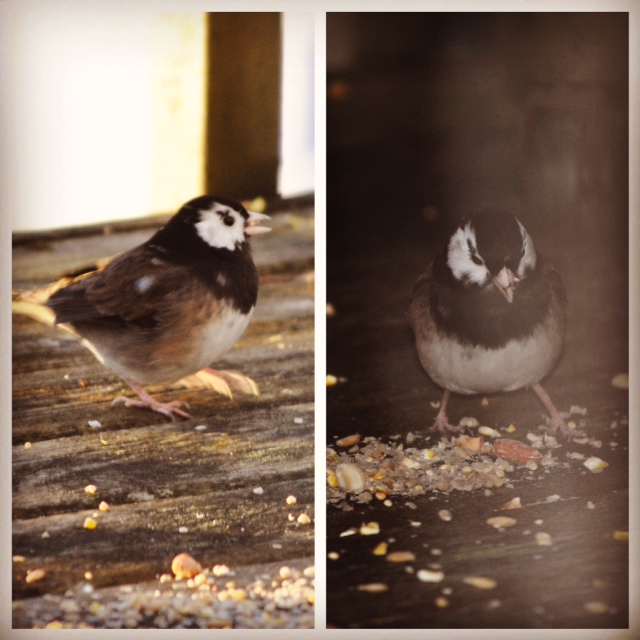
A leucistic dark-eyed junco spotted at my feeder.
Diet
Diets low in protein may also contribute to leucism, as the amino acid lysine has been correlated with increased white feathers. This is supported by the observation that urban birds (who presumably have a diet lower in meat and protein) typically have more color aberrations than their rural or forested peers. Carotenism, on the other hand, is very strongly influenced by diet, since animals cannot produce this color on their own. A very familiar example of this is seeing the white young of flamingos who, in this early stage of life, have not yet had enough time to begin producing mass quantities of their pink pigments.
Age/injury
Lastly, age and injury may also contribute to feathers which fail to correctly pigment though this is poorly understood. Somatic genetic mutation (i.e mutations that occur after conception) are associated with increased age, and indeed, older crows are more often seen with white feathers. Avian Pox is known to play a role in carotenism though not much is understood about this.

ZB’s eye catching leucism in flight. Photo c/o Sarah Ramirez
*Updates* a previous version of this post contained a typo stating that humans have 24 pairs of chromosomes.
A previous version stated incorrectly that a complete leucitic juvenile could be identified by its correctly colored iris. Since blue pigments occur irrelevant of melanin, this is not the case.
Lit cited
Guay, P.J., Potvin, D.A., and Robinson, R.W. 2012. Abberations in plumage coloration in birds. Australian Field Ornithology 29 23-30.
Filed under Crow curiosities, Crow life history
Reaching the limits of crow intelligence
When I was in college it became a joke among my friends and I that they would greet or bid me farewell with the following phrase “I believe in crow intelligence.” Even as an undergrad, my passion for crow behavior and cognition was evident to my friends and family and I relished the emerging data demonstrating that this relative underdog was far exceeding our expectations of what an animal, especially a bird, could do. While I still carry this phrase as a mantra in my research, it’s something I’ve also grown cautious to keep in check. I’ll come back to this point in a minute, but for now let me rather crudely transition to some exciting new research.
The fantastic Alex Taylor and his group at Auckland University have once again dazzled us with another one of their eloquent studies on the New Caledonian crows. This time they were looking at yet another aspect of crow’s learning intelligence: the ability to observe cause and effect and exercise a new behavioral pattern i.e causal intervention. Essentially the researchers presented both the crows and two year old children with cylinder that, when hit with a block, would reward them with food. The subjects were first exposed to the set up by baiting the block with food, thereby demonstrating that, when moved in an effort to reach the bait food, the block would drop and release even more food via hitting the cylinder. Babies quickly learned how to use an unbaited block provided in a new location to access the food hidden by the cylinder, but the crows failed to make the cause and effect connection.
The researchers were apt to point out that while this failure provides a fascinating insight into the evolution of causal reasoning, it does not negate the ways in which these animals remain exceptional in this respect as well. Indeed, crows outperform children in some aspects of causal reasoning as demonstrated by the Aesop’s Fable experiments they conducted looking at object discrimination.
For me, it also provides one other important reminder: that crows are not feathered humans. Reflecting on my earlier anecdote about my iconic catch phrase, something I’ve had to come to terms with as a graduate student is recognizing my own bias regarding these animals. Occasionally, I find myself truly disappointed by results like the aforementioned one. Perhaps it’s an all-American love for the underdog, or a hope that if only people understood how smart these animals are they would show them more respect. Whatever the reason, an important area of growth for me has been acknowledging my desire to continuing showing that these animals are exceptional and being aware of when or how that might be affecting my interpretation of my results. This is indeed what it means to be a scientist. Even when I have a my civilian hat on, accepting that crows are not simply feathered humans is, I think, an important part of truly embracing the natural world for what it is: a rich source of both diversity and overlap all of which deserve our admiration and preservation.
Filed under Crow behavior, crow intelligence, Crow life history
Do crows reduce other songbirds?
A comment I occasionally hear, especially while conducting my research in neighborhoods is, “Ugh, I hate the crows. All of a sudden we have tons of crows and they’ve scared off all our songbirds!” This comment always pains me, but I understand that for most people it arises from a genuine concern for songbird abundance and conservation. First off, as a reminder crows are songbirds themselves; ravens are our biggest songbird. Semantics aside, I understand that there are many, many bird lovers who just can’t get on the crow bandwagon and when they talk about wanting songbirds at their feeders they mean chickadees, juncos, grosbeaks, etc. They feel that since the “arrival” of the crows their observations of these other birds have diminished. So is there anything to this? Do crows indeed drive down populations of small, “desirable” backyard birds?
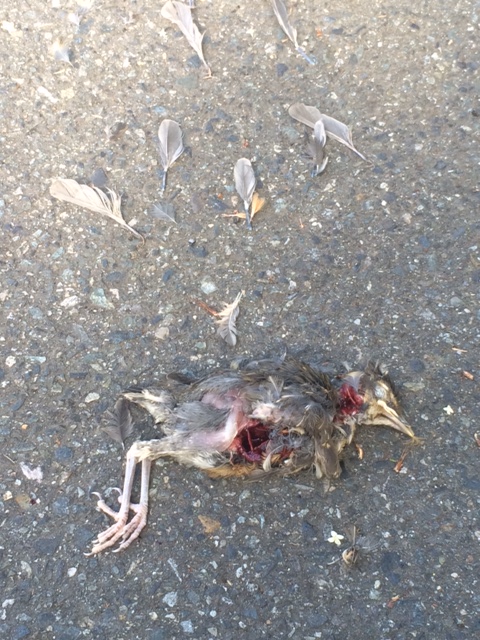
I came across this grizzly scene while conducting research in Bellevue. An adult robin calling frantically while a crow munched on one of its young. Later that same week I would watch of pair of adult crows chase hopelessly after a cooper’s hawk that had taken one of their offspring.
The short answer is: not usually. Now, let’s be clear, crows will absolutely kill and eat eggs, nestlings and even adult birds if they can get their hands on one. I once saw a crow take down an adult house sparrow in an attack so quick and dexterous I only realized what had happened after the crow had already started eating its meal. It’s important to keep in mind, however, that crows are one of many, many animals that are eating the young and adults of other bird species. Raccoons, squirrels, foxes, hawks, owls, bullfrogs, rats, mice, and of course cats will all gladly eat birds, especially eggs and nestlings. The vulnerability of young birds is in fact why the breeding strategy of many birds is to have multiple clutches over the course of the breeding season. Crows themselves are subject to these same predators and very few of their young will make it to adulthood.
Why do we think that crows aren’t responsible for the any observed decrease in feeder birds? Predator removal studies. These studies are straightforward and essentially create two populations, a control population that has been unmodified and a second where the predator in question has been actively removed. Prey abundance or productivity is monitored and compared at the end of the trial.
Recently, Madden et al. published a comprehensive literature review of 42 studies across 9 countries that looked at the impacts of corvid removal on a variety of avian groups including gamebirds, passerines, waders and other ground nesting birds. They found that in 81% of cases corvid removal made no impact on prey abundance or productivity. They also found that impacts of corvids on prey species was similar, and no one group was particularly more sensitive than any others. Of the corvids studied, magpies consistently had the smallest impact on prey productivity, but no difference was found if the study was looking at prey abundance. So if corvids are such conspicuous avian predators, why doesn’t their removal seem to matter in most cases?
This is explained by idea of compensatory mortality, which is essentially that removing one predator just means that the other predators will account for its absence by eating the prey it otherwise would have. Kevin McGowan provided a great description for this idea on his site “I like to use the analogy of handicapped parking spaces at the mall You drive up to the mall, looking for a parking space in a crowded lot. You can’t find a parking space, but there are four near the entrance that are reserved for handicapped permits only. You complain and think that if only those handicapped restrictions weren’t there, you could park in those spots (common sense). In truth, of course, if those spaces were not reserved they would have been taken long ago, just like all the other spaces in the lot.” Indeed, Madden et al. found this to be true. When they looked at studies that only conducted corvid removal, they found that only 16% of cases saw a difference in prey productivity. Whereas if all predators were removed the researchers reported that 60% of studies found a significant difference in prey productivity.
What this means for those of us trying to improve the bad reputations of crows and other corvids is that the data is on our side, crows are not usually the problem predators they’re often made out to be (though in a small number of instances they are, and it’s important to acknowledge when that’s the case). In fact, in 6% of cases the researchers found that corvid presence actually benefited other birds. So what I suspect is happening when residents ask me why they see fewer birds and if crows are to blame is that crows often follow urban development and it’s possible that what these residents are experiencing is a change in species diversity as habitats are disrupted and modified to make way for new human settlements. Though it’s also possible they simply don’t know where to look. It wouldn’t be the first time I’ve listened to folks complain about crows driving away their birds in the presence of yellow-rumped warblers, white crowned sparrows, juncos and chickadees. Indeed, suburbia is often a great place to enjoy both crows and other smaller songbirds.
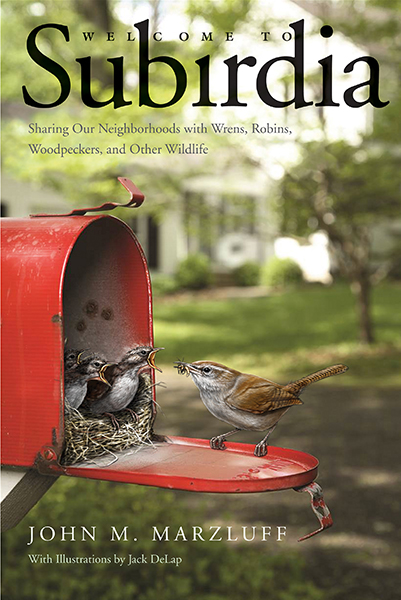
John Marzluff’s newest book which describes the awesome power of suburbia to become a heaven for a huge diversity of birds. Illustrations by my friend and colleague, Jack DeLap.
John Marzluff’s new book Welcome to Subirdia, highlights that vast species diversity that can come with suburban development, showing that these types of habitat modifications aren’t doomed to be low diversity. With a bit of thought on our part, we can create habitats that attract a variety of birds. Namely, by limiting lawn space, increasing snags, native plants and bushes and keeping our cats indoors, we can expect to see a great variety of birds visiting our feeders, crows included!
Madden, C.F., Beatriz A., Amar, A. (2015) A review of the impacts of corvids on bird productivity and abundance. Ibis: 157, 1-16.
Filed under Crow behavior, crow conflicts, Crow life history, Crows and humans
Notes from the field: Reflecting on my first season
This year, my field sites range through the east side from Mercer Island to Kirkland. My first field season, however, took place throughout downtown Seattle and included the ID, First Hill, the Central Business District, SODO, Belltown, and South Lake Union. I went to high school on Mercer Island and, while certainly a victim of the “MI bubble” as we called it, generally felt pretty familiar with the west side. I went into my field season last year anticipating to learn a lot about birds, which I did, but what I had not expected was to learn as much as I did about the city and the people it harbors. In fact, I doubt there’s anyway to become more intimately familiar with the real identity of a city than to spend from dusk to dawn on its streets, just watching.
Watching from the same spot on the sidewalk for 2 or 4 hours, invites the attention of all kinds of people. Lots of these are people who, come nightfall, remain on the sidewalk. Partly what I learned from these interactions is that they too watch the crows, and delight in sharing their stories. My favorite was someone who told me that the reason crows can be seen methodically wiping their bills on branches is because that’s how they mark their landing spot for next time. I suggested that it’s likely a way for them to keep their bills clean and well manicured (like fingernails, bird beaks never stop growing), but he couldn’t be dissuaded. It was such an ingeniously creative idea, I didn’t blame him for being so stubborn. The other was a man who informed me that if it were up to him, we would be wiping out the crows. “They attack the eagles and I just can’t stand for that, it’s unpatriotic”, he explained while wearing a sweatshirt emblazoned with an American flag and a proud eagle head.
It wasn’t all positive, of course. There was the woman at six in the morning in the ID who causally sat down next to me and started smoking crack. Or the guy who sits on the walking bridge to the ferries who threw a stroller onto the street below where it landed about 3 ft away from me. But mostly it was just unintentional conflict. Arriving to an experiment site with a desperate amount of limited time only to find someone sleeping the location I had established as the feeding/experiment site. Or people eating the food I had set out. That was tough. How do you ask a hungry human being to not eat food off the ground because it’s for birds? In some places I just started bringing snacks. In others, folks with whom I had previously bonded with over the crows could address these folks by name and explain the situation for me. That was easier but it still felt…bad.
On the other side of the spectrum were the people on their way to work or who were renting the pricy downtown apartments who “see you everyday and just can’t figure out, and now must know, what you’re doing”. They too were delighted to tell me about crows. Mostly they insisted I come to their house because “there are more crows at my house than anywhere else in Seattle.” But they could also problematic, and usually in ways that threatened the whole seven day experiment and not just a few minutes of it. I am now an expert at identifying the sometimes surprisingly subtle line in the sand between public and private property in a city. When you’re throwing food on the ground, or asking masked people to stand around, this distinction can mean the difference between a successful experiment, and security being called and days of wasted work. But even on public property, food on the ground is in a constant state of peril.
Something I don’t know if a lot of Seattlites are aware of are the omnipresent human street sweepers. I’ll never forget watching the 2013 LGBTQ pride parade (well, less watching than quickly walking by it between trial sites) and feeling such pride and joy that so much proactive passion has paid off in this state, only to return to Belltown at five the next morning to find the sidewalks covered in apathetic rainbow garbage. But, like clockwork, the street sweepers came out to erase the evidence of people so figuratively and literally intoxicated with activism they forgot about the other battles to care about (like the planet). The street sweepers themselves were always a roll of the dice. Some would not hear one word about leaving my pile of food for the experiment while others laughed and obligingly kept moving. Many grew to recognize me as I moved on from one site in the city to another and would happily use it as an opportunity to take a break from work and engage with someone who would give them the time of day.
Then there are all the stories of people who span the spectrum. I listened to two men emerging from the 5 Point at 5:00am, causally exchange a story of witnessing sexual assault (and doing nothing). There was the time I overheard a group of people talking about a friend on their way to jail over what, suffice it to say, was a graphic murder. They were not happy once they discovered I was filming during this conversation. Not on purpose, but their conversation was in the line of fire for filming my experiment site. This was maybe the most danger I was ever aware I was in during my field season. But some calm(ish) explanation of my research diffused the situation and led to, you guessed it, crow stories. Then there was the guy who, unaware that the woman he was talking about was standing near him concealed in one of the experimental masks I use, proceeded to annihilate me personally to a friend. He was certain that that woman who is usually always here “watching birds” was a lazy, entitled piece of shit who is wasting her parents money.

“Excuse me, I’m doing a research study, will you please wait here while I take of this mask? And watch my camera?” (Shortly after this photo was taken I had professional looking signs made)
But stories like those are less common. What really demonstrated the spirit of the city to me were the dozens of people who, after being approached by the muffled voice of a creepily masked person, agreed to watch my video camera while I ran to remove the mask. You see, the most important piece of data I collect is the time it takes the birds to return to the food site after the “dangerous” person leaves. If it consistently doesn’t take them long then I can surmise that the presence of this person isn’t resulting in a change of feeding behavior. If, on the other hand, I show that their feeding behavior dramatically does change then I can say that seeing people associated with dangerous things like dead crows or predators causes birds to avoid areas they hang out in, even if those areas are good food resources. Ideally, I had a volunteer be this person, and maintained my position a ways away as the friendly feeder person who innocently stands around watching the birds eat. But volunteers were in short supply, and sometimes I had to show up to an experiment site, throw out the food as myself, the friendly feeder person, and then run to a hiding spot and don the mask. At the end of the exposure period I needed to leave to remove the mask and collecting this key data point was contingent on finding a person willing to hear me out while I wore this crazy mask, wait for what, to them, was an unknown amount of time, and, critically, not steal my video camera. Over the course of my field season I asked dozens of people of all stars and stripes (I was on too critical of a timeline to be judgmental or picky) and not one of them ever bailed or took my camera. Like I said, I received an unexpected education of this city and the result was learning that the vast majority of people here are in fact extremely wonderful.
And bathroom codes. I know the code to every Starbucks bathroom from SODO to SLU.
Filed under Being a scientist, women in science
The many sounds of crow, including the jaws theme
I am constantly fascinated by the vocal repertoire of crows. They produce over 20 calls, but I would venture a guess that for most people (I being one of them) the vast majority of those sounds are too subtle to distinguish between. As I hear it, there are four majors “classes” of call that are easy to differentiate, even for a completely novice birder. Those are: The classic ‘caw’, the harsh ‘scold’, the female courting ‘rattle/knock’ call, and the juvenile begging sound. To make up the rest of the over 20 sounds, they use a combo of caws, clicks, coos, grunts and rattles. While more has been decoded than I offer here, there is still much that remains a mystery. Take for example their scold call.

Me, getting yelled at by a raven in Yellowstone that wanted a treat NOW!
Stimulus days featuring either our dead crow or our dead crow+the hawk consistently draw the largest number of birds. In fact based on last year’s data, the dead crow+hawk stimulus draws the greatest numbers of birds by a large margin. That’s not a huge surprise since hawks are a primary predator and responding very strongly to an obvious kill would provide a safety mechanism to the ‘neighborhood’. Needless to say, with few exception once the first bird comes across this scene it alarm calls (scolds) and either very quickly or over a few minutes will draw a crowd of 10-30 birds. It can certainly be more or less but somewhere in that range is most typical in my experience. Now, none of this is particularly interesting. What’s interesting is what happens the next day. As a reminder, all our stimulus trials feature one of the known dangers paired with a person. In the case of the dead crow+hawk this person is standing 2m away from the stuffed birds. In half my trials I send this person out the next day and in the other half they get sent out a week later. This is to test for any “guilty by association” inferences the birds are making about these people simply because they were near a known threat. To my elation I’ve found that many birds do indeed respond to these people when they see them in the future. While that’s certainly cool in and of itself, what makes it interesting from the perspective of their calls is that although their alarm call in this instance does not sound different to me, they almost never draw the crowds the initial stimulus day does. It’s almost as if the hawk or dead crow is a neighborhood problem but a dangerous person is only the territory holder’s problem. Is the caller advertising this distinction and intentionally not drawing in the other birds or are the others making that choice themselves? I have no idea. But there’s no arguing that there’s a level of complexity there worth investigating.
As for the story on my Jaws loving bird. This afternoon I was returning to a field site I had, just the previous day, tested the stimulus I described above on. While I was walking through the woods on my way there I noticed a shadow occasionally passing above me. Finally I saw my stalker: A crow who I can only assume had spotted me and was hoping I’d offer some food before we actually arrived at the now tainted feeding site. Once we arrived I threw my food out and, unsurprisingly, was not greeted by eager feeding. Instead the bird merely perched in the tree and stared wishfully at the food it was too nervous to eat. After a few minutes I started to hear an inexplicable noise. A very low duh-nuh. Duh-nuh. The field site is located on the edge of a residential street and at first I assumed it was some kids, maybe just playing or perhaps intentionally trying to mess with me. It was clearly the intro to the Jaws theme song. But the more I listened, I realized there were no kids around and the sound was coming from the wrong direction to be made my a person. With some careful watching I realized that, although I could not perceive it to be moving its bill, my perching crow bowed its head in perfect unison with the sound. It became clear it was the sound’s author. In all my time watching these birds I have never heard anything like it. Have you? You can listen to it here, but be warned it’s pretty quiet so turn your sound up.
Filed under Crow life history
My top 15 favorite crow facts
I, apparently like so many of my generation, are a sucker for insta-read lists. Something I can crunch through in about 5min between classes. My favorite proprietor of this content is Buzzfeed. Although most of their lists are some kind of pop-culture reference, every once in a while I see something nature or science related and on two separate occasions have even seen posts related to crows. Both were rather jejune. So it seemed a perfect marriage to unite one of my favorite social media sites with some carefully selected and researched crow tidbits. You can check out my post here on my top 15 favorite crow facts.
Filed under Crow behavior, Crow curiosities, crow intelligence
Crows: A birdwatcher’s best friend

A Wompoo Fruit Dove
In every habitat in every country there’s always a particular species you can count on to give away interesting and cryptic critters. When I was conducting research in the eucalyptus forests of eastern Australia it was bell birds, a small green bird with a distinctive bell like call that echos through the forest at a numbing consistency all day long. While their conspicuous and raucous nature made them tempting to ignore, these birds were often the first on the scene when interesting new species entered the forest, and by learning their alarm calls I discovered far more birds, especially predatory birds, than I would have on my own. A favorite moment was being the only field tech on my crew to glimpse a wompoo fruit dove, a particularly beautiful and secretive dove native to this area. Given its beauty spotting this bird was high on all our lists, but it wasn’t until the end of the field season when my attention was caught by some rather rowdy bell birds that I actually got to see one. Had I grown completely accustomed to ignoring the ringing calls of the Bell Birds, I might have missed what was one of the birding highlights of my time in Australia.
Here in the states, crows are often our bell bird equivalent. While crows get a bad wrap from birders for depredating and depleting backyard bird populations this is unfounded. In fact, I think crows make an excellent companion for a birder if you know what to look for. Cryptic hawks or owls that you would never know are sitting quietly in the trees above you are given away by the loud aggressive alarm calls of crows.
While nest searching in Mercer Island’s Island Crest Park this morning I couldn’t help but be drawn to the scolds of about a dozen crows across a ridge in the ravine of the park. The quick staccato and harsh tone of the call is easy to recognize with some practice, especially when it’s being given by several birds at once.
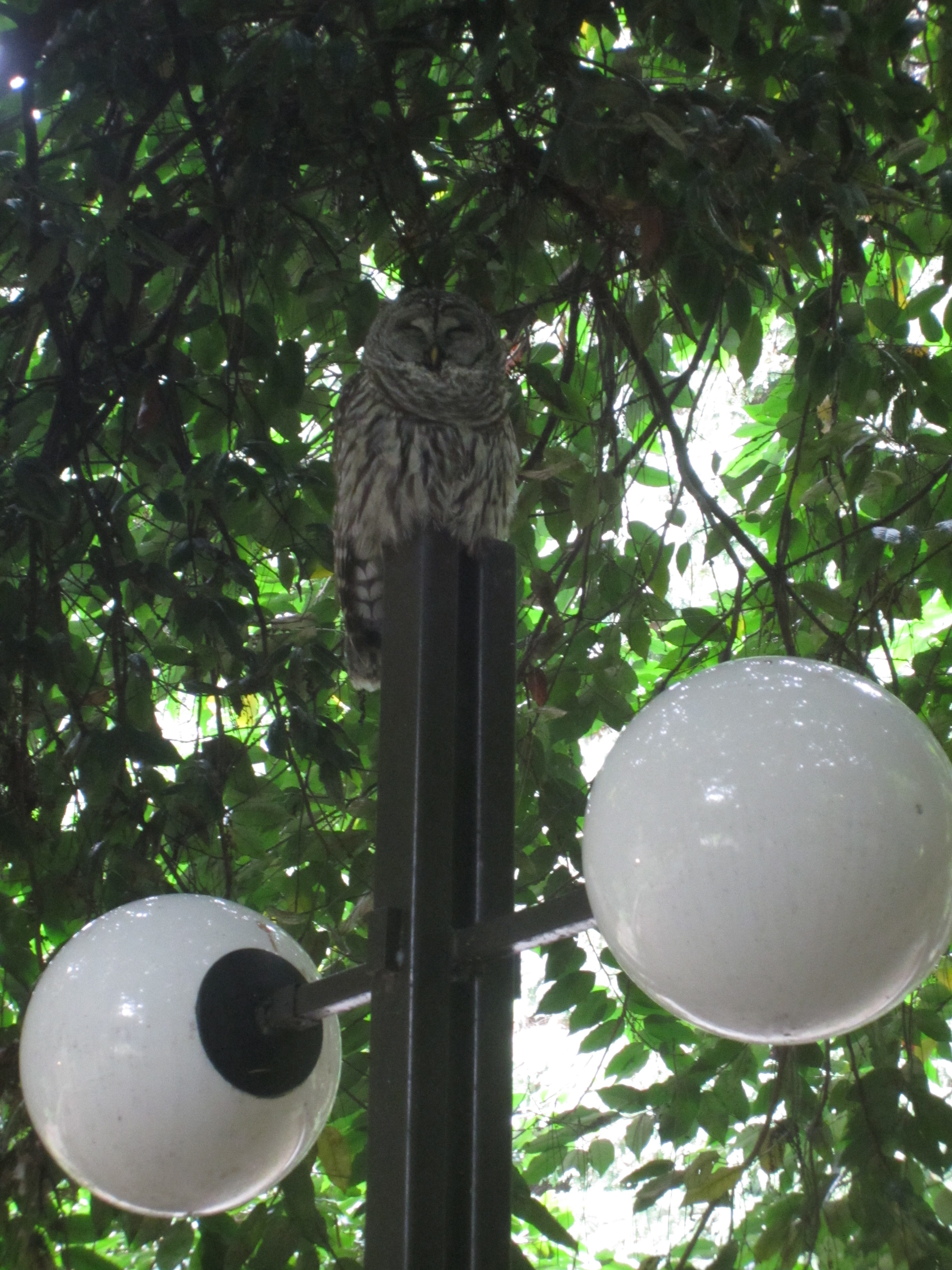
The Barred Owl often found hanging around our office on campus
Peering across the ridge I couldn’t make out much through the branches, but sure enough after a few minutes of waiting came the unmistakeable “who cooks for you” call of a barred owl. Another one quickly responded sending the crows into a fervor, and after a couple more dive bombs the owl emerged from its mossy post and opted for a quieter resting place away from the crows. My feelings about the detriment of Barred Owls aside, there’s something unmistakeably thrilling about seeing an owl for a birder, and probably for most people. They’re cryptic and undeniably charismatic, a good combo for making an exciting bird and, as has been the case for many birds before it, I wouldn’t have spotted this one without a little help from the crows.
Filed under Birding, Crow behavior
 corvidresearch.blog