
As long as I’ve been interested in crows, I’ve wondered the same thing that many other people who study or simply enjoy crows have wondered; why do they gather so predictably around their dead? It’s with great pleasure that this week not only do I get to address this question, but I get to do so with my own research, which was recently published in Animal Behaviour. Banished are the days of cagey descriptions of my work and results, the peer review process has finally green-lighted full disclosure.

Anecdotes of crows’ attraction to their dead have long been documented and accounts usually go something like this: a dead crow is observed laying in the grass and other crows, sometimes an individual, sometimes a large group, are perched nearby silently or very raucously. People have reported that sometimes these onlookers stay for minutes, sometimes days. So what are we to make of this? Well it could be explained a number of ways:
- Maybe it’s purely coincidental, the crows have no idea there’s a dead crow on the ground. Anyone who has observed this event in action, of course, will know that this explanation seems unlikely, but from a scientific perspective, we’ve also been able to invalidate it through previous experiments on corvids1,2,3. So we can pretty safely ex-nay that explanation.
- Maybe they gather because it’s a foraging opportunity. Well, as far as we know crows rarely cannibalize each other, and even if they did, they probably wouldn’t be simultaneously scolding. So this also seems like an unworthy hypothesis.
- Maybe they’re experiencing a deep sense of mourning and have come together to grieve and pay their respects. Having spent as much time around crows as I have, I hold little doubt that they have emotional intelligence. But testing this scientifically remains problematic because there’s still no way we can truly know what’s happening on an emotional level in an animal’s head. We’ve tried4, using noninvasive brain imagining (invasive meaning lethal or surgical), but this method is imperfect and while it can tell us the parts of the brain used, it still doesn’t tell us what they’re thinking or feeling. So for now, the question of crows and grief remains open (scientifically anyway).
- Which brings us to danger learning. If I were to find a dead person in the woods I might be feeling sad but I’d also be alarmed and likely looking for the cause of death to make sure I’m not next. Perhaps the crows are doing the same thing; looking for the source of danger and remembering key elements of the experience that will help keep them safe in the future.
Previous experiments in jays1, crows2 and ravens3, suggested that danger learning is likely a key motivator behind these gatherings since corvid effigies can be an effective deterrent, a fact that is old hat to many farmers. So I wanted to look at this question with a little more nuance and ask, 1) whether crows would avoid food in areas previously associated with crow death, 2) could they learn new predators (i.e specific people) they see near dead crows, 3) for how long will they remember these people and, 4) how do these same responses compare if we substitute a “dead” crow for a “live” familiar predator.
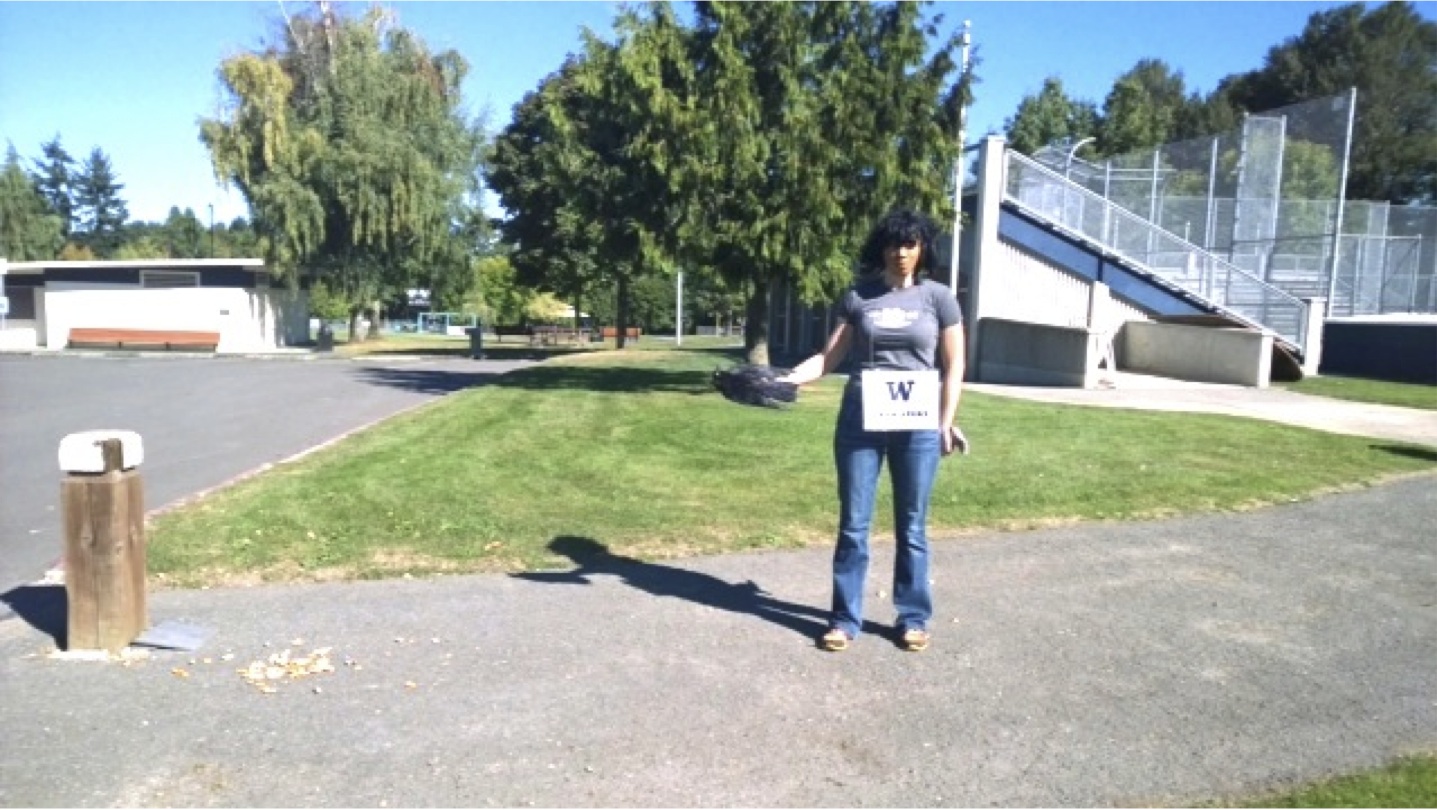
To do this I would locate a territorial pair and feed them for 3 days. This would give me a baseline of their feeding behavior and allow me to say, “on average, crows take x minutes to arrive at a fresh food pile.” Then I would introduce one of my three dangerous scenarios: a masked person holding a dead crow, a masked person standing near perched hawk, and a masked person standing near a perched hawk with a dead crow. In all these cases the birds were taxidermy-prepared mounts. In a handful of cases (4 to be exact) the birds simply observed the scene in silence and left. In most other cases however, the response was pretty stereotyped; the discovering bird (usually the territory holder) would scold and typically attract 5-11 additional birds. The mob would stick around for 10-20 minutes, scolding loudly and gradually growing more silent and dispersing before all but the territory holders were left. Exposure to the dangerous stimuli would only last 30min, after which they were removed. I found that crows responded most strongly when they saw a person and a hawk with a dead crow as opposed to a person holding a dead crow or a person near a hawk. This tells us that context matters, and crows are most sensitive to dead crows when they’re with familiar predators.
Following this event, for the next three days I would continue feeding the birds. By doing this I was able to test if exposure to the dead crow, hawk, or hawk with dead crow would make them act differently in the area, despite the presence of their favorite food. Spoiler alert, it did! While the crows usually approached the food it would take about 15-30min longer than it used to. This suggests that dead crows are used, in part, to assess that an area is dangerous, and that this information is retained and used for future decisions about spatial use.
The last question was if and for how long they would remember that masked person associated with the dangerous event. Provided the birds had scolded them in the first place, a week after the main experiment wrapped up, I would reintroduce the dangerous person. I found that, of birds that were administered this test (N=84) the majority of them remembered and scolded the person. Even after 6 week, 38% of the 65 pairs eligible for all 6 tests continued to respond to the ‘dangerous’ person. It’s incredibly cool to me that crows cannot only learn new predators based on their proximity to dead crows but to other predators and remember them for so long. It’s really amazing. Crows are likely learning and remembering an incredible number of humans faces over their lifetime.
So why do crows gather around their dead, according to the best available science? At least in part, it’s to learn about dangerous places and new predators. Could there be other, more emotionally intelligent reasons? Sure. Scientists simply haven’t devised a way to address that yet, but we’re trying to think of ways to do so that are minimally invasive. Until then, I know there are many folks out there who need no scientific evidence to believe that that’s precisely what’s going on and I see no reason studies like this should disabuse them of that belief. Studies of animal emotions are the next frontier and I couldn’t be more excited to watch crows continue to blow people away.
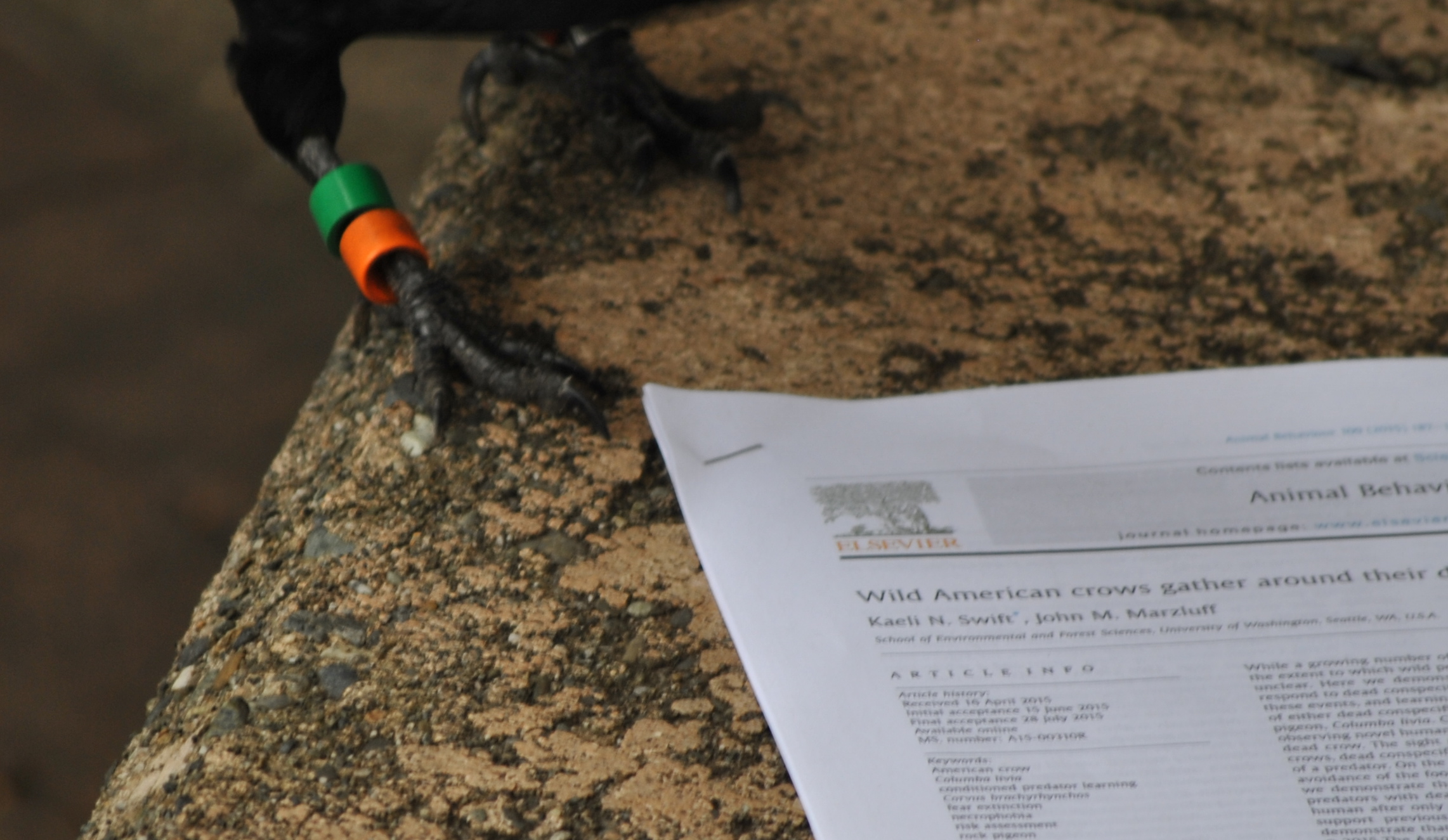
To read the scientific article in full, which covers the many additional elements of this experiment, click here.
Literature cited
- Iglesias, T.L., McElreath, R., & Patricelli. G.L. (2012) Western scrub-jay funerals: cacophonous aggregations in response to dead conspecifics. Animal Behaviour 84: 1103-1111.
- Avery M.L., Tillman E.A., & Humphrey J.S. (2008) Effigies for dispersing urban crow roosts. Proceedings of the 23rd Vertebrate Pest Conference. Davis, CA: University of California, Davis: 84–87
- Peterson, S. & Colwell, M. (2014) Experimental evidence that effigies reduce corvid occurrence. Northwest Naturalist 95: 103-112.
- Cross, D.J., Marzluff, J.M., Palmquist, I., Minoshima, S., Shimizu, T., & Miyaoka, R. (2013) Distinct neural circuits underlie assessment of a diversity of natural dangers by American crows. Proceedings of the Royal Society B. 280: 20131046



 corvidresearch.blog