Category Archives: Crow behavior

Crow curiosities: Do crows play and why?

A few years ago, on a mildly windy day, I watched a group of crows line up on the top of a building and then take turns flying off into the draft before letting it gently return them back to the rooftop to do it all over again.  This continued for at least ten minutes before I had to bid my feathered friends adieu and go to work.  Last summer, I watched two juveniles perch on a cable wire that ran from the power lines down to the ground at a steep incline.  While one of the kids was minding its own business the other snuck up and pecked and pulled its sibling’s tail until the sibling lost its balance on the crooked wire and was forced to fly to a higher perch.  Then the mischievous, ah hem, ‘pecker’ followed its sibling to the higher perch and started again. And every winter without fail, at least one person will send me the video of the snowboarding Russian hooded crow or the barrel rolling crow or the crows having a snowball fight.  Ok, so that last one isn’t real, but with all the other videos of crows at play it certainly seems like it’s only a matter of time before they start hocking little crow-sized snowballs at each other.  With all these videos and stories comes the inevitable question: Are corvids having as much fun as it looks like and, if not, what are they doing?
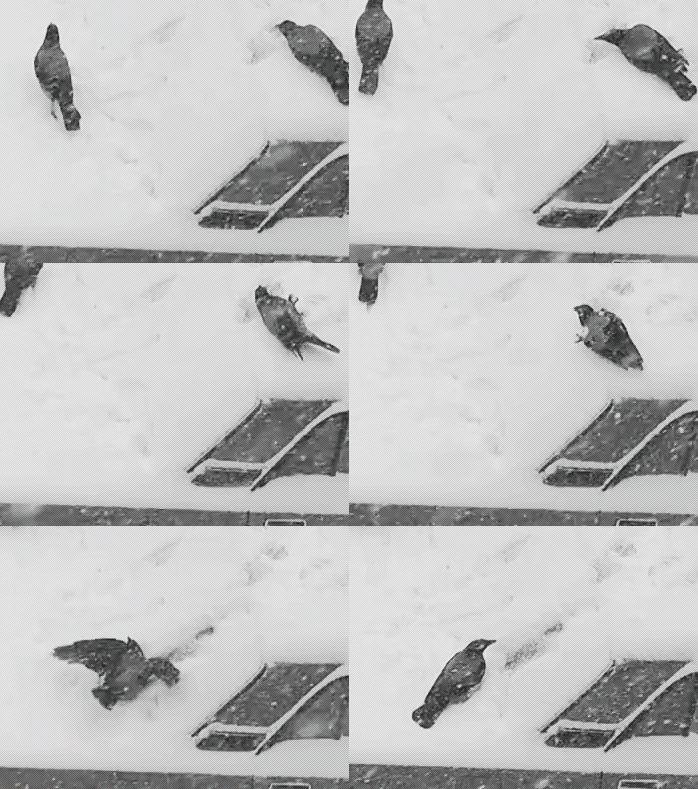
rolling
For scientists, this question is inherently difficult to answer.  There’s the obvious part where it still remains impossible to ask animals how they feel about their activities, but at an even more fundamental level is the question of:  how do we define play?  Play, as all things in science do, requires a very specific definition that may or may not depart from how we use the word in everyday language.  The most widely referred to definition is the following very dry and jargony sentence:  ‘…all motor activity performed postnatally that appears purposeless, in which motor patterns from other contexts may often be used in modified forms or altered sequencing’1.  And with that, what I can only imagine must be one of the most fun things on the planet to study suddenly becomes sleep-inducingly boring and the humor of the picture below is no longer confined to biologists.
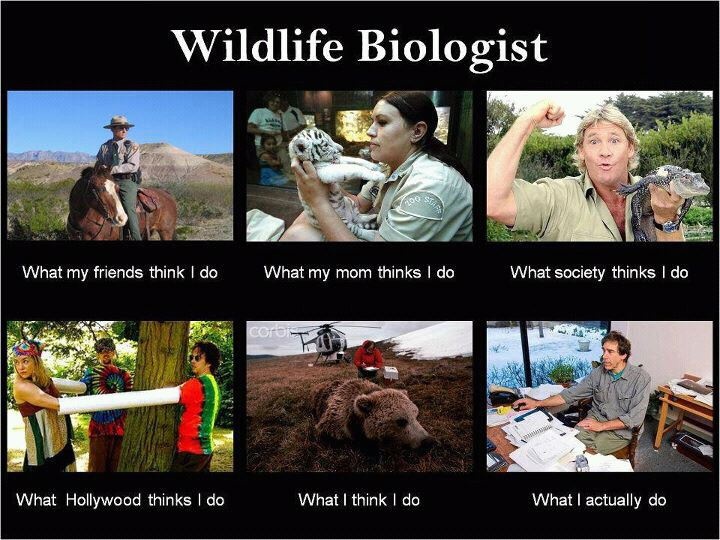
wildlife bioFor now, let’s just focus on the part that said “…activities that appear purposeless.”  That leaves scientists with a different problem; how do we define ‘purposeless’ (i.e do you mean right now, or indefinitely? What if it has a purpose but I just don’t know what it is?), and therefore, how do we even identify when animals are playing and when they’re not.  Can you see the big circular rabbit hole we’ve gotten ourselves into?  Since I think most people use the catch-all definition from Potter Stewart and simply say that you know it when you see it, it can be difficult to empathize with why play has been such a difficult behavior for scientists to say a whole lot about.  Now that I hope I’ve given you some insight into why this is a difficult subject to study and thus, in many ways remains mysterious, let’s get to the fun part of talking about what we do know.

So far, observations of play in birds is limited to corvids, parrots, hornbills and babblers, reaching a grand total of about 25 species2.  To put that in perspective, there are ~10,500 species of birds in the world, making it an incredibly rare behavior among birds, and emphasizing the awesomeness of getting to observe it in our own backyards here in the PNW.

Although the snowboarding crow is probably the instance of crow play that gets the most attention, there’s actually 7 kinds of play that researchers have documented3.  Maybe I’ll try and publish my observation of the bickering crow kids, but for now, irritating-your-siblings-play is not one of them.  Here are the big 7:

  • Object play (manipulating things for no reason)
  • Play caching (hiding inedible objects)
  • Flight play (random aerial acrobatics)
  • Bath play (more activity in water than necessary to get clean)
  • Sliding down inclines (snowboarding, sledding, body sliding)
  • Hanging (hanging off branches but not to obtain food)
  • Vocal play (you know how kids go through that phase when they talk to themselves a lot? The crow version of that.)
A crow just hanging out

A crow just hanging out

So what are we to make of seeing ravens hanging, apparently joyfully, from the ends of buoyant branches in our yards or magpies playing tug of war with an otherwise ordinary twig or crows doing elaborate aerial maneuvers for no obvious reason?

Young crows playing tug of war. Photo c/o Bob Armstrong

Young crows playing tug of war. Photo c/o Bob Armstrong. (The white eye of the bird on the left is not from disease or injury, but is the protective nicitating membrane that many animals have, in case you were wondering.)

Let’s start with the conventional wisdom that everyone grows up hearing: Animals play to practice skills they need to be successful later in life.  Cats play with strings to hone attack skills, dogs wrestle to practice fighting skills their wolf ancestors would have needed as adults, etc.  The problem with this wisdom is that despite all the intuitive sense it makes it turns out it’s not very…true. In mammals, it has been shown over and over again to be unsupported.  In birds it hasn’t been looked at as extensively, and there’s at least one exception I know of that showed  ravens play cache (hide things) to evaluate competitors so that they know who is most likely to steal their cache once the stakes are raised and they’re actually hiding food4.

Other then that, the vast majority of data across both birds and mammals have shown that animals who play most often or most fiercely are no better hunters or fighters later in life than their peers.  Same goes for the studies that have compared animals that are allowed to play with those who were not5.  No difference.  So is it as easy as saying crows play just because it’s fun?  Well the problem with that is that play can be risky. Playful, distracted kids are often snatched up by predators or accidentally killed by a miscalculation of their environment.  With the level of risk that’s involved it seems unlikely it’s not doing anything for them. To make matters more complicated, although animals don’t seem to be better at the skills they appeared to be practicing, some studies show that they do seem to be better off overall.  In mammals we’ve seen that they’re more successful parents and have longer life expectancies6.  So what might be the adaptive value of fun?

Although there’s still much to be learned as far as testing play in corvids, right now I’m inclined to agree with play researcher Lynda Sharpe, who wrote a piece on this topic for Scientific American which I encourage everyone to check out.  Stress is in no way unique to humans, and it can be as debilitating and deadly for animals as it is to us.  Play is a great way for animals to hone their stress response so they’re less high strung as adults7.  Not to mention the complex, stimulating nature of play helps the brain grow8.  So why do crows play?  Learning about their peers, gaining new experiences in a low risk way, honing their stress response, and growing their big brains all seem like a good excuse to have a bit of fun to me.

Literature cited

1. Bekoff, M. and Byers, J.A. (1981) A critical reanalysis of the ontogeny of mammalian social and locomotor play.  An ethological hornet’s nest.  Behavioral Development, The Bielefeld Interdisciplinary Project.  pp296-337.  Cambridge University Press.

2. Diamond, J, and Bond, A.B. (2003) A comparative analysis of social play in birds.  Behaviour 140: 1091-1115

3. Heinrich, B. and Smolker, R. Play in common raves.  In: Animal Play: Evolutionary, Comparative and Ecological Perspectives.  Ed: Bekoff, M and Byers, J.A. Cambridge University Press

4.  Bugnyar, T., Schwab, C., Schloegl, C., Kortschal, K., and Heinrich, B.  (2007).  Ravens judge competitors through experience with play caching.  Current Biology 17: 1804-1808.

5. Thomas, E. & Schaller, F. 1954. Das Spiel der optisch isolierten Kasper-Hauser-Katze. Naturwissenschaften, 41, 557-558. Reprinted and translated in: Evolution of play behaviour. 1978. (Ed. by D. Muller-Schwarze.) Stroudsburg, PA: Dowden, Hutchinson & Ross.

6. Cameron, E.Z., Linklater, W.L., Stafford, K.J. & Minot, E.O. 2008. Maternal investment results in better foal condition through increased play behaviour in horses. Animal Behaviour, 76, 1511-1518.

7. Meaney, M.J., Mitchell, J.B., Aitken, D.H. & Bhatnagar, S. 1991. The effects of neonatal handling on the development of the adrenocortical response to stress: implications for neuropathology and cognitive deficits in later life. Psychoneuroendocrinology, 16, 85-103.

8. Ferchmin, P. A. & Eterovic, V. A. 1982. Play stimulated by environmental complexity alters the brain and improves learning abilities in rodents, primates and possibly humans. Behavioral and Brain Sciences, 5, 164-165.

29 Comments

Filed under Being a scientist, Crow behavior, Crow curiosities

A scientist’s thoughts on The Crow Box

The first time I watched the writer and hacker Josua Klein’s crow vending machine TED talk as a college undergrad, I was floored.  It was my first exposure to Betty, to the tool making capabilities of some crow species, and to the idea you could potentially train wild crows.  The purported success of the vending machine filled me with ideas.  I used clips from the talk for a variety of public outreach presentations and they were always met with the same kind of GTFO amazement that I love watching people experience as they learn about crows.

Betty just doing her normal New Caledonian crow thing of making hooks out of wire to pull up buckets of food.  No big deal.  :)

Betty just doing her normal New Caledonian crow thing of making hooks out of wire to pull up buckets of food. No big deal. 🙂

As I moved on to graduate school, however, and was fully immersed in the scientific community of crow nerds, I started to hear rumblings that gave me pause.  Rumblings that suggested the vending machine wasn’t all that it was cracked up to be and, in fact, had not worked as it was implied in that TED talk.  Since I’ve never worked personally with Klein, I’ll let my fellow crow scientists speak for themselves on the issue.  You can find one of the graduate students he worked with relating her experience during a reddit AMA here, and as well as the correction that the New York Times Magazine was forced to run after publishing an article on Klein’s effort with the vending machine.  If you don’t want to read them, suffice it to say the main point is that Klein gave people the impression that it had been tested (successfully even) on zoo and wild crows when it hadn’t.

The Crow Box

The Crow Box

Leading the public to believe that we’ve arrived at conclusions when we haven’t is the stuff of stress dreams for scientists, and it’s why the peer review process is the foundation of good scientific practice.  By taking “results” that were only in the early stages of being tested and bringing them to the attention of the public without permission or support from the scientists he was working with, Klein burned his bridge to the folks who had offered to help him test the idea, and any other crow scientist he might approach next.  Which brings me to the recent article I read titled “This Machine Teaches Wild Crows to Bring You Coins for Peanuts.”  

No, it doesn’t.  It might, but probably not.  No one has been able to train wild crows to bring specific items in exchange for food, the website selling the machine even points this outGabi Mann did not intentionally train her crows to bring her things.  They did this of their own volition which is why her collection is as diverse, unique, and beautiful as it is.

Gabbi showing me a sampling of her favorite gifts from the crows

Gabbi showing me a sampling of her favorite gifts from the crows

The suggestion that this machine could train crows to bring you quarters holds about as much water for me as saying you could use a dog whistle to train wild wolves to roll over on command.  The reason that the machine worked on captive birds in the Brooklyn apartment where it was originally tested is that, in captivity, you have a certain amount of leverage over an animal.  You can motivate it with food or treats or affection.  The chances that a wild crow would go to the effort of looking for coins when it could simply skip that step and look for other food seems insurmountable.

All that being said should you turn your nose up at The Crow Box if the idea intrigues you? No, go for it! Maybe yours will be the mind to figure out how to motive wild birds to participate. Or, perhaps you don’t care if it works or not, you’re just in it for a new experience or the joy of trying.  Trying and failing is part of discovery and I see no reason people should wash their hands of it if it sounds like fun.  Plus, even if it doesn’t work, you may end up learning different, but just as amazing things about these birds.  Just don’t hold it against the crows if they decide it’s simply not worth the trouble and leave it to you to go collect the quarters you lost buying The Crow Box.

8 Comments

Filed under Being a scientist, Crow behavior, crow intelligence, Crows and humans

All in the (crow) family

With the breeding season fast approaching, I thought it would be fun to write a post dedicated to some of the finer details of growing up in a crow family.  From territory selection to the function of helper birds I hope this post illuminates some of the less familiar aspects of what goes on between crow parents and kids.

Mate/Territory selection
Crows reach sexual maturity between 2-4 years, with females generally maturing faster.  Once they’ve bonded with a mate it’s time to secure a territory.  After they’ve settled on a territory they’ll hold on to it for years, if not the rest of their lives, providing a great opportunity for some in depth crow watching!  With few exceptions, crows generally nest in areas similar to where they were raised1.  Meaning, rural crows settle down in rural areas, suburban crows in suburban areas and so on and so forth.  Dispersal distance ranges (generally) from 0-60 km, and some birds will settle down right next door to their natal territory.

Monogamy
As far as mating goes, we refer to crows as being socially monogamous but genetically promiscuous, as is the case with most birds.  This means mated pairs will typically stay together for life, but extra pair copulations are not unusual, at least in some populations. For example, in one study in New York, breeding males sired 82% of their offspring, while the rest of the clutch resulting from extra pair matings.2 A separate study showed that among 25 families, 36% experienced extra pair attempts, and of 252 offspring, 19% were not sired but their mother’s permanent partner.³ Whether females are soliciting these extra pair matings is unclear, but most data suggest that females do not have complete control over their extrapair partners, if any.2  Loss of paternity increases dramatically if the male has been non-fatally injured.  Although his partner won’t leave him altogether, he is generally at risk for smaller brood sizes and paternity loss jumps to about 48%, likely due to more difficultly mating and guarding his mate, as well as lower sperm counts as a result of stress3.  In these cases, females may be more willing to accept fertilization from extrapair males,  though this is poorly supported.

The mechanics of mating
lovers
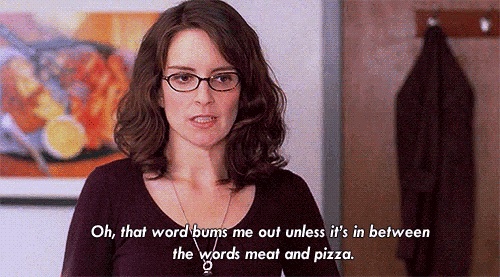
For those that want the biological details on crow sex, male crows, like the majority of birds, do not have an external penis.  So mating is generally preceded by solicitation from the female, followed by the male mounting and rubbing his cloaca against hers, which transfers the sperm.  This is known as the cloacal kiss (which, bleh, saying reminds me of Tina Fey in 30 Rock talking about the word ‘lovers’).  The whole process takes a couple of seconds.

Nesting

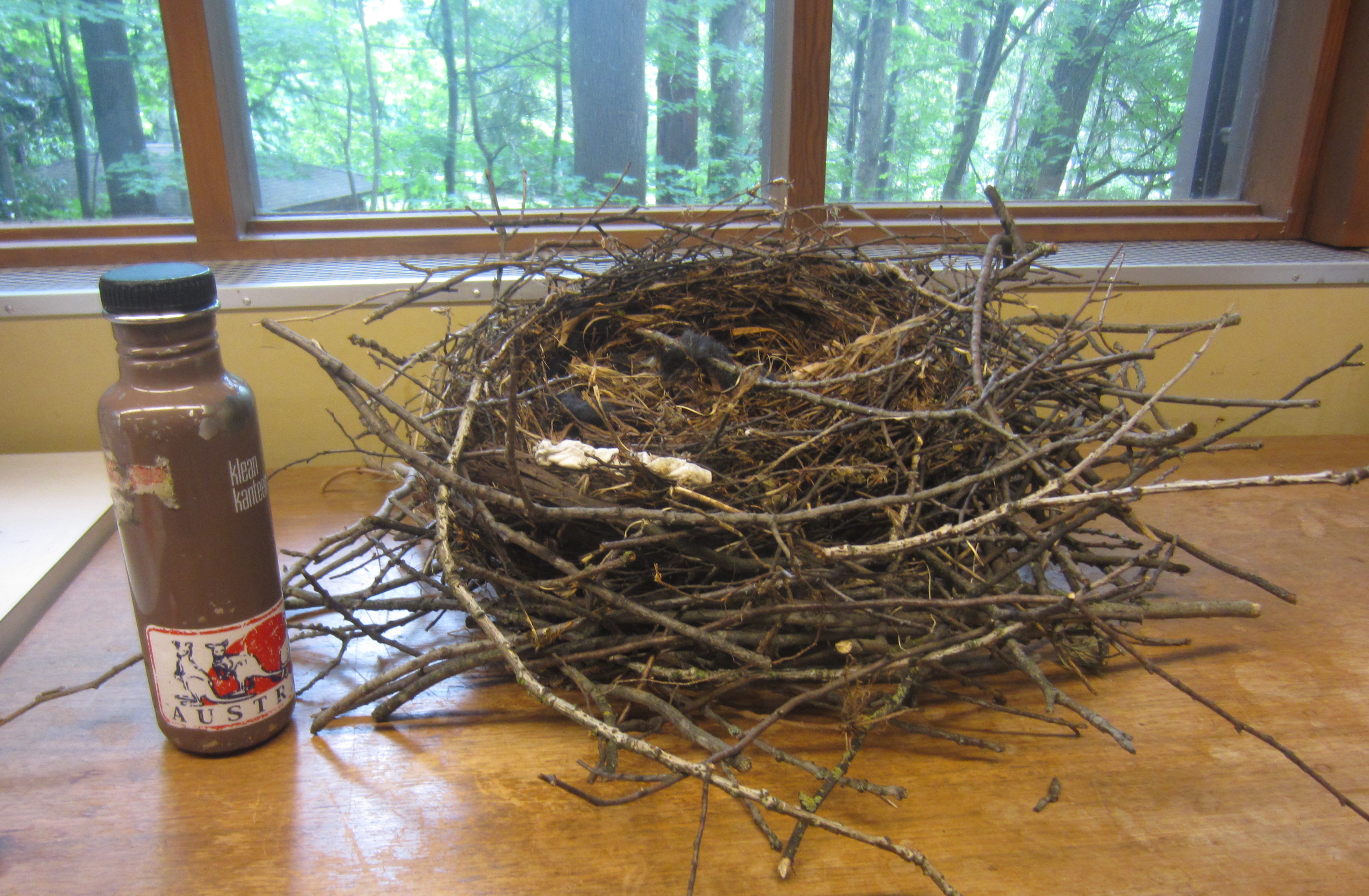
A typical looking crow nest with a water bottle for scale.

A typical looking crow nest with a water bottle for scale.

Crows start to nest in mid to late march with both males and females participating in nest building.  Nests are constructed from sticks and lined with grass, fur, feathers or other soft materials.  The building process is pretty conspicuous if you know what you’re looking for (and very fun to observe) but be warned; I have little doubt that crows will build fake out nests if they believe they are being watched by someone they don’t know or trust.   Females lay a clutch of usually 3-4 blue and brown speckled eggs.  Although males will occasionally (rarely) sit on the nest while the female is away they can’t really incubate because they lack the necessary brood patch to transfer heat.  Chicks hatch after about 19 days of incubation followed by another 30-45 days in the nest before fledging.   Once they fledge they spend 1.5-2 months dependent on their parents before they’re ready to strike it out on their own.

Helpers
I dedicated another post to talking about the behavior and survival rates of hatch-year offspring which you can find here.  Let me use this space to pick up where that post left off addressing helpers.  Crows, like a number of other birds including nuthatches and kingfishers, engage in cooperative breeding, though they are not obligate cooperative breeders meaning they can successfully fledge young without helpers.  Cooperative breeding is defined as when more than two individuals contribute to the care of young in a single brood.  For crows this means that, in addition to the mated pair, there can be up to 10 additional birds helping to raise this year’s brood.1  Generally, these are young males that are related to the male breeder.2 The motive behind cooperative breeding is somewhat mysterious since there are costs to both breeders and helpers.  Costs to parents including diversion of food provisioning towards helpers and, for males, threat of paternity loss to helpers.  Costs to helpers are more straight forward; they’re delaying their own breeding efforts to rear offspring which only share some of their genetic identity.  So why do crows bother?

Let me preface this by saying that quantifying the helpfulness of helpers is surprisingly difficult. A central roadblock can be; how do you tease out the effects of helpers, vs the underlying quality of parents that have lots of helpers? One study that controlled for differences among parents, found that helpers were’t hardly helpful at all, begging the question if “helper” is really the most apt word choice here.5  Still they are fact of life for many crow pairs, so let’s attempt to understand what’s going on here, based on the available evidence.

Why parents keep them around:

One insight comes from studies done on carrion crows (a species native to Western Europe and Asia). In these birds, differences in helper helpfulness are so obvious that some individuals are scientifically referred to as “lazy” group members.  Amazingly, however, if one of the parents is injured it’s these lazy group members that pick up the most slack to compensate for the reduction in effort by another group member.6 So they’re kinda like your State Farm policy.  Most of the time they feel like an annoying burden that will never come in handy, until that one time they do.  Alternatively, in other birds, it’s been shown that although helpers don’t make much of a difference as far as each individual breeding attempt goes, they do increase the breeding female’s overall life expectancy and therefore pay off in the long run.7

Why helpers help:

Now the connection between HBO's Game of Thrones and corvids takes on yet another meaning...

Now the connection between HBO’s Game of Thrones and corvids takes on yet another meaning…

For the helpers themselves, there are more potential benefits.  Whether it’s by choice or force,  helper males can sire as much as 7% of offspring, so breeding is in fact not out of the question.4  Although it’s a small number, some of that percent is even from mother/son relationships, though this isn’t consistent among corvids and some species do a better job avoiding incest than others. Even if they don’t breed with the female, they’re still helping to raise siblings that share some of their genetic material so it’s not a complete loss from the standpoint of their DNA (something known as inclusive fitness).  They also stand to inherit the territory, should something befall the territorial pair.  Finally, though this has been especially difficult to quantify, it’s possible that sticking around and observing a breeding attempt offers valuable insights that helper birds will go one to use when they raise their own brood.

How did such a behavior evolve?
That really is the million dollar question.  It may have to do with delayed dispersal, which is basically a fancy way of saying there wasn’t always places for these young juveniles to go so they just stuck around at home (ah ha! See, millennial are just doing what comes naturally).  It’s notable that the majority of birds that partake in cooperative breeding do so in kin based groups, which seems to suggest that perhaps this is a product of the fact that kin tend to settle down close to each other and as time went on a more loose, flexible system of helping became the more formal cooperative system we see today.

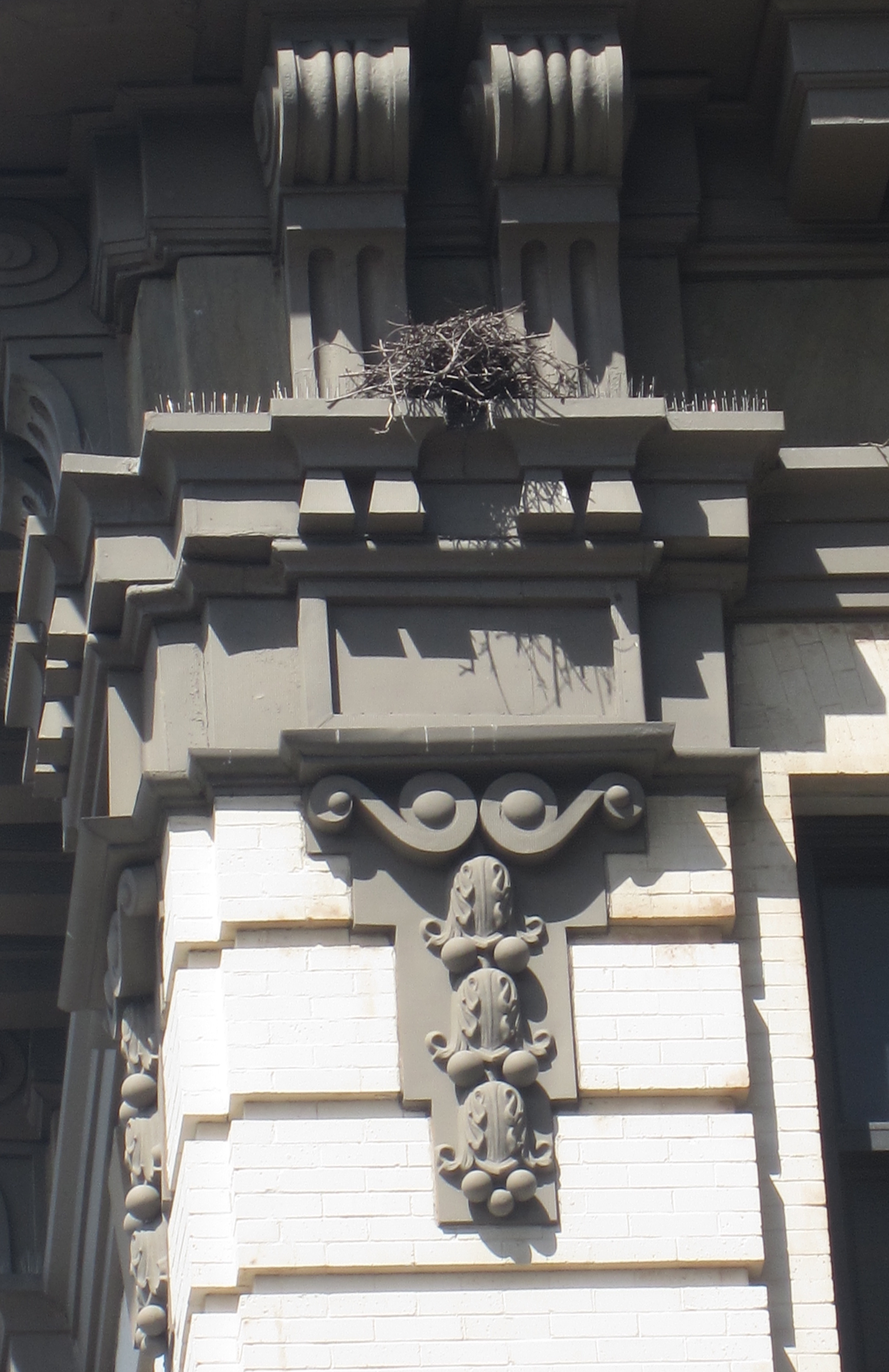
This is one of my favorite nesting locations I've discovered so far.  Rather than being deterred by the bird spikes, they've essentially used it as rebar!

This is one of my favorite nesting locations I’ve discovered so far. Rather than being deterred by the bird spikes, they’ve essentially used it as rebar!

Literature cited

1McGowen, K. 2001.  Avian ecology and conservation in an urbanizing world.  Kluwer Academic Press, Norwell, MA.  p 365-381

2Townsend, A.K., Clark, A.B., McGowen, K.J., and Lovette, I.J. 2009.  Reproductive partitioning and the assumptions of reproductive skew models in the cooperatively breeidng American crow,  Animal Behavior 77(2)

³Townsend, A.K. (2009). Extrapair copulations predict extrapair fertilizations in the American crow. The Condor 111: 387-392

4Townsend, A.K., Clark, A.B., and McGowen, K.J. 2011.  Injury and paternity loss in cooperatively breeding American crows.  J. Field Ornithology 82(4): 415-421

5Caffery, C. (2000). Correlates of reproductive success in cooperatively breeding crows: If helpers help, it’s not by much. The Condor 102: 333-341

6Baglione, V., Canestrari, D., Chiarati, E., Vera, R., and Marcos, J.M. 2010.  Lazy group members are substitute helpers in carrion crows. The R. Soc. Proc. B: 282(1804)

7Wright, J., amd Russell, A.F., How helpers help: Disentangling ecological confounds from the benefits of cooperative breeding.  British Ecological Society 77: 427-429

14 Comments

Filed under Crow behavior, Crow life history

Do crows reduce other songbirds?

Updated with data from a new review of studies looking at impacts of corvid removal on other birds.

corvidresearch's avatar

A comment I occasionally hear, especially while conducting my research in neighborhoods is, “Ugh, I hate the crows.  All of a sudden we have tons of crows and they’ve scared off all our songbirds!”  This comment always pains me, but I understand that for most people it arises from a genuine concern for songbird abundance and conservation.  First off, as a reminder crows are songbirds themselves; ravens are our biggest songbird.  Semantics aside, I understand that there are many, many bird lovers who just can’t get on the crow bandwagon and when they talk about wanting songbirds at their feeders they mean chickadees, juncos, grosbeaks, etc.  They feel that since the “arrival” of the crows their observations of these other birds have diminished.  So is there anything to this?  Do crows indeed drive down populations of small, “desirable” backyard birds?

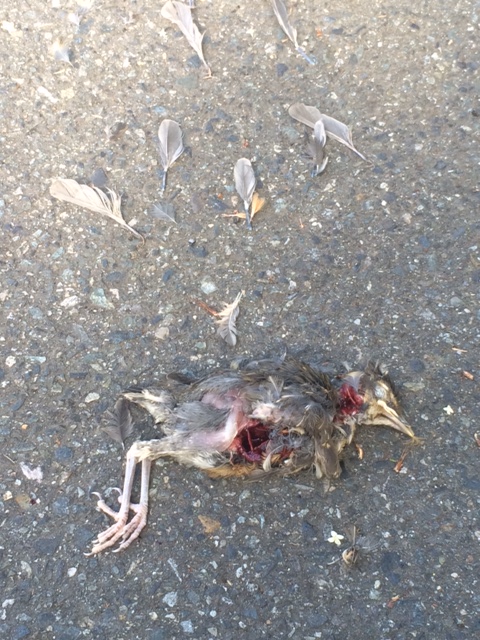
I came across this grizzly scene while conducting research in Bellevue.  An adult robin calling frantically while a crow munched on one of its young.  Later that same week I would watch of pair of adult crows chase hopelessly after a cooper's hawk that had taken one of their offspring.   I came across this grizzly scene while conducting research in…

View original post 867 more words

1 Comment

Filed under Birding, Crow behavior, crow conflicts, Crow life history

What happens to baby crows at the end of summer?

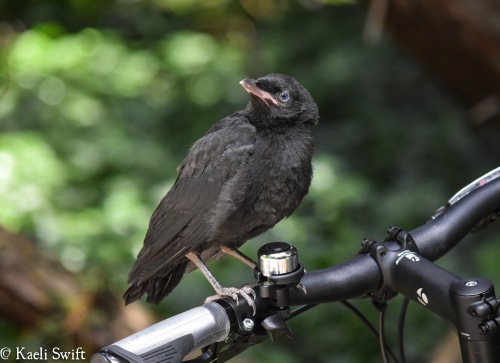
Watching each year’s new crop of kiddos is one of my favorite parts of the summer field season.  I love observing the awkward, dumpy juveniles making their first forays into the wild.  I get a special kick out of watching them interact with other animals, especially the pigeons that they often find themselves competing for handouts with.  In one instance, I watched as a young crow decided to practice a bit of tail pulling on an unlucky pigeon.  After grabbing it by the tail feathers, the crow started swinging the pigeon around its head; the pigeon remaining aloft with its useless flapping while the crow just went round and round, seemingly very pleased with its animate lasso.  Antics like these are much of what I suspect drives many people’s interests in crows.  They’re just so charismatic!  So it’s no wonder I encounter so many people who take an interest in their resident family of birds.  For those of you that do, you may find yourself wondering what happens to each year’s batch of young fledgies.  Although there’s still much that remains mysterious about the transition from crow kid to crow adult, we know, or at least have begun to understand, some of the options that face these young birds.

DSC_0710

Without being able to fly just yet, this fledgling appears to be vying for an alternate means of transportation!

Let’s get the painful part out of the way first.  Although estimates vary, it’s safe to say many, if not most, of young crows die within their first year.  We know this by putting light (3% of a bird’s body weight) radio transmitters on a reasonable sample size of birds and then following them over the course of the next several years.  Previous work in the PNW showed that about half died.1  This is consistent with observations of banded birds out of the McGowen lab at Cornell.2  So that, unfortunately, takes care of a lot of the young birds that delight us during June and July.  But what of the others?

For the first few months after they leave the nest, young crows stick close to the family unit.  They are fiercely defended by their parents, and as a result of this safety net have the time and energy to engage in the play behaviors like those I watched.  Allowing for this period of relatively safe exploration and play may be part of the reason long lived social animals such as corvids, primates, cetaceans (dolphins and whales) and elephants, are known for being so smart.  Though, I’ll qualify that by saying exactly why that correlation exists is very poorly understood despite what your high school bio teacher may have told you about the function of play.

DSC_1920

A baby crow begs while mom and dad attempt to enjoy some parental bonding time.

After this security period, young birds will begin to spend more of their days with larger flocks that may or may not include members of their family.  At this time of year I’m often seeing large groups of local juvies hanging out and generally causing mayhem.  Come the fall and winter, however, each individual is faced with a more distinct option:  They can either take off to “float” before finding a mate and establishing a territory of their own, or remain on their home turf and act as a “helper” for next year’s brood.  The latter option is known as cooperative breeding and I’ll save a more full discussion of it for another post.  If they float, they may do so close to home and regularly visit the territory, or far from home returning only occasionally or not at all. Suffice it to say that crows who take this option are making a fascinating “choice” to delay their own reproduction in favor of helping their parents, something that is the subject of much study.   Of the crows tracked as apart of the UW study, about 1/5 remained with parents and there was a very strong sex bias in favor of males for this option.  Of those that disperse they’ll likely settle down within 2-3 years and find a territory similar to the one they were raised in.  So keep your eyes out as the fall progresses, and watch how the dynamic of your resident family plays out.

IMG_7476-2

***

Literature cited

  1. Marzluff, J. M., et al. 2001. Pp 332-363
    in Avian ecology and conservation in an urbanizing world (J. M. Marzluff, R. Bowman, and R. Donelly, eds.). Kluwer Academic Press, Norwell, MA.
  2. McGowan, K.J. (2001). P 365-381 in Avian ecology and conservation in an
    urbanizing world (J. M. Marzluff, R. Bowman, and R. Donelly, eds.).
    Kluwer Academic Press, Norwell, MA.

3 Comments

Filed under Crow behavior, Crow life history

Reaching the limits of crow intelligence

When I was in college it became a joke among my friends and I that they would greet or bid me farewell with the following phrase “I believe in crow intelligence.”  Even as an undergrad, my passion for crow behavior and cognition was evident to my friends and family and I relished the emerging data demonstrating that this relative underdog was far exceeding our expectations of what an animal, especially a bird, could do.  While I still carry this phrase as a mantra in my research, it’s something I’ve also grown cautious to keep in check.  I’ll come back to this point in a minute, but for now let me rather crudely transition to some exciting new research.

The fantastic Alex Taylor and his group at Auckland University have once again dazzled us with another one of their eloquent studies on the New Caledonian crows.  This time they were looking at yet another aspect of crow’s learning intelligence: the ability to observe cause and effect and exercise a new behavioral pattern i.e causal intervention.  Essentially the researchers presented both the crows and two year old children with cylinder that, when hit with a block, would reward them with food.  The subjects were first exposed to the set up by baiting the block with food, thereby  demonstrating that, when moved in an effort to reach the bait food, the block would drop and release even more food via hitting the cylinder.  Babies quickly learned how to use an unbaited block provided in a new location to access the food hidden by the cylinder, but the crows failed to make the cause and effect connection.

The researchers were apt to point out that while this failure provides a fascinating insight into the evolution of causal reasoning, it does not negate the ways in which these animals remain exceptional in this respect as well.  Indeed, crows outperform children in some aspects of causal reasoning as demonstrated by the Aesop’s Fable experiments they conducted looking at object discrimination.

For me, it also provides one other important reminder: that crows are not feathered humans.  Reflecting on my earlier anecdote about my iconic catch phrase, something I’ve had to come to terms with as a graduate student is recognizing my own bias regarding these animals.  Occasionally, I find myself truly disappointed by results like the aforementioned one.  Perhaps it’s an all-American love for the underdog, or a hope that if only people understood how smart these animals are they would show them more respect.  Whatever the reason, an important area of growth for me has been acknowledging  my desire to continuing showing that these animals are exceptional and being aware of when or how that might be affecting my interpretation of my results.  This is indeed what it means to be a scientist.  Even when I have a my civilian hat on, accepting that crows are not simply feathered humans is, I think, an important part of truly embracing the natural world for what it is: a rich source of both diversity and overlap all of which deserve our admiration and preservation.

2 Comments

Filed under Crow behavior, crow intelligence, Crow life history

Do crows reduce other songbirds?

A comment I occasionally hear, especially while conducting my research in neighborhoods is, “Ugh, I hate the crows.  All of a sudden we have tons of crows and they’ve scared off all our songbirds!”  This comment always pains me, but I understand that for most people it arises from a genuine concern for songbird abundance and conservation.  First off, as a reminder crows are songbirds themselves; ravens are our biggest songbird.  Semantics aside, I understand that there are many, many bird lovers who just can’t get on the crow bandwagon and when they talk about wanting songbirds at their feeders they mean chickadees, juncos, grosbeaks, etc.  They feel that since the “arrival” of the crows their observations of these other birds have diminished.  So is there anything to this?  Do crows indeed drive down populations of small, “desirable” backyard birds?

I came across this grizzly scene while conducting research in Bellevue.  An adult robin calling frantically while a crow munched on one of its young.  Later that same week I would watch of pair of adult crows chase hopelessly after a cooper's hawk that had taken one of their offspring.

I came across this grizzly scene while conducting research in Bellevue. An adult robin calling frantically while a crow munched on one of its young. Later that same week I would watch of pair of adult crows chase hopelessly after a cooper’s hawk that had taken one of their offspring.

The short answer is: not usually.  Now, let’s be clear, crows will absolutely kill and eat eggs, nestlings and even adult birds if they can get their hands on one.  I once saw a crow take down an adult house sparrow in an attack so quick and dexterous I only realized what had happened after the crow had already started eating its meal.  It’s important to keep in mind, however, that crows are one of many, many animals that are eating the young and adults of other bird species.  Raccoons, squirrels, foxes, hawks, owls, bullfrogs, rats, mice, and of course cats will all gladly eat birds, especially eggs and nestlings.  The vulnerability of young birds is in fact why the breeding strategy of many birds is to have multiple clutches over the course of the breeding season.  Crows themselves are subject to these same predators and very few of their young will make it to adulthood.

Why do we think that crows aren’t responsible for the any observed decrease in feeder birds?  Predator removal studies.  These studies are straightforward and essentially create two populations, a control population that has been unmodified and a second where the predator in question has been actively removed.  Prey abundance or productivity is monitored and compared at the end of the trial.

Recently, Madden et al. published a comprehensive literature review of 42 studies across 9 countries that looked at the impacts of corvid removal on a variety of avian groups including gamebirds, passerines, waders and other ground nesting birds.  They found that in 81% of cases corvid removal made no impact on prey abundance or productivity.  They also found that impacts of corvids on prey species was similar, and no one group was particularly more sensitive than any others.  Of the corvids studied, magpies consistently had the smallest impact on prey productivity, but no difference was found if the study was looking at prey abundance.  So if corvids are such conspicuous avian predators, why doesn’t their removal seem to matter in most cases?

This is explained by idea of compensatory mortality, which is essentially that removing one predator just means that the other predators will account for its absence by eating the prey it otherwise would have.  Kevin McGowan provided a great description for this idea on his site I like to use the analogy of handicapped parking spaces at the mall You drive up to the mall, looking for a parking space in a crowded lot. You can’t find a parking space, but there are four near the entrance that are reserved for handicapped permits only. You complain and think that if only those handicapped restrictions weren’t there, you could park in those spots (common sense). In truth, of course, if those spaces were not reserved they would have been taken long ago, just like all the other spaces in the lot.”  Indeed, Madden et al.  found this to be true.  When they looked at studies that only conducted corvid removal, they found that only 16% of cases saw a difference in prey productivity.  Whereas if all predators were removed the researchers reported that 60% of studies found a significant difference in prey productivity.

What this means for those of us trying to improve the bad reputations of crows and other corvids is that the data is on our side, crows are not usually the problem predators they’re often made out to be (though in a small number of instances they are, and it’s important to acknowledge when that’s the case).  In fact, in 6% of cases the researchers found that corvid presence actually benefited other birds.  So what I suspect is happening when residents ask me why they see fewer birds and if crows are to blame is that crows often follow urban development and it’s possible that what these residents are experiencing is a change in species diversity as habitats are disrupted and modified to make way for new human settlements.  Though it’s also possible they simply don’t know where to look.  It wouldn’t be the first time I’ve listened to folks complain about crows driving away their birds in the presence of yellow-rumped warblers, white crowned sparrows, juncos and chickadees.  Indeed, suburbia is often a great place to enjoy both crows and other smaller songbirds.

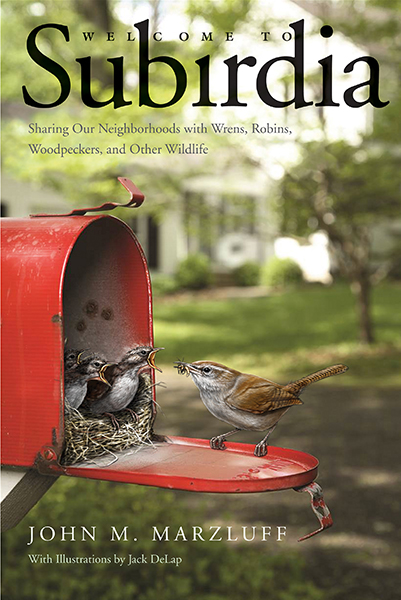
John Marzluff's newest book which describes the awesome power of suburbia to become a heaven for a huge diversity of birds.  Illustrations by my friend and colleague, Jack Delapp.

John Marzluff’s newest book which describes the awesome power of suburbia to become a heaven for a huge diversity of birds. Illustrations by my friend and colleague, Jack DeLap.

John Marzluff’s new book Welcome to Subirdia, highlights that vast species diversity that can come with suburban development, showing that these types of habitat modifications aren’t doomed to be low diversity.  With a bit of thought on our part, we can create habitats that attract a variety of birds.  Namely, by limiting lawn space, increasing snags, native plants and bushes and keeping our cats indoors, we can expect to see a great variety of birds visiting our feeders, crows included!

Madden, C.F., Beatriz A., Amar, A. (2015) A review of the impacts of corvids on bird productivity and abundance. Ibis: 157, 1-16.

137 Comments

Filed under Crow behavior, crow conflicts, Crow life history, Crows and humans

My top 15 favorite crow facts

I, apparently like so many of my generation, are a sucker for insta-read lists.  Something I can crunch through in about 5min between classes.  My favorite proprietor of this content is Buzzfeed.  Although most of their lists are some kind of pop-culture reference, every once in a while I see something nature or science related and on two separate occasions have even seen posts related to crows.  Both were rather jejune.  So it seemed a perfect marriage to unite one of my favorite social media sites with some carefully selected and researched crow tidbits.   You can check out my post here on my top 15 favorite crow facts.

Leave a comment

Filed under Crow behavior, Crow curiosities, crow intelligence

Crows: A birdwatcher’s best friend

fruit-dove.woompoo

A Wompoo Fruit Dove

In every habitat in every country there’s always a particular species you can count on to give away interesting and cryptic critters.  When I was conducting research in the eucalyptus forests of eastern Australia it was bell birds, a small green bird with a distinctive bell like call that echos through the forest at a numbing consistency all day long.  While their conspicuous and raucous nature made them tempting to ignore, these birds were often the first on the scene when interesting new species entered the forest, and by learning their alarm calls I discovered far more birds, especially predatory birds, than I would have on my own.  A favorite moment was being the only field tech on my crew to glimpse a wompoo fruit dove, a particularly beautiful and secretive dove native to this area.  Given its beauty spotting this bird was high on all our lists, but it wasn’t until the end of the field season when my attention was caught by some rather rowdy bell birds that I actually got to see one.  Had I grown completely accustomed to ignoring the ringing calls of the Bell Birds, I might have missed what was one of the birding highlights of my time in Australia.

Here in the states, crows are often our bell bird equivalent.  While crows get a bad wrap from birders for depredating and depleting backyard bird populations this is unfounded.  In fact, I think crows make an excellent companion for a birder if you know what to look for.  Cryptic hawks or owls that you would never know are sitting quietly in the trees above you are given away by the loud aggressive alarm calls of crows.

While nest searching in Mercer Island’s Island Crest Park this morning I couldn’t help but be drawn to the scolds of about a dozen crows across a ridge in the ravine of the park.   The quick staccato and harsh tone of the call is easy to recognize with some practice, especially when it’s being given by several birds at once.

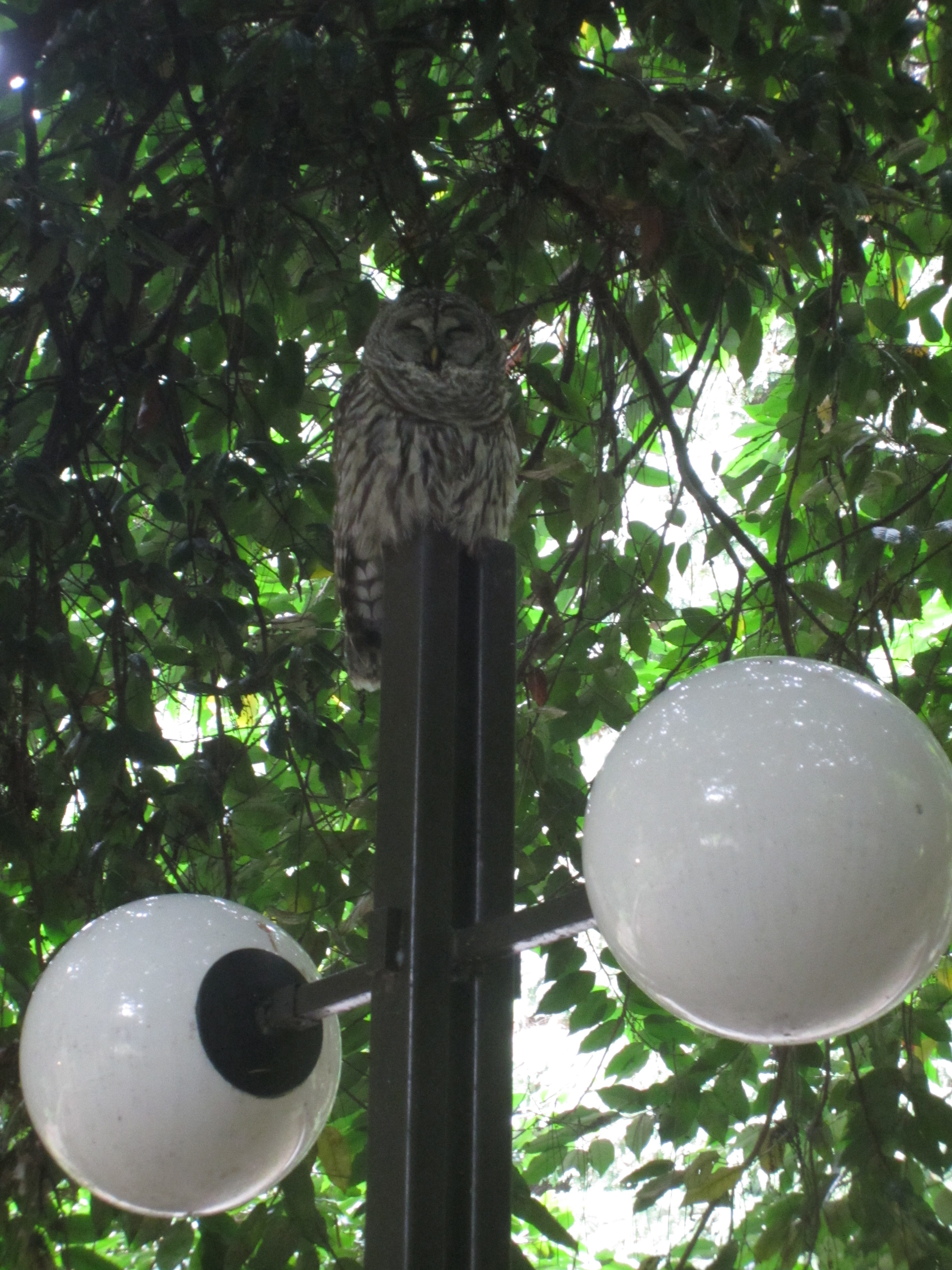
The Barred Owl often found hanging around our office on campus

The Barred Owl often found hanging around our office on campus

Peering across the ridge I couldn’t make out much through the branches, but sure enough after a few minutes of waiting came the unmistakeable “who cooks for you” call of a barred owl.  Another one quickly responded sending the crows into a fervor, and after a couple more dive bombs the owl emerged from its mossy post and opted for a quieter resting place away from the crows.  My feelings about the detriment of Barred Owls aside, there’s something unmistakeably thrilling about seeing an owl for a birder, and probably for most people.  They’re cryptic and undeniably charismatic, a good combo for making an exciting bird and, as has been the case for many birds before it, I wouldn’t have spotted this one without a little help from the crows.

Leave a comment

Filed under Birding, Crow behavior

Crows, quotes, and cooking.

In an effort to keep up with the onslaught of crow news, one of the first things I did as a newly minted graduate student was setup a daily Google news alert to the key term “crow”.  Although most of it is news about the Australian football team the Adeliade Crows, or futile efforts on behalf of desperate business districts to rid themselves of problem roosts, every once and a while some big new study will have also made the daily report.  While this is more of what I was expecting when I  signed up for the alert, it’s not what I’ve found to be the most important part.  I’ve realized that new  studies will always find their way to my desk-that’s the benefit of being a graduate student in a particular field.  No, what’s been the most savory part of this endeavor are the small, obscure observations from local and international sources.  It’s there that I’m reminded of the details that make these animals so special to me, and inspired this harried journey to try and study them in academia.

Take this recent article out of an Indian newspaper, The Hindu.  While the notes about protective crow parents are relatively banal, it’s her story about her crow visitors that struck me, particularly the last two lines of the piece.  “They do not like anything white, plain and stale. If it finds the food delicious, it calls out for others in the community.”  I found myself saying these lines over and over again both because I love their poetic feeling, and because I find myself in them as well.

When I started graduate school I knew that there were certain pieces of my life it wasn’t worth giving up, even if accommodating them would take considerable effort.  One of these things was cooking.  My husband and I love to cook, it’s an expression of passion both as individuals and as partners and something we make happen every night, even if it means eating at 9:30.  Even during my field season when he was away on the road, and I was working 14 hour days I would come home and prepare a meal from scratch.  Food is something I feel privileged to use as a form of love and expression, and nothing beats a comforting meal after a long day of discovery or failure (or more often the case, both).  And sharing that passion is a primary way my partner and I connect with our friends and family, we love cooking for others and it’s something I give up during the summer field season in exchange for all day crow watching.

Photo by Nicole Nicky

Photo by Nicole Nicky

With summer fast approaching, I’m confident this quote will float around my head as I watch crows pick at their peanuts in the dwindling hours of daylight and I’ll be reminded of exactly why I’m out there: to better understand an animal who’s avian biology is so different from ours, but whose behavior is strikingly similar. For don’t we all crave the joy of pleasurable food in the company of others?

Leave a comment

Filed under Crow behavior