Monthly Archives: June 2016

Crow curiosities: crows without tails

For the most part, crows come in the same general size, shape and color, but every once in a while individuals will deviate from this template in eye catching ways. These deviations can manifest as missing or elongated beaks, color abnormalities such as white plumage, or jarring metamorphoses into rudderless, flying orbs. 

DSC_0208

Tailless crows are fairly uncommon; in a typical year I’ll maybe spot a couple afflicted individuals. Although feather loss and replacement is a normal part of a crow’s annual cycle, crows don’t shed their tail feathers simultaneously so we can’t blame molting season for this odd appearance. Instead, a tailless crows most often indicates that the bird recently escaped a predator or other kind of threat. 

Similar to some lizards, many bird species can drop their tails defensively as a last resort to avoid being injured or killed. In fact, tail feathers require less force to detach in contrast to other feathers on a bird’s body. In addition, the force required to remove tail feathers decreases with how vulnerable a species is to predation.1 Tail feathers can also be broken, rather than completely lost. Although that might sound painful, unlike a bird’s beak which is full of nerve endings, mature feathers are dead structures like hair or fingernails. While a bird surely feels and avoids the sensation, it’s not painful. 

Tails are crucial to most birds not only for their visual appeal but also because they allow birds to steer and maneuver in flight. Without one a crow can still fly and land, but they’re not nearly as agile in the air and you’ll notice their take offs and landings are a bit awkward. Fortunately, the tail will eventually grow back though just how quickly is contingent on what happened to the feathers themselves. If the feathers were pulled out, so long as the follicles weren’t damaged they will begin to regrow immediately. If, on the other hand, the feathers were broken rather than pulled out, the crow will need to wait until its annual summer molt to replace them. 

DSC_0212

For crows fortunate enough to be brought into a wildlife care facilities, there’s also a secret second option to correcting a broken flight feather: imping. Although little known outside of rehab or falconry circles, imping is an age-old technique dating back to at least the 1240’s when it was mentioned in The Art of Falconry by the Holy Roman Emperor, Frederick II. The procedure involves trimming the broken feather to about one inch above the skin and then inserting a thin piece of wire, fiberglass, or wood (called the imping needle) into the empty feather shaft. A matching donor feather is then affixed to the exposed portion of the imping needle. Picture sheathing a double sided samurai sword, where the sword is the imping needing and the sheaths are the imbedded, trimmed feather shaft and the donor feather respectively. Historically, rust was used as a bonding agent but today vet safe epoxies are the standard adhesive. 

So the next time you see a tailless crow go ahead and give it a few extra treats. It’s not in any pain, but it’s been through something fierce. And to quite literally add insult to injury, it looks absolutely ridiculous.

Literature cited

  1. Moller, A.P., Nielsen, J.T., Erritzoe, J.  (2006).  Losing the last feather: feather loss as an antipredator adaptation in birds.  Behavioral Ecology 17: 1046-1056
28 Comments

Filed under Uncategorized

5 reasons to leave baby crows alone 

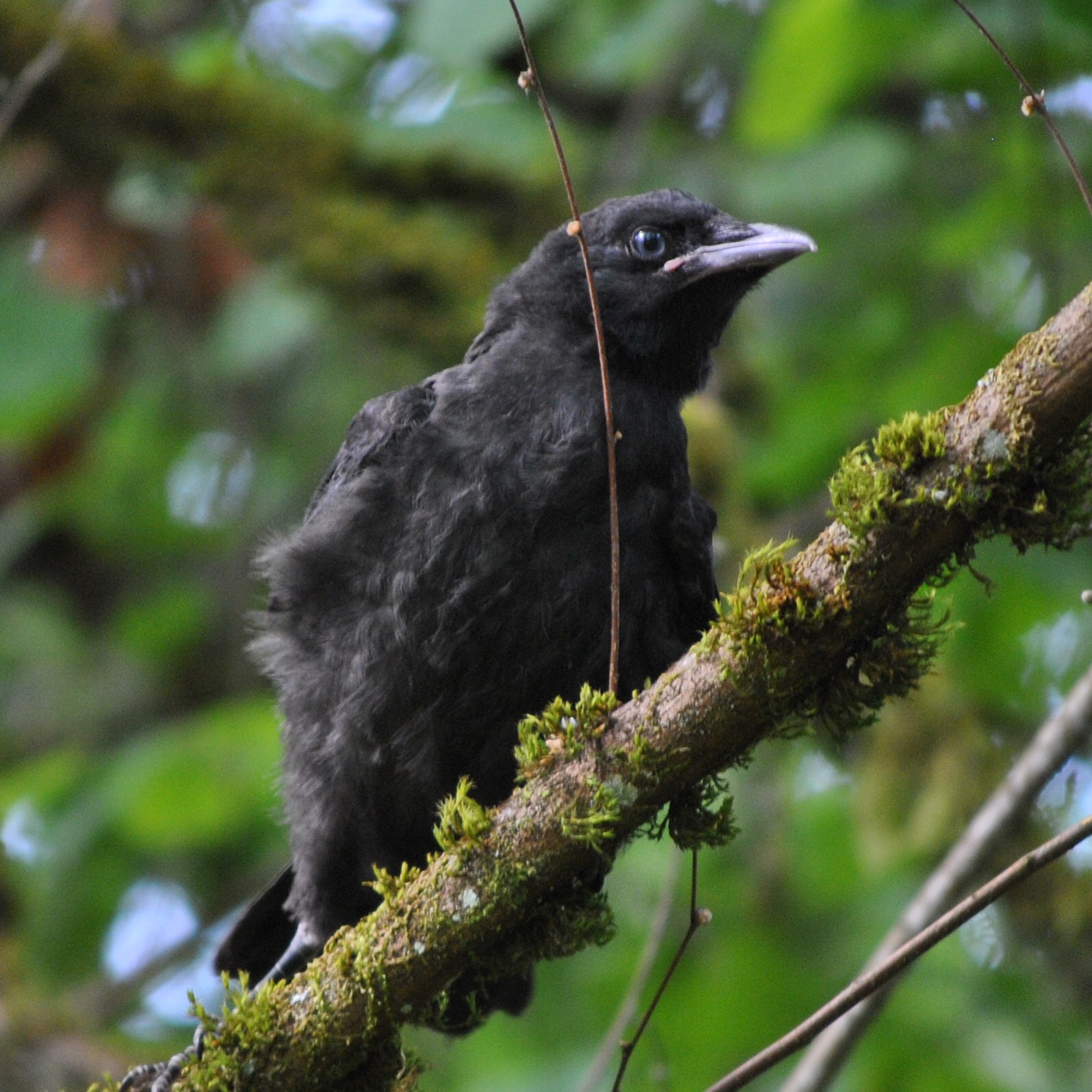
Those blue eyes, that awkward gate, their seemingly constant precariousness, they’re all calling to you to intervene. Here are 5 reasons second guessing that instinct might be in the bird’s best interest.

File_006

1) The vast majority don’t need your help. It’s totally normal for baby crows to be on the ground and flightless as long as they’re covered with feathers and appear otherwise alert and mobile. Even nestling crows are usually on the ground on purpose. Not because they are ready, but because their parents have intentionally rejected them for one reason or another. They will die and that’s ok. Part of coexisting with wildlife is giving them the agency to be wild. The story is different of course for species where the survival of individuals may mean the difference between population survival and extinction, especially because these situation are almost always driven by human activity.

2) It’s hard to tell when they’re stressed.  Recently, I saw a video on Facebook of a Steller’s jay fledgling in the care of a very well intentioned person.  She was giving it gentle strokes with her fingertips, each touch resulting in the young bird turning its head towards its back and opening its mouth.  The comment thread filled with ooo’s and awww’s and general comments of encouragement or gratitude for her actions.  For me it was like watching an alien attempt to care for a human child, the child recoiling and screaming while its caretakers congratulated themselves on how kind they were being.  Having handled baby corvids before, I know what that kind of posturing means, it means “I’m scared and stressed.”  To an untrained eye though, it may not look much different than the kind of gaping that means ‘feed me.’  Being stressed to death is a reality for young, or even adult animals, so any handling best be done by experts whenever possible.

DSC_3477

3) It’s illegal to rehab crows without a license. You can provide temporary care until you can get them to a licensed facility, but do not attempt to rehab them on your own.  Mistakes like the one I just described are a prime example of why the law seeks to protect animals by ensuring they are only raised or rehabilitated by experts.  For more information on how to handle them until you can get them to a facility visit my previous post.

4) Imprinted crows do not survive well in the wild.  Even if baby crows are receptive to being treated like a pet, doing so is both a legal violation and I would argue a violation of their right to be a wild animal with a healthy fear of people.  Of all my daydreams, at the top of the list is having a wild but imprinted crow that follows me around.  I even have a name picked out.  This fantasy of mine will forever remain just that, however, because it’s too dangerous to allow a crow to become that comfortable with people.  All it would take is one cranky neighbor with a pellet gun and it would be over.  Not to mention being imprinted on people, instead of crows, denies them access to skills and relationships with other crows that will help them survive into adulthood. 

5) It may do more harm than good.  The conventional wisdom suggests “well, worse case scenario is I try and rehab this baby crow and it dies, which it would have done anyway so really, nothing’s been lost.”  The more we study death in social animals the more we are beginning to realize there may be a cost to prematurely removing ailing or dead animals from their groupmates.  Being able to interact with their dead may serve an important role for social animals, and denying them this opportunity may have serious implications in their ability to process that death.  So be thoughtful about how slim the chance of survival is.  It might be that the kindest, most responsible action is no action at all.

27 Comments

Filed under Corvid health, Crow behavior, Crow curiosities, Crow life history, Crows and humans, Uncategorized