Hello blog followers. It’s been a long time. Looking over my stats today, I was pretty horrified to see I’ve only published a whopping 4 times this year. I don’t have a very good excuse.
2019 was certainly professionally busy, but not more so than in years past. Probably the biggest reason for my absence is that I am sinking considerably more scicomm time on places like twitter and Instagram, and it doesn’t leave a lot of room for blog articles. Which is a shame, because that’s where some of my best science communication has happened.
I also think that because I’ve historically treated the blog as a place where I only publish researched, 800 word articles, I’ve been hesitant to just send out quick updates a la a more traditional blog. But since at least some of you don’t follow me on the other platforms, you end up missing a lot of stuff.
Like, for example, did you know I published a short fiction story about crows (a very specific crow to be exact) on Audible this year? I did! And I’m damn proud and excited. And as followers of my writing, you all are probably among the most interested audience for that kind of material, and I didn’t even tell you.
So take this as a vow that 2020 will be better. I already have a ton of ideas for new articles, at least some of which will come out before the end of the year. Teaching an ornithology class has vastly improved my arsenal for communicating some pretty cool bird biology through the vehicle of corvids. Oh right, did you know I am no longer a postdoc but a lectuter at the Unviersity of Washington? Yeah, we need to catch up more.
Thanks for your patience and continued readership.
Whether it’s from actively watching crows, or simply just existing in a city, we’ve all seen it: the overflowing garbage bin with fat-stained wrappers littered at its base, and the crows snapping up each bit of leftover junk like spilled money. Cheetos, cheeseburgers, fries, nuggets, chips, or pizza, they will devour basically anything fatty and salty with absolute glee. This behavior is so canonically crow that it’s stapled into our contemporary imagery of these birds. Take this 12ft statue called “Crow with Fries” by artist Peter Reiquam.
I’d wager that most people don’t think about this behavior beyond simply finding it amusing or annoying, but I suspect that if you describe yourself as crow lover, naturalist, or bird watcher, you’ve been struck with the same thought as me: “This stuff is called junk food for a reason—it’s bad for you. What’s it doing to these birds?”
Given that anthropogenic foods can account for as much as 65% of an urban crow’s diet, it seems essential to understand what a diet derived from regularly feasting at McDonalds might do to an animal with 0.7% the body mass of a typical human.1 Unfortunately, we could do little more than shrug and speculate as to its effects. The data for a more informed understanding just didn’t exist. That is, until today.
A new study published in The Condor by Dr. Andrea Townsend et al. examines the relationship between urbanization, junk food, and the body conditions of crows.2 To conduct this study, her team blood sampled 140 wild crow nestlings along an urban to rural gradient. They found that plasma blood cholesterol levels increased in correlation with the amount of impervious surface, which is a typical way we measure urbanization. This finding suggests that crows in the city have more access to high cholesterol foods and they make haste in gobbling it up.
Correlation is not causation, however, so to confirm this, they ran an additional supplementation study where they provided 10 rural crow parents with 3 McDonalds cheeseburgers 5-6 days a week, and then looked at how their nestling’s blood cholesterol levels compared with unsupplemented nestlings from the same area. They found that eating cheeseburgers most days of the week had a demonstrable effect on the subject’s cholesterol levels. While this finding may not be raising any eyebrows, the actual logistics of carrying out a study that required buying hundreds of cheeseburgers each week, and sometimes in one order, certainly did. In one of their more memorable attempts, Hannah Staab called to place an order for 125 pickle-less cheeseburgers, a request to which McD’s staff replied, “Sure, we’ll get right on that.” When she arrived several hours later to pick them up, however, they hadn’t made any, having been convinced that the call was a prank. The peculiarities of urban fieldwork never falter.
So far, these findings tell us little more than what most people could have probably intuited, but they were crucial to laying the foundation for the real clogged heart of this study: Whether any of this is actually a bad thing. In the final piece, they examined the body condition, and 2-3 year survival of the 140 nestlings sampled along the urban to rural gradient. They found that cholesterol levels had no detectable effect on survival and were actually correlated with higher indices of body condition (meaning mass adjusted for size), a feature that is sometimes tied to higher reproductive success and survival. In other words, there might actually be a scenario where regularly pigging out on McDonalds doesn’t kill you and is maybe kinda helpful?
Needless to say, this caught everyone off guard, including Dr. Townsend, who told me, “I was surprised that we didn’t detect any negative health effects. I was thinking—based on the human literature—that high-cholesterol birds would have lower survival rates, but we didn’t see any effect of cholesterol on survival.”
So what gives? Is the universe really just this unfair? While we can’t rule out that the answer is simply, “Yes,” the authors speculated that it’s possible a longer study would bear out health consequences that take more than a few years to accrue. There’s also something to be said for the fact that body condition has complex and not always agreed upon relationship with fitness and survival.3 While some studies show pudgy birds have more resources to produce more offspring and keep on ticking, others find inconsistent support. Alternatively, crows may just not live long enough to see their lifestyle catch up to them. Future long-term studies will be necessary to fully understand whether crows have truly found a loophole in the junk-food problem. For now however, I’m happy to wish my favorite dumpster divers well, though I’ll hold off placing my own orders.
Literature cited
Marzluff JM, McGowen KJ, Roarke D. and Knight RL. 2001. Causes and consequences of expanding American crow populations in Avian ecology and conservation in an urbanizing world (J.M. Marzluff, R. Bowmanm and R Donelly, eds). Kluwer academic Press, norwell, Ma.
Townsend AK, Staab HA, and Barker CM. 2019. Urbanization and elevated cholesterol in American Crows. The Condor page 1-20
Milenkaya O, Catlin DH, Legge S, and Walters JR. 2015. Body Condition Indices Predict Reproductive Success but Not Survival in a Sedentary, Tropical Bird. Plos Onehttps://doi.org/10.1371/journal.pone.0136582
In Part I of this series I overviewed a new study from my colleague, Loma Pendergraft, about why crows call after discovering food. For Part II, Loma answered follower-supplied questions on all things crow communication. The topics we cover include:
Crow-human communication Crow-other animal communication Crow-crow communication Crow sounds The study of crow communication
I hope you find these answers helpful, or at least illuminating into all that is left to be discovered. Please feel free to leave any additional questions in the comments!
Many people describe situations where they feel they have experienced “conversations” with crows, meaning a back and forth exchange of sounds. Do you think crows notice when we vocalize at them and attempt to vocalize back?
If a person and a crow regularly interact (usually because the person reliably feeds the crows), then it’s fairly common for ritualistic behavior to develop, especially if the behavior is rewarded with food. I don’t know if crows see our vocalizations as an attempt at communication, but they might see it as step one in a series of steps that ends with them being fed- they are vocalizing back to the person because the last time they tried, the person fed them afterwards.
Should people give a signature sound when feeding “their” crows?
It certainly wouldn’t hurt. Crows are smart animals and they’ll quickly learn to associate “their” person’s call with imminent food. This would let the person call the crows to them over long distances.
Do crows try and get the attention of their human feeders with sounds? Might these sounds be just for them (like a specific name or greeting)? Yes, crows will certainly try to use sounds to get their feeder’s attention. I have a family of crows that come to my office window, and they’ve learned that if they give a rattle call, I’ll feed them (this is actually because I’m often too focused on my computer to notice them unless they call). As to the personalized greeting, that’s possible, but I don’t know for certain.
Can you tell if you are in a crow’s good graces by the sounds it makes? I don’t know about good graces, but you can certainly tell if you’re in a crow’s bad graces by the sounds they make. If a crow starts scolding you, you know it considers you a threat.
Can crows describe specific people to other crows? Not directly through vocalizations (e.g. “the dangerous human has black hair and a red shirt”), but they can do so indirectly. If a crow sees a dangerous person, they communicate the presence of danger via vocalizations (“danger here”). When other crows arrive, they watch what the calling crow does to identify which person is dangerous (the screaming bird is divebombing the black-haired human with the red shirt; I better remember him).
Crow-other animal communication
Do crows eavesdrop on other birds to learn new information?
Yes. Crows will respond to the alarm calls of other birds to learn about a predator’s location.
Can crows communicate with other corvids?
Crows will respond to the alarm calls of other corvids (for example, it’s quite common in Seattle for a Steller’s jay to find a sleeping owl, alarm call, and subsequently attract a mob of crows).
Any evidence they listen to mammals? Like would they respond to a squirrel alarm call and vice versa?
I am not aware of any studies that examined whether crows respond to the alarm calls of mammals. I would argue that crows can probably identify certain species of mammalian predators (such as cats, raccoons, squirrels, etc) by listening to their vocalizations, but again, I’m not aware of any studies that examined this.
Crow-crow communication
Do individual crows have specific sounds (like names) for each other?
I don’t know, but there are some interesting anecdotal stories that might shed light on this. Pet ravens who’ve learned to mimic human speech will yell their own name when searching for their owner. This suggests that while the human assigns the name to the bird, the raven assigns the name to the pair bond between them.
Do crow dialects vary by region? If so, on what kind of spatial scale do we define region? Would crows from different regions react appropriately to calls from outside their region? American crows west of the cascade mountains sound different (their calls are harsher and lower pitched) than the American crows throughout the rest of the country, probably due to ancestral hybridization with Northwestern crows. I don’t know if American crows have dialects in the sense that “traditional” songbirds (such as song sparrows) have dialects. While visiting Oklahoma, I tried playing back alarm calls that I’d recorded in Seattle- the Oklahoma crows reacted the same as Seattle crows (I didn’t have the opportunity to try other call types).
How much variation is there in how individual crows sound? Is it distinct enough to be identifying? There is a LOT of variation in crow vocalizations, which made interpreting my results very difficult. However, there is evidence that this variation is distinct enough to allow for individual identification. 1
Crow sounds
How many difference sounds can a crow make?
More than most people think. The loud caws make up the bulk of their vocalizations, but they will also utter rattles, growls, coos, and other odd sounds. They are also decent mimics, and can learn to imitate the vocalizations of other animals (including people).
Is there a library that describes the different calls and what they mean? You can find a large repository of crow recordings at the Macaulay Library, but I am not aware of any libraries that attempt to explain what the calls mean (mostly because we DON’T know what most crow calls mean).
What do the number of caws in a sequence mean? We don’t know. They are probably important, but only as one component among many different elements.
How much do we know about crow syntax?
Next to nothing, unfortunately. We do know that structured calling has layered repetition in that caws are repeated several times in a series, and series are repeated over the course of several minutes. Here’s one of the more comprehensive studies that cover this topic: Parr, C. (1997). Social behavior and long-distance communication in Eastern American Crows. Ph. D. dissertation, University of Michigan, Ann Arbor, MI
Can you distinguish males and females from their calls? I can’t, but there is evidence that the crows can distinguish between male and female calls.2
Do they learn their core sounds from a vocal tutor (as do other songbirds) or is it innate? I don’t know, nor am I aware of any studies that have examined this.
Do crows ever talk to themselves? Meaning, make sounds not intended for the ears of other crows?
Young crows will “babble” quietly to themselves. I have recorded captive crows uttering very quiet notes in the absence of any immediate neighbors, but as there were other crows in view, you can’t say with certainty that they were talking to themselves.
People described one particular sound in a variety of ways. Some called it clicking, other knocking, some described as the sound Predator makes. I suspect you’ll know it as the rattle call. By any name you wish you describe it, what does it mean?
Most scientists describe it as the “rattle call” (for those who haven’t heard it, it really does sound like the rattling growl of the predator from the 1987 movie). Unfortunately, we don’t know what it means. There is evidence that only female crows utter this sound.3
What do the soft “wow/hoo/wah” calls mean? We don’t know. It has been described in several scientific papers, but those authors don’t know what it means either.
Have you ever heard them give a call you would describe as a single “beep” sound? Do you know what it means? Unfortunately, I have not heard them utter this sound. Crows are decent mimics- perhaps what you heard was a crow mimicking something else?
Do you know what the “Gah” sound means? Unfortunately, no.
Do you now what it means when they puff up and bow and make this kind of “rah RAH” sound?
It sounds like you are describing a vocalization that I labeled “medium call” in my paper (the puffed-up bowing display is commonly done with this call). I believe it is a territorial call- when I played it back to listening crows, they became agitated and responded with their own calls and dominance displays.
Do crows have predator-specific calls like chickadees or prairie dogs?
We don’t think they have species-specific calls the way that prairie dogs do, but there is evidence that they call louder and faster around more dangerous predators (such as hawks) in a similar manner to chickadees giving more “dee” notes to denote relative danger.4
Can crows mimic human voices? Would a wild crow ever learn to mimic human voices, or only captive ones? Crows are capable of mimicking human voice, but I would only expect captive crows to do this. Hand-reared captive crows usually see themselves as people and bond with their owner the way they normally would a mate. Wild crows wouldn’t have the same exposure or motivation.
Do wild crows ever mimic non-human sounds (other birds, car alarms, etc.). If so, why? They are capable of mimicking other sounds. I don’t know their motivation for doing so, but I would guess that there’s a social aspect to it (play behavior or impressing prospective/current mate).
The study of crow communication
Very bright people have poured energy and resources into studying crow communication with little return on investment. Why is this so difficult to study? Crow vocalizations are difficult to study because there’s so many variables to consider. Individual caws can have a wide variation in duration, pitch, and inflection, and they can be uttered in a structured series (which itself can have variation in cadence and rhythm) or as unstructured calls. The context also matters- the same call might mean different things if uttered on/off territory or in the presence/absence of a mate, whereas different calls might mean the same thing depending on whether it’s uttered by a male/female or large/small bird.
I believe that you would need the following before you can “crack the code” on crow vocalizations: a large population of marked crows (caller’s ID, sex, age, and social status), constant tracking of which bird is calling (to account for individual call variation), the caller’s location (on/off territory, is it flying, on ground, or perched), info on what’s happening near the caller (mate nearby/away, food present, rival present), and a sound analysis program sophisticated enough to extract complex info from individual calls (such as pitch contour, pitch wobble, power envelope, and inflection duration) and the overall bout of calls (such as the time between calls within and between series or the cadence among series).
Is there evidence of identifiable morphemes?
None that I’m aware of. There was a study conducted 40 years ago that focused on a topic similar to morphemes- they examined which qualities of an assembly call were the most important for conveying the message to listening crows.5
From an animal communication perspective, can you explain the differences between “call and response” and “turn taking”?
I’m not very familiar with the differences between these terms, but it’s my understanding that “turn taking” animals aren’t focused on communicating with each other- they are simply waiting for the other to stop calling before they give their own call (there’s less noise and better transmission if two signals don’t overlap). In contrast, animals engaged in “call and response” are directly communicating with the other- one animal listens to another’s signal and formulates its response accordingly.
Do crows sing (by the technical definition)? This is a tricky question. Bird song is learned, more complex than calls, species specific, and serves the dual purpose of warning males away from the territory and attracting/courting females. We don’t know if crow caws are learned or innate, but they do fit the remaining criteria for song (although the various coos, rattles, and other soft notes mates utter to each other might be part of the courtship behavior). It might not sound like a traditional bird song, but structured crow caws seem to fit the technical definition for it.
Do crows meet the definition of having language? Anytime a scientist describes an animal’s communication system as a language, it makes the linguists angry. Language has many definitions, but all acknowledge that it’s a complex form of communication with rules and syntax (for example, there’s a difference between “hat on head” vs “head on hat”) that’s limited to humans. While crows are certainly capable of communicating basic information among themselves, this communication does not meet the definition of having language.
***
Thanks again to everyone that sumitted questions for this post and to Loma for taking the time to respond. To learn more about Lomas’ work or ask him more questions please check out his blog.
Literature cited
Mates, E. A., Tarter, R. R., Ha, J. C., Clark, A. B., & McGowan, K. J. (2015). Acoustic profiling in a complexly social species, the American crow: caws encode information on caller sex, identity and behavioural context. Bioacoustics, 24: 63-80
Yorzinski, J. L., Vehrencamp, S. L., McGowan, K. J., & Clark, A. B. (2006). The inflected alarm caw of the American crow: differences in acoustic structure among individuals and sexes. The Condor, 108 518–529
Tarter, R. R. (2008). The Vocal Behavior of the American Crow, Corvus brachyrhynchos [master’s thesis]. The Ohio State University
Yorzinski, J. L., & Vehrencamp, S. L. (2009). The Effect of Predator Type and Danger Level on the Mob Calls of the American Crow. The Condor, 111: 159–168
Richards, D. B., & Thompson, N. S. (1978). Critical Properties of the Assembly Call of the Common American Crow. Behaviour 64: 184–203
If there’s one general area of questioning that overshadows all others that I receive, it’s questions about vocalizations. One caw, five caws, quiet wows, and loud clicks. We can’t help but to ask what it all means, and wonder how we might better understand and connect with crows if only we knew. To the chagrin of virtually everyone that has asked me a vocalization question, however, the answer is almost always a very disappointing shrug of ignorance. So to help you better understand what we do know about crow vocalizations and why it pales in comparison to what we don’t know, I am dedicating two posts to this topic. The first one–this one–will cover a recent study authored by my colleague and former labmate, Loma Pendergraft.Part II will take the form of a vocalization Q&A. So sit back, grab a snack, and get ready to know more, or maybe less, about crow vocalizations than you ever thought you could.
***
Why are you yelling at the dinner table?
If you’ve ever fed a crow you may have noticed that shortly after whatever tasty morsel you’ve offered hits the ground, the receiving crow will give a couple caws. If you’re anything like Loma Pendergraft, your next thought will be, “Why?” Are they inviting family members to the feast? Are they trying to scare off competitors? Do the number of caws mean anything?
Unlike most crow feeders that have to settle for a disappointingly fruitless Google search for an answer, when Loma first asked this as a graduate student he was in a unique position to test it. After three years of labor, his findings have been published in a new paper entitled: Fussing over food: factors affecting the vocalizations American crows utter around food.1 As I can already feel your anticipation in finally finding out what all those food calls are about let me start with a spoiler; you are probably not going to learn what you had hoped to from this study. But you will learn something invaluable about crow communication and how we study it. So with that out of the way let’s start at the beginning.
Generally speaking, if an animal vocalizes at a food source, it must incur some benefit from that vocalization that outweighs the potential costs. Costs include things like getting your food stolen by a competitor or drawing the attention of predators. Conversely, the benefits may consist of things like being able to share resources with your mate or kin, claiming ownership, or attracting other individuals to help you secure a food source away from another bird.
To try and determine what, if any, of these might motivate the calls that crows produce, Loma conducted three experiments. In the first, he attempted to look for patterns in their vocal behavior by categorizing and quantifying the calls given around food of varying amounts. For example, perhaps for an amount of food small enough as to be consumable by one crow they keep quiet, but for a significant amount they have a specific three-note “I found food” call to alert their mate. In Experiment 2, he ground-tested his ideas about how he was interpreting the calls from Experient 1 by doing playback. Essentially, he wanted to show that if he thought a three-note call was used to attract a mate, then by playing it back the mate should come in. Finally, in Experiment 3 he tested whether the different calls he had recorded had any effect on the listener’s ability to find the food.
To conduct these tests, Loma used wild crow pairs that he located all around Seattle. To prevent the birds from learning his face, he used a variety of sometimes hilarious disguises. He fed each pair three different amounts of food over the course of three trials: 1 peanut, 5 peanuts or a bountiful 25 peanuts. To try and suss out both if there were any patterns in calls given around food and if calls varied with the amount of food, he recorded their behavior before and after feeding them, and then used vocal analysis software to detect patterns in call structure.
What he found was that, unlike the grand reveal we were all hoping for, few clear patterns emerged from the call data. When crows are around food, they give shorter calls than they did before, and their calls around only a single peanut are longer than when they are around a more substantial amount of food. But in all the other areas where you might expect some pattern to emerge; call rate, peak frequency, the number of syllables, etc., none did.
Still, the fact that they give short calls around food is suggestive of something, so Loma attempted to determine in Experiment 2 if these short calls are used to either attract birds in or repel them away by playing back those short calls and watching for how the birds responded. The resulting response was more of a whimper than a bang. Or maybe I should say more of a short call than a bang. Because outside of matching the short calls with their own short calls, the crows hardly changed their behavior. Even in Experiment 3 where he looked for whether specific calls aided in the listener’s ability to locate the food, he came away still puzzled. Crows were only able to locate food in 38% of cases and were no better than when played the control chickadee calls.
A cynic may walk away from these findings feeling as if nothing has been gained; that we know little more about what crows are saying around food than we did before. While it’s true we may not have learned much about what they are saying, this study did reveal something important about what they are not saying. Because while Loma found few patterns once the food was down, he did discover that crows give longer calls in the absence of food and that those medium calls prompted territorial behavior when played back. The implication is that crows do not give territorial calls around food, perhaps to avoid risking its discovery by adversaries.
In addition, while it makes for a less compelling headlines, failing to support our hypotheses offers fundamental insights and lays the groundwork for future studies to keep pressing forward. In this case, Loma and his coauthor John Marzluff question whether the difficulty of detecting clear patterns in “x” vocalization leading to “y” behavior is because crows encode so much context-specific information in their calls. In fact, a previous study on American crows found that acoustic variation can indicate the caller’s sex and identity.2 Perhaps the reason we have so much difficulty in mapping out the world of crow communication is that, unlike a crow, we fail to detect all of the information they can ascertain and use to determine how to respond.
So, yes, in some ways we are no closer to Dr. Doolittling the crows than we were before. Instead, we are left with the more compelling reality that our inky friends likely posses an incredibly rich and complex vocal system. For me, this continued mystery only serves to endear them further. After all, do any of us love these birds because we find them straightforward and predictable? I doubt it.
***
Want to learn more about Loma’s research or this study in particular? Don’t forget to head over to his blog. There you can drop him a line with more crow questions or to request his new paper in full. He did so much more than I summarized here, it’s really worth a full read!
Camp robber. Whiskeyjack. Canada jay. Gray jay. I know of no other bird that goes by as many names as the Canada jay. In fact, it has so many names it’s possible for two people to be swapping stories and not even realize they are discussing the same animal. Why this sweet-faced bird possesses a number of aliases better befitting an agent of espionage is, in part, the result of a rather fascinating bit of birding history replete with controversy, colonialism, chaos, and a contest of national importance.
Before we get to the jays though, I want to put in your mind the image of the Ouroboros. If you’ve never seen it before, the Ouroboros is a symbol from Egyptian iconography that depicts a snake or a dragon eating its own tail. The image is meant to imply infinity; the idea that where you end is also where you begin, on and on, forever. Because, as you’ll see, it’s impossible to tell this story without eating our own tails at many different points along the way. So let’s start with the name that’s both the beginning and potentially the end of this story: Canada jay.
On May 23rd, 2018 the American Ornithological Society announced that Perisoreus canadensis, the bird formerly known as the gray jay, would be officially recognized as the Canada jay. Although this change felt disruptive to some, for the folks spearheading the campaign, including foremost Canada jay expert Dan Strickland, this was the righting of a historical wrong more than a half-century in the making.
According to Strickland’s research, which he details in a facinating article called “How the Canada Jay Lost its Name and Why it Matters,” one of the earliest scientific references to this bird was in an 1831 zoology book called Fauna boreali-Americana where they name it as a Canada jay. Even James Audubon used the name Canada jay when he described it in the 1840s. From here the story of the jay’s name gets hairier, with lots of different dates, acronyms, and taxonomic nuance, but I want to try and take you through it because it tells you so much about why things ended up as they did.
During the early 1800’s the process of discovering* and naming birds was something of a wild west operation. It wasn’t until 1883 that an official body, the American Ornithologist’s Union, AOU, (now called the American Ornithology Society, AOS), was formed to take leadership and help legitimize the field of ornithology in North America. Part of this goal was to act as the official body for taxonomic and nomenclature decisions. In keeping with this goal, AOS publishes a checklist of North American birds every decade or so. So who is on that list, and what they call it, means a great deal. For the first two publications (1886 and 1895) our bird was called the Canada jay, but then after 1895 all more or less goes to hell.
At the root of this naming disaster was a failure to provide a clear and rigorous English naming system at both the full and subspecies level. Instead, the system (if you could call it that) was that birds with only one species (monotypic species) were given a binomial Latin name and an English common name, but birds with subspecies (polytypic species) like our bird, may or may not be given an English common name or a Latin binomial name. Instead, their subspecies were given Latin trinomial names and English common names. What this meant is that if you saw a Canada-jay like bird, unless you knew which subspecies it was, the best your guide could tell is that it was merely a Perisoreus jay. This also meant that the name “Canada jay” effectively got downgraded to describing a single subspecies: Perisoreus canadensis canadensis. An effort to name yet another Perisoreus subspecies, Perisoreus obscurus griseus, appears to be when the name “gray jay” first comes into play.
I doubt anyone would question why failing to provide common names to full species would cause confusion, but matters were made worse because there was no system in the nomenclature behind the common names for the subspecies. This lead to problems like not being able to identify from the English name alone if you were talking about a species or a subspecies, and having subspecies from different respective species sharing the same root name. For example “clapper rail” could refer to subspecies of either Rallus obsoletus or Rallus longirostris.
In the late 1930s, people grew increasingly frustrated with this system and started to put pressure on AOS to develop a more logical naming scheme. At the forefront of this effort was a recommendation by Alden Miller to adopt a system where full species would be given English common names and binomial Latin names, and subspecies would only be provided a trinomial latin name. For example, Perisoreus canadensis would be given the English common name of Canada jay, and its Alaskan range subspecies would be known only as Perisoreus canadensis fumifrons.
Although this scheme was well supported, during the 1940 vote, it was inexplicably voted down. Instead, in 1947 the committee welcomed a new system where both the full species and the subspecies were given common names but, in an attempt for clarity, required that the subspecies’ common name was both rooted in the full species’ common name and geographically relevant. It’s this decision that officially killed the “Canada jay” because the committee likely felt it would be too geographically awkward to have subspecies names like the “Alaskan Canada jay” or the “Oregon Canada jay” and so instead, they opted for gray jay as the official full-species name.
By 1954, however, this system grew too taxing and the committee essentially adopted Miller’s 1930’s suggestion: only full species get official common names and subspecies are named and identified by their trinomial Latin name. For some reason, though they did not revert back to the original* name of Canada jay as their rules suggested they should, and instead they curiously retained the name gray jay. This may have been the last of it if not for a ~political~ controversy that would rock the nation of Canada a half-century later.
In 2015 the Royal Canadian Geographical Society sought to declare a national bird of Canada, a spot that remained egregiously vacant, by hosting a massive public vote to choose among 40 potential candidates. As the popular vote neared an end, five front runners had emerged: the gray jay, the Canada goose, the common loon, the black-capped chickadee and the snowy owl. Ultimately, the common loon would go on to win the popular vote by a 10% margin. Once voting closed, however, the RCGS convened a panel of experts to debate which bird they thought was most worthy. To the shock and upset of the voters, in 2016 RCGS ultimately chose the gray jay, a bird many voters complained did not have the connotation of national pride that the loon did. In the end, though, none of it-the year and a half long competition, the 50,000 votes, the ensuing controversy-mattered because the actual Canadian government had no interest in naming a national bird.
Still, the public’s perception that the jay was not a strong enough symbol did not sit well with Canadian jay scientists like Strickland and Ryan Norris who knew of the jay’s more patriotic heritage. Determined to understand and ultimately reverse the 1954 ruling, Strickland set out to show AOS that the decision to retain the name “gray jay” was not in keeping with their own rules. And, as you already know, in 2018 he succeeded; the bird formerly known as the gray jay (which was formerly known as the Canada jay) is now officially reknown as the Canada jay. The Ouroboros has finally caught its tail. Well, for many people it has. I want to enter yet one more heir into this contest, the one that I believe holds the most legitimacy to the throne: the whiskeyjack.
Unlike the name might suggest, whiskeyjack isn’t derived from campfire tales about these gregarious birds robbing campers of their whiskey. It’s an English name derived from the indigenous Cree (and other Algonquian family languages) name for the bird, Wisakedjak. In Cree culture (and some other First Nations peoples of the subarctic region) Wisakedjak is a sacred figure who is known as a trickster and in some cases for being among the creators of the world. It’s a befitting name for this clever little corvid and the merits of its legacy are without question. In fact “whisker-jack” can even be found in the English literature as early as 1740, nearly one hundred years before the name Canada jay would first be used. I’m not alone in my support either, even during the 1947 debate, L.L. Snyder notes that “‘Whiskeyjack’ is used universally in the north (& will continue to be).”
Throughout this article, you may have noticed the occasional * following words like “original” or “discovered” and that’s because those words are only relevant when thinking about natural history in post-colonial terms. But the truth is that most wildlife were already known, already named, already studied by the various peoples that called this continent home before their lands were taken from them, and their traditional knowledge erased in favor of a Western approach. So if our goal is to honor the heritage of this bird, I can think of no name more appropriate than the “whiskeyjack jay.” That is the return to the beginning that this magnificent bird deserves.
As 2018 draws to a close, I want to dedicate a post to five of the most interesting and important publications about our favorite family of birds that came out this year. For the sake of a brevity, the reported studies are largely condensed with some tests/results omitted and little attention to normally key experimental elements like controls, statistical analyses, etc. Please click on the study title to be directed to the full publication.
Background: Depending on where you live, the answer to, “Do crows migrate?,” can be quite different. For example, most Seattle residents would probably say no, since large numbers of crows can be seen here year round, while someone in say, a southern Canadian province, may notice a sharp decline in the number of crows during the winter. That’s because crows are what’s know as “partial migrant species” meaning that within a population, some individuals may be migratory and others resident with more migratory strategies biasing in areas with harsh winters. Despite the role of partial migration in how scientists currently explain the evolution of complete migration, little is known about the phenomenon. Even elemental questions such as: is this behavior fixed or flexible within individuals, is it environmentally influenced, and how might species use it to adapt to changing conditions remain under-explored.
Methods: The study looked at two populations of overwintering crows: one in Ithaca, New York and a second in Davis, California. They used a combination of intrinsic (meaning originating in the body) and extrinsic (meaning originating outside the body) markers to track the movement and origin of their 18 tagged subjects over 2-4 years. The intrinsic makers included molecular and stable isotope data, and the extrinsic marker was a satellite tracking device that was attached to the bird via a light backpack. I won’t go into the details of the molecular and stable isotope data, but suffice it to say that stable isotopes were used to identify the place of origin via the unique properties of the local food and water that embed into an individual’s tissue and the molecular data was used to sex individuals and establish relatedness.
Key findings: Of the 18 tagged crows across both east and west coast populations, they found that almost 78% were migratory. This was a shock to me, TBH. I had no idea just how many crow were making these annual trips. The distance these birds traveled varied widely, with some going as “little” as 280 km (173 miles) and others as much as 1095 km (680 miles). Among resident birds, they found that individuals never ventured further than 25 km (15.5 miles) from the center of their breeding site. For both resident and migratory individuals they found that birds were very loyal to their breeding sites; returning to the same territory year after year. Given this finding, it should not be surprising to learn that individuals did not vary from year to year in whether they were migratory or not. Together these results offer clues to how crows may respond to climate and urbanization induced changes in temperature to their local environments.
Background: For decades people considered the use of tools to be a uniquely human feature. Now we know that all sorts of animals, ranging from fish to monkeys, use tools and a handful of animals even create tools. Among the small number of animals that create tools, we have only seen wild individuals modifying a single object. For example, stripping a twig of small leaves or branches in order to probe small holes for insects. Whether any wild animal is capable of making compound tools, those made by combining seperate non-functional parts, is unknown. Even in captivity, this behavior only has limited observation in the great apes. Understanding what animals are capable of this complex task and how they achieve it, might give us insight into the evolution of our own exective functions.
Methods: This study used eight wild caught captive New Caledonian crows. Like many experiments involving novel objects, this one occurred over multiple different phases. In phase I the birds were provided a long stick and a baited test box where food was within reach when using the stick, but not without it. In phase II the birds were presented with the same baited test box, except that instead of a single long stick, they were given a hollow cylinder and a second, thinner cylinder that needed to be combined in order to generate a tool long enough to reach the food. In phase III, the birds were given the same problem, only now with novel combinable items. In phase IV, the researchers tested whether the birds were combining elements because they understood that they needed to, or if because they derived some other benefit from the process. To do this, they presented birds with a bait box that had two tracks: one where the food was within reach of a single element and one where it required a compound element. In the final phase, birds were presented a bait box that required the combination of more than two elements.
Image from von Bayern et al. 2018
Key findings: All birds passed the initial tool use phase handily. Given that New Caledonian crows frequently use single element tools in the wild, this was not at all surprising. In the second phase, half of the subjects (four) were able to combine the two elements after no more than two failed attempts. These subjects were then able to transfer this knowledge when presented novel combinable objects. When given a bait box with food presented on the close and far tracks, birds most often only made compound tools when it was necessary, suggesting that they don’t do it just for fun. In the final phase, only one bird succeeded in making a tool that required more than two elements. These findings demonstrate that New Caledonian crows are not only on par with what’s know about compound tool use in the great apes, but actually exceed them.
Unfortunately what this study does not explicitly answer is whether the birds were able to create the needed tools as a result of mental mapping (i.e imagining the correct tool and how it might be assembled) or by happy accident. Without this knowledge, what their ability to make compound tools suggests about the evolution of things like insight remains mysterious. Given all the other remarkable ways New Caledonian crows show innovation when it comes to tool use, however, both myself and the authors of this study are hedging that it’s indeed cognition behind these behaviors rather than more simple mechanisms.
Background: One of the most frequent inquiries that come my way are requests to decipher various crow calls. Given all we know about crows, this doesn’t seem like such an impossible request, but the reality is that crow communications remains one of the most impenetrable black boxes of crow behavior. I’ll save more on this for a future post dedicated to an upcoming publication by my colleague Loma Pendergraft, who spent his MS learning this fact the hard way. But suffice it to say that any progress on this front in the various Corvus species is groundbreaking news. We do, however, know more about raven calls. For example long “haa” calls are thought to recruit other individuals to sources of food. What was unknown at the start of this study was whether these calls encoded any class-specific information about the caller, such as their age or sex. Calls that impart class-level information about the caller have been previously demonstrated in some marmots and monkeys.
Methods: The researchers recorded hundreds of “haa” calls from wild ravens which had previously been color banded and whose age and sex were known. Using acoustic software they analyzed the vocalizations for patterns in call elements like frequency and inflection rate.
Key findings: As the study’s title suggests, ravens appear to encode information about their age and sex in “haa” food calls. For animals like ravens that live in “fission-fussion” social systems, meaning flexible social groups where individuals regularly reencounter familiar individuals, but also encounter unfamiliar ones, class-level information helps individuals quickly assess important aspects of a caller’s identity. Such information may be key to helping individuals decide if they want to join a feeding event or not. This decision is particularly important because aggression at feeding events can cause mortal injury, so grouping with a bad crowd can come at a high price.
Background: The Mariana crow or Aga is a native species to the islands of Guam and Rota. After the introduction of the brown tree snake to Guam in the 1940’s, Guam’s entire population of Aga were wiped out leaving only those found on Rota to continue the species. In 1982, the population hovered around 1,300 individuals but things were clearly in decline. In 1984 the Aga was officially listed as endangered and today is considered critically endangered by the IUCN. Unlike on Guam, there is no clear reason why the Aga continues to decline on Rota, though habitat loss, persecution by humans, natural disasters and introduced predators like cats likely all work together.
Methods: During 2013-2014 researchers counted breeding pairs by surveying all known island territories. During these counts (which took 845 hours of labor and traversed 1,485 hectares!) the researchers also documented any unpaired or subadult birds. Since the entire island could not be surveyed, to ultimately estimate the population size the researchers used models that accounted for missed detections.
Key findings: Spoiler alert: They are A BUMMER. In all that searching only 46 breeding pairs were detected. Accounting for unpaired birds and detection failures, the researchers estimate that the current population of Aga hovers around 178 individuals. Obviously that number alone is a gut punch but it’s especially true when you consider that that’s a 10-23% decline since 2007 and a 46-53% decline since 1998. Researchers estimate that at least 75 pairs are needed to maintain a viable population of Aga. Without intensive predator management and community level advocacy for these birds, their future is sadly looking grimmer and grimmer.
Background: One of the most persistent myths about common ravens is that they have a symbiotic relationship with grey wolves; intentionally showing them carcasses they find and then sharing in the bounty together. But while the case is actually that ravens are unwelcome dinner guests at the wolves’ table, there’s no question that the two species have profound effects on one another. The reintroduction of wolves to Yellowstone in 1995 therefore offers a valuable way to study how the presence of wolves affects the spatial distribution and feeding behaviors of park ravens.
Methods: This study was a collaborative effort between avian and spatial ecologists at the University of Washington and Yellowstone wolf biologists. Using data from 2009-2017 on wolf abundance and prey kills, and raven surveys taken both within the interior of the park and at anthropogenic food sources in surrounding areas (ex: the Gardner town dump), the researchers were able to model raven abundance during both the study period and before the reintroduction of wolves. I won’t go into the details of how these models are created, but suffice it to say that their purpose is to take the data you give them and find what predictors best explain your observed outcomes. For example if, say, you have a bunch of data about where ravens were located at different times, and have data on different possible predictors, say, wolf abundance, weather, carcass abundance, carcass biomass, and distance to anthropogenic food, etc., the right model could help you identify that carcass biomass is the best predictor of raven abundance.
Key findings: Previous studies have demonstrated that wolves make more kills during severe winters with higher snowpack, because prey have a more difficult time evading them. As a result, the researchers hypothesized that ravens would depend more heavily on wolf kills during severe winters, but this is not what they found. Instead, Yellowstone ravens seem to lean more on consistent, anthropogenic food sources during tough winters, but lean more on wolf provided carrion during more mild winters. Still, the presence of wolves has increased and stabilized the number of ravens in the park, because they provide a second year-round source of food, in contrast to human hunter provided kills which are seasonally limited. These findings are yet another demonstration of the value of top carnivores in stabilizing food webs and providing food for a cascade of creatures.
6. And as a bonus let’s not forget the most important 2018 study of them all, “Occurrence and variability of tactile interactions between wild American crows and dead conspecifics,” which you can read all about here. 😉
Like all subcultures, the world of corvidphilia comes with its own set of corny jokes and puns. Of these, perhaps none is more well known than the classic: “What do you call two crows?”
“An attempted murder.”
Despite their groan-inducing nature, I consider myself a connoisseur of such jokes. After all, it’s rather flattering that crows are such a cultural fixture that they get their own jokes and cartoons.
There’s one joke though, that I have no choice but to spoil in the name of scientific accuracy. After all, what kind of scientist would I be if I left semi-obscure memes about crows go unchecked?
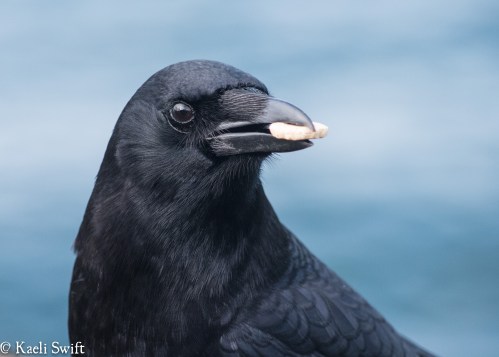
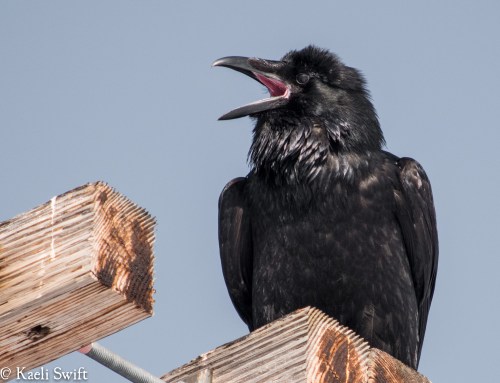
There are many version of the “matter of a pinion” joke but this one is the most cringe-inducing for me because it has the audacity to present itself as scientific fact. The truth is, not only do corvids have far fewer than sixteen primaries, but the entire premise of the joke is simply wrong.
All birds have at least nine primary feathers, but most birds, particularly within the passerines, have ten on each wing. Even outside of passerines, most birds have only ten, though there are exceptions. Flamingos, for example, have twelve, and ostriches have sixteen. Crows and ravens, on the other hand, are in no way exceptional, either from the norm or each other.
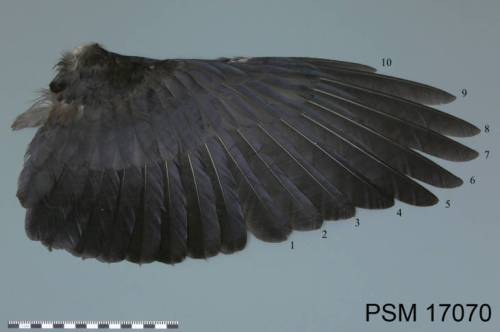
American crow wing. Photo c/o the Slater Museum of Natural History.
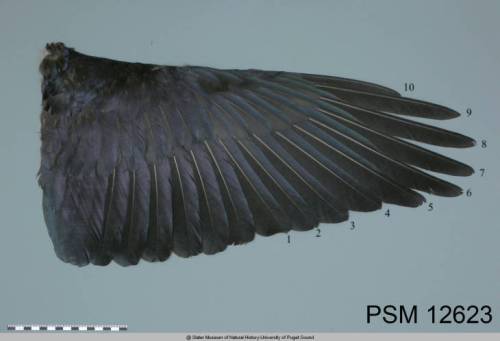
Common raven wing. Photo c/o the Slater Museum of Natural History.
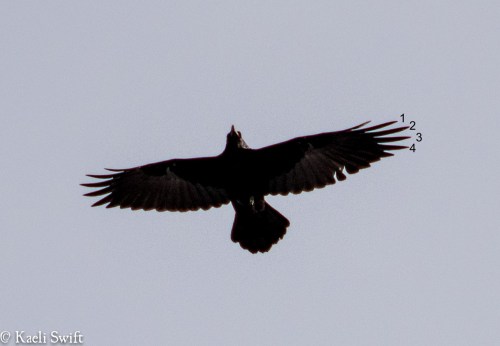
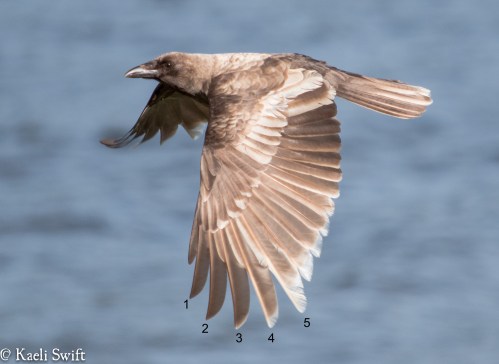
So, no, the difference between crows and ravens is not, in fact, a matter of a pinion. There’s one thing I do want to point out, though, particularly for you #CrowOrNo players. While it’s true that crows and ravens have the same number of primaries, they do look different enough that in flight you can often identify a bird as either a crow or a raven based on its primaries. Of the ten primaries, there is a handful that is longer and more distinct than the others, making them look kind of like “fingers”. Looking at the wing pictures above, you can see that the crow has five evident finger feathers (feathers 5-9) whereas ravens only have four (feathers 6-9). This difference is a bit easier to detect on birds in flight than on these static wing specimens.
Common raven in flight showing the typical four “finger” feathers.
American crow in flight with five evident “finger” feathers.
So with this in mind, it’s possible that with a little handwaving you can actually get away with saying the difference between a crow and a raven is a matter of a pinion, but by now there’s not much of the joke left since you have to leave off the initial context. A much more scientifically sound version, however, would be to compare crows and song sparrows, which only have nine primaries. “What’s the difference between a crow and a song sparrow?”
“It’s just a matter of a pinion!” And then, as with any good joke, you would explain to your audience the scientific merit of the punchline by describing the technicalities of wing feathers.
Funny right?
So what’s your favorite corvid joke? Let me know in the comments!
When I was still in Alaska back in the fall, my social media was brimming with pictures of the kinds of things you might expect from a biologist studying birds in Denali National Park. Photos of bears, Canada jays, arctic tundra, caribou, snowshoe hares, ravens, mountain and…puppies? Not just the occasional pupper photo either, but piles of puppies, puppies on parade, and videos of puppies doing the kinds of pupper things that make even the most cold-souled of us go red with glee.
Most of you were probably thinking, “IDK why this is happening and I don’t care, just give me more,” but a few of you may have found it a bit odd that I appeared to be spending so much of my time with doggos rather than the birds I was in Alaska to study. But, no matter which camp you were in, let me take a moment to clear the air and confirm that my time around the puppies was purely professional.
Let’s start with a fact that is not well known among the general public, but is crucial to the story: Denali is the only National Park with a full-time sled-dog team. In fact, Denali has had a mushing team since 1922, starting merely five years after the park’s inception. At that time, the team was responsible for patrolling the park boundary for poachers. Today, the dogs help deliver supplies and humans to places within the park that become difficult to reach during the winter months.
In any given year, the park is home to about 35 dogs, which when not working live in the kennels near park headquarters. As a park visitor, you can go to the kennels to meet the dogs and see mushing demonstrations. Needless to say between its cultural significance and popularity with the public, the kennels at Denali are a source of pride and joy for many park visitors and staff.
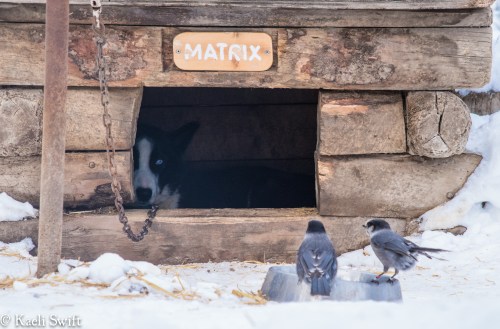
There is one aspect of the kennels, however, that makes their presence a bit tricky from a wildlife perspective. Like all US National Parks, Denali maintains a dogmatic “no-feeding wildlife” policy. This is meant to keep wildlife wild and prevent dependency and human conflict. Feeding time at the kennels, however, can be a real smorgasbord for the local corvids, particularly if some of the dogs are slow or reluctant to eat. How such food supplementation may be affecting the breeding success (or mortality) of the jays is therefore of keen interest to my work.
In partnership with kennel staff, my tech and I sought to document which birds were attending the daily feeding at the kennels. I will do the same come the winter field season, and ultimately we hope to determine if such attendance has any impact on how many fledglings those pairs are able to produce.
So, as I said, while visiting the kennels and the park’s annual litter is all fun and games for most, for me it was serious, professional science business and nothing more. Can’t you tell?
One of my followers on Instagram recently requested a list of all the wildlife I’ve seen in the park. Since my stay has (for now) come to and end, it’s actually a great opportunity to look back on everything I’ve enjoyed while I’ve been here. Which animal would you most want to see? Let me know in the comments!
Mammals
1. Voles. Unfortunately this is only animal I neither have photos of nor can ID to species. When you see a vole the sighting usually goes something like this “look there’s a v-” and then it’s gone. Not much time to even wrap your head around it, frankly. Though I did get one good look once when I got to see one swim across a puddle at my feet.
2. Red squirrel (Tamiasciurus hudsonicus). If you follow me on Twitter you’ll know I was quite enamored with their mighty middens.
3. Short-tailed weasel (Mustela erminea). Easily one of my favorites of the trip. They are as hilarious to watch as they are adorable. It’s like if squirrels rebranded their frenetic stress into something cool.
4. Collared pika (Ochotona collaris). Like hares and rabbits, although pikas may look rodent-like they are actually in the lagomorph family. Pikas can be found on rocky hillsides throughout the park.
5. Arctic ground squirrels (Spermophilus parryii). You can easily find these critters all over the Eielson visitor center, but they’re abundant across most of the park too
6. Muskrat (Ondatra zibethicus). There are at least a half dozen muskrats making their home in Horseshoe Lake alongside the beavers that keep it dammed it up.
7. Snowshoe hare (Lepus americanus). You can learn more about these animals in this post.
8. Red fox (Vulpes vulpes). I spotted a fox while en route from Wonder Lake to Eielson, but it was too far off to bother with a photo for.
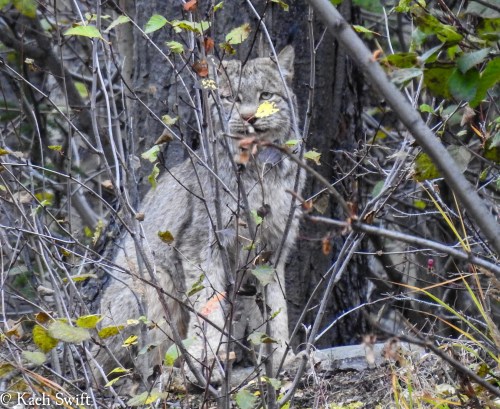
9. Canada lynx (Lynx canadensis). I was really, really hopeful to see a lynx but until now that’s resulted in nothing more than disappointment. Finally success!
The remaining 5 mammals I’ve already dedicated an entire post to. Check it our here!
10. Grey wolf (Canis lupus)
11. Dall sheep (Ovis dalli)
12. Caribou (Rangifer tarandus)
13. Girzzly bear (Ursus arctos horribilis)
14. Moose (Alces alces)
Birds 15. Boreal chickadee (Poecile hudsonicus). These little winter warriors are everywhere, and are always tricking us into thinking they’re jays and then laughing at us for confusing such a tiny bird with a corvid.
16. Common redpoll (Acanthis flammea). I didn’t see any when I was here last March, so this was a lifer for me!
17. Dark-eyed junco (Junco hyemalis). A familiar face from Washington.
18. American tree sparrow (Spizella arborea). I spotted this one with help from birder extraordinare Noah Strycker, who joined us for a few days to help with data collection.
19. Lincolns sparrow (Melospiza lincolnii). These birds joined us on one of my favorite hikes of the trip.
20. White-winged crossbill (Loxia leucoptera). Like all crossbills, these birds use their amazingly adapted bills to fiddle with spruce cones. They move through areas in fairly large flocks chattering up a storm and raining cones down in their wake. Then like a flash they are gone.
21. Pine grosbeak (Periporphyrus erythromelas). The males can be easily mistaken for a crossbill at first glance, but their bulky size and beautiful song distinguishes them.
22. American dipper (Cinclus mexicanus). America’s only aquatic songbird. We saw a pair of these birds mulling around Horseshoe Lake.
23. Varied thursh (Lxoreus naevius). If you’ve never heard it, the varied thrush produces a very whistle-like tone sung in a single pitch for about two seconds. For me, these sounds are familiar forest sounds, but for many visitors these birds and their calls are completely foreign. As a result, evidently it’s not uncommon for visitors to mistake their calls for emergency whistles and report them to park law enforcement!
24. American robin (Turdus migratorius). A turd I can’t live without.
25. American three-toed woodpecker (Picoides dorsalis). For all the dead trees around here I am frankly surprised we didn’t see more woodpeckers. It took about five weeks before I finally saw my first one! Then it was like we couldn’t shake them.
25. Canada jay (Perisoreus canadensis). It would have been kinda a problem if these birds hadn’t made the list.
26. Boreal owl (Aegolius funereus). This sleepy bae was very rudely awakened by some cranky Canada jays. It just gave them a few robotic blinks and went back to sleep.
27. Merlin (Falco columbarius). These birds are so fun to watch, but I only ever caught the occasional glimpse while driving through the park.
28. Black-billed magpie (Pica hudsonia). For such a pretty bird they are darn camera shy!
29. Greater scaup (Aythya marila). I was a little late to see much in the waterfowl department but we did see a few of these in the kettle ponds near Wonderlake
30. Northern hawk owl (Surnia ulula). This picture is from last spring, but I am claiming the right to never need another hawk owl photo again.
31. Northern goshawk (Accipiter gentilis). Don’t let their scientific name fool you. These are serious murder birds and probably the number one killer of hares that we encountered.
A goshawk chases a raven.
32. Gyrfalcon (Falco rusticolus). Man I wish I have been able to capture one of these in full glory. Such beautiful falcons.
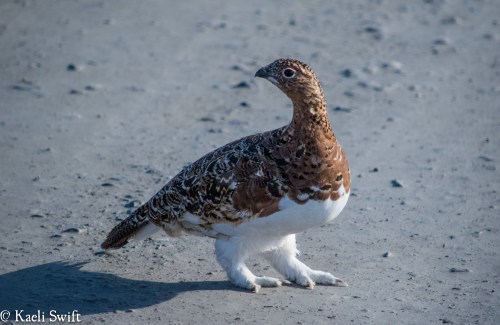
33. Willow ptarmigan (Lagopus lagopus). The state bird of Alaska! Like the hare and the stoat, these birds adopt a new look during the winter. This one was early in the transition.
34. Spruce grouse (Falcipennis canadensis). I wrote about a cool encounter with these birds in an earlier post.
35. Common raven (Corvus corax). Somebody find me a project so I can study these next!
36. Great-horned owl (Bubo virginianus). It’s within the realm of possibility that this particular GHOW killed one of our jays, but the evidence was circumstantial so I won’t hold them to account just yet.
37. Sandhill crane (Grus canadensis). Listening to them fly over the park as they begin their fall migration is a sound so beautiful that it hurts to think how few people will get to hear it in their lifetime.
38. Golden eagle (Aquila chrysaetos). Okay, so I didn’t take this picture in Denali, but I couldn’t have ended on a picture-less note! Plus, look at that handsome devil. My goodness.
While Denali is worth visiting on the basis of its scenery alone, it’s the wildlife that will truly shape your experience. In the summer, Denali is host to some eight species of medium to large sized mammals, including foxes, lynx, wolves, grizzly bears, black bears, caribou, Dall sheep and moose. Among those, the moose, grizzly bear, caribou, wolf, and Dall sheep make up what’s known as the “Denali Big 5.”
Seeing wildlife in Denali is mostly about luck and timing, but the longer you’re in the park the more chances you have to view wildlife. As I described in my earlier post, I scheduled and bus hopped my trips in such a way that I stayed in the park most of the day. This is particularly important for moose, which are generally crepuscular, meaning they are more active in the morning and evening . Everything else is really just a gamble. Sometimes the odds are in your favor and sometimes they’re not. For what it’s worth, though, out of my four all-day trips into the park I got The Big 5 twice, both during the times I stayed primarily on the bus.
While I always left the park having experienced something new, there were definitely trips that were more memorable than others, and the range of experiences really made me appreciate the luxury of being able to go multiple times. Whatever wildlife you do have the privilege of encountering is sure to fan the flames of your love affair with this park, but I imagine for many people that affair starts first and foremost with the most visible and charismatic of Denali’s wildlife: The grizzly bears.
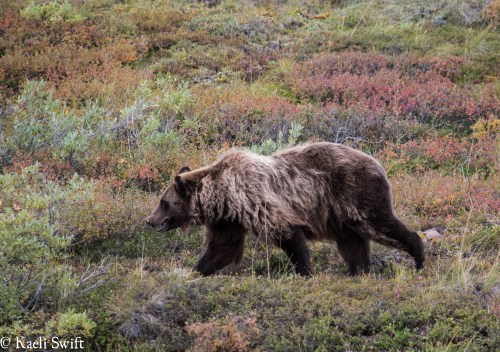
I took this photo in late August, just as the colors started to change.
By late July, bears across Alaska are gearing up for hibernation by entering a phase called hyperphagia, where they basically eat constantly and gain somewhere on the order of 400 pounds. In the park, their diet consists mostly of blueberries, soapberries, and roots, but they will gladly eat whatever mammals they can catch, including small rodents, caribou, moose and even other bears.
A big highlight when bear watching is seeing sows out with spring cubs. Unlike mom, the young are generally a lot darker in color, prompting people to sometimes mistake them as black bears. Observing cubs playing, foraging, and trying to keep up with mom is definitely the kind of experience that will make you wonder if you were somehow transported, Truman style, to some kind of nature documentary, but in the best kind of way.
While I won’t pretend for a second that seeing bears ever gets old, they honestly weren’t the animal that I was most looking forward to encountering when I arrived in Denali. Maybe it’s because I’d never seen one before, or because of some deep affection instilled by decades of Christmas marketing, but something about caribou utterly charms me.
Unlike many of Alaska’s other herds, the Denali caribou do not undertake an immense seasonal migration, opting instead to remain almost exclusively within the bounds of the park year round. Unless you can travel into the interior of the park, however, you’ll have little luck seeing them in the winter.
Denali used to play host to a herd that ranged in the tens of thousands, but after decades of over hunting followed by a mysterious period of low calf survival and harsh winters, Denali’s herd has dwindled to around 2,000 individuals. Fortunately, things seem to have stabilized for the time being. I wish I had seen more before the end of the season, but I’ll never forget what it was like watching this small herd move through this painted hillside.
The ungulates that seemed to most delight my fellow visitors, however, were the moose. For all of Denali’s hooved animals fall is the rut, which means males have grown out their antlers or horns and are putting them to use in sparring (practice) matches, as they ready themselves for the violent matches to come. I only saw such behavior between moose once. They locked antlers for a few seconds and went back to grazing shortly thereafter. Unfortunately it was too far away to bother with any photos. I’ll admit, seeing a bull moose, particularly on foot, is a gripping experience. However big you imagine them to be, they’re bigger in person. The rack alone can be 40lbs.
In Denali, the stakes of these fights are high, as the moose here operate in a polygynous system, where the victor will mate with and defend an entire heard of females. In other places, moose form monogamous pairs for the breeding season.
It was early morning still when we watched this cow move her two calves across the valley. They seemed pretty wary of our bus, though her biggest real threat is the park’s main carnivorous predator: The gray wolf.
Even in Yellowstone I don’t get my hopes up about seeing wolves despite there being far more individuals there. Across the Denali’s 6 million acres, there are only 30 known packs comprising about 75 adults. You can imagine my delight then, when, as we were making our way out of the park at dusk on our first trip, we rounded a corner to see this rump trotting up ahead of us. As it happens, I had been walking the road on foot only minutes before. I probably wouldn’t have caught up with it had I not gotten on the bus, but it’s still pretty incredible to imagine that I more or less went hiking with a wolf. We must have followed this adult for about a mile. It stopped a few times, evening giving it’s signature mournful howl a before it disappeared off the side of theroad. Honestly, that would have been enough for me, but our second to last trip had something really special in store.
I had heard whispering about wolf pups back at our housing campus but I never thought much of it. I figured that was deep interior kind of stuff, the kind of trek our field schedule just wouldn’t permit. So while I figured it was something exciting when we arrived at a jam packed road, I just wasn’t picturing this…
Cue total F-ing meltdown on my part.
This pup was born sometime mid-may to the single male and female that comprise the Riley Creek West pack. By around four months the pups start venturing away from their den site. Lucky for us, for a few day stretch the area they were exploring was right near the road by Toklat. After a few days, they moved away from the road, which was no doubt for the best.
The last animal I have the great pleasure to highlight is the most iconic of Denali’s wildlife. In fact, it was this animal for whom the park was dedicated. The endemic Dall sheep.
In 1906, hunter and conservationist Charles Sheldon noticed a worrying decline in the Dall sheep favored by hunters. He feared that without protection, they would be hunted to extinction. Now this is an all too familiar concept, but coming off the heels of the “era of abundance” this was actually a revolutionary way of thinking in western culture. Until 1900, colonists/settlers in the United Stated hunted without regulation and, seemingly, without much thought or worry as to the integrity of ecosystems. As a frame of reference, the field of wildlife management wouldn’t come onto the scene for another two decades.
Sheldon, however, had the foresight to recognize that something must be done and set out to establish Denali as a national park. It took 11 years, but in 1917 Woodrow Wilson signed the bill into law. Since that time Dall sheep populations rebounded and are currently considered healthy.
Despite their robust numbers, however, most of my experiences of seeing Dall sheep in the park were “technical”. As in, “technically those white specks on the mountain side are Dall sheep”. So on our last day as we traveled out of the park, I couldn’t believe my eyes when a ewe and her lamb were jogging down a hillside close enough that you could judge their forms as Dall sheep even with your naked eye. For the minute or so that we were able to watch them, I felt myself overcome with equal parts joy and despair. I was profoundly grateful for the gift of such beauty and yet so sad that once again its integrity is under such threat.
Driving home one night, my fellow passengers and I shared our backgrounds and motivations for visiting the park. Some came to experience mammals the size of which dwarfs anything in their native country, some were fulfilling missions to visit all the National Parks, while others had arrived with a spirit of adventure and little else. Together, we marveled at the unforgettable things we had seen and shared our anxieties that future generations may not be so lucky. We discussed our anger and disappointment (or among some of the foreign tourists utter bafflement) at the US government’s unwillingness to act more effectively on climate change.
One hundred years ago someone looked at this land, recognized that change must be implemented, and fought for over a decade to convince congress that in fact wild spaces and wildlife mattered enough to act. As a result, my fellow passengers and I got to see and experience things that will bring us joy the rest of our lives. The question now is whether we will wage our own fight for the future, or if we will watch from the sidelines as it turns to ash in our warming world.
***
For information about climate change in the arctic please visit the following resources


















 corvidresearch.blog