
I, apparently like so many of my generation, are a sucker for insta-read lists. Something I can crunch through in about 5min between classes. My favorite proprietor of this content is Buzzfeed. Although most of their lists are some kind of pop-culture reference, every once in a while I see something nature or science related and on two separate occasions have even seen posts related to crows. Both were rather jejune. So it seemed a perfect marriage to unite one of my favorite social media sites with some carefully selected and researched crow tidbits. You can check out my post here on my top 15 favorite crow facts.
Author Archives: corvidresearch
Crow(d) funding!
It’s no secret that funding resources are shrinking. It’s become more and more difficult for projects to receive grant money, especially for those of us in animal behavior. It’s for this reason that, across all STEM fields, many of us are turning to crowd sourcing to help generate research funds. If you’ve enjoyed my posts and are interested in helping learn more about crow funeral behaviors consider checking out our crowd sourcing site at Experiment.com. There’s a video, budget break down, project details and everything else you may want to know before choosing if this sounds like a project you want to help fund. Please check it out!
Filed under Uncategorized
Crows: A birdwatcher’s best friend

A Wompoo Fruit Dove
In every habitat in every country there’s always a particular species you can count on to give away interesting and cryptic critters. When I was conducting research in the eucalyptus forests of eastern Australia it was bell birds, a small green bird with a distinctive bell like call that echos through the forest at a numbing consistency all day long. While their conspicuous and raucous nature made them tempting to ignore, these birds were often the first on the scene when interesting new species entered the forest, and by learning their alarm calls I discovered far more birds, especially predatory birds, than I would have on my own. A favorite moment was being the only field tech on my crew to glimpse a wompoo fruit dove, a particularly beautiful and secretive dove native to this area. Given its beauty spotting this bird was high on all our lists, but it wasn’t until the end of the field season when my attention was caught by some rather rowdy bell birds that I actually got to see one. Had I grown completely accustomed to ignoring the ringing calls of the Bell Birds, I might have missed what was one of the birding highlights of my time in Australia.
Here in the states, crows are often our bell bird equivalent. While crows get a bad wrap from birders for depredating and depleting backyard bird populations this is unfounded. In fact, I think crows make an excellent companion for a birder if you know what to look for. Cryptic hawks or owls that you would never know are sitting quietly in the trees above you are given away by the loud aggressive alarm calls of crows.
While nest searching in Mercer Island’s Island Crest Park this morning I couldn’t help but be drawn to the scolds of about a dozen crows across a ridge in the ravine of the park. The quick staccato and harsh tone of the call is easy to recognize with some practice, especially when it’s being given by several birds at once.
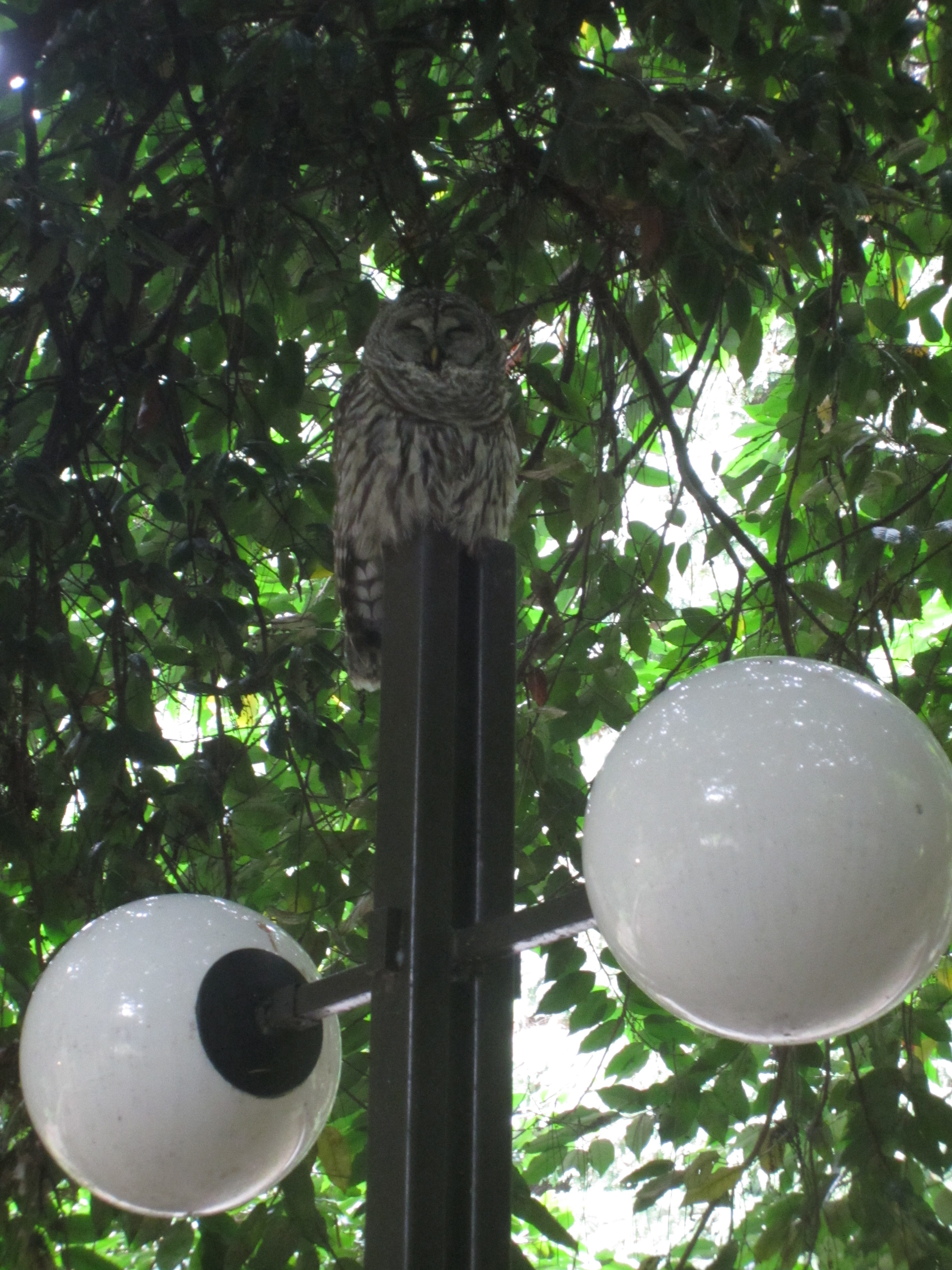
The Barred Owl often found hanging around our office on campus
Peering across the ridge I couldn’t make out much through the branches, but sure enough after a few minutes of waiting came the unmistakeable “who cooks for you” call of a barred owl. Another one quickly responded sending the crows into a fervor, and after a couple more dive bombs the owl emerged from its mossy post and opted for a quieter resting place away from the crows. My feelings about the detriment of Barred Owls aside, there’s something unmistakeably thrilling about seeing an owl for a birder, and probably for most people. They’re cryptic and undeniably charismatic, a good combo for making an exciting bird and, as has been the case for many birds before it, I wouldn’t have spotted this one without a little help from the crows.
Filed under Birding, Crow behavior
Crows, quotes, and cooking.
In an effort to keep up with the onslaught of crow news, one of the first things I did as a newly minted graduate student was setup a daily Google news alert to the key term “crow”. Although most of it is news about the Australian football team the Adeliade Crows, or futile efforts on behalf of desperate business districts to rid themselves of problem roosts, every once and a while some big new study will have also made the daily report. While this is more of what I was expecting when I signed up for the alert, it’s not what I’ve found to be the most important part. I’ve realized that new studies will always find their way to my desk-that’s the benefit of being a graduate student in a particular field. No, what’s been the most savory part of this endeavor are the small, obscure observations from local and international sources. It’s there that I’m reminded of the details that make these animals so special to me, and inspired this harried journey to try and study them in academia.
Take this recent article out of an Indian newspaper, The Hindu. While the notes about protective crow parents are relatively banal, it’s her story about her crow visitors that struck me, particularly the last two lines of the piece. “They do not like anything white, plain and stale. If it finds the food delicious, it calls out for others in the community.” I found myself saying these lines over and over again both because I love their poetic feeling, and because I find myself in them as well.
When I started graduate school I knew that there were certain pieces of my life it wasn’t worth giving up, even if accommodating them would take considerable effort. One of these things was cooking. My husband and I love to cook, it’s an expression of passion both as individuals and as partners and something we make happen every night, even if it means eating at 9:30. Even during my field season when he was away on the road, and I was working 14 hour days I would come home and prepare a meal from scratch. Food is something I feel privileged to use as a form of love and expression, and nothing beats a comforting meal after a long day of discovery or failure (or more often the case, both). And sharing that passion is a primary way my partner and I connect with our friends and family, we love cooking for others and it’s something I give up during the summer field season in exchange for all day crow watching.

Photo by Nicole Nicky
With summer fast approaching, I’m confident this quote will float around my head as I watch crows pick at their peanuts in the dwindling hours of daylight and I’ll be reminded of exactly why I’m out there: to better understand an animal who’s avian biology is so different from ours, but whose behavior is strikingly similar. For don’t we all crave the joy of pleasurable food in the company of others?
Filed under Crow behavior
Bothell crow roost public event
Anyone who lives in Seattle has probably noticed that between about 4-6pm each night hundreds of crows take to the skies with evident purpose. Those who live outside of the city my find themselves wondering where they’re going, but anyone who lives in Bothell knows exactly where: the wetland behind the UW Bothell campus. Every night during the fall and winter approximately 10,000 crows call this their nighttime home, and it’s nearly impossible not to notice. Between the thousands of birds perched on any available surface to the raucous “conversations” among the birds it’s a hard sight to miss.
This Friday, October 25th, at 6:00 at the North Creek Events Center I’ll be guest speaking an event for Cascadia Community College centered around viewing and exploring this spectacle. It’s a public event for kids and adults alike so whether you love crows, or want to know if this nightly scene is start of a Hitchcock movie this talk is for you!
Filed under Uncategorized
Baby Boom
It’s June which means the grounds of Seattle are littered with dumpy, awkward kids. People often ask me why it is they’ve never seen a baby crow before and the answer is you probably have, you just didn’t know it. But once you know what to look for you’ll start seeming them allover the city. From the suburban backyard to the middle of Westlake center, kids are everywhere right now. Up close the signs to look for are: brownish feathers, blue eyes, short tails and pink/tan bills and legs. From far away the best tell is the behavior of the parents. If they’re wildly screaming, and dive bombing anything that moves, there’s probably a kid on the ground nearby.

Notice the blue eyes, and tan bill and feet. While this fledgie is completely flighted its parents will still defend it if you get too close.
In contrast to many urban bird species, crows fledge the nest before they are completed flighted, spending about a week on the ground before they can fly comfortably. During this time the parents will continue to feed, and often aggressively protect their young. It’s a behavior that can be confusing both because people often don’t understand why their walk has turned into a scene from The Birds, and because it seems counterproductive to leave the nest before you can fly. But the stationary nature of nests make them easy targets for predators, and while the ground is not without its dangers, being mobile has proved a greater fitness advantage.
Watching so many confused people defending themselves from angry crow parents while strolling through the park has made me wonder if it would be viable for the parks department to put out A-frame signs describing this behavior. Seems like an excellent opportunity to engage people with the natural world in which they live, and inform people that unflighted crows are not in need of their help, a common mistake that has separated many a baby crow from its parents and unnecessarily into the hands of wildlife rehabers. So keep your eyes and ears open and you’re bound to start seeing them everywhere!
Filed under Uncategorized
Citizen science envy
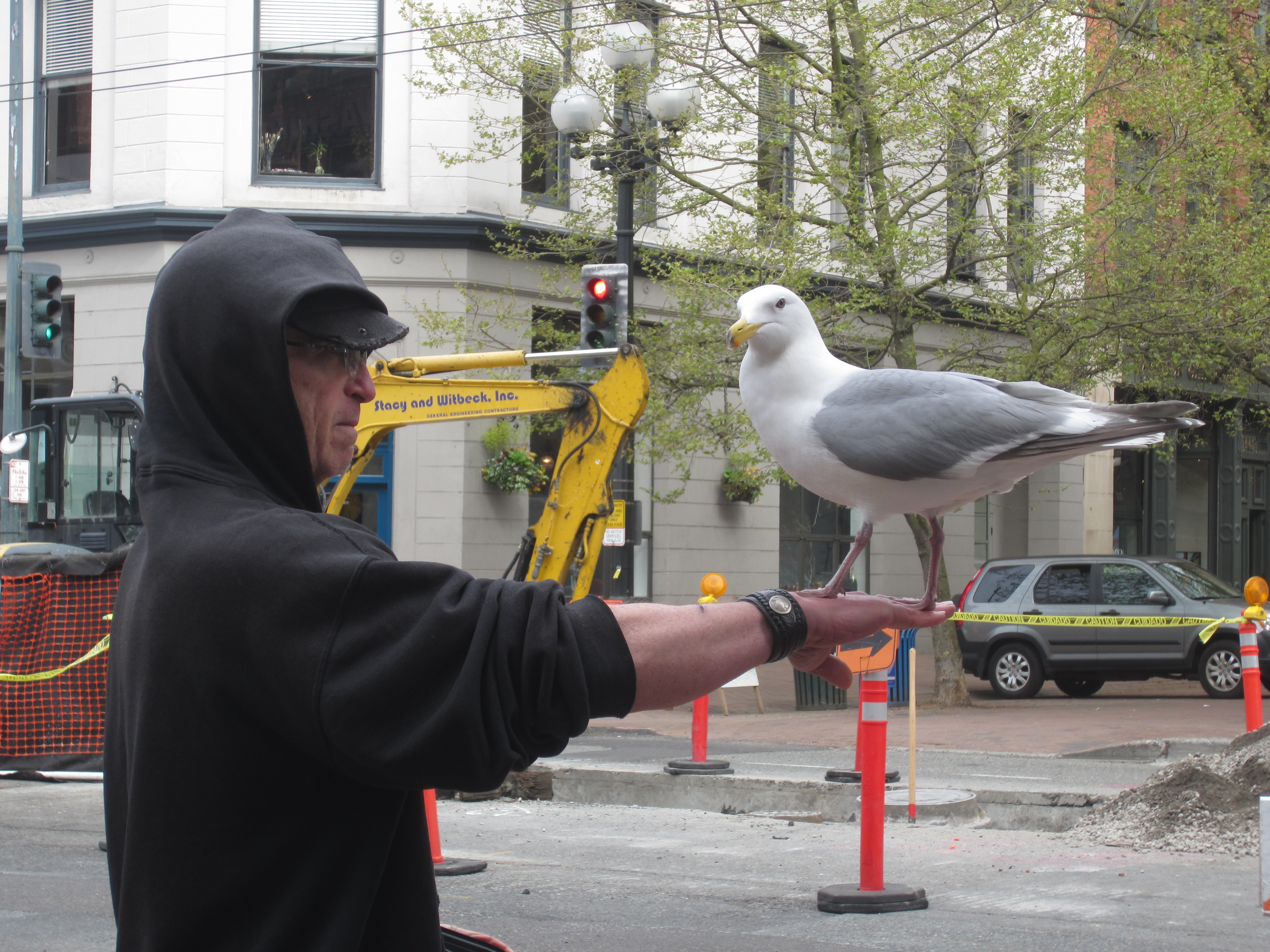
Although Dan did not wholly welcome gulls, there was one he had a special relationship with. After months of feeding it grew comfortable enough to feed from his hand and shortly there after what was once “hand feeding” became “on the hand feeding”. Now it waits for him to finish up with the crows before they have their daily exchange.
After days of less than consistent feeding by birds near Century Link Field, I was scratching my head at why I was having such a hard time attracting birds to my food pile. Lucky for me, a curious dog walker asked what I was up to and after explaining my project, he pointed me in the direction of another crow feeder just down the block. After my trial was over I packed up my things and hoped that I might catch this other feeder before he left. Armed with a bag of dog food (and no dog) Dan was easy to spot at the Starbucks the passerby told me he would be at. Sitting down to talk with him it became abundantly clear why I was having such a hard time getting birds to feed from me: Here, just a few blocks away, was someone who had been feeding the birds for over a year and provided an exponentially superior food over my “crumby” bread. Although his out competing me for crows had been problematic over the past few days, discovering Dan presented an invaluable opportunity to take advantage of birds that someone else had already conditioned to a feeding regime. With Dan’s blessing I incorporated his routine into my study, letting him feed the birds while I took data and eventually presented the birds with a stimuli.
Although the use of “his” birds was a great asset to my project perhaps more so was his depth of knowledge after having fed the birds for so long. His feeding suggestions, his knowledge of the crow’s territories and routines all reminded me of the great advantage of being a citizen scientist. Without deadlines, or the need for publishable and repeatable methods, Dan was free to just try new things out and see what worked. Most impressively, he had developed an ingenious technique for selecting out gulls and pigeons-a magnetized feeding dish that attached to street signs to thwart non-perchers, and a squirt gun for the pigeons. He had an intimate level of knowledge of his local birds, something that I will not have time to achieve during my project.
Although the city dweller may compelled to ignore their urban wildlife in favor of more “wild” animals, Dan was an excellent reminder that one does not have to travel or have the blessing of an institution to conduct their own animal behavior experiments. With a little bit of time and persistence anyone can become a great urban naturalist.
Filed under Uncategorized
Looking for volunteers!
Now that my trials are in full swing, I’m on the lookout for volunteers. Trials generally last 30min, and there’s no minimum commitment to help. Even one time could be of great use to me, especially weekday mornings and weekends. Leave a comment if you’re interested in helping and learning more!
Filed under Uncategorized
Spring nest searching
Spring is here which means the crows are busy building nests and I need to get busy starting my research! Although the details of my project are evolving the central question remains: Do crows use dead conspecifics (animals of the same species) as a cue of danger and can they infer novel dangers based on their proximity to dead crows? This research speaks to the broader inquiry into the purpose of crow funerals. Although there’s mounting evidence already in favor of the first part of my question, the second remains untested. By establishing predictable feeding sites and then introducing various dangerous stimuli, I hope to more clearly identify what information they acquire through these interactions. Before I can do that, however, I need to establish the various places around town where I will be setting up my feeding sites. So it’s been a whirlwind week searching for nests and establishing territories!
 Stick pulling behavior
I’ve learned a lot about their nesting behavior in this short time-and come up with a lot of new questions. Although they’re active throughout the day the busiest time is early morning and late afternoon/evening. The key behaviors to look for are stick breaking or spotting them flying with nesting material in their bills. Then it’s just a matter of hoping they’ll fly to their nest. Often, the most frustrating thing is eagerly waiting for a bird to take off with its stick , only to watch it casually drop the nesting material and start doing something else. Maybe they evaluate some aspect of the stick after they break it off and if it doesn’t cut it they toss it. Or maybe they’re just clumsy. Either way it will test your patience! They can also be very wary of onlookers. Although some birds are quite bold in their trips to and from the nest other birds, especially our banded birds, will start building “false nests” if they find youwatching. Although trying out a few nest trees before choosing the one is par for the course, the behavior is exacerbated if they feel observed.
I’ve been lucky to have so many keen observers send emails in with sightings of banded birds in the are building nests-it’s been a big help in identifying good study sites. I welcome emails with observations and questions as these are often the building blocks for interesting research topics. Keep your eyes open and enjoy the nest searching!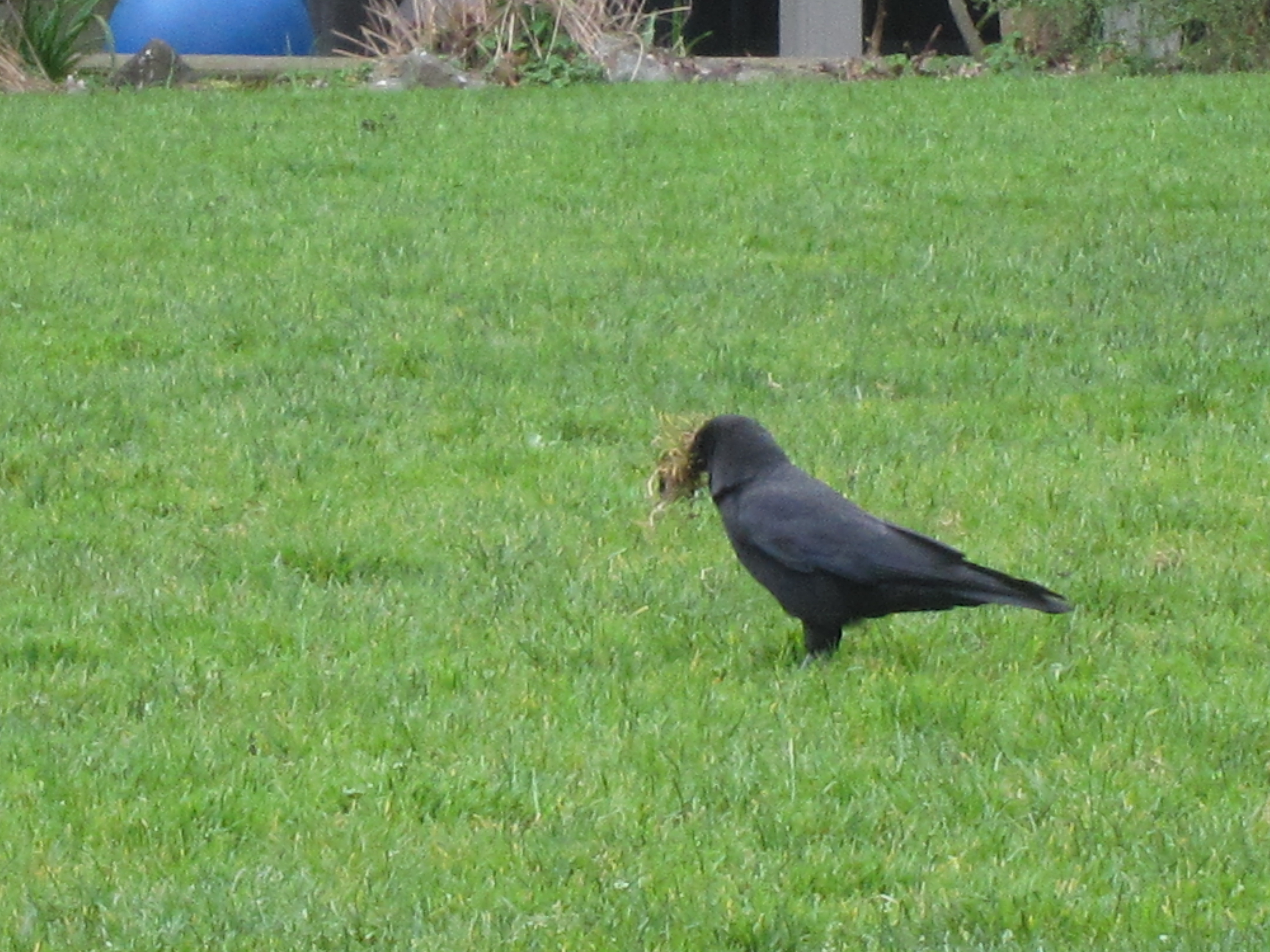
Filed under Uncategorized
Trapping and brain scanning 101
Earlier this week we were fortunate to play host to Science and National Geographic writer, Virginia Morrell. Her upcoming book, Animal Wise, walks readers through some of the most exciting science in animal behavior and emotions and is available for preorder on Amazon. It was a wonderful opportunity to meet a renowned science writer but, even better, an excuse to go out trapping and get my first scanning experience with the crows.
Our first trapping effort took place the day after new years and, all in all, was a disaster. The birds took longer than expected to find our food bonanza and once they did, our net launcher failed to deploy. Thinking it was a problem of dead batteries, we headed in and ate some lunch while we waited for them to charge. Hours later, after more deployment failures we discovered it was a faulty trigger and wrapped up the day. We would have to head back to campus and get the other trigger box, something that would take too much time to do try any more trapping that day. Once back on campus we discovered, of course, that the second trigger box didn’t have the right plug and would require an adapter. Although a disappointment to finish the day empty handed, it was a good reminder how many details are present (and can go wrong) at every step of the research process.
Day two promised more success, and indeed we managed to net a bird. A wonky net deployment, however, missed a great group feeding from our bait site, and we were disappointed to have not caught more. The scanning demo for Virginia only required a single bird, but it’s hard not to get greedy when you know more data could be collected. Having caught our bird early enough in the day we thought it was worth trying again and laid more bait out. After waiting around with no success we packed up and moved our trapping equipment down the road, hoping to net some naive birds. After our dispersal there was an almost immediate return to our former bait site by the waiting crows. Our net launcher had been camouflaged, how did they know the danger was gone? Or did they? What cues might they have been paying attention to? I sense the questions of a Master project coming together…Our second site didn’t prove much more successful and after a long morning we headed in with our single bird.
For the next 5 days I was charged with feeding and caring for “Blue” (named after the color band we applied). We were lucky to have caught such a robust adult, and to our relief he was not the least bit timid about eating his food or generally making a big mess. With the wild crows there to pick up the scrapes and keep him company, Blue tamed up quick and it was a pleasure to watch move about his aviary.
 6 days after trapping him, it was time to take Blue in for scanning. The whole procedure went incredibly smoothly, and Blue perked up quickly after taking him off anesthesia. After 24 hours of recovery time, it was time to let Blue go. It was a great experience, and a pleasure to share that, and the rest of our day with Virginia. I can’t wait for her book to come out!
Filed under Uncategorized
 corvidresearch.blog