Author Archives: corvidresearch

The birds and the bees

~This post describes sex in explicit terms ~

It’s springtime in Seattle which means the air is marked with the scent of warm, wet earth, the cherry trees are in full bloom, and our conversations of the goings on in the natural world are couched in the phrase “the birds and the bees”.  While its origin story is not completely clear, it’s very likely that this euphemism has been around for hundreds of years, dating back as early as 1644 in the Evelyn Diaries.  Despite the phrases’ ubiquity for discussing human sexuality, ironically very few people know much about the sex lives of the phrase’s subjects.  This is attributable largely to the fact that how these animals procreate is quite different from the mammalian systems we are familiar with.  So in the spirit of springtime let’s talk about the birds and the bees, the real story of the birds and the bees.

Birds
The most consequential departure by birds from mammalian systems is that most birds lack any kind of external sex organ. In contrast, most other kinds of animals have sex organs that are either maintained outside the body permanently, or can emerge temporarily as needed. Among birds, there are exceptions to this but fair warning you’ll probably never look at a duck in the same lighthearted way again if you pursue this line of knowledge. Which is to say of course that you absolutely should.

As far as crows and other songbirds are concerned though, sex must be conducted without penetration by a sex organ. So instead, these birds copulate by way of the “cloacal kiss”.  The cloaca is a bird’s single external vent and it’s used for both waste elimination and reproductive activities. During the breeding season, both the male and female’s vents swell.  To copulate, the male mounts the female and pushes her tail aside with his.  Once they make cloacal contact, the sperm that’s been stored in his cloaca is transferred.  It’s an awkward looking balancing act that lasts only a few seconds.  After the initial copulatory event the pair may mate again several times within minutes or over the course of weeks.

Whereas people need to consider timing, birds can successfully mate even in the absence of ovulation.  That’s because females have specialized sperm storage tubes inside their oviducts.  A female’s vagina is very picky, however, and only a very small number of the male’s sperm will reach this holding chamber.  Depending on the species, once there a female can store the living sperm for weeks or months. The exact mechanism of how the sperm are subsequently released is not entirely known, but possibilities include that it’s the mechanical pressure of the passing ovum (unfertilized eggs) that releases the sperm, or that it’s directed by hormonal changes during ovulation.1

One additional consequence of sperm storage is that it allows for different eggs within the same clutch to be sired by unique males.  In crows for example, about 80% of a nest has been sired by the female’s permanent partner.  It is unclear how many of these extra pair copulations are either solicited by or forced on the female.

Bees
While mid-air copulations have never been confirmed in birds, honey bees do in fact mate on the wing during what’s called the mating flight.  A newly minted, week old queen will take to their air followed by thousands of male drones.  She will only mate with about 10-20 of these individuals though.  To mate, the male inserts his endophallus (bee penis) into the queen’s sting chamber.  Once he has deposited his sperm, the male detaches.  Unfortunately for the male, however, he doesn’t do so with all the parts he arrived with.  His endophallus will rip off and remain inside the female, most often killing him.  As if that wasn’t brutal enough, the next male is required to remove the previous suitor’s leftovers before being granted the ability to seal his own fate.

By the end of the mating flight, the queen will be carrying hundreds of millions of sperm, most of which will be used immediately to begin fertilizing her eggs.  Like birds, the queen has a specialized storage chamber called a spermathecal where she keeps the unused sperm.  The stored sperm from her mating flight will last up to 4 years, after which the queen’s reign will come to an end, and the cycle begins anew.

Literature cited

  1. SASANAMI, T., MATSUZAKI, M., MIZUSHIMA, S., & HIYAMA, G. (2013). Sperm Storage in the Female Reproductive Tract in Birds. The Journal of Reproduction and Development, 59(4), 334–338. http://doi.org/10.1262/jrd.2013-038

5 Comments

Filed under Breeding, Uncategorized

ƨ’ileɒꓘ story

It still leaks through my writing sometimes.  Missing or misplaced letters, even whole words conspicuously absent as if a miniature black hole opened up mid sentence. My grammar and punctuation leave something to be desired too, and all these problems are exasperated when I’m stressed or rushed.  Childhood ghosts that love to pay visits at the most inopportune of times, haunting me with their reminders that my grasp of written language was a war hard fought, and not every battle was won.

As a kid, a mixture of ADHD and dyslexia made learning to read and write feel impossible.  While my peers were in the worlds offered by their chapter books, I was getting lost in the world provided by my own imagination; a much friendlier place at the time than the outside one where my literacy progress seemed to be causing great distress among my guardians and educators.  Things came to a head near the end of second grade, when an art activity to decorate flag with our name went a little ~backwards~.  A meeting was set to discuss that I would not be permitted to move forward the next year with my peers.  The repercussions of that fact pierced even the densest layers of my imaginary world.  Instead of watching my friends sail away from me while I stayed in place, I chose to switch to a public school that had programs for kids like me.

IMG_0563

The flag has been a staple of my parent’s home ever since 2nd grade, always stationed across from the bathroom mirror.

Over the next two years I saw psychologists and therapists, attended special literacy classes, got Hooked on Phonics, and made the dreaded daily trips to the nurse’s office for The Pills.  I hated the pills.  I can’t even remember why at this point.  It could have been because of how they made me feel, or with what other kids chose to do with the information that I was on them, or some combination.  Either way, it became my mission to get off them.

Returning to my old school had always been the goal, and by the end of 4th grade they agreed I had made enough progress to rejoin my peers the next year.   I advocated that coming back wasn’t enough, I no longer wanted to be medicated.  I would do whatever I needed to make that happen, and my 5th grade teacher took the reins in planning a strategy to help me.  I never returned to the meds, even over the next three years as I continued to struggle and intermittently fail classes.  Then, in 8th grade, my family moved out of state and I switched back from a private school to a public one.  My new 8th grade coursework was almost identical to the 7th grade coursework at my former school.  Suddenly, rather than trailing my peers, I was slightly ahead.  Although slight, the margin was just enough to afford me the mental bandwidth of learning time management and self imposed structure.  By the end of 8th grade I, for the first time, was excelling at school. And apart from the occasional bump, I continued to do well enough to eventually earn a PhD in avian ecology from the University of Washington.

I would never go on to be a top 10th percentile kind of person, and when it came to applying for undergrad and graduate programs I had more than one institution look no further than my numbers and respond with a hard, “pass”.  In place of the skills that might make me an excellent test taker, however, some things much more valuable to me bloomed.  A sense of creativity born out of those years deep in imaginary worlds.  A willingness to ask for extra help and the ability to say the words “I don’t understand.” Finally, a sense of resiliency.  I can fail or struggle many times and either overcome it, or make the choice to exert my energies in other ways instead.

These benefits and coping tools didn’t come right away though. These were not things I, as an 8, 10, 12, even 15 years old, could have just set my mind on and materialized. I process things differently than most people, and getting a handle on how to make that work within our educational system required tireless effort on behalf of myself, my family, and my educators, in addition to the simply the passage of time.  Time to develop self-specific skills and coping mechanisms.  Time to grow into my brain and realize that my value as a person, as a scientist, are not contingent on my successes or failures but how I respond to them. Time to embrace that it’s not the mid sentence black holes that define my writing, but the way the message resonates with the reader.

***

I wrote this piece in response to the handful of parents and kids over the years who have identified with my story.  I wanted to offer a more permanent legacy that could be read and shared by those who wanted it. However, I do not intend for this to act as a roadmap for other people because, A) I recognize that not all families have access to the immense resources that my family did, and B) the culture and pressures of primary school has changed tremendously over the past couple decades, and C) the hard truth is that there is no roadmap or magic wand because every child is unique. For example now in my adult life I know plenty of people that benefit tremendously from medication. I know others that decided traditional academia was not a place they could thrive, and now they put their talents and enthusiasm elsewhere. What unites us is not how we learn to cope. It’s recognizing how valuable our stories and our minds are, despite existing in worlds that weren’t made for us.

♥♥♥

19 Comments

Filed under Being a scientist, Just for fun

NCI corvid class open for registration

Hi Folks!  A few posts ago I mentioned the North Cascade Institute’s corvid class taught every June by John Marzluff and myself.  Good news; registration is officially open!

For those of you that missed my previous post, the corvid class is an overnight course hosted in the beautiful North Cascades alongside those iconic glacial blue lakes. During the class we will venture into snowy mountain passes to search for grey jays and nutcrackers and then head down to the Methow valley in search of magpies.  It’s not unusual for us to see nearly every species of corvid found in Washington state by the end of the trip.  To finish each day you’ll be treated to short corvid lectures and the wonderful meals provide by the NCI cooks.  It’s a wonderful class, so if you have the means I encourage you to register.  There’s limited spots available, however, so do it quickly!

13 Comments

Filed under Uncategorized

It’s a wonderful raven’s life

Every year, Jimmy graces our screens as countless people watch him help tell the story of the Christmas classic, It’s a Wonderful Life.  I’m talking of course about Jimmy the Raven, though I suppose one could make the same case for Jimmy Stewart.  Between the two, however, even Stewart recognized that it was the raven who was the superior colleague, and acquiesced to being referred to as “JS” to stop Jimmy from flying on set every time the director said Stewert’s name.1

“The raven is the smartest actor on set.  They don’t have to make as many retakes for him as for the rest of us.” – Jimmy Stewart, while filming You Can’t Take it With You in 19382

Among corvid lover’s, Jimmy’s role in It’s a Wonderful Life is surely a memorable delight, but few probably know the full extent of his career and accomplishments.

Jimmy_the_raven_in_It's_a_Wonderful_Life.png

Jimmy in a screenshot of It’s a Wonderful Life.

Jimmy’s first role was in Frank Capra’s 1938 movie, You Can’t Take It With You, after which Capra cast Jimmy in every one of his subsequent films.  As a result, Jimmy is sometimes mistaken as Capra’s pet, though he really belonged to animal trainer Curley Twiford.  In fact it was Jimmy riding on Twiford’s bulldog, Squeezit, along with two parakeets that initially caught a director’s attention and launched Twiford’s career as one of Hollywood’s earliest animal trainers.3

To make him more marketable, Twiford trained Jimmy to do a wide variety of things including opening mail, operating a typewriter, lighting a cigarette, flipping magazine pages, and dealing a hand of poker.  In the course of Twiford’s career he trained hundred of animals, but it was Jimmy and his subsequent corvids that he marveled at the most.  In a remark that will probably surprise no one, Twiford once said that of all the animals he trained, cats were the most challenging and corvids were the easiest, remembering their stunts for ten years.3

To achieve such tricks, Twiford taught Jimmy a sizable vocabulary of 53 words.  Since so much of Jimmy’s act (and therefore Twiford’s income) depended on Jimmy’s memory of these words, Twiford had Jimmy insured with a first of its kind “loss of memory” policy.4  Lloyds of London, which remains in operation today, wrote the policy–no doubt with ample side-eye from their competitors.  No word, though, on if they currently have any avian clients.

Twiford claimed that between 1938 and 1950, Jimmy had appeared in over 1,000 credited and uncredited films. IMBD, the contemporary scorekeeper of such things, lists 22 credited appearances, including The Enchanted Valley, God’s Country, and The Secret Garden.  He even had an extended roll in The Wizard of OZ, though the scene was later cut.

wizard

A deleted scene from The Wizard of Oz

At the height of his career, Jimmy might well have been a household name, even having newspaper articles dedicated to his biography and upcoming films.  One such article in 1948 boasted that Jimmy possessed a, “Red Cross gold medal for his 200 hours spent entertaining Wold War Two veterans,” though the article did not specify if it meant the American Red Cross, or some other entity.5  Still, neither Rin Tin Tin nor Lassie (both of whom Jimmy worked with6,7) can claim such an honor, even if its true nature is rather murky .

jimmy

The Evening News. Harrisburg, Pennsylvania. December 31, 1948. p. 12 (and, no, ravens don’t live until they’re 140 even in captivity.)

Jimmy’s last film was Three Ring Circus, filmed in 1954, nearly 20 years after his first movie.  Sadly, his subsequent whereabouts and death are unknown, though I found one article from 1957 that talks about a raven named Jimmy.7  For iconic animal actors however, their successors are often named after them and, indeed, an article published in 1958 mentions a raven by the name of Jimmy Jr., so it’s possible that other articles published during that time were really talking about different birds.8  Curley Twinford died himself only two years after Three Ring Circus in 1956.

Searching through newspaper databases, it’s incredible to see the amount of attention Jimmy received throughout his career. Like other Hollywood stars, his activities, on-set demands, and pay rate were all the subjects of much ado.  He charmed audiences and his costars alike, no doubt leaving impressions of intelligence that would not be widely accepted until much later.  It would be nearly another twenty years after his death before corvids such as Jimmy would be federally protected under the Migratory Bird Treaty Act.  I can’t say what role, if any, Jimmy played in shaping the public’s perception of these birds, but it’s hard to imagine that such a star left without leaving a mark.

References:

  1. The Cincinnati Enquirer June 7, 1946: pg 17.
  2. Driscoll, C. New York Day by Day. The Choshocton Tribune. Choshocton, Ohio.  June 29, 1983: pg 8.
  3. Kohrs, K. and Ross, S. Movie Animal Man. The Salt Lake Tribune.  March 26, 1956: pg 109.
  4. Clary, P. Hollywood Film Shop. The Daily Republican.  Monongahela, Pennsylvania. November 18, 1948: page 6.
  5. Jim, the Raven, in new flicker. The Evening News. Harrisburg, Pennsylvania. December 31, 1948: p. 12.
  6. Parsons, L.O. Those Film Fauna are Ticklish Detail.  Tampa Bay Times, St. Petersburg, Florida.  March 17, 1946: pg 79.
  7. Burton, R. Film Shop. Odessa American.  Odessa, Texas. April 30, 1957: pg 8.
  8. Performing Raven. The Tribune. Coshocton, Ohio.  August 23, 1958: pg 4.

13 Comments

Filed under Corvid trivia, Just for fun, Ravens

15,000 crows

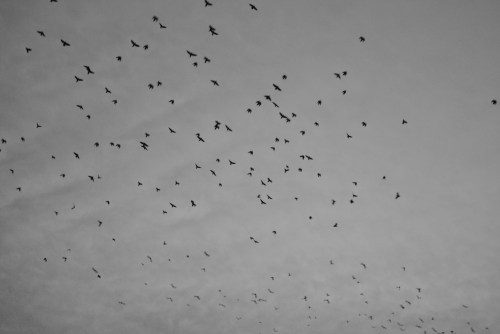
I had imagined it like a beckoning flood.  A small sputter of water followed with increasing force until a great river finally makes its way.  Rather than water though, the flood I was trying to envision was the ascent of 12-15,000 crows to their nightly roost in Bothell, Washington.

DSC_5117.jpg

Witnessing it in person, I found that my water analogy was not entirely accurate.  Rather than being a steady stream with a predictable course, their arrival ebbed and flowed, sometimes leaving the sky lonely with only its fading grey light while other times exploding into seemingly endless black clouds.  They arrived from all cardinal directions, colliding into a mass that could be deafening at close range.  Although the movement of the flock as a whole was more restrained, individually they showed off with spontaneous dives and barrel-rolls.  Soon the light receded completely, and all I could sense was the cacophony of so many crows settling into the willow trees they would call their beds for the evening.

Time lapse of Bothell crow roost I took with my GoPro in December of 2016.  Music by Andy McKeen.

Since that first experience, I have visited the Bothell roost many times, each as awe inspiring as the time before.  This behavior isn’t unique to my region, however.  Cities and rural areas all over the world call themselves home to the upwards of thousands, even hundreds of thousands of crows that may seek their refuge when darkness falls.  Even in the greater Seattle area, Bothell is only one of two roughly equally sized roosts.  This kind of mass sleepover, known as communal roosting, isn’t unique to crows, but it certainly captures our attention in ways most other birds don’t.  So what exactly are the characteristics and functions of roosts?

For all species of corvid, roosts are places where anywhere from a small handful to hundreds of thousands of individuals may converge to spend the night together.  Though roosting occurs year round, it peaks in winter, when territorial pairs are free from the eggs or nestlings that demand all-night attention.  They may occur in wildlands, but more typically occur in cities, where sequestration of heat is higher than in surrounding areas.  Here in Bothell, the roost converges in a wetland outside of the University of Washington’s Bothell campus, but in other areas they may take over the rafters of abandoned buildings or trees dotted within a business district.

Historically Danville, IL hosted North America’s largest roost, a whopping 325,000 birds but I do not know if they remain the contemporary record holder.  The midwest is particularly primed to host such large numbers because many thousands of crows head there during winter from their too cold territories in Canada and because appropriate roosting locations are few and far between.

DSC_5079

Prior, or just after roosting crows attend “staging” or “pre/post-roost” areas where they gather in the trees or on the ground by the hundreds or thousands.  Since these staging areas often occur on asphalt or turf where there’s little food or water, their function continues to elude scientists though social or anti-predator implications seem likely.1 A new UW research study is attempting to parse why crows are so vocal during the staging period and what they might be trying to communicate.  Perhaps their findings will shed some much needed light on these events. 

Corvids get different things out of roost itself depending on the species or possibly even the region they live.  For example, for ravens roosts act, in part, as mobile information centers.2  A raven knowledgeable of a food bonanza such as a moose carcass will display to other ravens at first light, and recruit others to the food.  Rather than being a sign of food altruism, this kind of recruitment is often the only way a lone raven can gain access to a large carcass.  Finding and gaining access to an animal carcass is challenging both because its arrival is unpredictable but also because it’s intensely guarded by the pair whose territory happened to claim the animal’s life.  Overpowering a pair takes a small army, so by recruiting other birds, rather than giving up food in the name of helping others, the lone raven actually gains access to a resource it would have otherwise been boxed out of.

American crows on the other hand do not have this need because urban waste and invertebrate filled yards are so easy to come by.  For crows, roosts act in large part as predator protection.  The odds of successfully fleeing an incoming owl are much better when there are thousands of you, rather than just you and your mate.  They may serve other purposes as well though including socialization, mate finding, and thermoregulation.  Lastly, while there isn’t strong evidence of information sharing among crows it would be arrogant to claim we know it doesn’t occur.

How roosts are organized remains largely mysterious.  For example some evidence shows that ravens that come from the same food bonanzas also sleep near each other in a roost,2 whereas other work done on crows suggested that group cohesion is low at roosts.3  Still, other research suggests that while group cohesion from the territory is low,  it’s high leaving the staging area.  So perhaps there is deep rhyme and reason for who they sleep with, it just hasn’t been captured by the questions we’ve so far asked.  One thing is for certain though; the one place you don’t want to be is low in the trees with others above you.  There would be no escaping the white shower raining down throughout the night.

Even the people who share the UW’s campus are sensitive to this reality.  In perfect synchrony with the incoming cloud of birds, the umbrellas bloom like moonflowers.  Here in Seattle, people seem willing to take such measures to coexist with the birds (though I’m sure there are many who only do so only by rule of law).  In other areas though the cultural attitude or resulting damage makes such cohabitation difficult, even deadly.  In the most extreme case, 328,000 crows were killed in 1940 when the city of Rockford, IL elected to dispose of a local roost with dynamite.4  Today, crows are protected under the migratory bird treaty act and cities are usually required to take more creative, non-lethal approaches including noise and light deterrents.

City living doesn’t always lend itself to witnessing the kind of mass animal movements we fawn over when they appear in Planet Earth footage, but that doesn’t mean they are devoid of such spectacles.  The mass micro-migration of thousands of crows is an awe inspiring event,  grand in both scale and the mysteries it contains.  Any corvid or birdwatcher would be remiss to ignore such an opportunity and I encourage everyone to get outside, head to your roost, and watch the magic unfold.

Literature cited

  1. Moore JE, and Switzer PV. (1998).  Preroost aggregations in the American crow, corvus brachyrhyncos.  Canadian Journal or Zoology.  76: 508-512.
  2. Wright J, Stone RE, and Brown N. (2003).  Communal roosts as structured information centers in the raven, Corvus corax. Animal Ecology 72: 1003-1014.  DOI: 10.1046/j.1365-2656.2003.00771.x
  3. Donald F. Caccamise, Lisa M. Reed, Jerzy Romanowski and Philip C. Stouffer
    (1997). Roosting Behavior and Group Territoriality in American Crows. The Auk 114: 628-637
  4. Marzluff, J.M. and Angel, T. 2005. In the company of crows and ravens.  Yale University Press

13 Comments

Filed under Birding, Crow behavior, crow conflicts, Crow curiosities, Crow life history, Crows and humans

Gifts for crow lovers

With the holiday season upon us, many people find themselves tasked with finding thoughtful gifts for their loved ones.  Although birds are seemingly so universally adored that finding bird themed gifts is no trouble, if it’s specific species you’re after, the challenge can be more immense.  Fortunately for crow lovers, there are lots of options to choose from if you know where to look.  Since you’re looking here, rest easy that half the battle is now over.  So sit back, enjoy, and feel free to add your own suggestions in the comments.

    1. Jewelry and apparel
    2. Art
    3. Books and education
    4. Kids
    5. Conservation


    Jewelry and apparel


    Sometimes you want to wear your passions on your sleeve, literally.  Fortunately online marketplaces like Etsy makes this more than possible.  A quick search of “crow t-shirt” reveals hundreds of options for any aesthetic.  Personally, I like to stick with shirts featuring original art.  Here are some of my top Etsy picks:

    Coyotees Maine

    Elusive Catfishery
    Maison Hydre
    Kathy Morton Stanion

    Outside of Etsy the apparel options can be harder to find but they are out there.  Charlie Harper for example, has an awesome screen printed tee that any crow lover will adore.

    For jewelry you can turn, once again, to Etsy but there are other options too.  June Hunter, who I also recommend elsewhere on this list, has a great collection of corvid themed jewelry.  The bonus here is that I can personally attest to the care and passion June has for these birds, so finding something in her shop will not only deem you an awesome gift-finder among your crow friends, but you’ll be supporting the work of someone who is themselves an ardent lover of crows.  Your local art galleries can also be great places to find amazing crow themed jewelry.  A favorite among my own collection was sourced from the Mary Lou Zeek gallery in Salem, Oregon.

    For something more personalized, consider getting a custom embroidered necklace or full size loop from the talented Sarah Buckley.  I had her make a custom necklace from one of my favorite jay photos to commemorate my PostDoc research.  I couldn’t be happier with the result!


        Art


I can’t stress enough here that your city’s art galleries and boutiques can be great places to find local, handmade, and even one of a kind items.  Many people (including artists) love crows, which is good news for your brick and mortar shopping prospects.  Please, spend your money locally as much as possible.  That said, here are some online shopping options that support talented artists:

From prints, to wall art, to totes and calendars, June Hunter has you covered.  Her Vancouver based studio celebrates the beauty of urban wildlife, with a special emphasis on crows.

If ever I find myself with a great deal of disposable money, purchasing one of Jason Tennant’s astounding wood carvings will be among my top priorities.  Seriously, they’re unbelievable.  And wouldn’t luck have it, ravens are a fairly regular subject of his work.

If it’s illustrations and painting you’re after, Etsy is once again a great resource. From acrylic to watercolor, there’s something for everyone.  Heck, even if you want something more out of the box like stained glass, you’re bound to find something.

Don’t limit your search to etsy, however as there are lots of great artists that sell via their own websites.  Julia Eva Bacon produces stunning oil paintings and has several pieces dedicated to corvids.  Although her originals would be worth every penny, you can also buy prints.  A luck would have it one of my favorite pieces is actually on sale right now!

  1. CorvusCorax_borderPerhaps the person you are shopping for already has walls covered in corvid paraphernalia and you need to get a little more creative with housewares.  Laura Zindel will help you outfit their shelves and table tops with gorgeous ceramics.  I own a set of plates and can attest to their beauty and durability.


    Books and Education

    There are so many excellent books on the topic of corvids that covering them really requires its own post. Fortunately, that post already exists, so I’ll simply direct you to it here.

  2. Books aren’t the only way, however, to give the gift of knowledge. Back in 2010, PBS first aired their NATURE documentary, A Murder of Crowswhich showcases a number of great studies and anecdotes, including the facial recognition work conducted by John Marzluff. Although you can stream the video for free, $18 is a small price to pay for being able to watch it whenever you please, and showing PBS some love.
    NCI_Logo
    For the ultimate crow education however, you should consider registering your loved one for the North Cascades Institute’s corvid class that’s offered over the summer.  In previous years the class has been co-taught by myself and John Marzluff, but for the 2019 edition I will be the sole instructor.  As usual, it’s a two day class complete with lovely and TAG approved accommodations, great food, beautiful scenery, and more information about corvids than you can possibly retain.  We often see nearly every species of corvid found in Washington, including ravens, crows, magpies, Clark’s nutcrackers, Steller’s jays and grey jays.  Registration for this year won’t open until January or February, but who doesn’t like an IOU for a gift?  It is worth noting the class fills up quickly once registration is open so make sure to stay on the ball.

  3. Kids


    I firmly believe that the indoctrination of crow love into kids should begin early; immediately if possible.  Fortunately, Etsy has your back with onesies, night lights, and probably whatever else your imagination can cook up.  For stuffies, local children’s stores or nature stores often carry raven or crow themed plush toys including this awesome raven puppet.

    There’s no shortage of corvid books aimed at kids either.
    10 roudy ravens by Susan Ewing is a counting book great for early readers.
    Lila and the crow by Gabrielle Grimard tells the story of a little girl who learns the beauty of being different from her neighborhood crow.
    Clever crow by Cynthia De felice uses rhyme to tell the story of a young girl trying to outwit a mischievous crow that is stealing trinkets from her mother.  Obviously the biology isn’t a highlight here, but the reviews are otherwise great.
    If accurate biology is what you’re after, Crow smarts by Pamela Turner promises to introduce children (and adults!) to the astounding minds of crows.
    For a children’s book that is more for adults than kids, consider Aldous Huxley’s The Crows of Pealblossom.  Considering that crows and snakes are both often on the receiving end of misguided public vitriol, I’m not a fan that the crows’ triumph comes at the  expense of the snake’s grisly end.  While the snake’s fate may not be appropriate for sensitive children, any adults that share a love of crows and Huxley’s other works will surely be delighted.


    Conservation

    alala-blk-logo_crop

    Perhaps your family tradition is that gifts should give back, or you recognize that your recipient would be happier knowing money was spent towards helping crows.  The Alalā, or Hawaiian crow, is one of the most endangered animals on the planet. Since 2002, they have been considered extinct in the wild.  Thanks to captive breeding efforts by the Alalā project, which is a partnership between San Diego Zoo Global and the Hawaiʻi Division of Forestry and Wildlife, and the US Fish and Wildlife Service, eleven individuals were just released into the forests of the Big Island.  These kinds of captive breeding and reintroduction programs are the only hope for these birds, but they are expensive.  By donating not only can you directly help their cause, but you can demonstrate public interest in keeping this species alive.  Currently, there is no way to donate money online but you can do so the old fashion way.  Make checks payable to San Diego Zoo Global and put in the memo line that the money is to be directed to the the Hawaiian crow project.  I called San Diego Zoo Global to confirm that money can be allocated to the Alalā project specifically.  Mail checks to: P.O. Box 120271 San Diego, CA 92112.

    With these suggestions in mind, I wish you the best in your search for the perfect gift for the crow lover in your life. Happy hunting and please feel free to mention your own gift suggestions in the comments section.


8 Comments

Filed under Crows and humans, Just for fun

“Mirror, mirror on the wall

am I the smartest of them all?”

…Is not a question crows are asking, despite what you may have heard.  Because they, like basically all the super smart birds, are really, really bad at the mirror test.

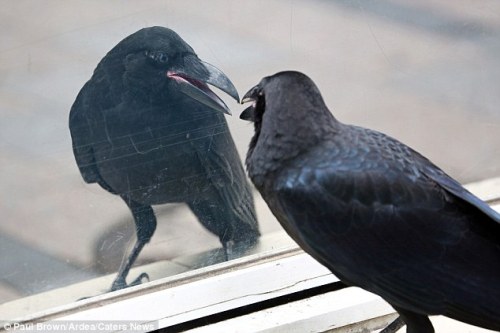
Jungle crow mirror

A juvenile jungle crow catches its reflection in a window. Photo: Paul Brown

This might contradict what you’ve heard elsewhere.  But the reality is that corvid after corvid fails the mirror test.  Except two European magpies.1  That’s right,  every sound bite you’ve ever heard that corvids possess self awareness (as evidenced by their excellence at the mirror test) is based on the performance of two birds. But more on that later.

In humans, self recognition in mirrors emerges reliably when we are about two years old and it marks the beginning of a developmental process that culminates in the rich consciousness that makes us human, at least abstractly.  Given a mirror’s significance to our own understanding of the self, it’s no surprise we’re so curious to see what non-humans animals do, and more curious still to see if it can show us whether they share our possession of consciousness.  In fact, putting animals in front of mirrors and looking for signs of recognition is something we’ve been doing, at least officially, since the 1970’s.   Since those initial studies on chimps, a debate has raged over the outcomes and overall efficacy of such tests.

A mirror test is generally composed of two parts.  The first is spontaneous self directed behaviors.  In other words, when an animal encounters a mirror for the first time, does it react like it’s looking at itself with behaviors like self exploration or does it freak out at this stranger suddenly standing in front of it?  What about after it has 100 hours of experience with a mirror or a 1,000?  The second test is known as the ‘mark test.’ A mark like a red or blue dot is applied to the animal without its knowledge and we watch and see if once it gets in front of the mirror it tries to remove or at least touch the mark.

With respect to both these tests, from African grey parrots to New Caledonian crows, we see consistent failure, or at best inconsistent maybe-kinda success.2,3 For the record, while there’s no published tests that have been done on American crows, I can tell you that I’ve watched reflective windows and car mirrors ruin many a breeding crow’s afternoon plans. In Mind of the Raven, Bernd Heinrich reports a mostly neophobic response among his captive birds, punctuated in some individuals with moderate curiosity.

So what of Gretie and Goldie, those two magpies that did show higher mark recognition when given a mirror than control birds?  There’s two problems. The first that they used stickers to mark the birds and it’s difficult to know whether it was really the mirror eliciting the behavior or if maybe they could just feel the stickers. This idea was championed after a study done on jackdaws found that birds without mirrors detected the stickers just as often as those with mirrors.4  If they had detected them equally zero times then it might just indicate that jackdaws are bad at the test, but the fact that they did detect them in both cases is what raises the alarm because it shows the birds were somehow sensing the stickers in the absence of the mirror.

The second problem is simply:  what can two birds, especially out of a sample size of five, really tell us about whether corvids understand their reflection in a mirror anyway?  Not much.

Maybe you’re thinking “well, perhaps they just don’t understand how mirrors work at all, so of course they don’t recognize themselves.”  This isn’t a bad idea but it doesn’t appear to be true.  In that study on New Caledonian crows for example, while the birds didn’t show any self recognition behaviors, they could use the mirror to find hidden food. This demonstrates that they can exploit the properties of a mirror, and understand that mirrors reflect objects in the real world.  We see the same in grey parrots.

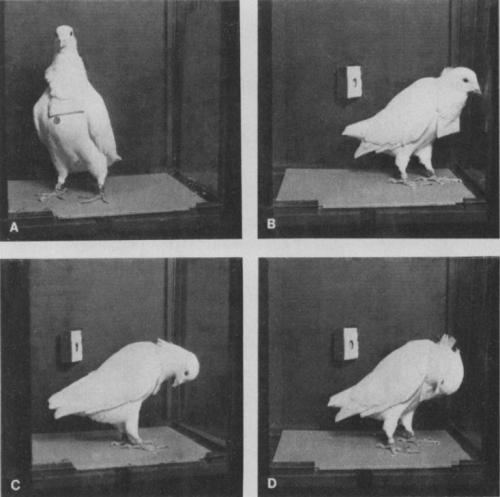
So now that I’ve gone and dampened things, let’s just go ahead and soak the rest of that blanket.  Because even if corvids or other birds passed the mark test with flying colors, it wouldn’t necessarily mean they are self aware   which is kind of the point of the whole test.  Enter pigeons.  Since the 1980’s we’ve known that pigeons excel at the mark test with a little bit of training, just like they can excel at shape discrimination or any number of other seemingly complex tasks.5  But the ability to learn isn’t in and of itself a reflection of capacity for complex thinking.  After all, it only takes 8 days to train a spider to solve a maze.6

pigeons

Pigeons in the original Epstein et al. 1981 paper

So does failing the mirror test mean corvids don’t possess theory of mind or the capacity for self awareness?  No.  Based on other studies, particularly those in ravens, it may be more likely that a mirror test, at least in it’s most common form, is just not a biologically appropriate way to ask this question.7,8  So don’t write off the capacity of a corvid to know thyself just yet.  But maybe offer a polite “ah, hem” the next time someone marvels at the narcissism of magpies.

Literature cited

  1. Prior, H., Schwartz, A. and Güntürkün, O. (2008). Mirror-induced behavior in the magpie (Pica pica): Evidence of self-recognition.  PLOS Biology 6: https://doi.org/10.1371/journal.pbio.0060202
  2. Pepperberg, I. M., Garcia, S. E., Jackson, E. C., & Marconi, S. (1995). Mirror use by African Grey parrots (Psittacus erithacus). Journal of Comparative Psychology, 109: 182
  3. Medina, F.S., Taylor, A.H., Hunt, G.R., and Grey, R.D. (2011).  New Caledonian crows ‘ responses to mirrors.  Animal Behaviour 82: 981-993
  4. Soler, M., Perez-Contreras, T., and Peralta-Sanchez, J. (2014).  Mirror-mark test performance on jackdaws reveals potential methodological problems in the use of stickers in avian-mark test studies.  PLOS ONE 9: https://doi.org/10.1371/journal.pone.0086193
  5. Epstein, R., Lanza, R.P., and Skinner, B.F. (1981).  “Self-awareness” in the pigeon.  Science 212: 695-696
  6. Punzo, F. (2000). An experimental analysis of maze learning in the wolf spider, Trochosa parthenus (Areaneae: Lycosidae).  Florida Scientist 63: 155-159
  7. Clary, D. and Kelly M.D. (2016).  Graded mirror self recognition by Clark’s nutcrackers.  Scientific Reports 6: doi:10.1038/srep36459
  8. Bugnyar, T., Reber, S.A., and Buckner, C.  (2016) Ravens attribute visual access to unseen competitors.  Nature Communications 7.  doi:10.1038/ncomms10506

37 Comments

Filed under Uncategorized

I need your help or Corvid Research is toast

About three years into my graduate program the emails, letters and blog comments started. A trickle at first, maybe only one or two things every couple of months. Now, five years into my program, the questions, calls for help, requests for opinions, and desire to share stories of corvid joy, sadness or sheer mystery are relentless.

And I love it. It’s one of my favorite parts of my work. Few graduate students get to engage with the public in the way that I do or will ever experience the public appreciating the research they do or the expertise they’ve acquired through the often tremendous personal sacrifice of being a grad student. Hardly any will ever get an email saying “your research is so cool” or “keep up the good work” or “your work changed my heart and mine about something” or “thank you.” They won’t ever hear those words despite the fact their research may have far more reaching and positive effects on the health and wellness of their non-human and human communities than mine does. But I do get to hear those things because the nature of my research means it makes for a cool blog and gets written about in publications like National Geographic and The Week.  And I am truly grateful for that. But on behalf of all those students who aren’t so well known I want to use my platform to ask something of you now.  Because our existence as graduate students is under attack.

If you’ve been keeping up with current events you’ll know that our GOP leaders are working on a tax reform bill. What many people do not yet know, however, is that the current bill will do away with key features intended to help make higher education affordable. Including:

–Section 117(d), which exempts tuition waivers from being counted as taxable income

–Section 127, which exempts employer education assistance from being taxed

–The Lifetime Learning Tax Credit

–The Student Loan Interest Deduction

–Consolidation of the American Education Opportunity Credit to only be used for 4 + 1 years

I could write whole blog posts on every one of those points but for the sake of brevity let’s focus just on the first one, the tax exemption for tuition waivers.

Most grad students working in STEM fields (Science Technology Engineering and Math) fund their degree with teaching assistantships or research assistantships. In my case, I started with an RA because I had an NSF Fellowship and when that ended after three years, I transitioned to a quarter by quarter struggle to find a TA position. For my TA work, the university pays me at 50%, meaning I receive a salary based on 20 hours of work (despite the fact most TA’s work considerably more.) My annual stipend is $23,000, but it can vary anywhere from $15,000-35,000 depending on your source of funding and state. This money is intended to provide basic cost of living and for many students, especially those with dependents, it barely covers that. But we make due because there’s few other options, we love science, and we know that our work has a meaningful impact on our communities.

This stipend money, regardless of the source, is taxed. As it should be. But in addition to a small stipend these TA and RA positions include tuition waivers which are valued at anywhere from 12-50k a year. This waiver is basically the University paying itself for our tuition and under the current system it’s not considered income. The waiver is designed to offset the considerable costs of pursuing higher education in this country. And, because grad students aren’t just professionals in training, but are currently contributing to our universities (and communities at large) through our labor, research and publications, it seems reasonable that we shouldn’t be paying for work we do in their name.

Losing this tuition waiver would mean students like me would still be getting paid about $23,000 but taxed as if our salary was in the neighborhood of $60,000. In fact some grad students are poised to have the biggest tax hike of any demographic under this new plan. That’s not financially feasible for most people (including myself), especially those who have already accrued debt from their undergraduate education, or who come from low income families, or those supporting dependents. It would be a disaster for STEM. 

Let me be clear: I’m not trying to paint the plight of grad students as the most important casualty of this bill. There are lots of reason to oppose it and we can’t all be fighting the same battle when are are so many different ones underway. But if you are reading this because you know and appreciate my research, popular articles, #CrowOrNo, blog, or even if you just care about STEM…that it continues to exist and attracts people of all financial means, then I need you to call or write to your legislators. They need to know that their non-grad student, tax paying constituents want to keep people like me in school.  If you need any help navigating how to do this please use this resource: Action Alert! – Tax Reform.

I will be here to answer your crow questions from now until well after my run at grad school ends.  But this time I need you to return the favor.  Please contact your legislators.

4 Comments

Filed under Uncategorized

How crows responded to the eclipse, according to you

Back in August, I challenged my readers to submit their observations of how their local crows responded to the total (or partial depending on your location) eclipse that occurred on the 21st.  Six of you offered up your observations and suffice it to say they ran the gamut.  From completely typical behavior to massive gatherings deemed unusual, there was no pattern to the handful of observations that were reported.  Here’s my summary of what you observed:

Three people reported no changes in behavior, with one person even witnessing a crow flying overhead during the moment of totality.

Two people reported seeing more crows than usual and that they were more noisy.  Almost like a typical pre-roosting behavior but in the middle of the day.

One person reported that the birds were more quiet than usual, and remained quiet for 30min after the eclipse.

I myself failed to find any corvids during the totality but I did watch a sparrow (not identified to species) forage on the ground just before, and just after the totality.  I did not see where it was during the few moments of complete totality, though given its proximity to its position prior to totality I reasoned it must not have gone far and could have easily been foraging as before just without my detection.

Thanks for sharing your notes everyone!  Looking forward to the next round in seven years 🙂

2 Comments

Filed under Uncategorized

How will crows respond to the eclipse? 

Unless you’ve been living under a rock, you know that this coming Monday a total solar eclipse will cross the continental United States. Eclipses are significant moments in the lives of humans but scientists know less about how non-human animals respond to them. After all, opportunities to observe this phenomenon occur only a couple times a year, and its occurrence in the same geographical area is substantially more rare. The last total solar eclipse in the US was in 1979. Since then, not only has our technology to research this phenomenon evolved, but methods for the public to engage in eclipse related citizen science has exploaded. You can read about all the different opportunities here.


Of these opportunities, the one that excites me most is the California Academy of Science’s ‘Life Responds’. By using the iNaturalist app, CAS invites you to make and report observations of how a particular organism responds to the eclipse. The instruction are simple and you can read the full protocol here. I encourage all my readers to consider participating with any species you choose, BUT I thought it might be fun to host a mini crow-specific Life Responds challenge here on the blog. 

How will crows or other corvids respond to the eclipse?


To that end, I invite all of you to follow the Life Responds observation protocol, and in addition to sending your observations in via iNaturalist, email them to me or leave them in a comment here. I’ll then synthesize all your observations into a little mini report that we can all learn from and enjoy. Sound fun? I hope so! 

Remember, if you chose to participate, please follow the Life Responds protocol. While I’ll certainly accept general comments/observations, if everyone follows the same collection method our observations will be much easier to synthesize and interpret. 

Not able to be in the path of totality? No problem! Your observations are still invited and valuable. I’m particularly interested in whether or not Seattlites observe the crows abandon their daytime activities and head towards the roost as the light changes. I myself will be down in Oregon in the path of totality, so I’ll miss that observation. Hopefully I can locate a corvid from my observation spot in Oregon. If you have questions let me know, otherwise enjoy the eclipse and remember to protect your eyes 👀! 

12 Comments

Filed under Uncategorized