Author Archives: corvidresearch

Everything you want to know about crow nests

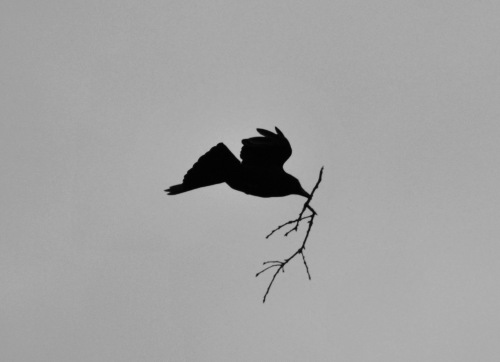
Spring marks one of my favorite times of year.  Cherry blossoms abound, the rain smell sweet and the birds get busy putting their carpentry skills to good use. Starting early March, the silhouettes of crows with bill loads of timber or wads of soft material dot the skies as they shuttle back and forth to their nest tree. Like a townhouse development, these construction projects are over in the blink of an eye and soon, their bill loads of twigs will be replaced by food for their mate and, eventually, their insatiable young. Spotting these nests is both a great way to observe and engage with your local crow family and avoid unpleasant conflicts with protective crow parents.  With a little knowledge and a bit of practice, tracking down your resident crow nest will become one of your favorite spring traditions in no time.
DSC_2832 (1)

Nest construction and site selection

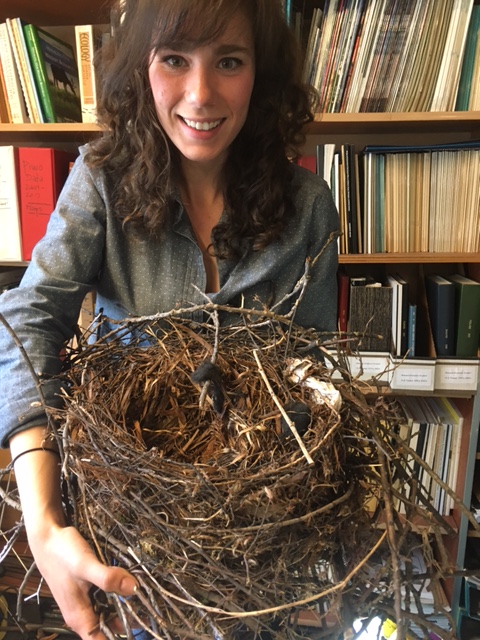
Nest construction begins in early March and will continue (as nests fail) through about June. It takes 1-2 weeks to finish a nest after which the female will lay a clutch of 2-6 eggs. Unlike similarly sized squirrel nests (aka: dreys) which are made of leaves, crow nests are made mostly of pencil-width twigs. A new nest is usually about 1.5 ft across and 8-10 in deep.  After the bulk of construction is complete, they’ll line the cup of the nest with soft materials like grass, tree bark, moss, flowers, paper or fur. Once we saw a crow ripping out the hair of an outdoor mannequin, no doubt to use as lining material.
DSC_3052

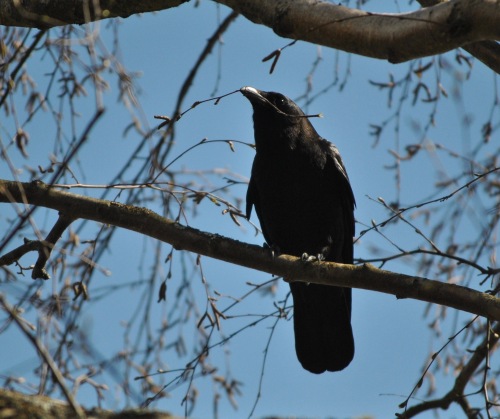
A crow gathers moss off the branches of a big leaf maple to use as lining material.  
DSC_2997

This bird toyed with this branch for a few minutes before rejecting it and letting it fall to the ground.  

DSC_2949

A sidewalk littered with twigs is good evidence that the nearby deciduous tree is a favorite among the local crows to pull branches from.  I’ve only once seen a crow try and retrieve a branch it dropped, so these are all rejects.  

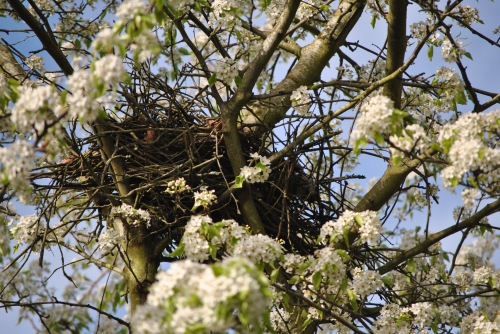
Crows will nest in an astounding array of places, from the eaves of skyscrapers to the crooks of well concealed tree limbs. They can tower in the sky or be almost within reach. Most commonly, I see them built close to the trunk in the top third of Doug fir trees, but this is, of course, specific to the PNW.  Both partners participate in nest construction. Helpers will aid to some degree but most of the work is left to the parents.
DSC_2930

Differences among corvids

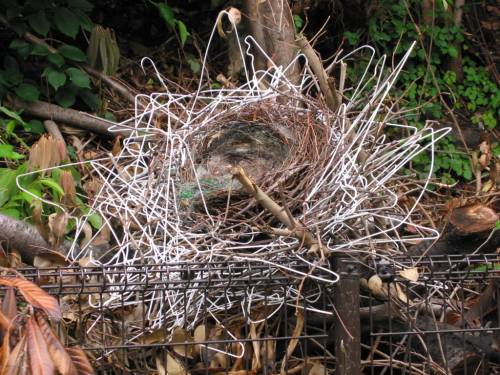
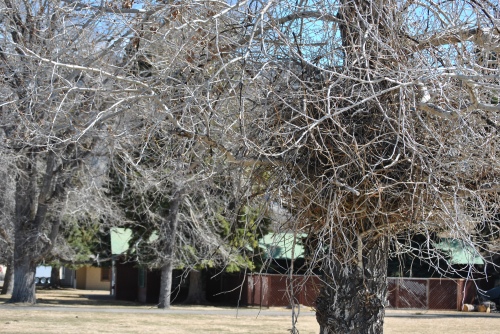
Crow, jay and raven nests are similar in shape and material but differ in overall size in accordance with the size of the bird. The main standout are magpies,  which build incredible domed-shaped nests the size of a large beach ball.  The nests require so much material, they can take as much as 40 days to build.  Japanese jungle crows are another species of note, as they have a (relatively) new and problematic habit of building nests out of wire hangers and causing massive blackouts.
Creativity_crows_nest_made_of_clothes_hangers

A Jungle crow nest in urban Japan. Photo: Götz
DSC_0331

The magpie’s nest is the big clump in the middle of the tree.

Reuse

The life of a typical nest is only about 9 weeks (1-2 weeks of building, 6 days of laying, 20 days of incubating and 4 weeks of nestlings) though they are hardy structures and can remain intact in a tree for years.  After the young fledge, the crows will not return to the nest.  Crows will only use a nest once, and generally only fledge one brood a year. They will, however, build on top of an old nest particularly in areas where nest trees are especially sparse like downtown Seattle. This also appears to be more common in the Midwest.

Avoiding conflicts

Most breeding related dive bombs occur as the result of a person being too close to a fledgling, but some crows get feisty around their nest too. Crows in areas where they are less persecuted (like cities) tend to be more aggressive than their rural counterparts. If you know where a nest is and can avoid it, do so and save everyone the aggravation. Otherwise carry an umbrella or paint eyes on the back of a hat. Crows rarely attack from the front so having eyes on the back of your head can be an effective deterrent!

***

Putting all this together to actually find nests, is one of the most rewarding moments an urban naturalist or crow enthusiast can have.  Be warned though: crows are wary of potential predators (including people) spying on them and they have a few tricks for throwing you off, so don’t be surprised if a nest location you were certain of turns out to have been a ruse!
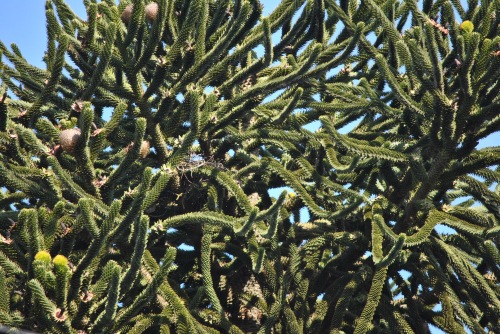
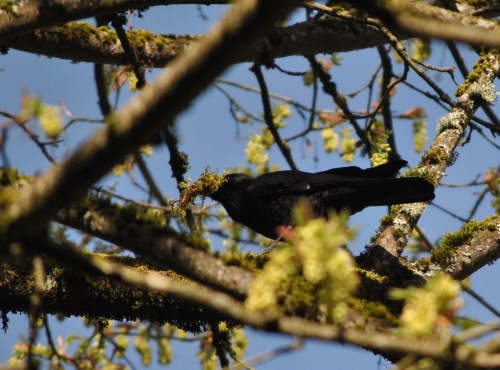
DSC_3055

Can you spot the nest? 

Have more questions? Let me know in the comments!
IMG_3761

287 Comments

Filed under Birding, Breeding, Crow behavior, Crow life history, Crows and humans

Why the crow smiles

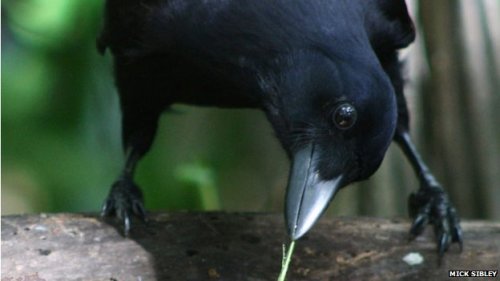
There’s hardly a corvid species that doesn’t strike me as beautiful but there’s only one that’s always struck me as particularly gleeful.  Looking at the New Caledonian crow it’s evident there’s something different about the shape and proportions of its bill. It’s a bit shorter and more blunt, and it lacks the obvious downward curve of a typical crow bill, with lower mandible actually curving slightly up. Put together, these features appear to give it the perpetual grin that trademarks this species.  I’ve joked that this must be because they’re always feeling very pleased with themselves for being so smart, and thanks to new research, I’ve come to learn my joke had it backwards.

By using tomography scans, Hiroshi Matsui and his team were able to compare the shape and structure of the NC crow’s bill with that of its close relatives. Their conclusion, which they report in the March issue of Scientific Reports, is that this shape makes the handling and manufacturing of tools easier. Looking at photos of the birds in action, it feels intuitive that the more exaggerated curve of a raven or American crow bill would have a hard time achieving the dexterity that NC crows need to use their stick and hook tools.

_62960355_newcaledoniancrow

Given this new research it’s time to amend my joke. It’s not that NC crows grin because they’re smart, they’re smart because they grin.

Literature cited

  1.  Matsui, H., Hunt, G., Oberhofer, K., Ogihara, N., McGowen, K., Mithraratne, K., Yamasaki, T., Grey, R., and Izawa, E. 2016.  Adaptive bill morphology for enhanced tool manipulation in New Caledonian crows.  Scientific Reports 6. doi:10.1038/srep22776

9 Comments

Filed under Crow behavior, crow intelligence, Crow life history, New Research

Australian magpies are not corvids

Ah the Australian magpie.  With its glossy tuxedo plumage, heavy bill, and charismatic reputation it’s no wonder it’s a favorite among corvid lovers.  Why then, do scientists keep insisting that it’s not, in fact, a corvid?  This insistence of ours can feel arbitrary, even perhaps insulting, to a bird that superficially looks and acts like the corvids we know.

magpie

A still frame from the infamously cute video of an Aussie magpie and a puppy play-wrestling together.  

To address this question, corvid expert and my colleague, Jennifer Campbell-Smith, recently penned a terrific piece to lay the confusion to rest.  I recommend everyone take the time to read it in full.

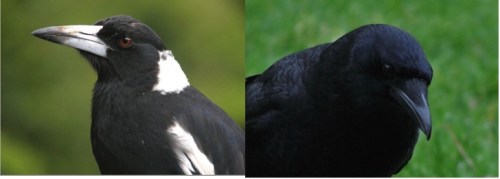
If you do not have time, the short version of the story is that physiologically, Australian magpies, like the other butcherbirds they are classified with, lack the nasal bristles indicative of corvids.  Genetically, DNA work done in the late 80’s also showed that, while they share a common ancestor, are are phylogentically  distinct from other corvids.  There has been some back and forth since then on the details, but there’s no scientific evidence that we should be lumping them in with corvids.

comparison

The nasal feathers are those thin, wire like feathers covering the base of the bill on the crow to the right, but conspicuously absent on the Aussie magpie to the left.  Australian magpie photo: Guy Poisson

Why this bums so many corvids lovers out is a curious mystery to me.  Personally, I find the convergent evolution with respect to both appearance and behavior much more interesting than if we simply made a taxonomic mistake.  As for whether corvid lovers should continue to find joy and fascination in observing these birds well, I’ll direct you to this video and let you be the judge.

10 Comments

Filed under Being a scientist, Birding, Crow curiosities, Crow life history, Taxonomy

I spy with my raven eye…

…someone trying to steal my lunch.  Turns out, humans are not the only ones wary of peeping Toms; new research shows raven can imagine being spied on by a competitor.

DSC_2198

***

The other day my friend and I were having a very merry time at the thrift store when, without cause or provocation, this women decides to up and ruin our trip.  Well really, she simply spotted the same gorgeous caste iron dutch oven that my friend wanted and reached it first, but the consequence was the same (it was a tragically beautiful dutch oven). This dynamic-my friend having her own intentions (to obtain and own that dutch oven for herself) and recognizing that this other women had her own intentions (to obtain and own that dutch oven for herself) is something so second nature to being human we rarely give it any thought.  But the ability to attribute mental states to those around us is an incredibly profound and complex cognitive task.  Understanding if this ability, called Theory of Mind, exists in other animals has been among our top interest as ethologists.

Like other corvids, ravens cache food and, as a consequence, run the risk of their caches being stolen by others.  It has long been known that if ravens can see that they are being watched, they behave differently when it comes to caching than if they are alone.  This is interesting, but doesn’t necessarily speak to whether they posses theory of mind because of the confounding effect of “gaze cues”.   Basically, the correlation between head cues and competitor behavior make skeptics doubtful about non-human animals having the ability to know what others might be seeing.  So raven master Thomas Bugnyar and his colleagues Reber & Bruckner recently published an elegant study to address just this issue.

By training captive ravens to look through a peephole, and then allowing them to cache food with the peephole opened or closed, the researchers were able to show that ravens behaved as if they were being watched when they could hear ravens and the hole was open, but not when they could hear ravens but the peephole was closed.  What this suggests is that ravens are capable of remembering their own experience of looking through a peephole to see into another room, and can imagine that another bird might be doing the same thing even if they cannot see this bird.

ncomms10506-f1

Experimental set up.  Bugnyar et al. 2016.  Nature Communications

Theory of mind and imagination (which are not mutually exclusive) are the cornerstones of what makes for a powerful cognitive toolkit and have long been thought to be uniquely human.  As we continue to build on the body of work showing non-human primates, corvids and some other animals posses some of the same skills we do, many will be challenged to redefine what it means to be human.  Personally, framing the question that way doesn’t interest me.  To me the more interesting question is not how are humans different from ravens, but how are we the same and why? What is it about being human and being raven that make possessing imagination important?  Fortunately there is still loads more research to be done, and when it comes to teasing out this question I can only imagine the possibilities.

Literature cited:

Bugnyar, T., Reber, S.A., and Buckner, C.  (2016) Ravens attribute visual access to unseen competitors.  Nature Communications 7.  doi:10.1038/ncomms10506


5 Comments

Filed under Crow behavior, crow intelligence, New Research, Raven behavior, Raven intelligence

Crow curiosities: What do crows eat?

Spoiler alert: They’re not, as so many people believe, true scavengers.  Meaning, they’re not mostly eating carrion.  I know what you’re thinking: MIND BLOWN.  Also you might be thinking PBS lied to you, and you’d technically be correct.  So why is this myth so pervasive that even PBS fell victim to its ubiquity?

DSC_2960

An American crow picks at the torn up belly of a rat in a Bellevue neighborhood.  After a few minutes, it had its fill and moved on to other feeding opportunities, leaving most of the rat untouched.  

Well, a huge part of the problem is that like so many words in science, their use in general discourse has parted from their scientific meaning.  Typically we use this word to describe say, grad students at the end of the party stuffing their pockets with the leftovers but, biologically speaking, scavengers are organisms who are specialized to consume, or obtain most of their food, from the decaying tissue of animals or herbaceous matter.  Now don’t get me wrong, the title of ‘scavenger’ can get a bit blurry as Bernd Heinrich argues in his book, Life Everlasting.  Ravens for instance, switch primarily to scavenging during lean winter months.  For most American crows, however, the identity of ‘scavenger’ simply will not do.

Which is really too bad, since the title of scavenger is bestowed with honor given how they make our living on planet earth possible.  I’m not being hyperbolic when I say thanking the undertakers of our ecosystem should be part of everyone’s pre-meal ritual, but perhaps that argument should be saved for another post.

As for crows, carrion makes up only a very small part of their diet.  In Seattle, roadkill accounts for <5% of crow food, and in wildland areas carrion accounts for even less1.  Crow beaks aren’t even strong enough to break through the skin of a grey squirrel, though they will usually give it a try.

So what are they eating?  Mostly human refuse (no surprise) and invertebrates.  In fact human garbage (meat, grain products and veggies) account for about 65% of their diet in urban areas, whereas in wildland areas it’s roughly split between garbage and inverts (35% and 35% respectively)1.

DSC_2705

Crows spend much of their time patrolling lawns looking for invertebrates


These data correct another common misconception about crows: they’re not mostly eating the eggs and nestlings of other birds.  In fact, crows only account for 1 of 20 observed nest predators in WA and have been found to have a nonsignificant, negative relationship between abundance and rate of predation in experiments using artificial ground nests, shrub nests, and canopy nests1.

So there you have it, American crows are neither true scavengers nor meaningful nest predators. They’re primarily omnivores with an emphasis on human refuse and invertebrates.  So the next time you see one patrolling your grassy lawn remember; they’re busy trying to bring home the bacon.  Er, bugs.  Well, probably bugs, but preferably bacon provided you were crazy enough to throw some out.

Literature cited

  1.  Marzluff, J.M., McGowen, K.J., Roarke, D. and Knight, R.L.  2001.  Causes and consequences of expanding American crow populations.  in Avian ecology and conservation in an urbanizing world (J.M. Marzluff, R. Bowmanm and R Donelly, eds).  Kluwer academic Press, norwell, Ma.

31 Comments

Filed under Crow behavior, Crow curiosities, crow diet, Crow life history

Crows with broken beaks

It hurts to look at.  The physical pain incurred at the time of the injury, the likely chronic pain on the path to recovery, the dubious chance of survival, it all makes me reach for my mouth in horror when I see this bird.  To me, the idea of living on in spite of such a grotesque injury seems impossible.   Yet here this bird is, surviving, reminding me of what life is capable of.

DSC_1625

So now that I had my moment of sadness and awe, let’s get to what everyone wonders when they see a bird like this: Will a crow’s beak grow back if it’s broken and if not, can it survive?

Cracks or complete fractures like this can result from a number of things, though the list could be longer since these accidents are so rarely observed firsthand.  Perhaps it was traumatic run in with a window, or perhaps the upper or lower bill got trapped against a fulcrum point and an opposing surface.

As far as the prognosis is concerned, I asked birds experts, wildlife rehabilitators and veterinarians and the answer was always an equivocal ‘maybe’.  Maybe it would heal back to something resembling normal and maybe it would remain stunted. Maybe it would survive and maybe it wouldn’t.  To fully understand the reasoning behind this ambiguity you need to understand how a bird’s beak is actually formed.

Like mammals, birds have two jaws bones that form the upper and lower mandibles.  These bones are surrounded by the nerves and blood vessels that support the beak’s functionality and growth. Protecting these layers is the outer lightweight layer of keratin called the rhamphotheca.  Like our fingernails, this layer is always growing and being replaced.

Depending on where the fracture occurs, the rhamphotheca can grow back enough to abolish the injury.  Unfortunately though, there’s not much room to work with before you hit bone, and the bone cannot be regrown.  In these cases the rhampotheca may heal over the exposed bone, but it may not grow back to full size since the template for its shape (the bone) has been stunted.  Even if it does grow back, it may not do so correctly, leading to twisty shapes.

crowskull21

A crow skull.  You can see that the jaws bones are almost the full length of a crow’s beak.  The black outer layer, the rhampotheca, adds only a little (think mm) extra length so there’s not much that can be removed from the tip of the bill without hitting bone.

So what’s the prognosis?  Well again, that depends.  Even if the bill does not grow back correctly, or at all, some crows can learn to compensate.  Fortunately, being a generalist helps their chances considerably.  Although some foods may now be out of reach, many crows lean how to scoop, poke, and jab their way to a full stomach everyday. The same cannot be said for many species of bird whose beaks are the cornerstone for consuming a specialized diet.

So while it’s fair to be heartbroken at such an injury, it’s not cause for hopelessness. Many crows will learn to compensate, and go on to remind us of the beautiful stubbornness of life.

12 Comments

Filed under Corvid health, Crow behavior, Crow disease, Uncategorized

What kind of crow feeder are you?

With the advent of social media, the number and official community of crow feeders is more apparent than ever.  They come together on twitter and facebook, though blogs and websites, to share their observations and even document the lives of individual crows.  They think deeply about crows and their relationship to them, but I wonder how much thought they’ve given to the science of their own activities and their relationship to fellow feeders?

File_000


For those curious how their own food provisioning behaviors relate to those of their peers, there’s no need to reinvent the wheel; crow expert, John Marzluff, and renowned culture anthropologist, Marc Miller, tackled this very question as a part of pilot study for a chapter in Biocommunication of Animals1. They argue that crow feeders can be sorted into two categories: ‘crow friends’ and ‘crow observers’.

Crow friends exhibit the following characteristics:

  • Have a personal commitment to the wellbeing of one or more named crows.
  • Care about signaling  approval, disappointment, sadness, praise, hope, etc.
  • Motivated to improve their friendship.
  • Value a symmetric relationship where both crow and human benefit equally.
  • Relationship mirrors that of a human/human relationship (commitments are honored, routines developed, and feelings considered).

Crow observers on the other hand are identified by these metrics:

  • Prefer interacting in unobtrusive and passive ways.
  • Do not identify or name individual crows.
  • Value providing food but do not consider what the crow may think of their actions.
  • Do not care if the crow comprehends their humanity.
  • More interested in learning general crow behavior and not the behaviors or personality of a specific crow.

With these guidelines in mind I’d love to learn which category you fit into.  Do you fancy yourself a crow friend or a crow observer?  Why do you prefer that approach?  Let me know in the comments!

What bird are you

What kind of bird FEEDER are you?

Literature cited:

  1.  Marzluff, J.M, & Miller, M.  2014.  Crows and crow feeders: Observations on interspecific semiotics.  In: Witzany, G. ed., Biocommunication of Animals.  New York: Springer Science+Business Media Dordrecht. pp 191-211.

26 Comments

Filed under Uncategorized

Crows caught play wrestling

I’ve posted before about the generals of crow play behaviors, and it’s something I’m routinely delighted with as the kids of late summer start testing the limits of their world and their peers.  Adult play (or what I’m fairy confident are adults) is something I’ve encountered far less often, however.  Even more rare is a camera on hand to capture what’s usually a rather fleeting behavior.

You can imagine my excitement then, when yesterday not only was I present to witness either two adults or one adult and one subadult play wrestling in the grass but I also had a camera already rolling.  Granted the footage isn’t great (it’s an old camera and they were far away) but you can make out enough to see what’s happening.

Here’s a play by play of them moments leading up to and during the event.

  • I had been following a family group of three, presumably composed of two territorial adults and one subadult based on mouth lining color and general behavior (allopreening).
  • Two of them were foraging when they joined together and began to roll in the grass.
  • No audible calls were given, which I would expect if it had been a malicious attack.
  • You can see moments where one crow appears to have the upperhand and then willingly falls to its side to allow a shift in power and continue the play.
  • The roughhousing only stopped after the third bird flew overhead and gave a short loud ‘caw’.
  • After they disentangled they continued foraging near each other rather then taking chase, another indication that is was mutual and fun rather than antagonistic.

Pretty cool right?!

7 Comments

Filed under Crow behavior, Field work, Just for fun, Uncategorized

Crow curiosities: Do crows collect shiny objects?

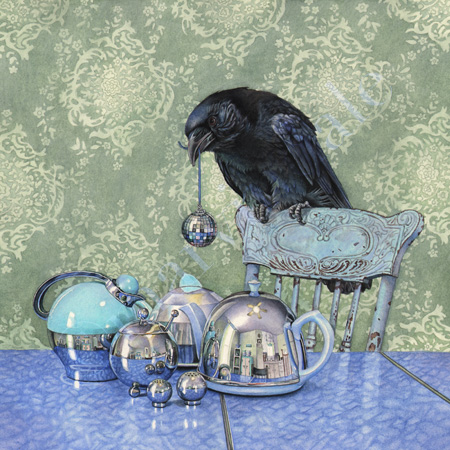
The notion that corvids, especially magpies, have a special affinity for shiny object has been around for more than a century.  In fact to refer to someone as a magpie is to describe them as someone who ‘compulsively collects or hoards small objects’.   This idea is so old hat that it can feel a bit frivolous to even wonder if it’s true.  The trouble with this bit of corvid whimsy, however, is that when we do investigate it, and scientists have, we find there’s no empirical evidence to support it.

'Crow Collects' by Cori Lee Marvin.

‘Crow Collects’ by Cori Lee Marvin.

For instance, one study presented both captive and free-living magpies piles of blue or shiny silver screws, rings, and pieces of tin foil near piles of food to which they had been previously habituated.1  They found that, rather than thieving and subsequently caching the gleaming objects, the birds were actually more nervous to take food than they had been previously.  In the 64 conducted tests, only two instances of contact between a bird and an object were recorded.

trial

Experimental set-up for magpie study.

Cornell crow expert Kevin McGowen, elaborates on this general conclusion, suggesting that perhaps the origin of this folklore is pet crows who are attracted to the objects of obvious value to their owner like coins, keys or jewelry.  Speaking personally as someone who has spent countless hours observing hundreds of individual crows in the field, I can also attest to the fact I have never witnessed anything resembling this behavior.  So there you have it, corvids do not, according to the best empirical evidence, show an attraction to, or are otherwise known to collect shiny objects.

And yet…

And yet I still hear anecdotes about this behavior that peak my curiosity.  For instance, once or twice a year I’ll see a headline about crows thieving shiny stones at the expense of bereft family members.  In Jewish culture, it’s tradition to leave a small stone atop a gravestone, as a way to honor the deceased and indicate that they’ve been visited.  For whatever reason, particularly across Ireland, these stones occasionally go for joy rides in the mouths of crows.  In Omagh, Patsy Kerlin who mounts headstones in his town’s graveyard recently told a local reporter that “It seems to be only the black shiny ones they take and a lot of them go missing.”  Even in my own neck of the woods at the University of Washington one of the gardeners at the Urban Horticulture Center regaled John Marzluff and I with his story of how the crows regularly steal the shiny metal placards that identify the center’s plants.

In science, we often like to say “the plural of anecdote is not data”.  This is unequivocally true.  But just because they’re not data doesn’t mean they’re meaningless either.  I’m inclined to believe there’s more to these stories than random chance and I think they are worth exploring.  Perhaps these stories emerge out of confirmation bias, meaning people tend to report theft with respect to shiny things more often because they’re looking to confirm a suspicion they already had.  If so, it would be yet another fascinating example of the extent to which corvids have infiltrated our culture.  Or perhaps this is the work of curious juveniles as has been suggested by my crow colleague Dr. Jennifer Cambell-Smith.  If so, teasing out any evidence of discrimination or bias juveniles are using when selecting objects to explore could give us insight into how they learn about the world, or how our garbage is modifying that behavior.  Or perhaps crows do like to carry off with glossy objects, but for textural, rather than visual reasons.  At least some corvid species swallow small stones to aid in digestion and these stones are most often partially smoothed.2  These ‘grit stones’, however, are considerably smaller (on average only 2.9 mm) than I imagine grave stones are, so perhaps this behavior is evidence of poor grit stone selection among naive birds.

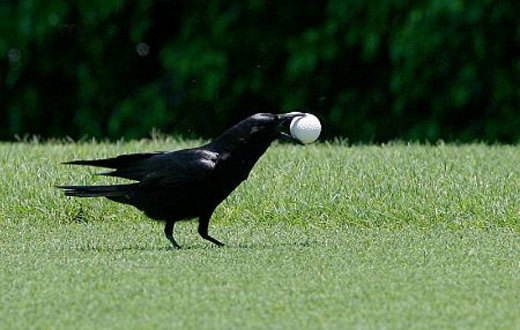
Or maybe it’s none of the above, we simply cannot say.  Which, for me, is exactly why I find these anecdotes so interesting.  While we can rule out that this behavior isn’t a manifestation of corvids’ love for bling, we can’t exactly explain this behavior either.   It’s yet another item on the shelf along with thieving golf balls and wiper blades where we can’t do much more than offer an educated guess.  So while I’m quick to clarify that crows are not attracted to shiny objects, I’m not dismissive of these anecdotes either.  My friend and colleague David Craig likes to say that every bird has a story, and citizen science is part of sharing that story.  In my book, the story of corvids and their light fingered behavior seems an ideal project for the crow minded bird nerd.

  1.  Shepard, T. V, Lea, S. E. G., and Hempel de Ibarra, N.  2014.  Thieving magpie’?  No evidence for attraction to shiny objects.  Animal Cognition 18: 393-397.
  2. Gionfriddo, J.P., and Best, L. B. 1996.  Grit-use patterns in North American birds: The influence of diet, body size and gender.  The Wilson Bulletin 108: 685-696

39 Comments

Filed under Corvid mythology, Crow behavior, crow conflicts, Crow curiosities, Crow life history, Crows and humans, In the news

Why the crow is black and other mythology

Since humans began telling stories and writing them down, they’ve told stories about crows and other corvids.  This should come as no surprise considering corvids are found in nearly every corner of the world and are as connected to us now as they were centennials ago.  Whether they are sharing (or thieving) the food we grow, consuming the soft tissues of our dead, or delighting us with their company, corvids have infiltrated the most intimate parts of our lives. They walk the earth cloaked in black, and yet persist with the light of life even we perish through disease or famine.  It is this juxtaposition that I think made our human ancestors look upon those glossy feather and conclude they must have some greater tie to creation than their other avian kin.  Be it India, Rome, the Middle East or North America, they’ve been written into the oldest stories explaining how the facts of the world came to fruition.  With that in mind, let’s break from answering questions with the rigors of science this week and embrace the explanations offered by our ancestors.

“Raven and the First Men” by Haida artist Bill Reid. Photo by Christer Waara/CBC

Why the crow is black (According the the Greeks/Romans)

Apollo, the son of the most powerful greek God Zeus, had an important, albeit tumultuous relationship with crows.  The greek word for crow, corone, comes from the name of Apollo’s mistress, Coronis.  According to the version of this story told by Appolodorus, although Coronis and Apollo had been lovers, she left him to marry a mortal, Ischys.  The crow, then white, brought news of the marriage to Apollo who became so incensed he burned the bird’s feathers and then burned Coronis to death.  In other versions Coronis is herself turned into the black crow and it’s possible the Greeks saw a mated pair of crows as a representation of the forbidden love between Coronis and Ischys.  This may be one of the earliest stories of a woman marrying below her class for love.

Apollo

Why the crow is black (According to Muslims)

Muhammad, born sometime around 570 CE, is considered to be the founder of Islam and the last profit sent to earth by God, according to the Islamic faith.  A popular legend depicts a time Muhammed was hiding from his enemies in a cave.  A crow, then white, spotted him and cried “Ghar, Ghar!” (cave, cave!) to his seekers.  They did not comprehend the crow’s cries, however, and Muhammad escaped.  He turned the crow black for the betrayal and cursed him to only utter one phrase for the rest of time;  “Ghar, Ghar!”

Why the crow is hoarse (According to Greek/Romans)

Apollo sent a raven to gather water for a feast but the raven was distracted by an unripened fig tree.  Determined to obtain the figs, the raven waited until the tree ripened, ate his fill, and then captured a watersnake to bring back to Apollo.  The watersnake, the raven explained, was the reason he was late and unable to collect the requested water, but Apollo saw through the lie.  As punishment, Apollo declared the raven could never again drink from the stream until the figs ripened.  Since the raven must now wait, his voice is hoarse from thirst.

Why owls and crows fight  (According to Hindus)

According to the great animal epic, the Panchatantra, the birds had come together to elect a king and choose his earthly appearance.  They had elected the owl and were beginning to organize his lavish coronation, when the crow arrived.  The crow laughed at their decision, protesting that the owl was too ugly, his features without tenderness, and his nature without pity.  Furthermore, Garuda, the eagle mounted Vishnu was already their king and to take another was a sin that could result in severe punishment by the Gods.  The others, scared by the crow’s warning, left in agreement.  Being nocturnal, the owl had slept through all this but now awoke to find his coronation canceled due to the crow’s persuasive words.  They have fought ever since.

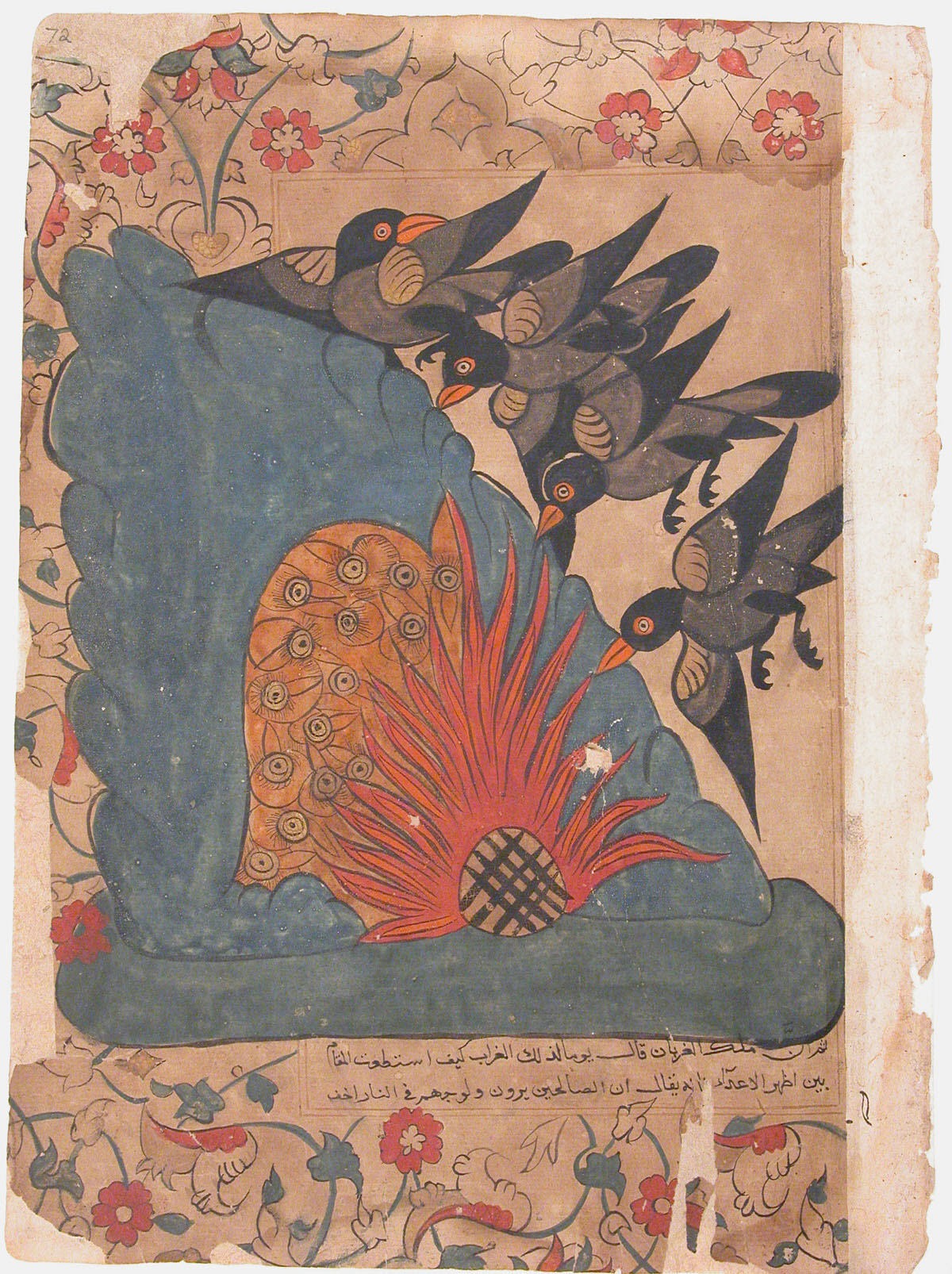
“The Crows Trap the Owls in Their Cave by Lighting a Fire at the Entrance and Fanning it with Their Wings” Folio from the Kalīla wa-Dimna. The Kalīla wa-Dimna is an Arabic translated collection of fables which are believed to be largely inspired by the Panchatantra. This specific image references a story from Book III of the Panchatantra which tells of how crows were able to trap and burn their owl nemesis to death. Image c/o The Metropolitan Museum of Art


Why we die (According to Haida Natives)  

Ravens have a significant role in the creations legends of many different Native American tribes.  According to the Haida people of what’s now the Queen Charlotte Islands, Greater Raven was the creator that first called earth into being on the endless sea.  He then made humans out of both rock and leaf.  The people of rock were (as I can well imagine) more difficult to shape and were never finished.  The people of leaf, on the other hand, were quickly completed and ready to roam the land.  The raven instructed them that, like the leaf, they must eventually fall and rot back into the earth and thus death entered the world.

Why the sky is full of light (According to Tsimshian Natives)

Greater Raven, as mentioned above, eventually gave dominion of the world to his sister’s son, Lesser Raven, who it was said was as robust as stone and would live forever.  Unlike Greater Raven, Lesser Raven was both a trickster and had a voracious appetite.  To satisfy his hunger, Lesser Raven filled the earth with food, but feared he would be unable to find it, as at that time the earth was still dark.  Seeking a solution, Raven flew through a hole in the sky where he found another world much like our own.  When he saw the daughter of the Chief of Heaven collecting water he transformed into a needle and floated into her vessel.  When she drank the water and the needle, Lesser Raven impregnated her and was later reborn as her son.  The infant charmed the Chief and his wife and was granted permission to play with the box containing the light of day.  Suddenly, Raven took his original form and flew back to earth through the hole in the sky, taking the box with him.  Later, he broke the box out of anger and filled the sky with the sun, moon and stars.

Please visit Whose Land to learn more about the ancestral lands of the Haida and Tsimshian people. It’s our responsibility as occupiers to learn about the people who existed here before us and where they live today.

Why we bury our dead (According to Judaism)

According to the Yalkut Shimoni, an aggadic compilation of the Hebrew bible written in the 13th century, after Adam and Eve’s son Abel died, they did not know what to do with the body.  Seeing their distress, a raven killed one of his companions to show the grieving couple how to dig a hole and bury the body. To thank the raven for his kindness, God feeds baby ravens until their feathers turn black after which their parents take over.

***

Thus, be it the color of ravens or the intimate mysteries of human death, crows have offered a canvas on which early peoples the world over painted their explanations of life.   My thanks to Borgia Sax and his terrific book, Crow, which was the factual source and inspiration for this post.

11 Comments

Filed under Corvid mythology, Crows and humans