Denali Diaries Part II: The Wildlife

While Denali is worth visiting on the basis of its scenery alone, it’s the wildlife that will truly shape your experience.  In the summer, Denali is host to some eight species of medium to large sized mammals, including foxes, lynx, wolves, grizzly bears, black bears, caribou, Dall sheep and moose.  Among those, the moose, grizzly bear, caribou, wolf, and Dall sheep make up what’s known as the “Denali Big 5.”

Seeing wildlife in Denali is mostly about luck and timing, but the longer you’re in the park the more chances you have to view wildlife.  As I described in my earlier post, I scheduled and bus hopped my trips in such a way that I stayed in the park most of the day.  This is particularly important for moose, which are generally crepuscular, meaning they are more active in the morning and evening . Everything else is really just a gamble. Sometimes the odds are in your favor and sometimes they’re not. For what it’s worth, though, out of my four all-day trips into the park I got The Big 5 twice, both during the times I stayed primarily on the bus.

While I always left the park having experienced something new, there were definitely trips that were more memorable than others, and the range of experiences really made me appreciate the luxury of being able to go multiple times.  Whatever wildlife you do have the privilege of encountering is sure to fan the flames of your love affair with this park, but I imagine for many people that affair starts first and foremost with the most visible and charismatic of Denali’s wildlife: The grizzly bears.
DSC_0877

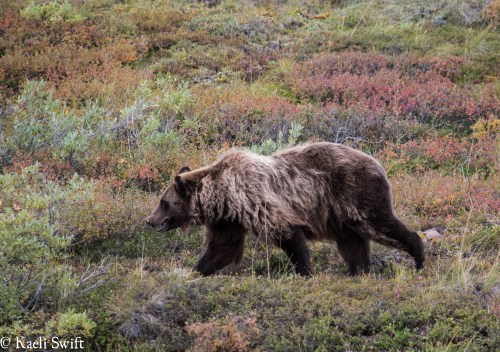
I took this photo in late August, just as the colors started to change.

By late July, bears across Alaska are gearing up for hibernation by entering a phase called hyperphagia, where they basically eat constantly and gain somewhere on the order of 400 pounds.  In the park, their diet consists mostly of blueberries, soapberries, and roots, but they will gladly eat whatever mammals they can catch, including small rodents, caribou, moose and even other bears.

A big highlight when bear watching is seeing sows out with spring cubs. Unlike mom, the young are generally a lot darker in color, prompting people to sometimes mistake them as black bears.  Observing cubs playing, foraging, and trying to keep up with mom is definitely the kind of experience that will make you wonder if you were somehow transported, Truman style, to some kind of nature documentary, but in the best kind of way.

DSC_0899-2

While I won’t pretend for a second that seeing bears ever gets old, they honestly weren’t the animal that I was most looking forward to encountering when I arrived in Denali.  Maybe it’s because I’d never seen one before, or because of some deep affection instilled by decades of Christmas marketing, but something about caribou utterly charms me.

DSC_0211

Unlike many of Alaska’s other herds, the Denali caribou do not undertake an immense seasonal migration, opting instead to remain almost exclusively within the bounds of the park year round. Unless you can travel into the interior of the park, however, you’ll have little luck seeing them in the winter.

DSC_0590

Denali used to play host to a herd that ranged in the tens of thousands, but after decades of over hunting followed by a mysterious period of low calf survival and harsh winters, Denali’s herd has dwindled to around 2,000 individuals.  Fortunately, things seem to have stabilized for the time being. I wish I had seen more before the end of the season, but I’ll never forget what it was like watching this small herd move through this painted hillside.

DSC_0591

The ungulates that seemed to most delight my fellow visitors, however, were the moose.  For all of Denali’s hooved animals fall is the rut, which means males have grown out their antlers or horns and are putting them to use in sparring (practice) matches, as they ready themselves for the violent matches to come.  I only saw such behavior between moose once.  They locked antlers for a few seconds and went back to grazing shortly thereafter.  Unfortunately it was too far away to bother with any photos.  I’ll admit, seeing a bull moose, particularly on foot, is a gripping experience.  However big you imagine them to be, they’re bigger in person.  The rack alone can be 40lbs.

DSC_0298

In Denali, the stakes of these fights are high, as the moose here operate in a polygynous system, where the victor will mate with and defend an entire heard of females.  In other places, moose form monogamous pairs for the breeding season.

DSC_0308

It was early morning still when we watched this cow move her two calves across the valley. They seemed pretty wary of our bus, though her biggest real threat is the park’s main carnivorous predator: The gray wolf.

DSC_0408

Even in Yellowstone I don’t get my hopes up about seeing wolves despite there being far more individuals there. Across the Denali’s 6 million acres, there are only 30 known packs comprising about 75 adults. You can imagine my delight then, when, as we were making our way out of the park at dusk on our first trip, we rounded a corner to see this rump trotting up ahead of us. As it happens, I had been walking the road on foot only minutes before. I probably wouldn’t have caught up with it had I not gotten on the bus, but it’s still pretty incredible to imagine that I more or less went hiking with a wolf. We must have followed this adult for about a mile. It stopped a few times, evening giving it’s signature mournful howl a before it disappeared off the side of the road. Honestly, that would have been enough for me, but our second to last trip had something really special in store.

DSC_0054

I had heard whispering about wolf pups back at our housing campus but I never thought much of it. I figured that was deep interior kind of stuff, the kind of trek our field schedule just wouldn’t permit. So while I figured it was something exciting when we arrived at a jam packed road, I just wasn’t picturing this…

Cue total F-ing meltdown on my part.

This pup was born sometime mid-may to the single male and female that comprise the Riley Creek West pack.  By around four months the pups start venturing away from their den site.  Lucky for us, for a few day stretch the area they were exploring was right near the road by Toklat.  After a few days, they moved away from the road, which was no doubt for the best.

The last animal I have the great pleasure to highlight is the most iconic of Denali’s wildlife.  In fact, it was this animal for whom the park was dedicated.  The endemic Dall sheep.

DSC_0579

In 1906, hunter and conservationist Charles Sheldon noticed a worrying decline in the Dall sheep favored by hunters.  He feared that without protection, they would be hunted to extinction. Now this is an all too familiar concept, but coming off the heels of the “era of abundance” this was actually a revolutionary way of thinking in western culture.  Until 1900, colonists/settlers in the United Stated hunted without regulation and, seemingly, without much thought or worry as to the integrity of ecosystems. As a frame of reference, the field of wildlife management wouldn’t come onto the scene for another two decades.

Sheldon, however, had the foresight to recognize that something must be done and set out to establish Denali as a national park.  It took 11 years, but in 1917 Woodrow Wilson signed the bill into law. Since that time Dall sheep populations rebounded and are currently considered healthy.

Despite their robust numbers, however, most of my experiences of seeing Dall sheep in the park were “technical”.  As in, “technically those white specks on the mountain side are Dall sheep”. So on our last day as we traveled out of the park, I couldn’t believe my eyes when a ewe and her lamb were jogging down a hillside close enough that you could judge their forms as Dall sheep even with your naked eye. For the minute or so that we were able to watch them, I felt myself overcome with equal parts joy and despair.  I was profoundly grateful for the gift of such beauty and yet so sad that once again its integrity is under such threat.

DSC_0587

Driving home one night, my fellow passengers and I shared our backgrounds and motivations for visiting the park.  Some came to experience mammals the size of which dwarfs anything in their native country, some were fulfilling missions to visit all the National Parks, while others had arrived with a spirit of adventure and little else.  Together, we marveled at the unforgettable things we had seen and shared our anxieties that future generations may not be so lucky.  We discussed our anger and disappointment (or among some of the foreign tourists utter bafflement) at the US government’s unwillingness to act more effectively on climate change.

One hundred years ago someone looked at this land, recognized that change must be implemented, and fought for over a decade to convince congress that in fact wild spaces and wildlife mattered enough to act.  As a result, my fellow passengers and I got to see and experience things that will bring us joy the rest of our lives.  The question now is whether we will wage our own fight for the future, or if we will watch from the sidelines as it turns to ash in our warming world.

***

DSC_0632

For information about climate change in the arctic please visit the following resources

NASA’s Arctic-Boreal Vulnerability Experiment

The National Snow and Ice Data Center

Chasing Ice

And remember…
~PLEASE VOTE ON NOV 6TH~


9 Comments

Filed under Climate change, Conservation, Denali Diaries, Ecosystem, Photography, Wildlife

You need to know more about jay spit

Look, I’m a reasonable person.  I know what you’re thinking.

“Literally never has it occurred to me I might know too little about jay spit.”

But here’s the thing: it’s actually super interesting and you really can’t understand Canada jays without knowing about their saliva.  It would be like trying to understand the internet without cat videos-you just can’t do it.  So trust me when I tell you this is the information you didn’t know you needed.

DSC_0164

In the early 1960’s Walter Brock was examining Canada jay corpses when he discovered that they have massive salivary glands on par with the ones found in woodpeckers.1 Such generously sized glands are found in no other songbird.  Furthermore, like the woodpeckers, it’s not just that Canada jays make a lot of saliva, but they make a lot of sticky saliva.  At the time this discovery was made, it was already known that the enlarged glands of woodpeckers served to allow for a foraging tactic called “tongue probing” where, like anteaters, the birds use their long sticky tongues to extract food from narrow crevices.  Although Canada jays don’t have especially long tongues, the ability to tongue probe seemed the most parsimonious explanation for this strange adaptation, and Brock suggested that this strategy may actually be the key to the jays’ winter survival.  A study a few years later examining their foraging behavior revealed that they don’t feed in this manner, however.  They feed more or less the same way the other corvids do.2  It seems instead, that it’s what they do with the food after that’s different.

DSC_0440

Rather than using their copious amounts of weird, sticky spit for acquiring food, it’s used for depositing it.  If you watch a jay closely after it’s got a bit of food you’ll notice it seems to have missed Emily Post’s memo about chewing with your mouth closed. Over the course of a few seconds you’ll see the food peek out from the bill as the bird moves it around inside its mouth.

DSC_0366

This jay picked up this bit of food about 60sec before this photo was taken.  Now it’s working it around with its tongue, coating it in sticky saliva.

Once sufficiently spit coated, the bird will deposit the food blob (called a bolus) onto the foliage or trunk of a tree.  No matter the material or angle, once the spit dries the food is safely secured come hell or high-water.  Because these caches are pretty small there’s little fear that many will be found.  More importantly, by stashing food high in the trees instead of burying them into the ground like many other cache-dependent corvids do, Canada jays can thrive in areas that receive much heavier snowfall, allowing them the title of the most northern residing jay in North America.

Here’s where it all really comes together though.  If you’ve seen me write about Canada jays before you’ll have noticed that it’s almost inevitable that I’ll use the phrase “Cute little faces” at some point to describe them.  But have you ever wondered why? Why do they have such cute little faces?  While jays do feed more or less in the same way as other corvids the one exception is that they don’t hammer at objects.  If you’re ever given a crow or a Steller’s an unshelled peanut you’ll know exactly the motion I mean. Without the need the hammer objects, or dig holes for burying food, Canada jays don’t need the heavy bills their cousins do.2  Instead they have the blunt little bill that helps give them their characteristic baby-faced look.  So not only is their spit responsible for their ability to tough it out in some of the harshest winter environments this continent offers, but it also means they get to look super cute while doing it.

So like I said, you don’t really know Canada jays until you know a thing or two about their spit.

DSC_1042

Literature cited

  1.  Brock WJ. (1961). Salivary glands in the gray jay (Perisoreus). The Auk 78: 355-365
  2. Dow DD. (1965). The role of saliva i food storage by the gray jay.  The Auk 82: 139-154

16 Comments

Filed under Birding, Canada jays, Corvid trivia, Diet, Field work, Jay behavior, Science

Denali field notes: Sexy birds, and a kitty

Working in Denali, there’s never a day when I get bored with the scenery or dismiss my great fortune in being able to do research here.  Certainly though, some field days are better than others either because the jays were particularly cooperative or because of some other wildlife highlight.  Today was one of those latter days.  The jays weren’t especially busy, and I’ve grown increasingly concerned that one of our females has died, but the park pulled through in delighting us in other ways.

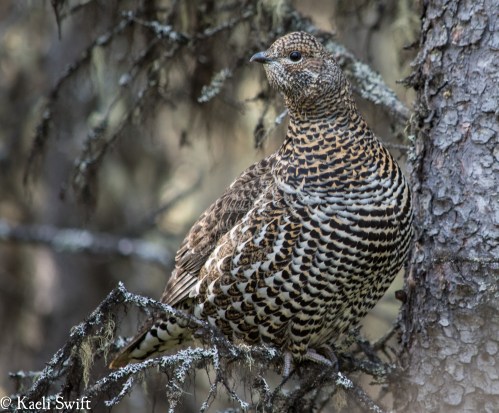
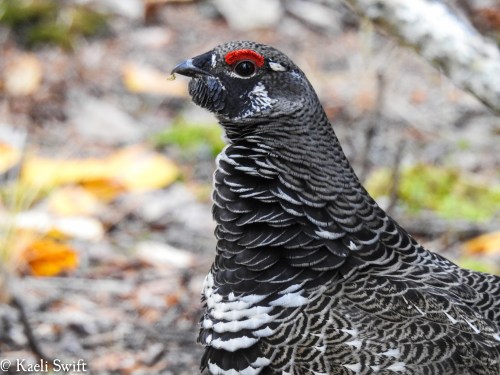
Spruce grouse are such a daily occurrence that it’s borderline obnoxious, but only because of their habit of waiting until the very last minute to flush and then nosily flying into your face like some kind of helicopter poltergeist. If you can manage to detect them before their fun little game of surprise though, watching them play statue can be quite comical.  It’s hard not to imagine them sitting there, praying they don’t get noticed and wishing they were still velociraptors.

DSC_0783

A female spruce grouse

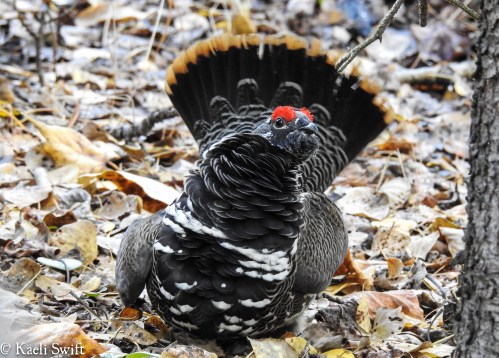
Today offered a very different kind of behavior outside of their usual repertoire, however.  I spied a male strutting about the undergrowth and couldn’t help but notice he was rather marvelous looking. The red comb over his eye was looking rather sharp, and his breast and tail feathers were fully erect.

DSCN1034

DSCN1038

At first I wondered if he was perhaps trying to intimidate me, but I quickly discovered that I was not the lady he was trying to impress.

Given that spruce grouse don’t start breeding until April, I can’t really imagine what this female made of the whole situation.  Evidently though, nonbreeding season courtship displays are not uncommon in grouse, prairie chickens or other galliformes (heavy-bodied ground birds).  Most of what I’ve heard suggests that these displays are the work of young males, eager to practice their skills for next year.  I did come across one paper that suggested such early season displays in black grouse are actually important for securing territories, and confer higher reproductive success.1  In any case while I can’t speak for her, I’ll tell you I was 100% feeling his moves.

DSCN1053

DSCN1068

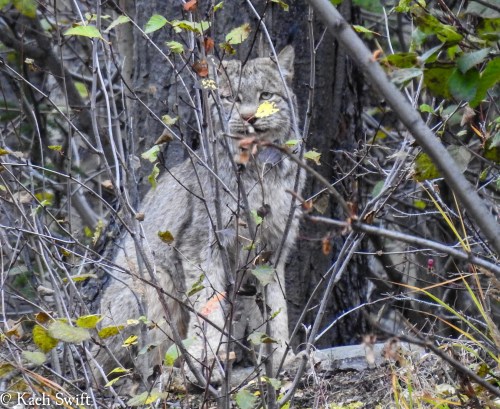
Our second encounter was substantially shorter but by far more thrilling.  I barely captured even one rather derpy photo but I don’t think you need much more to understand my excitement.

DSCN1009

This was my first wild feline ever.  I hope it’s not my last lynx of the season, but either way I’m not complaining.

***

Literature cited

  1. Rintamaki, P.T., Karvonen E., Alatalo, R. V., and Lundberg A. (1999). Why do male black grouse perform on lek sites outside of the breeding season? Journal of Avian Biology 30: 359-366.

13 Comments

Filed under Denali Diaries, Field work

Putting the “crow” in necrophilia

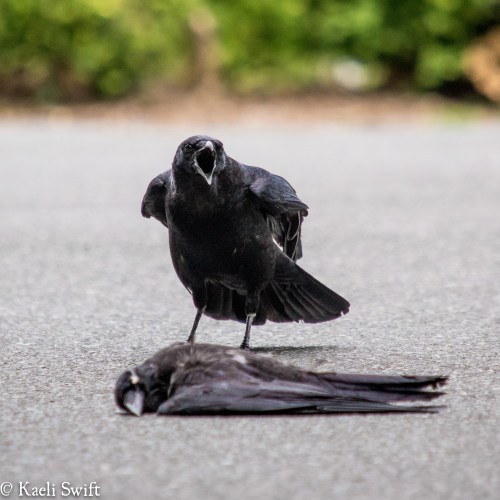
It’s early April 2015, and John Marzluff and I are standing with a film crew attempting to capture some footage of a crow funeral to compliment a story they are working on about Gabi Mann.  I’ve already set the dead crow on the ground, it’s placed just out from a cherry tree resplendent in springtime blossoms.  After only a few moments of waiting, the first crow arrives and alights on the tree, its head cocking around to get a better look at the lifeless black feathers beneath it.  I hold my breath for the first alarm call, ready for the explosion of sound and the swarm of birds that will follow it.  But it doesn’t come.  Instead, the bird descends to the ground and approaches the dead body.  My brow knits together in surprise but, ah well, I think, the shots of it getting so close and then alarm calling will make good footage.   The audience will have no questions about what it is responding to.  To my continued surprise, however, the silence persists; only now the crow has drooped its wings, erected its tail, and is approaching in full strut. No, no, this can’t be, I think.  But then it happens.  A quick hop, and the live crow mounts our dead one, thrashing in that unmistakable manner.  “Is it giving it CPR?” someone asks earnestly.  Still in disbelief, John and I exchange glances before shaking our heads and leaving the word “copulation” to hang awkwardly in the air.  After a few seconds another bird arrives to the cherry tree and explodes in alarm calls, sending our first bird into its own fit of alarm, followed by a more typical mobbing scene.  The details of what I’ve just witnessed as still washing over me when I hear John lean over to me…”You need to start your field season tomorrow.”

***

What crows do around dead crows is something I’ve dedicated much of my academic life to understanding.  In the course of my first study, my findings made for a nice clear narrative: crows alarm call and gather around dead crows as a way of learning about dangerous places and new predators.  Although there are other hypotheses we can’t rule out, certainly danger avoidance is at least partially driving this behavior.  An important detail of that original study though, is that because of the way it was designed, with a dangerous entity always near the dead crow, our live crows were never in a position to ever get very close to our dead stimulus. So the possibility that they do other things around dead crows, like touching them, couldn’t be explored.

DSC_1139

It’s been 3 years since that day in April and during that time it has taken every ounce of my power to remain tight lipped when journalists would ask “what’s the most interesting thing you’ve learned from your studies?” Because until we were able to scientifically vet the prevalence of this behavior, I wasn’t willing to say much about it for fear of making necrophilia mountains out of mole hills. But with our findings now officially available in the journal Philosophical Transactions B, I am delighted to finally share what has been the most curious secret of my PhD: crows sometimes touch, attack, and even copulate with dead crows.

DSC_1028

Although this statement is jarring in its own right, what really gives it power is that we know this not just from that first fateful day with the film crew, but through an experimental study testing the response of hundreds of birds over several years.  That’s important because it allows us to say not just what they’re doing but possibly why they’re doing it (and at least why they’re not doing it).  So how did we conduct this experiment?

First, I dove into the literature to try and see if there was any precedent for this kind of behavior in other animals.  Although there have been no systematic studies, repeated observations of animals touching, harming, even copulating with their dead occur in dolphins, elephants, whales, and many kinds of primates, among some other animals.  Based on this, we hypothesized that this behavior may arise from: attempts to eat it, attempts to learn from it, or a misuse of an adaptive response (like territoriality, care taking, mate guarding, etc.). To test these ideas I searched the neighborhoods of Seattle until I found a breeding adult pair and (while they weren’t looking) presented one of four stimulus options: An unfamiliar dead adult crow, an unfamiliar dead juvenile crow, a dead pigeon or a dead squirrel.  The latter two stimuli being key in helping us determine if the behavior was food motivated, whereas the nature and prevalence of the interactions themselves (common, uncommon, exploratory, aggressive, sexual) helped us address the other hypotheses.  In all, I tested 309 individual pairs of crows; or in other words, once again I freaked out a lot of Seattle residents wondering why there was a woman with a camera, binoculars, and some dead animals loitering in front of their house for long periods of time.

Our main findings are that crows touched the animals we would expect them to eat (pigeons and squirrels) more than the dead crows, and although crows sometimes make contact with dead crows, it’s not a characteristic way they respond.  Because this behavior is risky, this seems to back up previous studies in crows that suggest that they are primarily interested in dead crows as a way of self preservation and avoiding danger.

DSC_1142

A crow tentatively pokes at one of our dead crows

That said, in nearly a quarter of cases, crows did make some kind of contact with dead crows.  Like with mammals, we saw that these behavior could be exploratory, aggressive and in rare cases even sexual (about 4% of crow presentations resulted in attempted copulations), with the latter two behaviors being biased towards the beginning of the breeding season.  Importantly, the latter two categories of interactions were rarely expressed independently, and it was often a mixture of the first two; in rare cases, all three.  In the most dramatic examples, a crow would approach the dead crow while alarm calling, copulate with it, be joined in the sexual frenzy by its presumed mate, and then rip it into absolute shreds.  I must have gone through a dozen dead crows over the course of the study, with some specimens only lasting through a single trial. It was an issue that may have been insurmountable if not for the donations of dead crows by local rehab facilities and the hard work of my long time crow tech turned taxidermist, Joel Williams.

It’s hard to witness this behavior without wondering if maybe the crows somehow don’t recognize that it’s dead and are instead responding like they might to a living intruder or to a potential mate.  So we tested that idea too, by conducting a second experiment where we presented either a dead crow or a life-like crow mount.  The differences in their response was clear.  They dive bombed the “live” crows and less often formed mobs, just like we would expect them to do for an intruder.  They also attempted to mate with the “live” birds but in these cases it was never paired with alarm calling or aggression.  So the issue doesn’t seem to be that they think it’s alive.

The fact that this behavior was rare, and often a mix of contradictory behaviors like aggression and sex, seems to suggest that none of those hypotheses I outlined earlier are a good fit for this behavior.  Instead, what we think happens is that during the breeding season, some birds simply can’t mediate a stimulus (the dead crow) that triggers different behaviors, so instead they respond with all of them. This may be because the crow is less experienced, or more aggressive, or has some neurological issue with suppressing inappropriate responses.  Only more experiments will help us determine what makes this minority of birds unique, and whether expressing these seemingly dangerous behaviors are the mark of the bird that is more, or less reproductively successful in the long haul.

DSC_1088

So while there’s still much more left to be explore here, I can finally say that this is without a doubt some of the most interesting behavior in crows I’ve ever witnessed.  I hope you will check out the publication here, and seek out all the other amazing work being reported in this special thanatology (death science) themed issue.

***

61 Comments

Filed under Being a scientist, Breeding, Crow life history, Field work, Graduate Research, New Research, Science

Meet Ferdinand

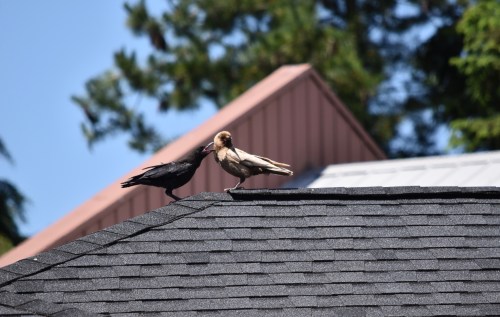
Around this time last year I was both delighted and intrigued when a reader emailed me about a very usual crow showing up in her yard.  Unlike its flock mates this crow was not black, but white and brown, like the kind of milked-down coffee that inspires the comment “would you like some coffee with your cream?”.  Understanding what would cause such a unique coloration in her crow sent me down a most unexpected rabbit hole where the science of what I call ‘caramel crows’ turned out to be somewhat subject to mystery.

Within months of publishing that article, I couldn’t believe my luck to encounter a caramel crow of my own named Blondie.  Whereas the science of their pigmentation may be up for debate, their beauty most certainty is not and I considered myself exceptionally lucky to lay eyes on one in person.

Photos of Blondie from 2017

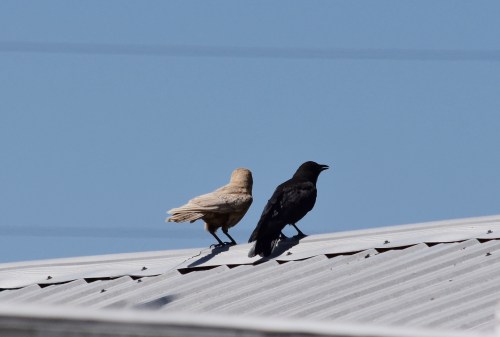
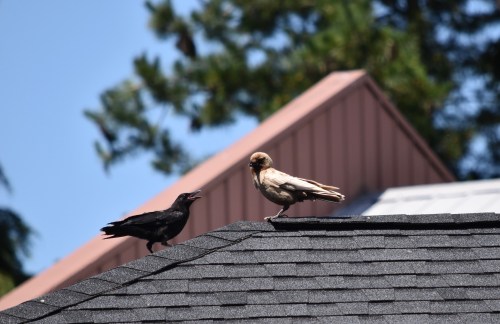
Now, it seems my perception of their rarity may not have been quite justified as I have since discovered yet a second caramel crow, who I call Ferdinand, in a completely different part of the city.  Unlike Blondie, who lives exclusively in a residential area, Ferdinand’s haunts include a public park.  I won’t give his or her precise location, but if you’re a Seattle native I encourage you to use the clues provided in the text and photos of this post to see if you can find Ferdinand.  If you do use the hashtag #FoundFerdinand to update us on its activities but remember not to give away its precisely location.  This is both to encourage people to get outside and explore on their own, and to protect Ferdinand’s safety.  If seeming him in person is not possible I hope these photos will suffice.  As a last bit of fun feel free to let me know in the comments who you think wore it better, Ferdinand or Blondie.

DSC_1106

DSC_1175

DSC_1032

DSC_1156

DSC_1063

DSC_1235

DSC_1236

53 Comments

Filed under Birding, Crow curiosities, Just for fun

ƨ’ileɒꓘ story

It still leaks through my writing sometimes.  Missing or misplaced letters, even whole words conspicuously absent as if a miniature black hole opened up mid sentence. My grammar and punctuation leave something to be desired too, and all these problems are exasperated when I’m stressed or rushed.  Childhood ghosts that love to pay visits at the most inopportune of times, haunting me with their reminders that my grasp of written language was a war hard fought, and not every battle was won.

As a kid, a mixture of ADHD and dyslexia made learning to read and write feel impossible.  While my peers were in the worlds offered by their chapter books, I was getting lost in the world provided by my own imagination; a much friendlier place at the time than the outside one where my literacy progress seemed to be causing great distress among my guardians and educators.  Things came to a head near the end of second grade, when an art activity to decorate flag with our name went a little ~backwards~.  A meeting was set to discuss that I would not be permitted to move forward the next year with my peers.  The repercussions of that fact pierced even the densest layers of my imaginary world.  Instead of watching my friends sail away from me while I stayed in place, I chose to switch to a public school that had programs for kids like me.

IMG_0563

The flag has been a staple of my parent’s home ever since 2nd grade, always stationed across from the bathroom mirror.

Over the next two years I saw psychologists and therapists, attended special literacy classes, got Hooked on Phonics, and made the dreaded daily trips to the nurse’s office for The Pills.  I hated the pills.  I can’t even remember why at this point.  It could have been because of how they made me feel, or with what other kids chose to do with the information that I was on them, or some combination.  Either way, it became my mission to get off them.

Returning to my old school had always been the goal, and by the end of 4th grade they agreed I had made enough progress to rejoin my peers the next year.   I advocated that coming back wasn’t enough, I no longer wanted to be medicated.  I would do whatever I needed to make that happen, and my 5th grade teacher took the reins in planning a strategy to help me.  I never returned to the meds, even over the next three years as I continued to struggle and intermittently fail classes.  Then, in 8th grade, my family moved out of state and I switched back from a private school to a public one.  My new 8th grade coursework was almost identical to the 7th grade coursework at my former school.  Suddenly, rather than trailing my peers, I was slightly ahead.  Although slight, the margin was just enough to afford me the mental bandwidth of learning time management and self imposed structure.  By the end of 8th grade I, for the first time, was excelling at school. And apart from the occasional bump, I continued to do well enough to eventually earn a PhD in avian ecology from the University of Washington.

I would never go on to be a top 10th percentile kind of person, and when it came to applying for undergrad and graduate programs I had more than one institution look no further than my numbers and respond with a hard, “pass”.  In place of the skills that might make me an excellent test taker, however, some things much more valuable to me bloomed.  A sense of creativity born out of those years deep in imaginary worlds.  A willingness to ask for extra help and the ability to say the words “I don’t understand.” Finally, a sense of resiliency.  I can fail or struggle many times and either overcome it, or make the choice to exert my energies in other ways instead.

These benefits and coping tools didn’t come right away though. These were not things I, as an 8, 10, 12, even 15 years old, could have just set my mind on and materialized. I process things differently than most people, and getting a handle on how to make that work within our educational system required tireless effort on behalf of myself, my family, and my educators, in addition to the simply the passage of time.  Time to develop self-specific skills and coping mechanisms.  Time to grow into my brain and realize that my value as a person, as a scientist, are not contingent on my successes or failures but how I respond to them. Time to embrace that it’s not the mid sentence black holes that define my writing, but the way the message resonates with the reader.

***

I wrote this piece in response to the handful of parents and kids over the years who have identified with my story.  I wanted to offer a more permanent legacy that could be read and shared by those who wanted it. However, I do not intend for this to act as a roadmap for other people because, A) I recognize that not all families have access to the immense resources that my family did, and B) the culture and pressures of primary school has changed tremendously over the past couple decades, and C) the hard truth is that there is no roadmap or magic wand because every child is unique. For example now in my adult life I know plenty of people that benefit tremendously from medication. I know others that decided traditional academia was not a place they could thrive, and now they put their talents and enthusiasm elsewhere. What unites us is not how we learn to cope. It’s recognizing how valuable our stories and our minds are, despite existing in worlds that weren’t made for us.

♥♥♥

19 Comments

Filed under Being a scientist, Just for fun

It’s a wonderful raven’s life

Every year, Jimmy graces our screens as countless people watch him help tell the story of the Christmas classic, It’s a Wonderful Life.  I’m talking of course about Jimmy the Raven, though I suppose one could make the same case for Jimmy Stewart.  Between the two, however, even Stewart recognized that it was the raven who was the superior colleague, and acquiesced to being referred to as “JS” to stop Jimmy from flying on set every time the director said Stewert’s name.1

“The raven is the smartest actor on set.  They don’t have to make as many retakes for him as for the rest of us.” – Jimmy Stewart, while filming You Can’t Take it With You in 19382

Among corvid lover’s, Jimmy’s role in It’s a Wonderful Life is surely a memorable delight, but few probably know the full extent of his career and accomplishments.

Jimmy_the_raven_in_It's_a_Wonderful_Life.png

Jimmy in a screenshot of It’s a Wonderful Life.

Jimmy’s first role was in Frank Capra’s 1938 movie, You Can’t Take It With You, after which Capra cast Jimmy in every one of his subsequent films.  As a result, Jimmy is sometimes mistaken as Capra’s pet, though he really belonged to animal trainer Curley Twiford.  In fact it was Jimmy riding on Twiford’s bulldog, Squeezit, along with two parakeets that initially caught a director’s attention and launched Twiford’s career as one of Hollywood’s earliest animal trainers.3

To make him more marketable, Twiford trained Jimmy to do a wide variety of things including opening mail, operating a typewriter, lighting a cigarette, flipping magazine pages, and dealing a hand of poker.  In the course of Twiford’s career he trained hundred of animals, but it was Jimmy and his subsequent corvids that he marveled at the most.  In a remark that will probably surprise no one, Twiford once said that of all the animals he trained, cats were the most challenging and corvids were the easiest, remembering their stunts for ten years.3

To achieve such tricks, Twiford taught Jimmy a sizable vocabulary of 53 words.  Since so much of Jimmy’s act (and therefore Twiford’s income) depended on Jimmy’s memory of these words, Twiford had Jimmy insured with a first of its kind “loss of memory” policy.4  Lloyds of London, which remains in operation today, wrote the policy–no doubt with ample side-eye from their competitors.  No word, though, on if they currently have any avian clients.

Twiford claimed that between 1938 and 1950, Jimmy had appeared in over 1,000 credited and uncredited films. IMBD, the contemporary scorekeeper of such things, lists 22 credited appearances, including The Enchanted Valley, God’s Country, and The Secret Garden.  He even had an extended roll in The Wizard of OZ, though the scene was later cut.

wizard

A deleted scene from The Wizard of Oz

At the height of his career, Jimmy might well have been a household name, even having newspaper articles dedicated to his biography and upcoming films.  One such article in 1948 boasted that Jimmy possessed a, “Red Cross gold medal for his 200 hours spent entertaining Wold War Two veterans,” though the article did not specify if it meant the American Red Cross, or some other entity.5  Still, neither Rin Tin Tin nor Lassie (both of whom Jimmy worked with6,7) can claim such an honor, even if its true nature is rather murky .

jimmy

The Evening News. Harrisburg, Pennsylvania. December 31, 1948. p. 12 (and, no, ravens don’t live until they’re 140 even in captivity.)

Jimmy’s last film was Three Ring Circus, filmed in 1954, nearly 20 years after his first movie.  Sadly, his subsequent whereabouts and death are unknown, though I found one article from 1957 that talks about a raven named Jimmy.7  For iconic animal actors however, their successors are often named after them and, indeed, an article published in 1958 mentions a raven by the name of Jimmy Jr., so it’s possible that other articles published during that time were really talking about different birds.8  Curley Twinford died himself only two years after Three Ring Circus in 1956.

Searching through newspaper databases, it’s incredible to see the amount of attention Jimmy received throughout his career. Like other Hollywood stars, his activities, on-set demands, and pay rate were all the subjects of much ado.  He charmed audiences and his costars alike, no doubt leaving impressions of intelligence that would not be widely accepted until much later.  It would be nearly another twenty years after his death before corvids such as Jimmy would be federally protected under the Migratory Bird Treaty Act.  I can’t say what role, if any, Jimmy played in shaping the public’s perception of these birds, but it’s hard to imagine that such a star left without leaving a mark.

References:

  1. The Cincinnati Enquirer June 7, 1946: pg 17.
  2. Driscoll, C. New York Day by Day. The Choshocton Tribune. Choshocton, Ohio.  June 29, 1983: pg 8.
  3. Kohrs, K. and Ross, S. Movie Animal Man. The Salt Lake Tribune.  March 26, 1956: pg 109.
  4. Clary, P. Hollywood Film Shop. The Daily Republican.  Monongahela, Pennsylvania. November 18, 1948: page 6.
  5. Jim, the Raven, in new flicker. The Evening News. Harrisburg, Pennsylvania. December 31, 1948: p. 12.
  6. Parsons, L.O. Those Film Fauna are Ticklish Detail.  Tampa Bay Times, St. Petersburg, Florida.  March 17, 1946: pg 79.
  7. Burton, R. Film Shop. Odessa American.  Odessa, Texas. April 30, 1957: pg 8.
  8. Performing Raven. The Tribune. Coshocton, Ohio.  August 23, 1958: pg 4.

13 Comments

Filed under Corvid trivia, Just for fun, Ravens

15,000 crows

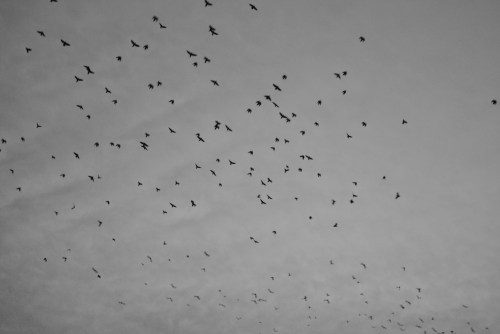
I had imagined it like a beckoning flood.  A small sputter of water followed with increasing force until a great river finally makes its way.  Rather than water though, the flood I was trying to envision was the ascent of 12-15,000 crows to their nightly roost in Bothell, Washington.

DSC_5117.jpg

Witnessing it in person, I found that my water analogy was not entirely accurate.  Rather than being a steady stream with a predictable course, their arrival ebbed and flowed, sometimes leaving the sky lonely with only its fading grey light while other times exploding into seemingly endless black clouds.  They arrived from all cardinal directions, colliding into a mass that could be deafening at close range.  Although the movement of the flock as a whole was more restrained, individually they showed off with spontaneous dives and barrel-rolls.  Soon the light receded completely, and all I could sense was the cacophony of so many crows settling into the willow trees they would call their beds for the evening.

Time lapse of Bothell crow roost I took with my GoPro in December of 2016.  Music by Andy McKeen.

Since that first experience, I have visited the Bothell roost many times, each as awe inspiring as the time before.  This behavior isn’t unique to my region, however.  Cities and rural areas all over the world call themselves home to the upwards of thousands, even hundreds of thousands of crows that may seek their refuge when darkness falls.  Even in the greater Seattle area, Bothell is only one of two roughly equally sized roosts.  This kind of mass sleepover, known as communal roosting, isn’t unique to crows, but it certainly captures our attention in ways most other birds don’t.  So what exactly are the characteristics and functions of roosts?

For all species of corvid, roosts are places where anywhere from a small handful to hundreds of thousands of individuals may converge to spend the night together.  Though roosting occurs year round, it peaks in winter, when territorial pairs are free from the eggs or nestlings that demand all-night attention.  They may occur in wildlands, but more typically occur in cities, where sequestration of heat is higher than in surrounding areas.  Here in Bothell, the roost converges in a wetland outside of the University of Washington’s Bothell campus, but in other areas they may take over the rafters of abandoned buildings or trees dotted within a business district.

Historically Danville, IL hosted North America’s largest roost, a whopping 325,000 birds but I do not know if they remain the contemporary record holder.  The midwest is particularly primed to host such large numbers because many thousands of crows head there during winter from their too cold territories in Canada and because appropriate roosting locations are few and far between.

DSC_5079

Prior, or just after roosting crows attend “staging” or “pre/post-roost” areas where they gather in the trees or on the ground by the hundreds or thousands.  Since these staging areas often occur on asphalt or turf where there’s little food or water, their function continues to elude scientists though social or anti-predator implications seem likely.1 A new UW research study is attempting to parse why crows are so vocal during the staging period and what they might be trying to communicate.  Perhaps their findings will shed some much needed light on these events. 

Corvids get different things out of roost itself depending on the species or possibly even the region they live.  For example, for ravens roosts act, in part, as mobile information centers.2  A raven knowledgeable of a food bonanza such as a moose carcass will display to other ravens at first light, and recruit others to the food.  Rather than being a sign of food altruism, this kind of recruitment is often the only way a lone raven can gain access to a large carcass.  Finding and gaining access to an animal carcass is challenging both because its arrival is unpredictable but also because it’s intensely guarded by the pair whose territory happened to claim the animal’s life.  Overpowering a pair takes a small army, so by recruiting other birds, rather than giving up food in the name of helping others, the lone raven actually gains access to a resource it would have otherwise been boxed out of.

American crows on the other hand do not have this need because urban waste and invertebrate filled yards are so easy to come by.  For crows, roosts act in large part as predator protection.  The odds of successfully fleeing an incoming owl are much better when there are thousands of you, rather than just you and your mate.  They may serve other purposes as well though including socialization, mate finding, and thermoregulation.  Lastly, while there isn’t strong evidence of information sharing among crows it would be arrogant to claim we know it doesn’t occur.

How roosts are organized remains largely mysterious.  For example some evidence shows that ravens that come from the same food bonanzas also sleep near each other in a roost,2 whereas other work done on crows suggested that group cohesion is low at roosts.3  Still, other research suggests that while group cohesion from the territory is low,  it’s high leaving the staging area.  So perhaps there is deep rhyme and reason for who they sleep with, it just hasn’t been captured by the questions we’ve so far asked.  One thing is for certain though; the one place you don’t want to be is low in the trees with others above you.  There would be no escaping the white shower raining down throughout the night.

Even the people who share the UW’s campus are sensitive to this reality.  In perfect synchrony with the incoming cloud of birds, the umbrellas bloom like moonflowers.  Here in Seattle, people seem willing to take such measures to coexist with the birds (though I’m sure there are many who only do so only by rule of law).  In other areas though the cultural attitude or resulting damage makes such cohabitation difficult, even deadly.  In the most extreme case, 328,000 crows were killed in 1940 when the city of Rockford, IL elected to dispose of a local roost with dynamite.4  Today, crows are protected under the migratory bird treaty act and cities are usually required to take more creative, non-lethal approaches including noise and light deterrents.

City living doesn’t always lend itself to witnessing the kind of mass animal movements we fawn over when they appear in Planet Earth footage, but that doesn’t mean they are devoid of such spectacles.  The mass micro-migration of thousands of crows is an awe inspiring event,  grand in both scale and the mysteries it contains.  Any corvid or birdwatcher would be remiss to ignore such an opportunity and I encourage everyone to get outside, head to your roost, and watch the magic unfold.

Literature cited

  1. Moore JE, and Switzer PV. (1998).  Preroost aggregations in the American crow, corvus brachyrhyncos.  Canadian Journal or Zoology.  76: 508-512.
  2. Wright J, Stone RE, and Brown N. (2003).  Communal roosts as structured information centers in the raven, Corvus corax. Animal Ecology 72: 1003-1014.  DOI: 10.1046/j.1365-2656.2003.00771.x
  3. Donald F. Caccamise, Lisa M. Reed, Jerzy Romanowski and Philip C. Stouffer
    (1997). Roosting Behavior and Group Territoriality in American Crows. The Auk 114: 628-637
  4. Marzluff, J.M. and Angel, T. 2005. In the company of crows and ravens.  Yale University Press

13 Comments

Filed under Birding, Crow behavior, crow conflicts, Crow curiosities, Crow life history, Crows and humans

Gifts for crow lovers

With the holiday season upon us, many people find themselves tasked with finding thoughtful gifts for their loved ones.  Although birds are seemingly so universally adored that finding bird themed gifts is no trouble, if it’s specific species you’re after, the challenge can be more immense.  Fortunately for crow lovers, there are lots of options to choose from if you know where to look.  Since you’re looking here, rest easy that half the battle is now over.  So sit back, enjoy, and feel free to add your own suggestions in the comments.

    1. Jewelry and apparel
    2. Art
    3. Books and education
    4. Kids
    5. Conservation


    Jewelry and apparel


    Sometimes you want to wear your passions on your sleeve, literally.  Fortunately online marketplaces like Etsy makes this more than possible.  A quick search of “crow t-shirt” reveals hundreds of options for any aesthetic.  Personally, I like to stick with shirts featuring original art.  Here are some of my top Etsy picks:

    Coyotees Maine

    Elusive Catfishery
    Maison Hydre
    Kathy Morton Stanion

    Outside of Etsy the apparel options can be harder to find but they are out there.  Charlie Harper for example, has an awesome screen printed tee that any crow lover will adore.

    For jewelry you can turn, once again, to Etsy but there are other options too.  June Hunter, who I also recommend elsewhere on this list, has a great collection of corvid themed jewelry.  The bonus here is that I can personally attest to the care and passion June has for these birds, so finding something in her shop will not only deem you an awesome gift-finder among your crow friends, but you’ll be supporting the work of someone who is themselves an ardent lover of crows.  Your local art galleries can also be great places to find amazing crow themed jewelry.  A favorite among my own collection was sourced from the Mary Lou Zeek gallery in Salem, Oregon.

    For something more personalized, consider getting a custom embroidered necklace or full size loop from the talented Sarah Buckley.  I had her make a custom necklace from one of my favorite jay photos to commemorate my PostDoc research.  I couldn’t be happier with the result!


        Art


I can’t stress enough here that your city’s art galleries and boutiques can be great places to find local, handmade, and even one of a kind items.  Many people (including artists) love crows, which is good news for your brick and mortar shopping prospects.  Please, spend your money locally as much as possible.  That said, here are some online shopping options that support talented artists:

From prints, to wall art, to totes and calendars, June Hunter has you covered.  Her Vancouver based studio celebrates the beauty of urban wildlife, with a special emphasis on crows.

If ever I find myself with a great deal of disposable money, purchasing one of Jason Tennant’s astounding wood carvings will be among my top priorities.  Seriously, they’re unbelievable.  And wouldn’t luck have it, ravens are a fairly regular subject of his work.

If it’s illustrations and painting you’re after, Etsy is once again a great resource. From acrylic to watercolor, there’s something for everyone.  Heck, even if you want something more out of the box like stained glass, you’re bound to find something.

Don’t limit your search to etsy, however as there are lots of great artists that sell via their own websites.  Julia Eva Bacon produces stunning oil paintings and has several pieces dedicated to corvids.  Although her originals would be worth every penny, you can also buy prints.  A luck would have it one of my favorite pieces is actually on sale right now!

  1. CorvusCorax_borderPerhaps the person you are shopping for already has walls covered in corvid paraphernalia and you need to get a little more creative with housewares.  Laura Zindel will help you outfit their shelves and table tops with gorgeous ceramics.  I own a set of plates and can attest to their beauty and durability.


    Books and Education

    There are so many excellent books on the topic of corvids that covering them really requires its own post. Fortunately, that post already exists, so I’ll simply direct you to it here.

  2. Books aren’t the only way, however, to give the gift of knowledge. Back in 2010, PBS first aired their NATURE documentary, A Murder of Crowswhich showcases a number of great studies and anecdotes, including the facial recognition work conducted by John Marzluff. Although you can stream the video for free, $18 is a small price to pay for being able to watch it whenever you please, and showing PBS some love.
    NCI_Logo
    For the ultimate crow education however, you should consider registering your loved one for the North Cascades Institute’s corvid class that’s offered over the summer.  In previous years the class has been co-taught by myself and John Marzluff, but for the 2019 edition I will be the sole instructor.  As usual, it’s a two day class complete with lovely and TAG approved accommodations, great food, beautiful scenery, and more information about corvids than you can possibly retain.  We often see nearly every species of corvid found in Washington, including ravens, crows, magpies, Clark’s nutcrackers, Steller’s jays and grey jays.  Registration for this year won’t open until January or February, but who doesn’t like an IOU for a gift?  It is worth noting the class fills up quickly once registration is open so make sure to stay on the ball.

  3. Kids


    I firmly believe that the indoctrination of crow love into kids should begin early; immediately if possible.  Fortunately, Etsy has your back with onesies, night lights, and probably whatever else your imagination can cook up.  For stuffies, local children’s stores or nature stores often carry raven or crow themed plush toys including this awesome raven puppet.

    There’s no shortage of corvid books aimed at kids either.
    10 roudy ravens by Susan Ewing is a counting book great for early readers.
    Lila and the crow by Gabrielle Grimard tells the story of a little girl who learns the beauty of being different from her neighborhood crow.
    Clever crow by Cynthia De felice uses rhyme to tell the story of a young girl trying to outwit a mischievous crow that is stealing trinkets from her mother.  Obviously the biology isn’t a highlight here, but the reviews are otherwise great.
    If accurate biology is what you’re after, Crow smarts by Pamela Turner promises to introduce children (and adults!) to the astounding minds of crows.
    For a children’s book that is more for adults than kids, consider Aldous Huxley’s The Crows of Pealblossom.  Considering that crows and snakes are both often on the receiving end of misguided public vitriol, I’m not a fan that the crows’ triumph comes at the  expense of the snake’s grisly end.  While the snake’s fate may not be appropriate for sensitive children, any adults that share a love of crows and Huxley’s other works will surely be delighted.


    Conservation

    alala-blk-logo_crop

    Perhaps your family tradition is that gifts should give back, or you recognize that your recipient would be happier knowing money was spent towards helping crows.  The Alalā, or Hawaiian crow, is one of the most endangered animals on the planet. Since 2002, they have been considered extinct in the wild.  Thanks to captive breeding efforts by the Alalā project, which is a partnership between San Diego Zoo Global and the Hawaiʻi Division of Forestry and Wildlife, and the US Fish and Wildlife Service, eleven individuals were just released into the forests of the Big Island.  These kinds of captive breeding and reintroduction programs are the only hope for these birds, but they are expensive.  By donating not only can you directly help their cause, but you can demonstrate public interest in keeping this species alive.  Currently, there is no way to donate money online but you can do so the old fashion way.  Make checks payable to San Diego Zoo Global and put in the memo line that the money is to be directed to the the Hawaiian crow project.  I called San Diego Zoo Global to confirm that money can be allocated to the Alalā project specifically.  Mail checks to: P.O. Box 120271 San Diego, CA 92112.

    With these suggestions in mind, I wish you the best in your search for the perfect gift for the crow lover in your life. Happy hunting and please feel free to mention your own gift suggestions in the comments section.


8 Comments

Filed under Crows and humans, Just for fun

My first caramel crow 

A few months ago I was both bewildered and delighted when someone emailed me some photographs of a brown crow that regularly visited them.  I had never seen such a bird myself, and was eager to arrive at an explanation for the crow’s strange caramel-colored appearance.  If you follow the blog, you know that I came to realize there was little to offer by way of explanation.  Instead, this color abnormality presents a rather fascinating mystery of conflicting opinions and an overall dearth of science.

So, after penning my answer I tucked this bird away in the back of my mind and moved forward with the science more relevant to my PhD.  Namely, testing how different crows across the Seattle area respond to dead crows.

To this aim, I spend my days wandering the neighborhoods of Seattle looking for crow families to use for my experiments.  Since I need lots of data points it means I encounter lots (think hundreds) of individual crows.  And wouldn’t you know it.  Sometimes the twain shall meet.

Its mate first caught my eye because, of course, I was looking for black things, not blond things.  Even after I registered the bird, I instinctively thought pigeon.  But then it called, and I realized what was happening.

DSC_0758

At 60m away with my naked eye, I first mistook Blondie for a friendly pigeon.

I FOUND A CARAMEL CROW!  And not just a caramel crow, but a caramel crow with a mate and three fledglings.  A black mate and three black fledglings.  Which suggests that whatever is going on is either recessive or not genetic.  It also shows that, for at least this one caramel bird, the color abnormality did not prohibit it from successfully reaching sexual maturity or finding a mate.  After speaking with the neighbors, it appears “Blondie,” as they call it, has been in the neighborhood for several years and it’s possible she’s not the only caramel crow, though I never confirmed any others.  Outside of that, I can’t say much more from a scientist’s standpoint that I haven’t said before.  So I’ll simply finish the post with a photo story of Blondie.  Enjoy!

DSC_0887 (1)

Meet Blondie

DSC_0743


DSC_0930

Blondie and its mate.  Since I discovered this bird after its nestlings had already fledged, I have no way of determining its sex.

DSC_0708

So beautiful in this juniper tree!

DSC_0751

Blondie’s fledglings were typical looking crow kiddos.

The next batch of images are probably one of the most hilarious bits of fledgling dramatics I’ve ever seen.  It is a scene familiar to many parents I’m sure.  Forgive me for taking my scientist hat off, but I couldn’t help but add some anthropomorphic captions.

DSC_0916 (1)

Hello parent I am hungry.

DSC_0924 (2)

DID YOU HEAR ME, I SAID I’M HUNGRY.

DSC_0918 (1)

(whispering) help, parent, I need sustenance for my growing body.


DSC_0919 (1)

(muffled whispering) please, have mercy, it’s been over 15 minutes since I was last fed.

DSC_0925 (1)

MAYBE I’VE ALREADY DIED AND NOW I’M A GHOST IS THAT WHY YOU AREN’T LISTING TO ME???

DSC_0928

I’m sorry.  I’m just hangry.  I love you.

DSC_0753

DSC_0911

DSC_0893

Cheers to yet another beautiful crow.  Goodbye for now!

58 Comments

Filed under Birding, Crow curiosities, Just for fun