Spoiler alert: They’re not, as so many people believe, true scavengers. Meaning, they’re not mostly eating carrion. I know what you’re thinking: MIND BLOWN. Also you might be thinking PBS lied to you, and you’d technically be correct. So why is this myth so pervasive that even PBS fell victim to its ubiquity?
An American crow picks at the torn up belly of a rat in a Bellevue neighborhood. After a few minutes, it had its fill and moved on to other feeding opportunities, leaving most of the rat untouched.
Well, a huge part of the problem is that like so many words in science, their use in general discourse has parted from their scientific meaning. Typically we use this word to describe say, grad students at the end of the party stuffing their pockets with the leftovers but, biologically speaking, scavengers are organisms who are specialized to consume, or obtain most of their food, from the decaying tissue of animals or herbaceous matter. Now don’t get me wrong, the title of ‘scavenger’ can get a bit blurry as Bernd Heinrich argues in his book, Life Everlasting. Ravens for instance, switch primarily to scavenging during lean winter months. For most American crows, however, the identity of ‘scavenger’ simply will not do.
Which is really too bad, since the title of scavenger is bestowed with honor given how they make our living on planet earth possible. I’m not being hyperbolic when I say thanking the undertakers of our ecosystem should be part of everyone’s pre-meal ritual, but perhaps that argument should be saved for another post.
As for crows, carrion makes up only a very small part of their diet. In Seattle, roadkill accounts for <5% of crow food, and in wildland areas carrion accounts for even less1. Crow beaks aren’t even strong enough to break through the skin of a grey squirrel, though they will usually give it a try.
So what are they eating? Mostly human refuse (no surprise) and invertebrates. In fact human garbage (meat, grain products and veggies) account for about 65% of their diet in urban areas, whereas in wildland areas it’s roughly split between garbage and inverts (35% and 35% respectively)1.
Crows spend much of their time patrolling lawns looking for invertebrates
These data correct another common misconception about crows: they’re not mostly eating the eggs and nestlings of other birds. In fact, crows only account for 1 of 20 observed nest predators in WA and have been found to have a nonsignificant, negative relationship between abundance and rate of predation in experiments using artificial ground nests, shrub nests, and canopy nests1.
So there you have it, American crows are neither true scavengers nor meaningful nest predators. They’re primarily omnivores with an emphasis on human refuse and invertebrates. So the next time you see one patrolling your grassy lawn remember; they’re busy trying to bring home the bacon. Er, bugs. Well, probably bugs, but preferably bacon provided you were crazy enough to throw some out.
Literature cited
Marzluff, J.M., McGowen, K.J., Roarke, D. and Knight, R.L. 2001. Causes and consequences of expanding American crow populations. in Avian ecology and conservation in an urbanizing world (J.M. Marzluff, R. Bowmanm and R Donelly, eds). Kluwer academic Press, norwell, Ma.
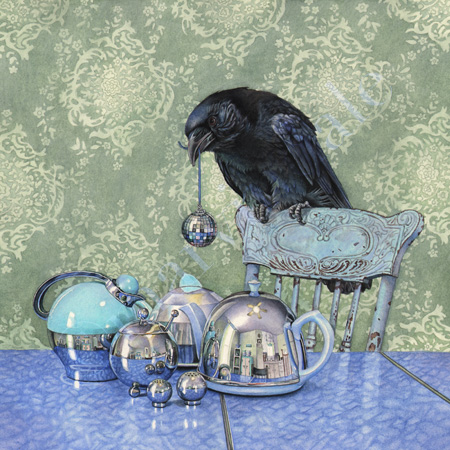
The notion that corvids, especially magpies, have a special affinity for shiny object has been around for more than a century. In fact to refer to someone as a magpie is to describe them as someone who ‘compulsively collects or hoards small objects’. This idea is so old hat that it can feel a bit frivolous to even wonder if it’s true. The trouble with this bit of corvid whimsy, however, is that when we do investigate it, and scientists have, we find there’s no empirical evidence to support it.
‘Crow Collects’ by Cori Lee Marvin.
For instance, one study presented both captive and free-living magpies piles of blue or shiny silver screws, rings, and pieces of tin foil near piles of food to which they had been previously habituated.1 They found that, rather than thieving and subsequently caching the gleaming objects, the birds were actually more nervous to take food than they had been previously. In the 64 conducted tests, only two instances of contact between a bird and an object were recorded.
Experimental set-up for magpie study.
Cornell crow expert Kevin McGowen, elaborates on this general conclusion, suggesting that perhaps the origin of this folklore is pet crows who are attracted to the objects of obvious value to their owner like coins, keys or jewelry. Speaking personally as someone who has spent countless hours observing hundreds of individual crows in the field, I can also attest to the fact I have never witnessed anything resembling this behavior. So there you have it, corvids do not, according to the best empirical evidence, show an attraction to, or are otherwise known to collect shiny objects.
And yet…
And yet I still hear anecdotes about this behavior that peak my curiosity. For instance, once or twice a year I’ll see a headline about crows thieving shiny stones at the expense of bereft family members. In Jewish culture, it’s tradition to leave a small stone atop a gravestone, as a way to honor the deceased and indicate that they’ve been visited. For whatever reason, particularly across Ireland, these stones occasionally go for joy rides in the mouths of crows. In Omagh, Patsy Kerlin who mounts headstones in his town’s graveyard recently told a local reporter that “It seems to be only the black shiny ones they take and a lot of them go missing.” Even in my own neck of the woods at the University of Washington one of the gardeners at the Urban Horticulture Center regaled John Marzluff and I with his story of how the crows regularly steal the shiny metal placards that identify the center’s plants.
In science, we often like to say “the plural of anecdote is not data”. This is unequivocally true. But just because they’re not data doesn’t mean they’re meaningless either. I’m inclined to believe there’s more to these stories than random chance and I think they are worth exploring. Perhaps these stories emerge out of confirmation bias, meaning people tend to report theft with respect to shiny things more often because they’re looking to confirm a suspicion they already had. If so, it would be yet another fascinating example of the extent to which corvids have infiltrated our culture. Or perhaps this is the work of curious juveniles as has been suggested by my crow colleague Dr. Jennifer Cambell-Smith. If so, teasing out any evidence of discrimination or bias juveniles are using when selecting objects to explore could give us insight into how they learn about the world, or how our garbage is modifying that behavior. Or perhaps crows do like to carry off with glossy objects, but for textural, rather than visual reasons. At least some corvid species swallow small stones to aid in digestion and these stones are most often partially smoothed.2 These ‘grit stones’, however, are considerably smaller (on average only 2.9 mm) than I imagine grave stones are, so perhaps this behavior is evidence of poor grit stone selection among naive birds.
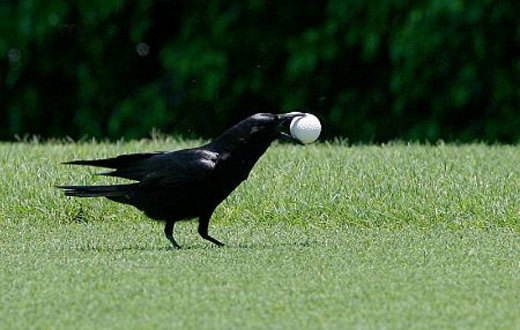
Or maybe it’s none of the above, we simply cannot say. Which, for me, is exactly why I find these anecdotes so interesting. While we can rule out that this behavior isn’t a manifestation of corvids’ love for bling, we can’t exactly explain this behavior either. It’s yet another item on the shelf along with thieving golf balls and wiper blades where we can’t do much more than offer an educated guess. So while I’m quick to clarify that crows are not attracted to shiny objects, I’m not dismissive of these anecdotes either. My friend and colleague David Craig likes to say that every bird has a story, and citizen science is part of sharing that story. In my book, the story of corvids and their light fingered behavior seems an ideal project for the crow minded bird nerd.
Shepard, T. V, Lea, S. E. G., and Hempel de Ibarra, N. 2014. Thieving magpie’? No evidence for attraction to shiny objects. Animal Cognition 18: 393-397.
Gionfriddo, J.P., and Best, L. B. 1996. Grit-use patterns in North American birds: The influence of diet, body size and gender. The Wilson Bulletin 108: 685-696
Since humans began telling stories and writing them down, they’ve told stories about crows and other corvids. This should come as no surprise considering corvids are found in nearly every corner of the world and are as connected to us now as they were centennials ago. Whether they are sharing (or thieving) the food we grow, consuming the soft tissues of our dead, or delighting us with their company, corvids have infiltrated the most intimate parts of our lives. They walk the earth cloaked in black, and yet persist with the light of life even we perish through disease or famine. It is this juxtaposition that I think made our human ancestors look upon those glossy feather and conclude they must have some greater tie to creation than their other avian kin. Be it India, Rome, the Middle East or North America, they’ve been written into the oldest stories explaining how the facts of the world came to fruition. With that in mind, let’s break from answering questions with the rigors of science this week and embrace the explanations offered by our ancestors.
“Raven and the First Men” by Haida artist Bill Reid. Photo by Christer Waara/CBC
Why the crow is black (According the the Greeks/Romans)
Apollo, the son of the most powerful greek God Zeus, had an important, albeit tumultuous relationship with crows. The greek word for crow, corone, comes from the name of Apollo’s mistress, Coronis. According to the version of this story told by Appolodorus, although Coronis and Apollo had been lovers, she left him to marry a mortal, Ischys. The crow, then white, brought news of the marriage to Apollo who became so incensed he burned the bird’s feathers and then burned Coronis to death. In other versions Coronis is herself turned into the black crow and it’s possible the Greeks saw a mated pair of crows as a representation of the forbidden love between Coronis and Ischys. This may be one of the earliest stories of a woman marrying below her class for love.
Why the crow is black (According to Muslims)
Muhammad, born sometime around 570 CE, is considered to be the founder of Islam and the last profit sent to earth by God, according to the Islamic faith. A popular legend depicts a time Muhammed was hiding from his enemies in a cave. A crow, then white, spotted him and cried “Ghar, Ghar!” (cave, cave!) to his seekers. They did not comprehend the crow’s cries, however, and Muhammad escaped. He turned the crow black for the betrayal and cursed him to only utter one phrase for the rest of time; “Ghar, Ghar!”
Why the crow is hoarse (According to Greek/Romans)
Apollo sent a raven to gather water for a feast but the raven was distracted by an unripened fig tree. Determined to obtain the figs, the raven waited until the tree ripened, ate his fill, and then captured a watersnake to bring back to Apollo. The watersnake, the raven explained, was the reason he was late and unable to collect the requested water, but Apollo saw through the lie. As punishment, Apollo declared the raven could never again drink from the stream until the figs ripened. Since the raven must now wait, his voice is hoarse from thirst.
Why owls and crows fight (According to Hindus)
According to the great animal epic, the Panchatantra, the birds had come together to elect a king and choose his earthly appearance. They had elected the owl and were beginning to organize his lavish coronation, when the crow arrived. The crow laughed at their decision, protesting that the owl was too ugly, his features without tenderness, and his nature without pity. Furthermore, Garuda, the eagle mounted Vishnu was already their king and to take another was a sin that could result in severe punishment by the Gods. The others, scared by the crow’s warning, left in agreement. Being nocturnal, the owl had slept through all this but now awoke to find his coronation canceled due to the crow’s persuasive words. They have fought ever since.
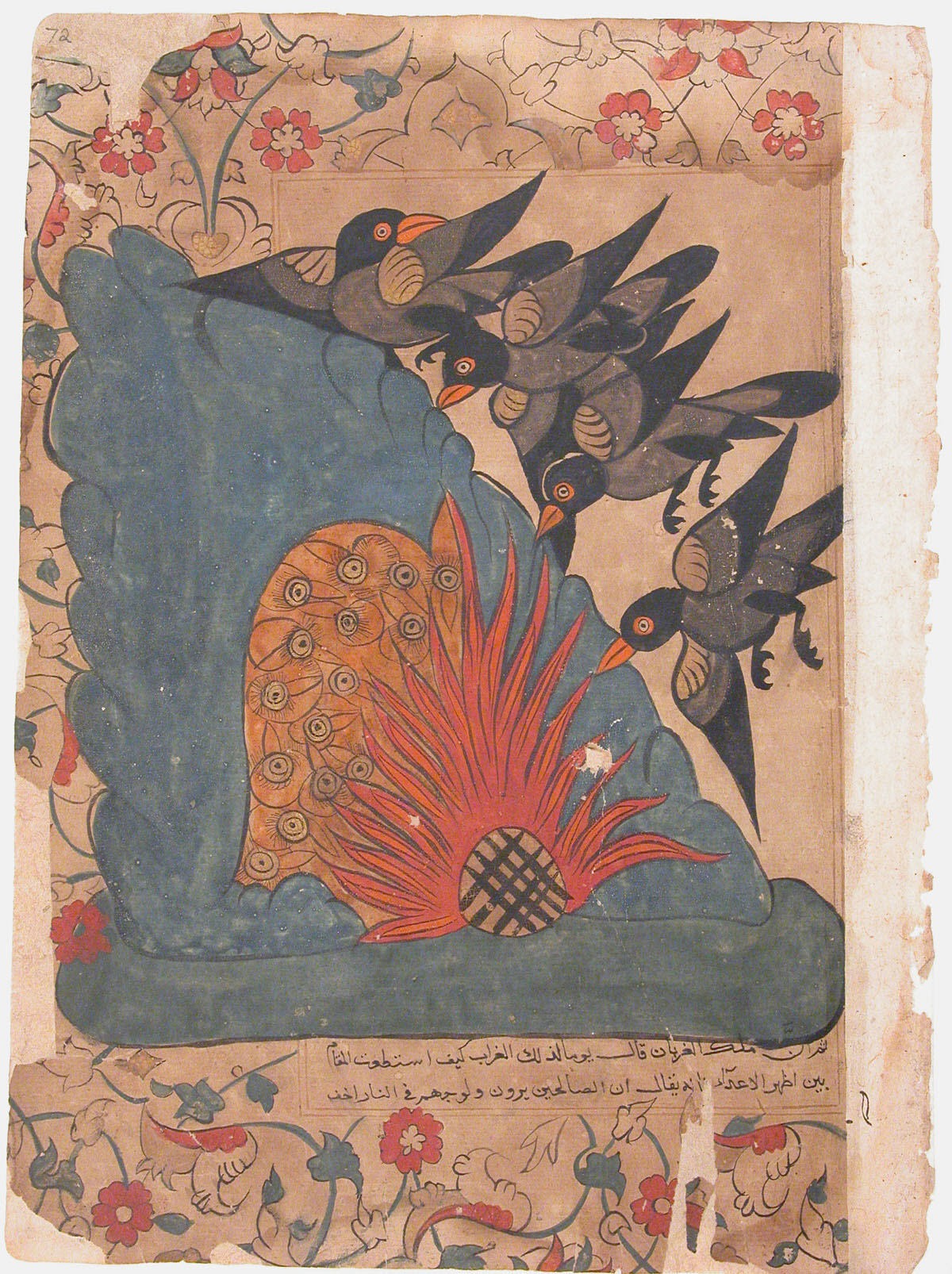
“The Crows Trap the Owls in Their Cave by Lighting a Fire at the Entrance and Fanning it with Their Wings” Folio from the Kalīla wa-Dimna. The Kalīla wa-Dimna is an Arabic translated collection of fables which are believed to be largely inspired by the Panchatantra. This specific image references a story from Book III of the Panchatantra which tells of how crows were able to trap and burn their owl nemesis to death. Image c/o The Metropolitan Museum of Art
Why we die (According to Haida Natives)
Ravens have a significant role in the creations legends of many different Native American tribes. According to the Haida people of what’s now the Queen Charlotte Islands, Greater Raven was the creator that first called earth into being on the endless sea. He then made humans out of both rock and leaf. The people of rock were (as I can well imagine) more difficult to shape and were never finished. The people of leaf, on the other hand, were quickly completed and ready to roam the land. The raven instructed them that, like the leaf, they must eventually fall and rot back into the earth and thus death entered the world.
Why the sky is full of light (According to Tsimshian Natives)
Greater Raven, as mentioned above, eventually gave dominion of the world to his sister’s son, Lesser Raven, who it was said was as robust as stone and would live forever. Unlike Greater Raven, Lesser Raven was both a trickster and had a voracious appetite. To satisfy his hunger, Lesser Raven filled the earth with food, but feared he would be unable to find it, as at that time the earth was still dark. Seeking a solution, Raven flew through a hole in the sky where he found another world much like our own. When he saw the daughter of the Chief of Heaven collecting water he transformed into a needle and floated into her vessel. When she drank the water and the needle, Lesser Raven impregnated her and was later reborn as her son. The infant charmed the Chief and his wife and was granted permission to play with the box containing the light of day. Suddenly, Raven took his original form and flew back to earth through the hole in the sky, taking the box with him. Later, he broke the box out of anger and filled the sky with the sun, moon and stars.
Please visit Whose Land to learn more about the ancestral lands of the Haida and Tsimshian people. It’s our responsibility as occupiers to learn about the people who existed here before us and where they live today.
Why we bury our dead (According to Judaism)
According to the Yalkut Shimoni, an aggadic compilation of the Hebrew bible written in the 13th century, after Adam and Eve’s son Abel died, they did not know what to do with the body. Seeing their distress, a raven killed one of his companions to show the grieving couple how to dig a hole and bury the body. To thank the raven for his kindness, God feeds baby ravens until their feathers turn black after which their parents take over.
***
Thus, be it the color of ravens or the intimate mysteries of human death, crows have offered a canvas on which early peoples the world over painted their explanations of life. My thanks to Borgia Sax and his terrific book, Crow, which was the factual source and inspiration for this post.
With all the online crow trivia listicles that are already floating around it can be hard to come up with tidbits that are both factual and interesting. I was up the the challenge though and am hoping I found at least one thing every reader didn’t know. Let me know how I did in the comments section!
1. Avocados are toxic to crows.1
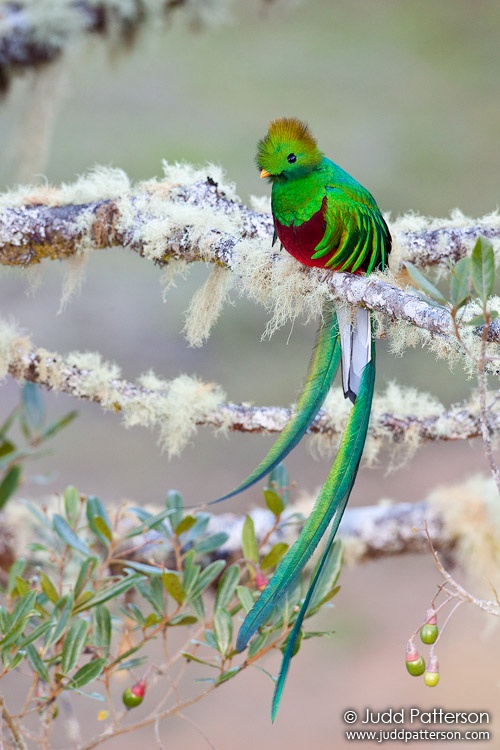
Well, really avocados are toxic to most birds, and many other kinds of domestic animals. Avocados contain a molecule called persin, which the plant produces as a fungicide. In birds, it can cause damage to the heart tissues, difficulty breathing, lethargy or even death. The resplendent quetzal is a rare exception in that it can not only tolerate avocados, but is considered a crucial seed distributor of the plant. So next time you’re considering sharing your Chipotle leftovers, make sure you didn’t order extra guac.
2. Scavenging accounts for very little of a crow’s diet2
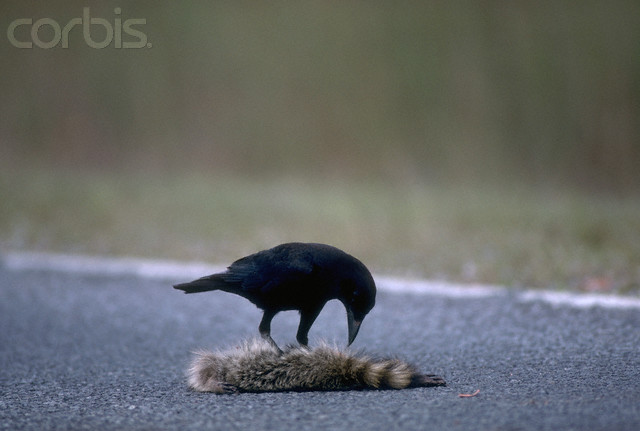
Scavenging, meaning the consumption of dead plant or animals material, is a crucial part of our ecosystem that is commonly the recipient of unfair prejudice. American crows often get thrown in with this lot, and while there wouldn’t be anything gross or insulting about this if it were true, it simply isn’t. Whether you’re in the city or the wildlands, scavenging and active predation account for only a minority of a crow’s diet. The bulk of their daily meal is made of human refuse, invertebrates and worms. In the cities, about 85% of their diet is human refuse, whereas in exurban and wildland areas human refuse and invertebrates account for roughly equal proportions of their daily food (about 35% each).
This scene is not as common as many people think! Photo: W. Perry Conway/CORBIS
3. There’s only three places with no native corvids3
New Zealand, the southern part of South America and the poles (ok so I guess technically 4 if you want to be a stickler about it). Why this is remains largely mysterious, but it probably has to do with where and how these birds radiated out from their ancestral origins.
Global corvid distribution. They’ll be our avian overlords soon enough I’m sure.
4. They have some of the best spatial memory of any animal4
Every year Clark’s nutcrackers and pinyon jays store tens of thousands of seeds to sustain them through the lean winter months. If they fail to retrieve enough they’ll perish, so a good spatial memory can literally be the difference between life and death. To deal with this mental load, these two species (and other food caching birds) have a huge hippocampus relative to the rest of their brain. With the spatial memory part of their brain super charged they’re able to retrieve 20,000-30,000 seeds with 90% accuracy or better. I can’t usually retrieve my cell phone what that kind of accuracy so I certainly tip my hat to them!
5. They account for the largest songbird in the world.5
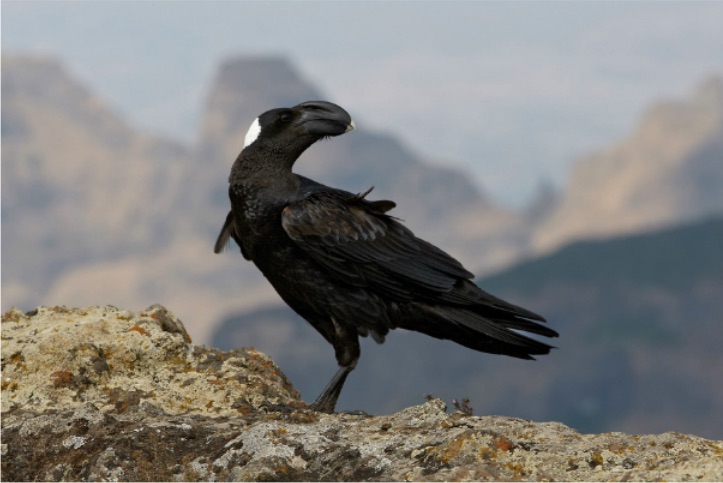
The common raven is marginally the largest songbird of the world with a 4.9ft wing span and weighing in at up to 4.5lbs. An extremely close second is the thick-billed raven, which is native Ethiopia and has limited range in some surrounding countries. In fact, the two are so close in size that there are conflicting reports of which is bigger depending which publication you look at3,5. Scientists finally resolved this dispute, however, and came to the consensus that the common raven is larger for the 2009 publication of the Handbook of the Birds of the World.*
Marzluff, J.M., McGowen, K.J., Roarke, D. and Knight, R.L. 2001. Causes and consequences of expanding American crow populations. in Avian ecology and conservation in an urbanizing world (J.M. Marzluff, R. Bowmanm and R Donelly, eds). Kluwer academic Press, norwell, Ma.
Madge, S. and Burn, H. 1999. Crows and jays. Princeton, New Jersey: Princeton University Press 1999.
Marzluff, J.M. and Angell, T. 2005. In the company of crows and ravens. Yale University Press.
dos Anjos, L., Debus, S., Madge, S., & Marzluff, J. (2009). Family Corvidae (crows). In J. del Hoyo, A. Elliot, & D. A. Christie (Eds.), Handbook of the birds of the world (Vol. 14, pp. 494e641). Barcelona, Spain: Lynx Edicions.
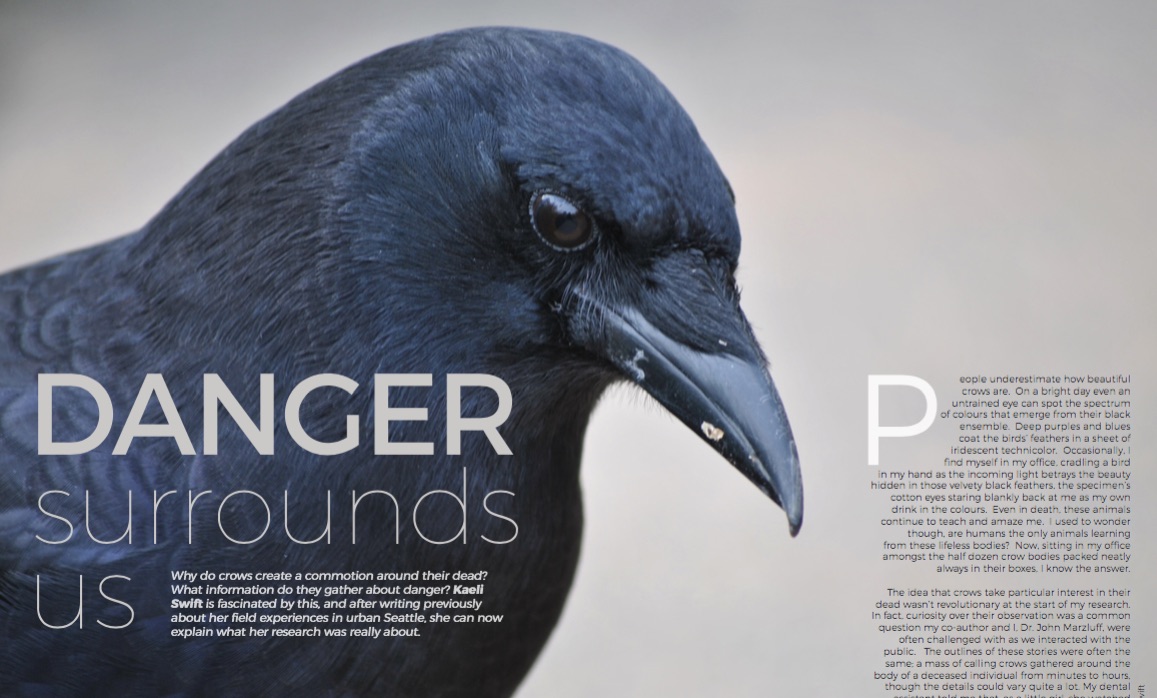
Curious to read my popular science take on our recent publication on how crows behave around their dead? Check out my latest article for Biosphere. Then check out all the other awesome authors and contributors to my favorite popular science publication. You won’t regret it. (And congrats to GO for making the article cover! She’s such a gorgeous bird…)
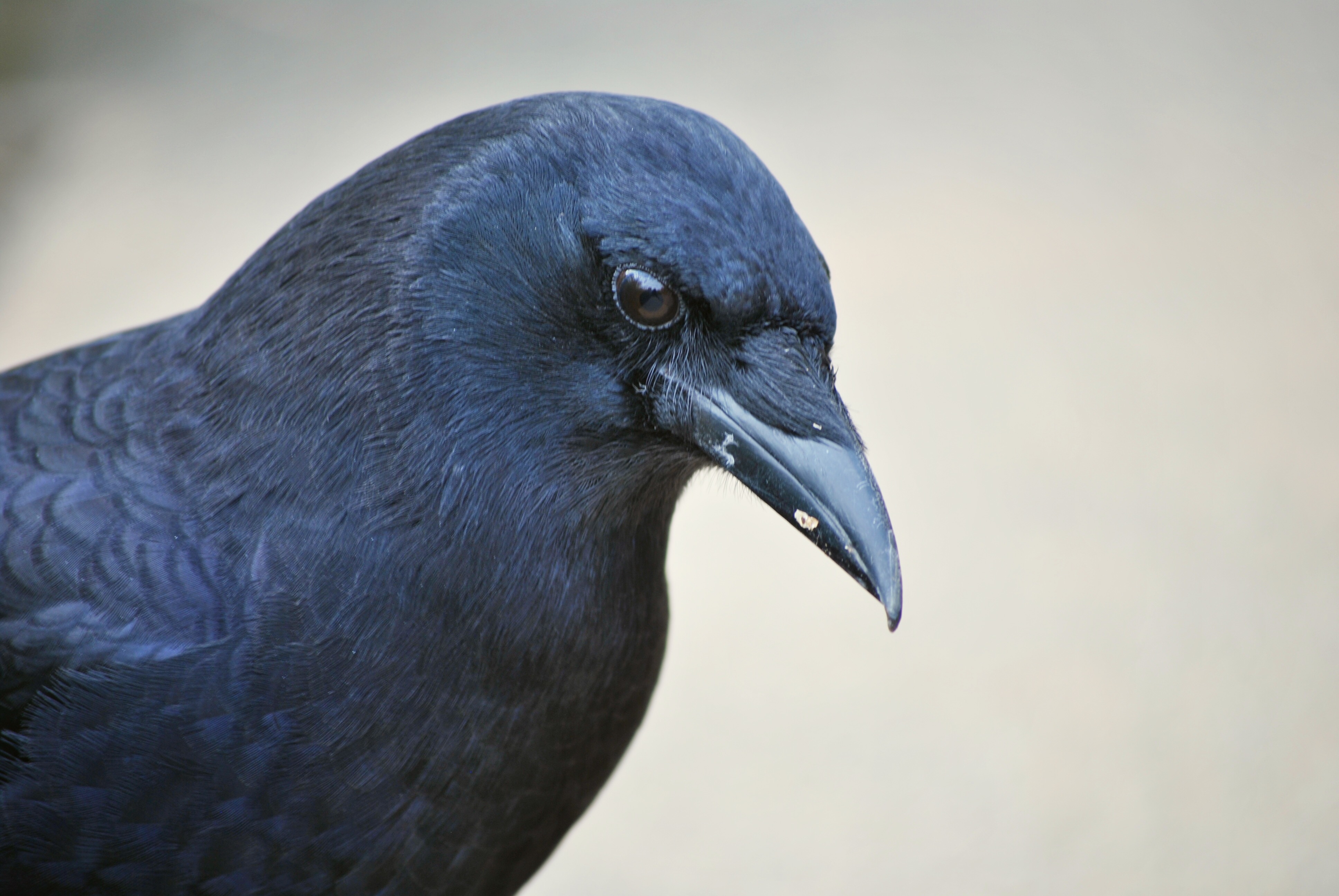
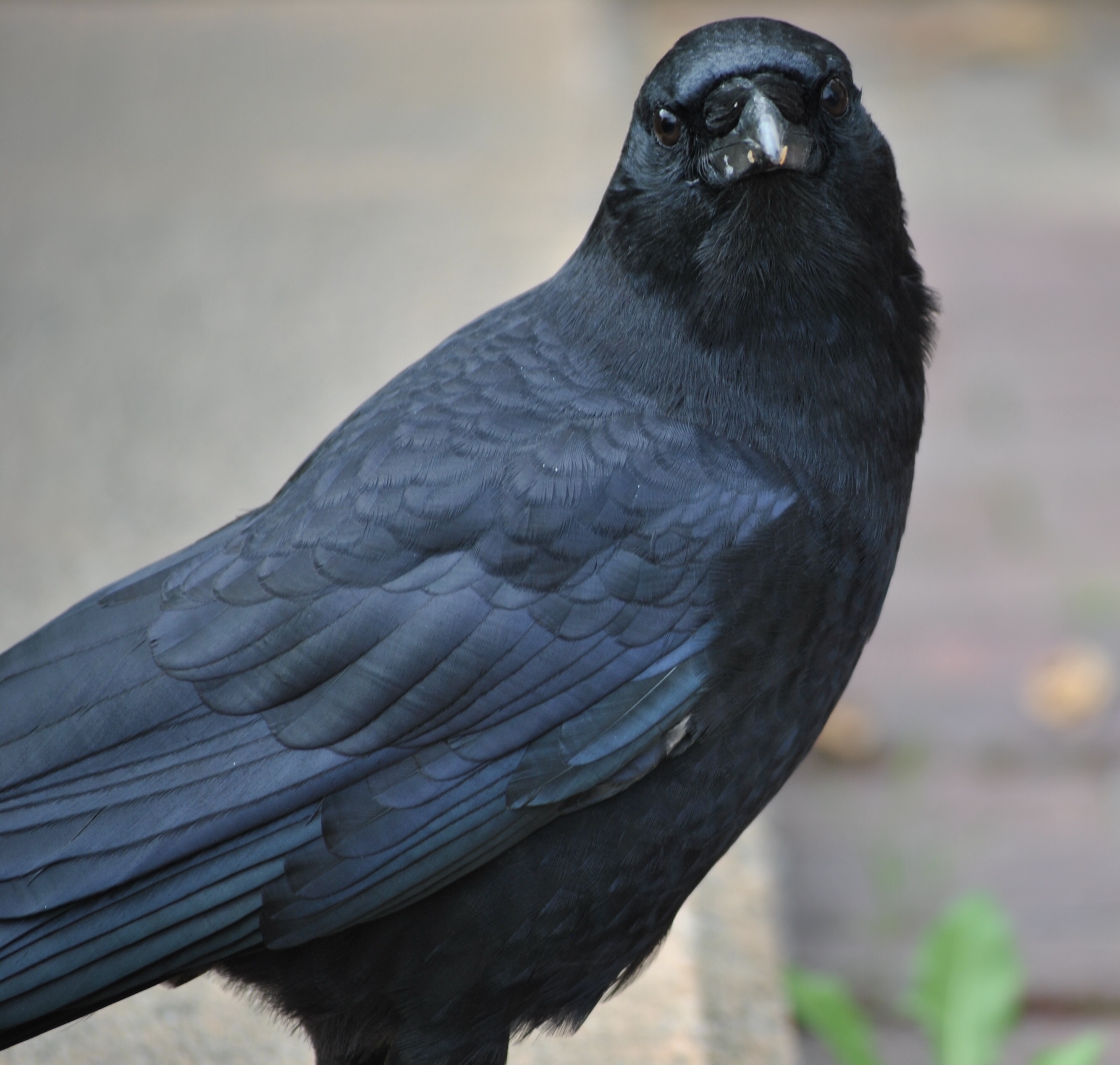
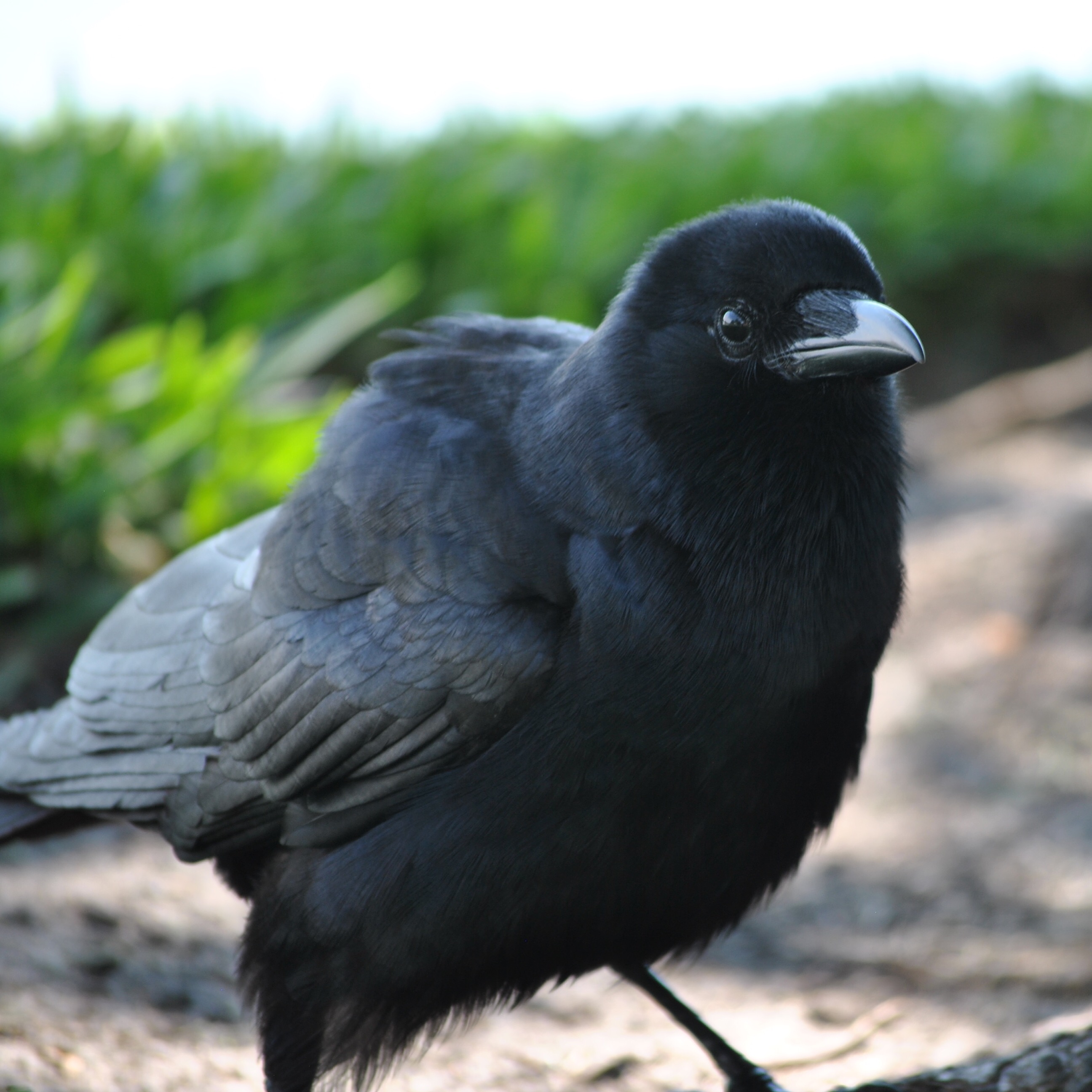
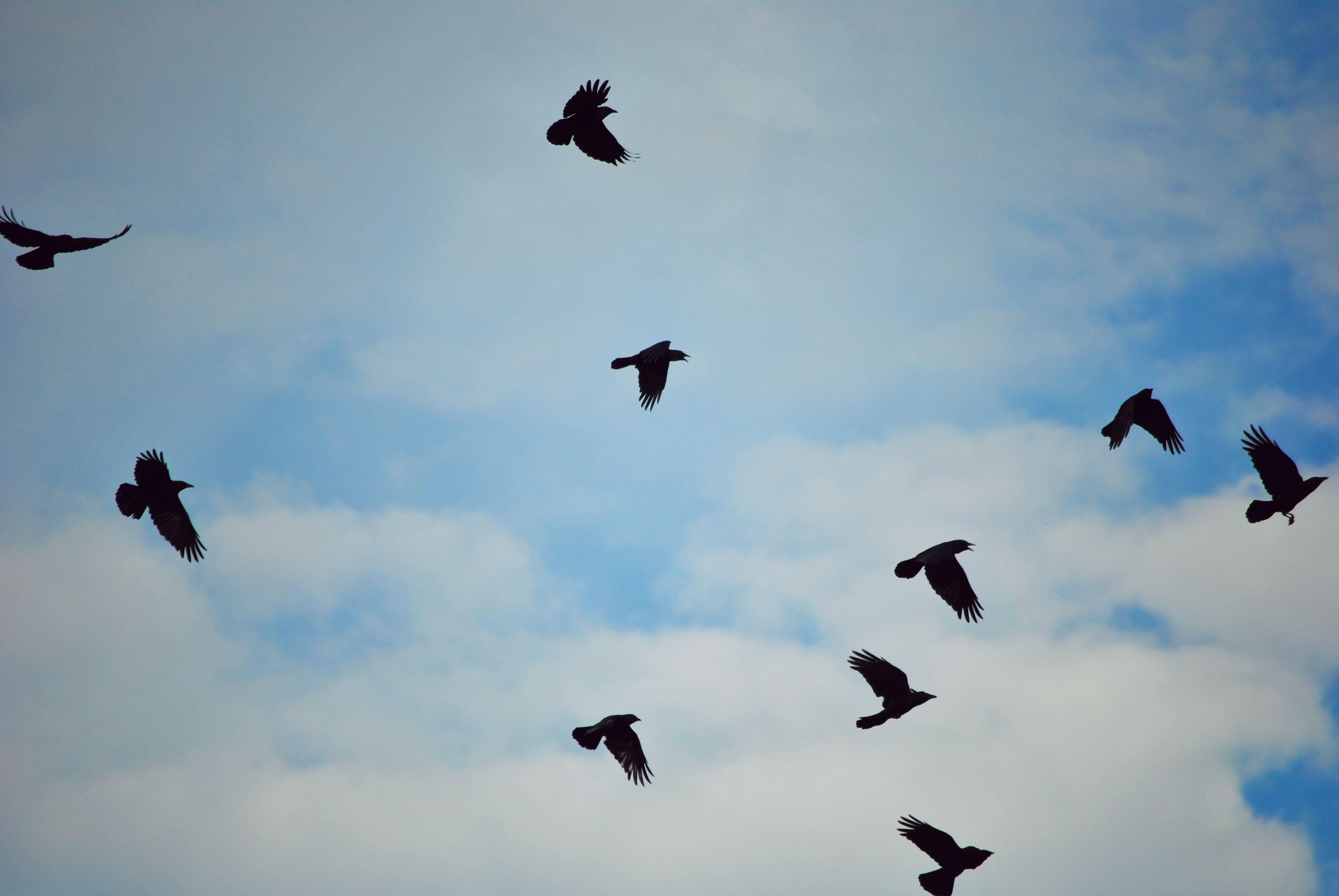
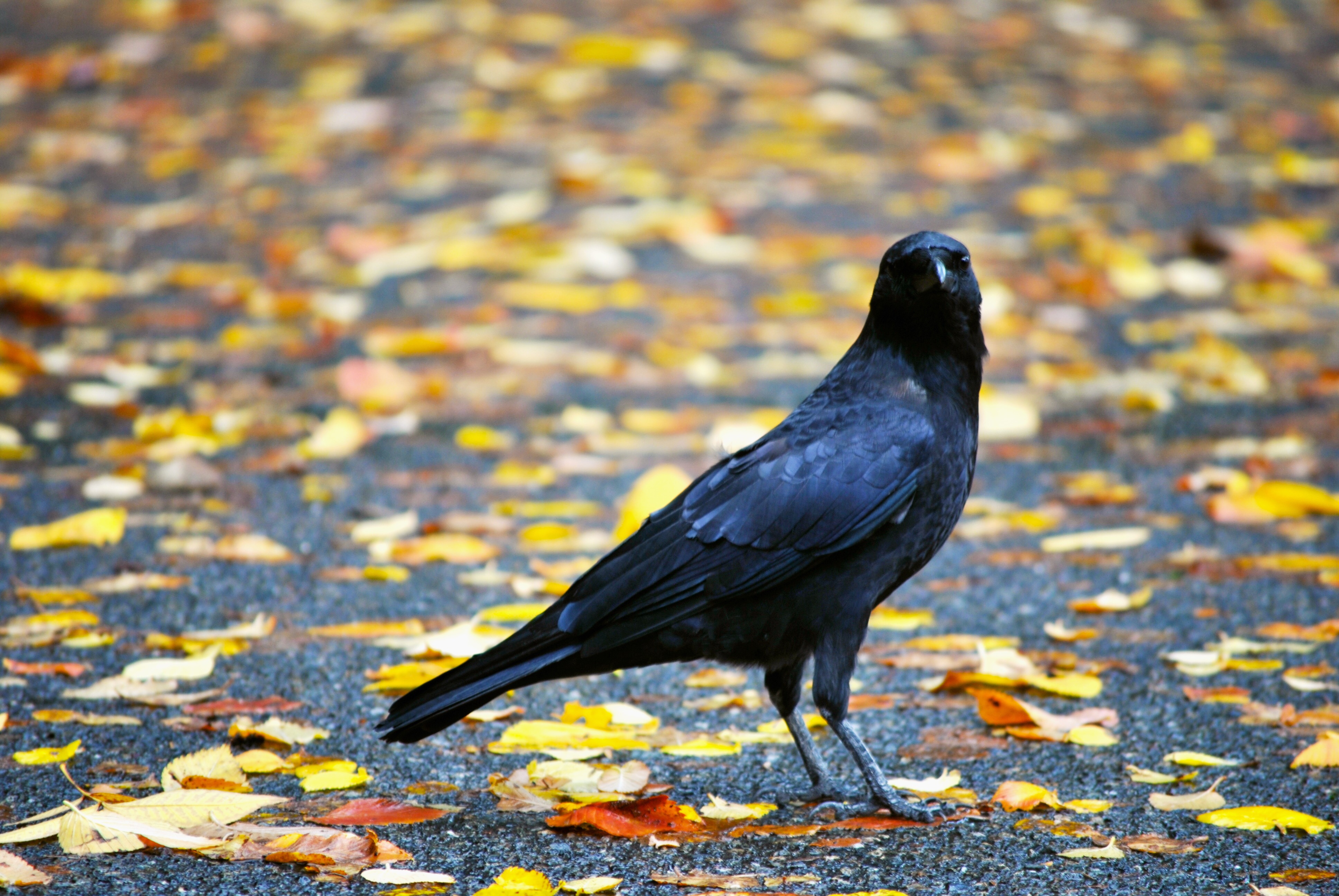
People underestimate how beautiful corvids are. In my field experiments, I’m so often wrapped up in taking the data with as much efficiency and focus as possible, that it makes it hard to step back and really take a bird in. So it’s in the quiet moments outside of my fieldwork that I make time to really see these animals. To do nothing more than watch as the sun brings out those rich colors hiding among the black pigments and marvel at how spectacular they really are. On some of these occasions I make an effort to bring my Nikon with me. Here are some of my favorite photos from those outings which I hope you delight in as much as I do.
Ah fall, the changing colors, the arrival of mushrooming season, and the gratuitous consumption of hot drinks makes this season a favorite of mine. But if you live in a temperate zone like the PNW, there’s one drawback to fall; West Nile virus (WNV). Make no mistake, since its first appearance in the US in 1999, cases of WNV have been documented year round. Outbreaks, however, typically peak in late summer and early fall which is why you often start to see increasing media attention directed towards the discovery of crow corpses. Such is the case with a recent die-off in Spokane which inspired a fleet of recent articles. My favorite was a post from an otherwise predominately car-focused site called The News Wheel which included the following passage:
“In either case, authorities are telling residents that, should they find a dead or dying crow in the street, that they should under no circumstances handle them…In the mean time, it may be a good idea to replace your car’s windshield cleaning fluid with holy water (just in case).”
I suspect some sarcasm was at work there but, in truth, people can get very worked up about WNV. So here are some FAQs about crows and WNV intended to keep you safe and informed.
What is WNV?
WNV is an arthropod-borne virus which can cause febrile illness, encephalitis (inflammation of the brain) or meningitis (inflammation of the lining of the brain and spinal cord). It was first documented in the US in 1999, and exists across most of the world (sigh; the costs of globalization)1.
Why are crows associated with WNV?
No, this isn’t unfair prejudice at work, corvids really do have it rough when it comes to this disease. In all the documented cases of WNV 80% of them have affected corvids, despite its presence in 300 other species of bird2. The connection between WNV and climate change means that corvids could be in big trouble which you can read about in a previous post here.
What does a bird sick with WNV look like?
Most birds who contract WNV will survive, but for the many crows and other corvids what won’t, symptoms include trouble with balance both at rest and while mobile, and lethargy. There won’t be any way to tell if a dead crow is infected simply by looking at it2.
Can I get WNV from touching a crow?
According to the CDC, there is no evidence that a person can be infected by direct contact with infected birds, dead or alive3. That being said, always use gloves when handling wildlife.
Can people get WNV? Yes, though keep in mind that the virus really doesn’t want to be in you. Humans and other mammals are considered ‘dead-end’ hosts meaning we generally don’t develop a big viral load and the virus cannot be transmitted from you to other humans via mosquitoes1.
How is it spread?
Mosquitoes, mosquitoes, mosquitoes. They bite the infected bird and then bite you. And very, very rarely through blood or organ transfusions, and from mother to baby during pregnancy or by breast feeding1.
How worried should I be?
I’m not a doctor so let’s let the numbers speak for themselves on this one. Here are the key stats you should know c/o the CDC1:
80% of infected humans will not develop any symptoms.
Of the 20% that show symptoms, most will look like the flu. It will suck, but you’ll recover just fine.
Only 1% of infected individuals develop life threatening symptoms.
As of September 22, 877 people have tested positive for WNV in 2015. Of those 43 have died. That’s about half the number that will probably be killed by bee stings and twice as many as will be killed by cows4.
For a look at the average annual WNV incidence by state from 1999-2014, check out this map from the CDC. Suffice it to say, in most states the incidence per every 100,000 people is less than 1. As a reference point, about 5-20% of the population gets the flu every year and about 36,000 die as a result5.
How can I protect myself?
The CDC recommends an integrated management plan that includes:
Mosquito surveillance (are there lots around, how often are you getting bitten, are illnesses being reported etc.).
Reduction of breeding sits (i.e eliminate standing water around your home).
The use of chemical and biological mosquito control.
And finally, education (which by reading this you’re already doing!).
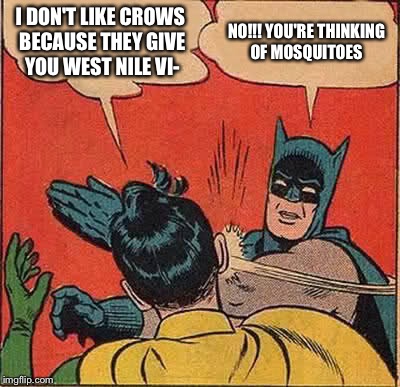
So, does a dead crow in your yard mean it’s time to break out the hazmat suit? Definitely no, but do Fish and Wildlife a favor and report your crow carcasses. And if any of your neighbors start to panic, calmly and gently give them the facts. Or just send them this meme I made you:
By now, most of us have come across these images of “baby crows” so often it induces more of a yawn than a fit of aggravation. If, somehow, these images are new to you feel free to check out my post fully debunking them, as I will not dedicate any further time to them here. But there’s a new photo circulating social media, and it makes for a much more compelling crow doppelganger;
You’ve got three, black, altricial baby birds in a nest and really, they’re not terribly un-crow like. It doesn’t make you a complete crow rookie to make this mistake, but there are some key things wrong here. And this is the moment where, as a scientist, these photos elevate from being simply another source of annoying misinformation (which, they are) to the kind detective work that childhood doctor visits fostered a deep love for. Because, not unlike my favorite activity in the Highlights magazines I anxiously parsed through in those waiting rooms, there are 4 things that are different between these two photos and it’s up to you to find them. So take a minute and see what jumps out at you….
Figured it out (or given up)? The first thing to know is that all bird species are very specific in terms of both nest materials and nest construction. Sure, some birds can happily use some ribbon in place of straw (like orioles) or build nests in old shoes just as easily as in gutters (like bewick’s wrens) but the basic style is always the same. Robins will always use mud as a binder and bushtit nests will always look like cozy sleeping bags made of moss. Knowing that, the material used in the nest on the right should jump out as a red flag. Of course you’ll find crow nests with a bit of string, fabric or grass (especially for lining) but the bulk of the nest is always made of pinky-wide sticks. Really, you need look no further at this point to know immediately that the photo on the right is an impostor but let’s keep going because it’s fun.
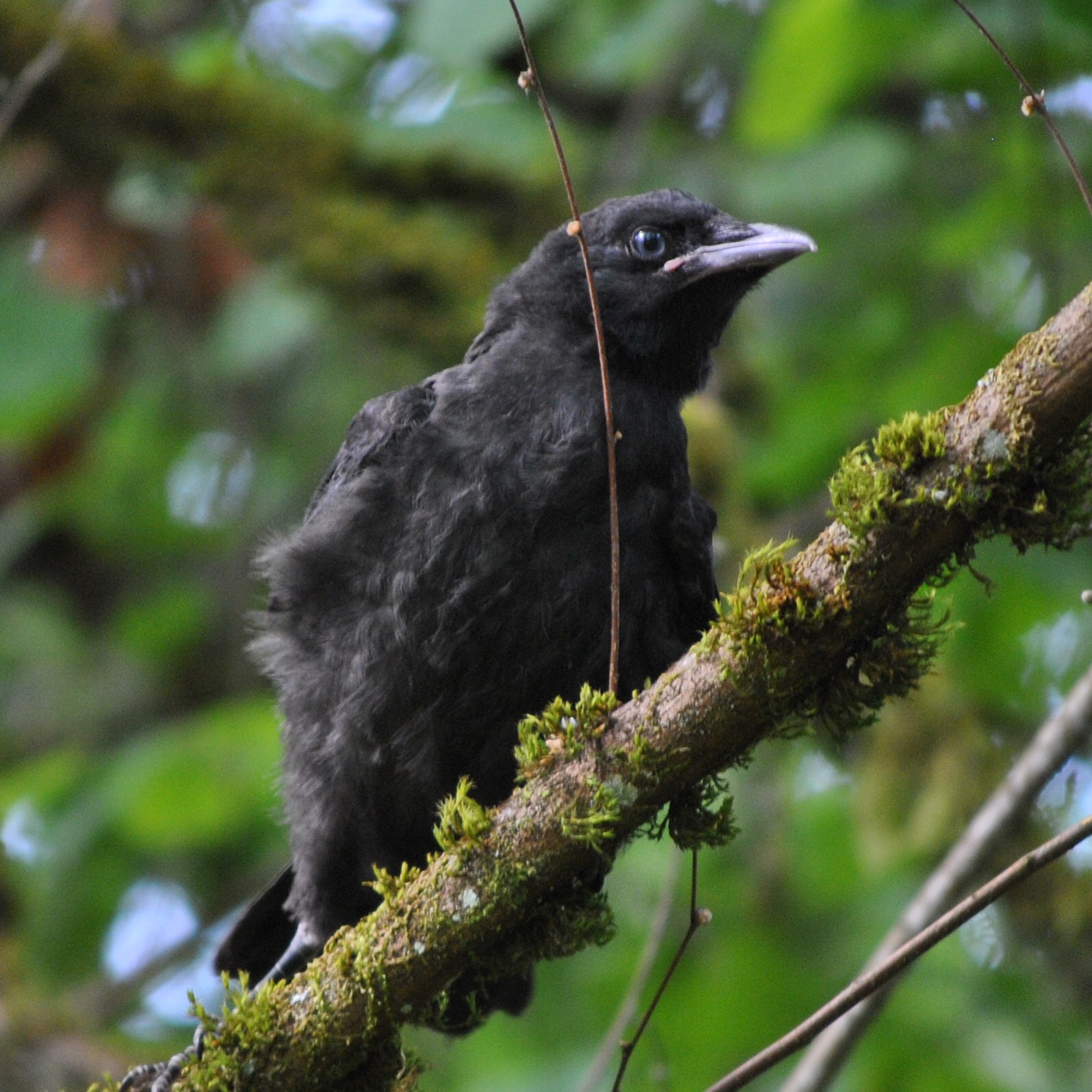
Next let’s look at the babies themselves, which is where the three remaining differences are. Two of them are color-coded, did you catch them? Ah yes, gape and eye color. See that brightly colored area on the corner of the bird’s developing beak? That’s called the gape, and the bright color that flashes when they open their mouths is a powerful signal that tells parents to “insert food here”. Crows have bright pink gapes, whereas these other birds have yellow gapes. Our other color coded giveaway is the eyes. Granted the lighting is not great, but it’s clear that the crows on the left have light blue eyes whereas these other birds have dark eyes. In some species of crow the babies are born with brown eyes that turn blue as they age, but such is not the case with our American crows and you can expect that nestlings will always have blue eyes. The last clue, which takes more expert level knowledge to notice, is the bill shape. The birds on the right have a slightly more embellished curve to the bill than a typical crow chick.
The final mystery, of course, is what the birds on the right actually are. Unfortunately, I failed to track down the original poster, but as best I can tell they’re black drongo chicks. Black drongos are members of the drongo family (Dicruridae) and are native to Southern and Eastern Asia. Here’s another photo I found that looks consistent with the previous one. If any drongo experts read this blog though and want to correct me, I’d love to hear from you!
Recently, scientists have been taking to social media to share their stories of field work bloopers under the tag #fieldworkfail. Things like dropping fecal samples on themselves, falling sleep while waiting for a turtle to arrive, only to be woken up by the curious turtle crawling over them, or darting a zebra and having it pass out in a precarious position. Needless to say I have plenty of stories of my own so I thought I would share my top three favorite, or at least most memorable, field moments.
1) What’s crackin?
At one point during my first field season I found myself spending a week’s worth of my mornings in Seattle’s International District between the hours of 5 and 7am. Looking back, this was a bad idea. So much so that at one point a cab driver pulled over to ask what I was doing and urge me, for the sake of my safety, to leave immediately. But there were crows there and after months of time on the streets of Seattle I had developed an inflated sense of my safety and bad assery and decided to stick it out. On one of my last mornings at this particular site, a women who I had previously encountered pan handeling took a seat on the bench next to mine, and proceeded to pull out what was unmistakably a crack pipe. Unwilling to give up my data, I politely asked her to move but, much to my dismay, she didn’t seem very interested in listening. High on crack, she then proceeded to do cartwheels over my peanuts and dance pants-less around my field site. After a while she tuckered out and left me alone to do my work. Looking back, I’m not sure if this was more a #FieldworkFail or a #KaeliLifeDecisionFail but it’s certainly not a field experience I wish to relive!
My unwelcome field participant spicing up my morning with some drug induced cartwheels
2) Sorry kids
During some of our experiments looking at the funeral behaviors, we would have volunteers stand around holding dead crows. To protect their identity should the crows decide to hold a grudge, I had the volunteers wear rubber makes that covered their whole head. One of my best volunteers was a fellow UW student, a mountain of a man who had a proclivity for wearing black and camo. One of these field experiments was in Magnuson park which, if you live in Seattle, you know is one of our most curious parks. It’s got all the features of a park you might expect like a play ground, soccer fields, trails that wander through peaceful restoration areas, but it’s also got some more curious features. Old, WWII era airplane hangers, a block of abandoned school building and a few miscellaneous businesses just to name a few. So when selecting a field site I picked a spot that seemed far from the potentially curious glances of parents or kids coming to enjoy a day at the park and instead nestled against one of the many buildings which appeared to have no foot traffic. I was surprised then, when moments after starting our experiment a police car rolled up with its lights flashing. Turns out the building I thought was rarely used was actually a pediatric dental office and I had planted my 6’6”, black and camo clad, dead bird holding, creepy mask wearing volunteer right under the side window. Whoops!
Volunteers were required to wear signs after this incident…
3) Off with their heads!
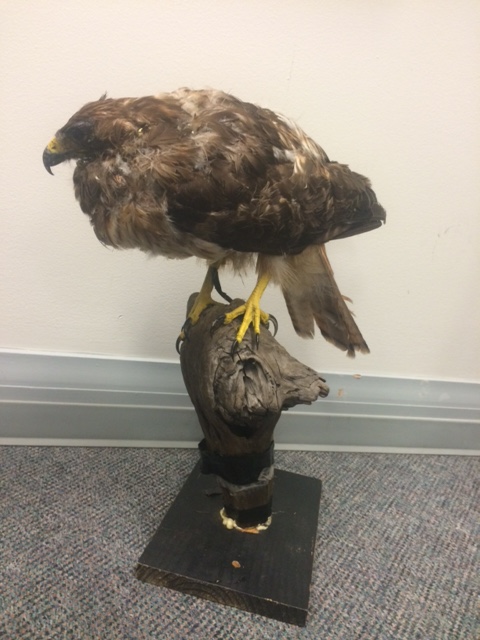
During one of my preliminary field experiments we were looking at how crows respond to a mounted stuffed hawk. We didn’t want them to see it before it was in position, so we would cover the bird with a piece of mesh camo fabric until moments before we were ready when a volunteer would run over and pull the cloth off. Although the holes in the mesh were very small, as it turned out they were exactly the right size for the tip of the hawk’s bill to fit through. One fateful day, my volunteer got more than she bargained for when the hawk’s bill caught on the mesh and the head ripped right off along with the cloth. Unsure of what to do she balanced the head on the hawk’s shoulders and proceeded with the experiment. All was well until right at the end, when one of the aggressively diving crows actually hit the hawk and knocked the head to the ground. We’ll never know what was going through his or her mind at the achievement or what followed, but I like to imagine that on the block of 8th and Madison in downtown Seattle to this day juvie crows share in uncertain but excited whispers about the legend of the crow so powerful, it took the head of the a hawk in one fell swoop.
Big Red is a little worse for the wear but she still gets the job done!
For most of us, it’s hard to imagine crows being anything but ubiquitous. Here in Seattle, American crows can nest so densely, I once found myself within 50 m of three different active nests. Such is the case for many other parts of the world too, where house crows, jungle crows, or hooded crows are an almost inescapable part of the landscape. Given these species’ success, it might be tempting to assume that all crows welcome human presence and habitat modification. Rules don’t exist without exceptions however, (especially in nature!) as our Corvid of the Month, the Mariana crow, tragically illustrates.
A female Aga and fledgling do some exploring. Photo: Matt Henschen
The Mariana crow, or Aga, is endemic to Guam and Rota and is the only corvid native to Micronesia1. In appearance, they bear a striking resemblance to the American crow, only they’re 40% smaller (cue adoring sound effects). Across their range they’re considered critically endangered and as of today, all of Guam’s birds have been extirpated by the invasive brown tree snake, and only about 46 breeding pairs remain on Rota. If that wasn’t alarming enough, their numbers continue to dwindle and researchers at the University of Washington project they could be extinct within the next 75 years2. Unlike Guam, however, there are no brown tree snakes on Rota. So what is causing the drastic decline of this island crow? As my colleague and Mariana crow researcher, Sarah Faegre, is beginning to tease out, the answer may lie in the delicate nature of island food webs, and the unanticipated butterfly effect that started with a few errant snails.
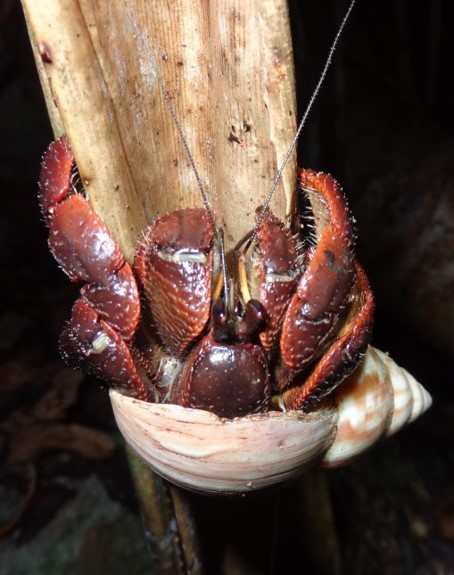
Like our American crows, Mariana crows are generalists and eat a wide variety of foods from insects, to geckos, to fruits and seeds. But adult Mariana crows have one other food source they’ve come to specialize on: the humble hermit crab. Despite the presence of hermit crabs near other species of corvus, the Mariana crow’s frequent predation on them is unique, especially when you look at how they extract them. Unlike most coastal or inland living crows that drop tough objects like clams or nuts onto hard surfaces to open them, the Mariana crow actually uses its bill to peck and break the shell at the seams to extract the vulnerable crab, a process that takes place entirely on the ground and is only shared by two other known bird species in the world (one of which is now extinct). So what does this have to do with wanderlusting snails? As it turns out, everything.
What’s crackin’ crabby? Photo: Sarah Faegre
Rota is home to several species of native land and sea snail, though hermit crabs only utilize the larger shell of the sea snail. Critically, these shells are extra hard and apparently impenetrable to even the most determined crow. In the late 1930’s, however, humans introduced the Giant African Land snail which quickly invaded the island. Two major differences between the native and invasive snails are 1) that the invasive snails have thinner shells, and 2) people were anxious to get rid of them. So, naturally, we introduced yet another invasive species (a predatory flatworm) and…it actually worked. By the 1970’s the island was brimming with large, thin, empty shells, ready and waiting to be filled with hermit crabs. Gradually, the crows learned that these shells were possible to peck open and now hermit crabs are an important staple for Rota’s crows.
Photo: Phil Hannon
On its surface, this seems like the making of an ecological disaster turned into a conservation blessing. After all, we successfully controlled an invasive species while simultaneously creating a new food source for a threatened bird. But in our tangled web of introduced species and ecological fallout we must considering the one remaining player: cats. Although further study is needed, Sarah’s work3 suggests that all that extra time adult crows now spend on the ground cracking open hermit crabs may be making them more susceptible to predation by cats.
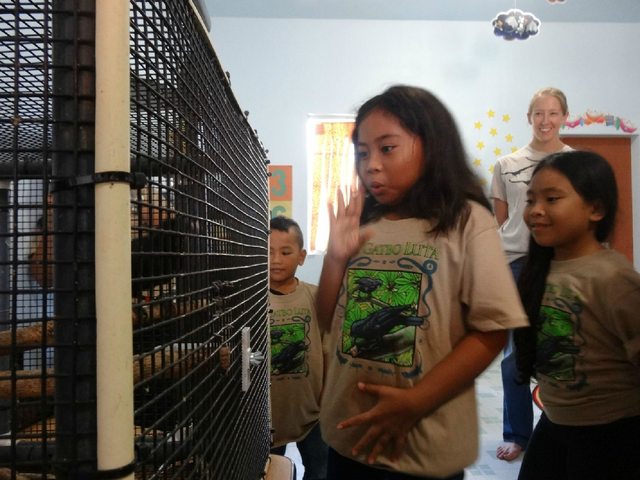
Couple the effect of cats with habitat destruction and persecution by people and the results project a bleak outlook for crow recovery. But conservationists and researchers like Sarah are working tirelessly to better understand the threats facing this bird and how to solve them. In fact Sarah and her husband, Phil Hannon, recently started a non-profit called Luta Bird Conservation to help raise awareness and conservation funds to better protect this unique crow. At the top of their priorities is funding initiatives that would bring the science of crow conservation to the classrooms of local people, helping to raise both pride and awareness for the plight of this endemic species.
So the next time you look at a crow and experience a slight feeling of fatigue at such a ubiquitous bird remember; not all corvid species welcome the consequences of people and some have suffered greatly from them. Aldo Leopold once said “to keep every cog and wheel is the first precaution of intelligent tinkering.” The lesson from Rota, and so many others, is that the same can be said of not adding any either.
If you wish to contribute directly to Mariana crow conservation, I encourage you to send Luta Bird Conservation Inc. a check at:
Luta Bird Conservation Inc. c/o Aron Faegre
520 SW Yamhill Street, Roofgarden 1
Portland, OR 97204
Sunny the captive Aga on an ambassadorial trip to a local classroom with Luta Bird Conservation Inc.

















 corvidresearch.blog