Crow curiosities: crows without tails

For the most part, crows come in the same general size, shape and color, but every once in a while individuals will deviate from this template in eye catching ways. These deviations can manifest as missing or elongated beaks, color abnormalities such as white plumage, or jarring metamorphoses into rudderless, flying orbs. 

DSC_0208

Tailless crows are fairly uncommon; in a typical year I’ll maybe spot a couple afflicted individuals. Although feather loss and replacement is a normal part of a crow’s annual cycle, crows don’t shed their tail feathers simultaneously so we can’t blame molting season for this odd appearance. Instead, a tailless crows most often indicates that the bird recently escaped a predator or other kind of threat. 

Similar to some lizards, many bird species can drop their tails defensively as a last resort to avoid being injured or killed. In fact, tail feathers require less force to detach in contrast to other feathers on a bird’s body. In addition, the force required to remove tail feathers decreases with how vulnerable a species is to predation.1 Tail feathers can also be broken, rather than completely lost. Although that might sound painful, unlike a bird’s beak which is full of nerve endings, mature feathers are dead structures like hair or fingernails. While a bird surely feels and avoids the sensation, it’s not painful. 

Tails are crucial to most birds not only for their visual appeal but also because they allow birds to steer and maneuver in flight. Without one a crow can still fly and land, but they’re not nearly as agile in the air and you’ll notice their take offs and landings are a bit awkward. Fortunately, the tail will eventually grow back though just how quickly is contingent on what happened to the feathers themselves. If the feathers were pulled out, so long as the follicles weren’t damaged they will begin to regrow immediately. If, on the other hand, the feathers were broken rather than pulled out, the crow will need to wait until its annual summer molt to replace them. 

DSC_0212

For crows fortunate enough to be brought into a wildlife care facilities, there’s also a secret second option to correcting a broken flight feather: imping. Although little known outside of rehab or falconry circles, imping is an age-old technique dating back to at least the 1240’s when it was mentioned in The Art of Falconry by the Holy Roman Emperor, Frederick II. The procedure involves trimming the broken feather to about one inch above the skin and then inserting a thin piece of wire, fiberglass, or wood (called the imping needle) into the empty feather shaft. A matching donor feather is then affixed to the exposed portion of the imping needle. Picture sheathing a double sided samurai sword, where the sword is the imping needing and the sheaths are the imbedded, trimmed feather shaft and the donor feather respectively. Historically, rust was used as a bonding agent but today vet safe epoxies are the standard adhesive. 

So the next time you see a tailless crow go ahead and give it a few extra treats. It’s not in any pain, but it’s been through something fierce. And to quite literally add insult to injury, it looks absolutely ridiculous.

Literature cited

  1. Moller, A.P., Nielsen, J.T., Erritzoe, J.  (2006).  Losing the last feather: feather loss as an antipredator adaptation in birds.  Behavioral Ecology 17: 1046-1056

28 Comments

Filed under Uncategorized

Everything you want to know about crow nests

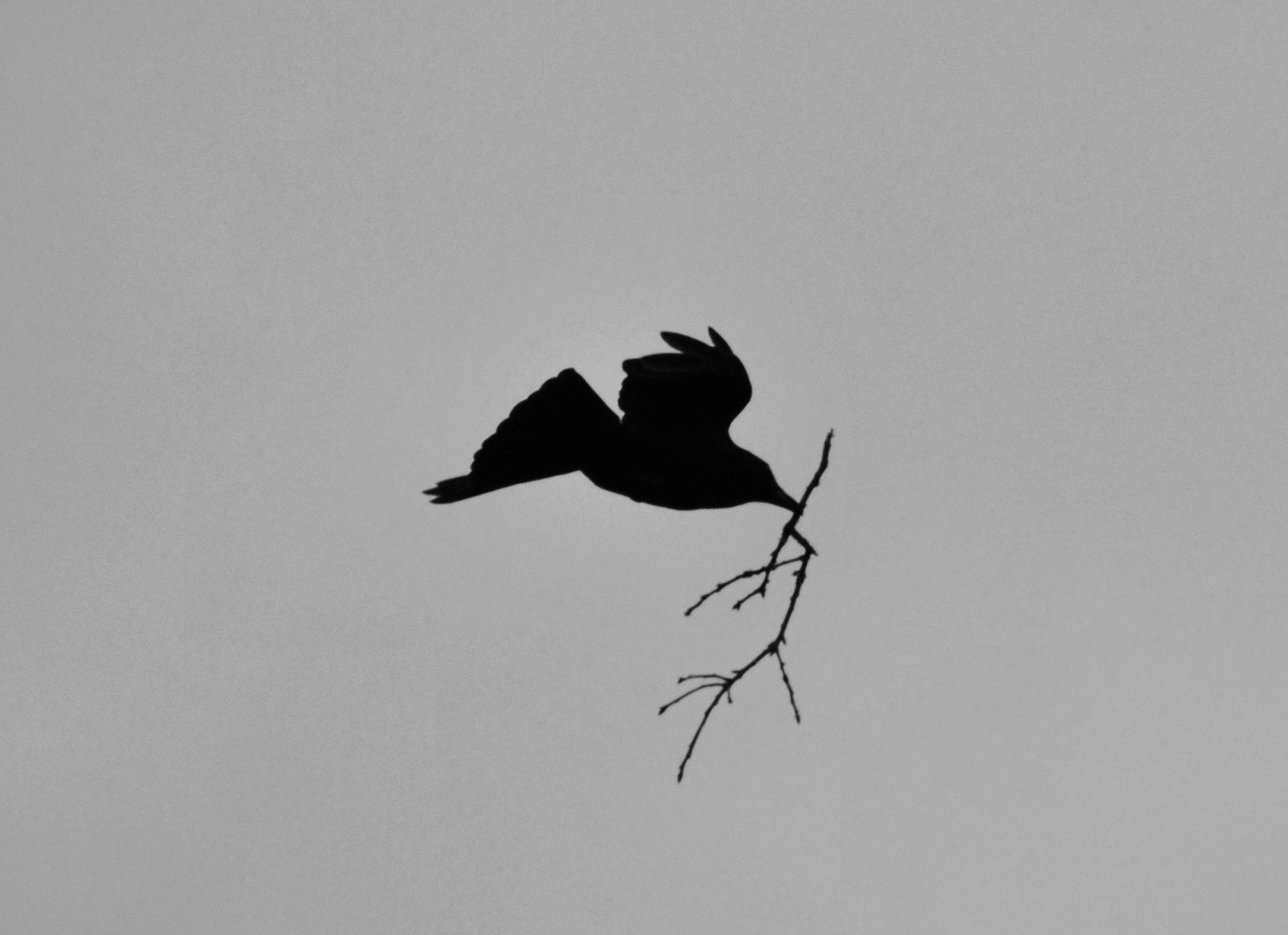
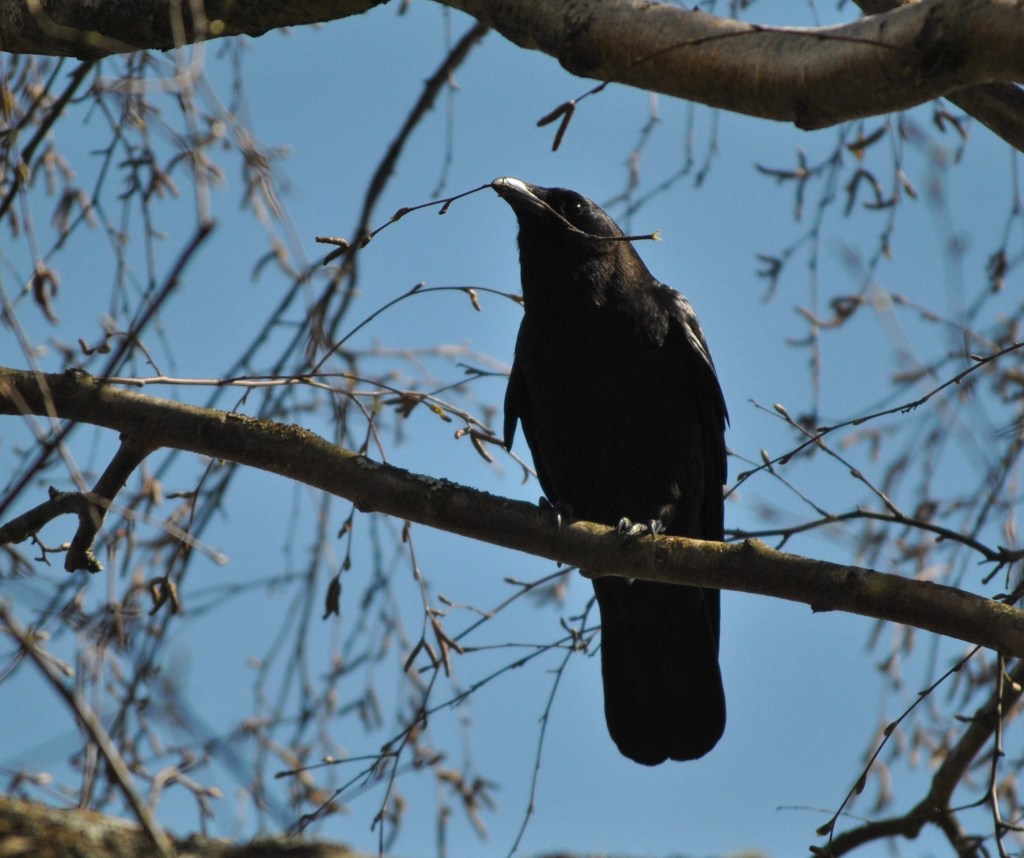
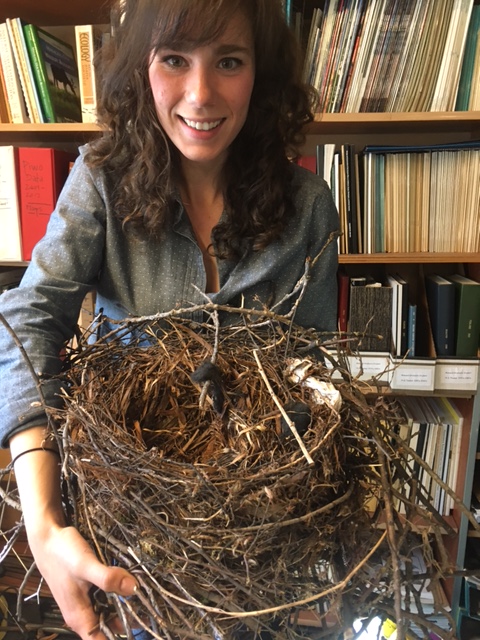
Spring marks one of my favorite times of year.  Cherry blossoms abound, the rain smell sweet and the birds get busy putting their carpentry skills to good use. Starting early March, the silhouettes of crows with bill loads of timber or wads of soft material dot the skies as they shuttle back and forth to their nest tree. Like a townhouse development, these construction projects are over in the blink of an eye and soon, their bill loads of twigs will be replaced by food for their mate and, eventually, their insatiable young. Spotting these nests is both a great way to observe and engage with your local crow family and avoid unpleasant conflicts with protective crow parents.  With a little knowledge and a bit of practice, tracking down your resident crow nest will become one of your favorite spring traditions in no time.

DSC_2832 (1)

Nest construction and site selection

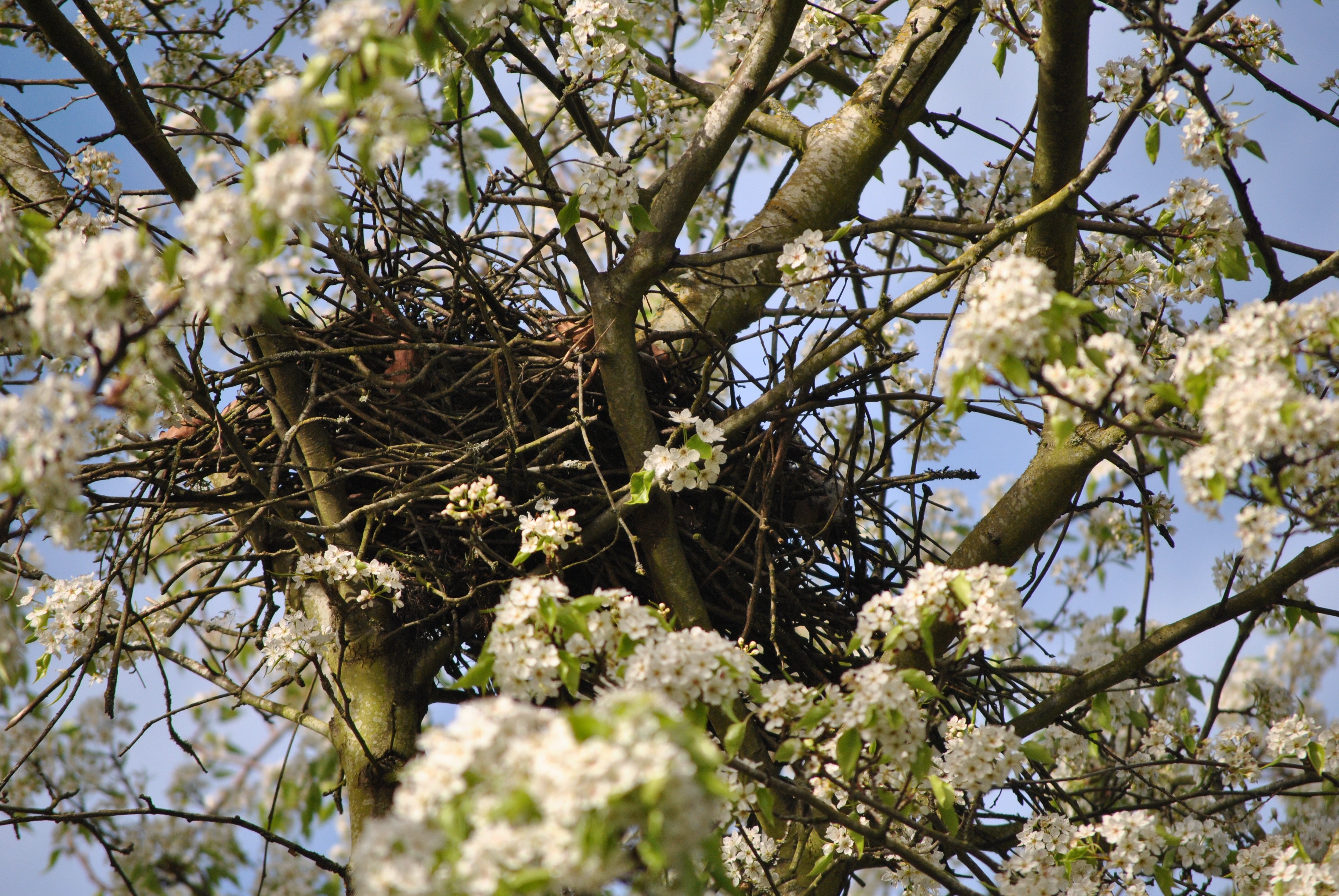
Nest construction begins in early March and will continue (as nests fail) through about June. It takes 1-2 weeks to finish a nest after which the female will lay a clutch of 2-6 eggs. Unlike similarly sized squirrel nests (aka: dreys) which are made of leaves, crow nests are made mostly of pencil-width twigs. A new nest is usually about 1.5 ft across and 8-10 in deep.  After the bulk of construction is complete, they’ll line the cup of the nest with soft materials like grass, tree bark, moss, flowers, paper or fur. Once we saw a crow ripping out the hair of an outdoor mannequin, no doubt to use as lining material.

DSC_3052

A crow gathers moss off the branches of a big leaf maple to use as lining material.  

DSC_2997

This bird toyed with this branch for a few minutes before rejecting it and letting it fall to the ground.  

DSC_2949

A sidewalk littered with twigs is good evidence that the nearby deciduous tree is a favorite among the local crows to pull branches from.  I’ve only once seen a crow try and retrieve a branch it dropped, so these are all rejects.  

Crows will nest in an astounding array of places, from the eaves of skyscrapers to the crooks of well concealed tree limbs. They can tower in the sky or be almost within reach. Most commonly, I see them built close to the trunk in the top third of Doug fir trees, but this is, of course, specific to the PNW.  Both partners participate in nest construction. Helpers will aid to some degree but most of the work is left to the parents.

DSC_2930

Differences among corvids

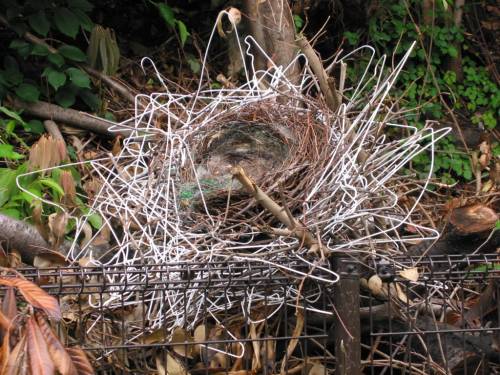
Crow, jay and raven nests are similar in shape and material but differ in overall size in accordance with the size of the bird. The main standout are magpies,  which build incredible domed-shaped nests the size of a large beach ball.  The nests require so much material, they can take as much as 40 days to build.  Japanese jungle crows are another species of note, as they have a (relatively) new and problematic habit of building nests out of wire hangers and causing massive blackouts.

Creativity_crows_nest_made_of_clothes_hangers

A Jungle crow nest in urban Japan. Photo: Götz

DSC_0331

The magpie’s nest is the big clump in the middle of the tree.

Reuse

The life of a typical nest is only about 9 weeks (1-2 weeks of building, 6 days of laying, 20 days of incubating and 4 weeks of nestlings) though they are hardy structures and can remain intact in a tree for years.  After the young fledge, the crows will not return to the nest.  Crows will only use a nest once, and generally only fledge one brood a year. They will, however, build on top of an old nest particularly in areas where nest trees are especially sparse like downtown Seattle. This also appears to be more common in the Midwest.

Avoiding conflicts

Most breeding related dive bombs occur as the result of a person being too close to a fledgling, but some crows get feisty around their nest too. Crows in areas where they are less persecuted (like cities) tend to be more aggressive than their rural counterparts. If you know where a nest is and can avoid it, do so and save everyone the aggravation. Otherwise carry an umbrella or paint eyes on the back of a hat. Crows rarely attack from the front so having eyes on the back of your head can be an effective deterrent!

***

Putting all this together to actually find nests, is one of the most rewarding moments an urban naturalist or crow enthusiast can have.  Be warned though: crows are wary of potential predators (including people) spying on them and they have a few tricks for throwing you off, so don’t be surprised if a nest location you were certain of turns out to have been a ruse!

DSC_3055

Can you spot the nest? 

Have more questions? Let me know in the comments!

IMG_3761

287 Comments

Filed under Birding, Breeding, Crow behavior, Crow life history, Crows and humans

How corvids mimic human speech

If you’ve spent much time watching corvids in person or online, chances are you’ve come across one doing a Fred Armisen-level impression of something else. Perhaps it was the Steller’s jay in your backyard tricking you into thinking there was a red-tailed hawk soaring overhead, or maybe you remember the trash talking American crow that invited itself to an Oregon elementary school and delighted children with some crass language. That corvids, like some parrots, starlings, bowerbirds, etc., can mimic is well understood, but have you ever wondered why? Why can a bird talk like a person but a chimpanzee, an animal who shares 98% of our DNA, cannot? The answer boils down to three things: vocal anatomy, the brain, and behavior.

In humans, as with virtually all other terrestrial vertebrates, sound is produced in the larynx aka the voice box. As air passes through the larynx it vibrates the vocal cords, producing sounds. Across different species this system is enhanced or reduced, resulting in the roar of a lion, the grunt of an alligator or that conversation you wish you could have avoided with your coworker. While birds also have a larynx, it doesn’t produce sound. Instead, birds (well, most birds) have a wholly unique structure called the syrinx which sits not at the top of the trachea as the larynx does, but at the bottom, right at the bronchial split. This unique forking anatomy allows some birds to lateralize their sounds, meaning making different sounds on the left or right side, sometimes even at the same time! The repertoire of parrots is further enhanced by their fleshy (for a bird) tongue, which can manipulate air flow and produce more human-like speech.1 It’s this level of vocal complexity and control that possess birds with the incredible vocal range we hear, whether they use it for mimicry or not. In fact, despite this potential, most songbirds do not mimic, and actually cannot learn new songs after their first year of life.

But while the syrinx explains why some birds can produce human speech sounds, it doesn’t explain why our closest primate relatives cannot, especially given the similarities of their voice box with our own. That’s where the brain comes in. While non-human primates have the correct hardware in their vocal tracts2, they’re missing the technology they need in their brains.3 Specially, in the cortical association areas in the neocortex (the part of the brain that’s responsible for our higher-order behaviors). They simply don’t have the neurological control required to mimic human speech (though they do mimic us in other ways). So why do birds?

Unlike in primates, vocal mimicry is a cornerstone of communication and signaling in certain birds. Whether they’re using it to advertise their quality as a potential mate, territory defense, or as a way to bond with partners or group mates, mimicry plays a key role in engaging with those around them. Though the specifics of that engagement may not always be clear. For example, despite persistent online assertions that Steller’s jays mimic hawks either to warn of their presence or to scare competitors, there’s zero evidence in support of either of these. In fact, a study from 2017 found that wild jays almost never do it when predators or competitors are around, and instead do it most often at the beginning of the breeding season in front of their mate.4 Which is probably for the best. After all, if corvids chose to really make a habitat of using mimicry to trick other animals we’d likely find ourselves at the top of their target list.

Literature cited
1. Beckers G, Nelson B, and Suthers R. 2004. Vocal-tract filtering by lingual articulation in a parrot. Current Biology 14: P1592-1597
2. W. Tecumseh Fitch, de Boar B. Mathus N, Ghazanfar A. 2017. Monkey vocal tracts are speech ready. Science Advances 2: DOI: 10.1126/sciadv.1600723
3. Dunn J and Smaers J. 2018. Neural Correlates of Vocal Repertoire in Primates. Frontiers: https://doi.org/10.3389/fnins.2018.00
4. Tippin T. 2017. Propensity of predator mimicry in wild Steller’s jays. Humboldt State University, MS thesis

6 Comments

Filed under Birding, Crow curiosities, Jay behavior, Ravens, Vocalizations

A letter to the broken hearted nest observer

Breeding season is often a hard time for the tender hearted among us. The joy of watching an animal construct a nest just to see their efforts cut short by predation is painful. Likewise, finding a dead chick is tough, and prompts many to ask how they could have prevented such loss and better protected them.

I appreciate the people that bring me these questions so much. That care so deeply they would put in the effort to seek out these answers from a scientist and spend their time doing what I suggest. These are good people.

But whether you’re asking how to protect birds from crows, or crows from other animals, my answer is always the same. As hard as it is to watch animals get eaten, it’s vital to remember that predation is what keeps wildlife wild. It’s what keeps ecosystems complex & beautiful.

When we get into the business of deciding that (native, natural) predators are bad, and attempt to take action against them, we are denying the very wildlife we want to thrive from facets of their identity that make them who they are. Prey communities are shaped by the predators that have historically hunted them, and vice versa. Whether it’s how cryptic the chick’s color pattern is, how many eggs the female lays, where they build their nests…not one corner goes untouched. It’s this very process that has made something so beautiful that we can’t stand to see it harmed. But for communities to function that death is essential.

Predation is the transfer of life and that life is a gift. It’s a gift that ensures the survival of another, and even if we don’t know that individual as well as the one we watched perish, it’s not for us to assert that it, or its offspring, deserves that gift any less.

On the other hand, finding a dead, otherwise unharmed, chick can feel less…purposeful. “Why was it out of the nest so early?” “I read to leave it alone and it died anyway…should I have stepped in?” “I feel so bad I couldn’t save it!”…These are common responses.

But while it’s true that baby birds do sometimes (rarely) accidentally get kicked out of the nest, it’s also true that it’s not always an accident.

Sometimes parents simply reject offspring for reasons that are not for us to know. And that is okay. Part of honoring their wildness is accepting that they know more than us about their own lives, and that if they choose to not to support a chick they have a reason. There are exceptions of course in cases of conservation concerns, but for most backyard circumstances it is okay to accept their choice without interfering. Even if it hurts.

So please, rather than shutting down those deep feeling you have for wildlife by intervening, lean into them. Teach your friends and neighbors and children to feel those deep feelings. Because it’s from that space that we can do best by wildlife, even if it’s the kind red in tooth and talon.

It’s from there that we can grow a culture of care and empathy that shows us that nature is a community and by thinking first of community and not of the individual, can we have the broadest reach. That planting native vegetation, and keeping cats indoors, and fighting to protect land and water, is the way to love wildlife. Not by choosing who deserves to eat and who does not.

32 Comments

Filed under Birding, Breeding, crow conflicts, Death, Ecosystem, Wildlife

Crow curiosities: do crows migrate?

That birds travel seasonally is perhaps one of the most familiar facts about the natural world. Whether it’s the arrival of technicolor spring migrants, or the din of waterfowl above our heads in the fall, it takes no formal training to recognize that something novel and beautiful has suddenly erupted into our lives. Their ephemeral presence offers an opportunity to ground ourselves in time and place and reflect on the shape of our lives since our last meeting. Or, if you don’t want to get that deep with it, there’s always Looney Tunes or any number of other children’s cartoons to remind us that some birds come and go with the seasons.

At the same time, for most of us living in the continental United States, that crows will be nearby to accompany us throughout our year is something we take for granted. Their predictability on our telephone poles and near our garbage cans is one of those quiet details not everyones thinks of often, but whose consistency surely calms us as so many other things feel unsteady. But at the intersection of these truths is an interesting question: if migration seems such an essential part of bird life, why don’t crows do it? Or do they?

Of the world’s ~ten thousand birds species, only 18% actually undertake annual long distance migrations.1 But there are other types of migration including short distance migration, altitudinal migration (short migrations from shorter to higher altitudes) and partial migration. Partial migration is when only certain individuals within a population migrate, while others are sedentary, and it’s this one that applies to crows. Because while crows in temperate Seattle may be quite comfortable year round, those that call higher latitudes “home”, say central Canada, would have a tougher time making it through the winter unscathed. So much like a wealthy aging relative, they snowbird it to more welcoming climates for the winter.

Until the last decade or so that’s really all we knew about about crow migration. Some did it, some didn’t, and that was that. But given the value of better understanding this behavior, as well as the technological advances that make it possible, western science has finally turned its eye to inspecting these patterns more closely. Because there are so many questions one could ask about this phenomenon. Why do some crows migrate and others do not? Do the same crows migrate each year or can they opt out? Do they return to the same place? How far do they fly? How do they survive the journey? How do they sleep?

In some cases the answers to these questions are surprisingly nuanced. For instance, birds living in the Central and Southern Canadian provinces will nearly always migrate hundreds of miles south into the US, which makes sense because Canadian winters can be especially harsh. But studies have shown that other crows make even shorter migrations, only about 350 miles between contiguous US states with similar climates.2 What motivates these shorter-distance trips remains to be seen. Likewise, whether migrating is a discretional activity is still in question. From a climate change perspective, that individual birds might be able to choose whether or not to migrate each year would have important implications in their ability to adjust to changing conditions. But in the studies conducted so far there’s been no evidence that crows pick and choose each year, rather it seems that you’re either a migratory individual or not, albeit this is based on low sample sizes.3 As a result, migrating crows show extremely high site fidelity; returning to the same breeding and winter sites each year.

As far as distances go, there’s huge variability there as well. In a study that looked at crows from both sides of the country, the average distance traveled by east coast crows was 287 miles, while west coast crows traveled an average of 366 miles.3 The longest migration on record is 1740 miles.4 One thing that’s for certain is that migration is a daytime affair. While most birds migrate at night, crows are among the minority that stick to business hours for their travels. The most compelling explanation for strategy is the “fly-and-forage” hypothesis. Look, even for the arguably most efficient fliers in the animal kingdom, flying is hard work and crows need a lot of calories to sustain flight speeds up to 37mph covering as much as 186 miles in a single day.2 To accomplish this, crows will make up to several pit stops during a marathon flight session, allowing them to refuel and prepare for the next leg. Importantly, although crows migrate both in groups and alone, when stopped they almost always make sure to dine with others. Traveling in the daytime probably helps facilitate finding other crows, and by extension, the local feeding grounds.

When it comes to sleeping, crows leave the fancy mid-flight naps to the swifts and the frigatebirds, opting instead to sleep at night in communal groups. In fact crows will sometimes abruptly change direction just to follow local birds to the nearest roosting grounds. In other cases though, crows have been know to travel routes that allow for stops at the same roosts year after year, underscoring why roost locations should be considered key pieces of habitat.2

So as it stands, crow migration can be summarized the same way as most other parts of their lives: we know some stuff, not everything, we’re probably wrong about a few things, and our best bet is to accept our role as eager pupil and celebrate the gifts of knowledge as they are granted to us.

Literature cites
1. Sekercioglu C.H. 2010. Partial migration in tropical birds: The frontier of movement ecology. Journal of Animal Ecology: https://doi.org/10.1111/j.1365-2656.2010.01739.x

2. Ward M.P. and Raim A. 2011. The fly-and-social foraging hypothesis for diurnal migration: Why American crows migrate during the day. Behavioral Ecology and Sociobiology 65: 1411-1418

3. Townsend A.K., Frett B., McGarvey A. and Taff C.C. 2018. Where do winer crows go? Characterizing partial migration of American crows with satellite telemetry, stable isotopes, and molecular markers. The Auk 135: 964-974

4. Brewer D., Diamond A.W, Woodsworth E.J, Collins B.T.,, and Dunn E.H. 2000. Canadian Atlas of Bird Banding, vol 1: Doves, Cuckoos, and Hummingbirds through Passerines, 1921-1995. Canadian Wildlife Service, Ottawa, ON, Canada

11 Comments

Filed under Climate change, Crow behavior, Crow life history, Movement

Butts for nuts: can crows do our dirty work (and should they)?


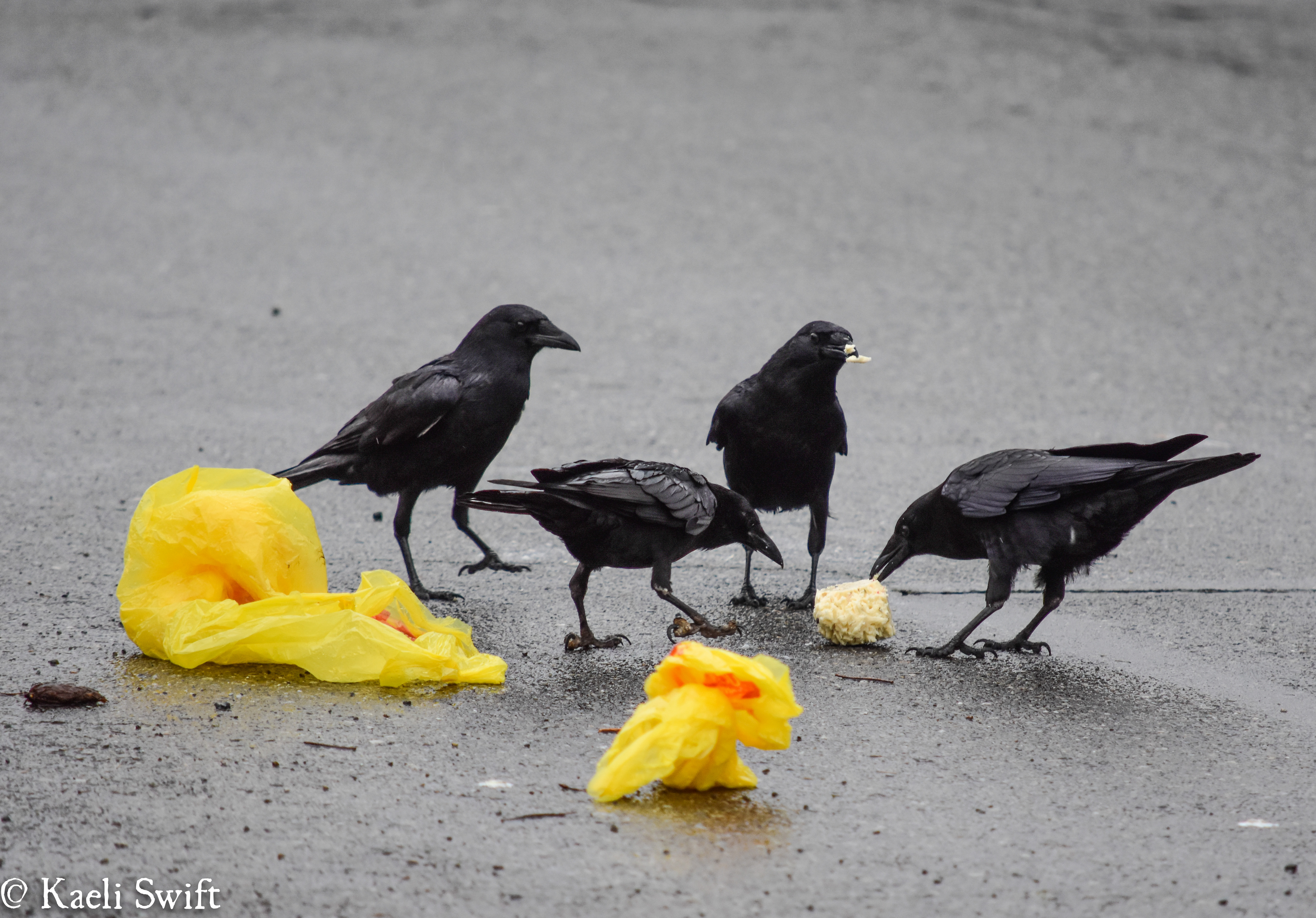
It’s no mystery that garbage is one of the most pervasive issues of our time. From oceanic microtrash to seeping landfills, people are trying to work out how to address the world’s garbage crisis with increasingly grand ideas. Corvids have long been associated with garbage, sometimes acting as agents of litter themselves, but one such idea asks if they might offer a solution.

A Swedish start up, Corvid Cleaning, is attempting to train corvids to pick up cigarette butts in exchange for food, as a means of combating the pervasive litter problem across their city. They plan do this through a machine that according to their website, they’ve already successfully ground tested with wild birds.

So, will this work and is it a good idea? In my opinion no and no, for many reasons. This whole idea rests on the premise that corvids are smart, (which they are,) but being smart and being motivated are very different. It’s not an issue of whether crows *can* learn it, but how you keep them engaged over time (the company hopes to save 75% of the city’s current cigarette clean-up costs). Having fed a lot of crows a lot of peanuts, I can tell you that the appeal of unlimited peanuts wanes drastically over time. While there might be an initial rash of participants, or at least a couple highly exuberant ones, there’s a serious question of meaningful sustainability without the introduction of a more desirable (and more expensive) food.

My skepticism here is born both from my experience with crows and the cold hard fact that this has simply never worked before. This isn’t the first time someone has tried this, but the 4th. The first was in 2008, when Joshua Klein delivered his infamous and highly misleading crow vending machine TED Talk. From there the Klein team debuted their Open Source idea for the Crow Box, a build it yourself machine that offered the chance to train wild crows to exchange found coins for food. While the no promises, DIY, community science nature of the project gets a more sound endorsement from me, to date, no one has had success with the final stage of the training process. The idea it seems, makes no cents. Next, in 2017, a Dutch start up called Crowded Cities pitched the exact same idea as Corvid Cleaning, though I assume their proprietary machine was a bit different. By December 2018 though, they tabled the idea, citing a lack of resources and an inability to, “get a clear picture of what the effects would be on crows and the environment.” That same year a French theme park, Puy du Fou, hired a falconer to train some captive rooks to pick up garbage as a stunt for the park. In that case it worked marvelously but of course the stakes are entirely different between wild and captive birds. And in between all those highly profiled efforts have most certainly been the odd successful backyard tinkerer. But what eventually plays out over and over again is that while wild crows can learn to do this, no one has ever been able to scale their success into something meaningful. And I don’t think they ever will.

For a moment though, let’s say that my skepticism here is invalidated; various corvids do consistently use the machine as intended. In fact, their intelligence and understanding of cause and effect renders them quite simply excellent at it. Without the appreciation for the purpose of their activities (cleaning up garbage) the project is liable to create two different kinds of cheaters: those that steal the food out from under the participants and those that resort to collecting their currency straight from the source, before it’s officially become garbage. I’m not sure how likely either of those two scenarios are, and in fact bearing that out is nearly worth keeping quiet and bagging this whole article simply to find out. But there remains at least one more point that compels me to keep going: I have never once seen a proponent of this idea fully tackle the very real health and safety issue at stake here.  

At the smaller end of this question are the issues associated with the maintenance of the machine itself. How do they plan to keep pests and mildew out of the food hopper? Rats would be the most conspicuous problem, but it’s the smaller stuff that might prove the most challenging. In my own hard learned lesson on this, I’ll never forgive myself for infesting my sister’s kitchen with pantry months after leaving behind a forgotten bag of peanuts. And of course like any high calorie food, nuts are liable to spoil especially when unsealed and exposed to the environment. I don’t offer this in denial of the absolutely horrendous things I’ve seen crows gleefully eat, but if you are intentionally creating a crow cafeteria you have a higher obligation to the food you are serving. Especially if you offer on your website that, “Chances are pretty good that it’s possible to put the birds on a better diet and improve their overall health with this solution.”

Which brings us now to the most obvious issue: cigarettes are toxic. For example, direct ingestion of nicotine at a concentration of 0.054ml/kg causes rapid death in birds.1 While there’s no way a crow would ingest that much nicotine simply from handling a cigarette butt (even with its mouth), there’s urgent need to understand how repeated handling of cigarette filters might impact these wild animals. And truth be told, I have very little confidence that the people behind these butts for nuts ideas understand the challenges of executing that study, though I would welcome their inquiries.

Earlier I asked two questions: will this work and is it a good idea. I suspect that every iteration of person that has come up with this idea genuinely appreciates corvids for their intelligence, is concerned with the amount of litter created by people, and believes that they’ve hit on an idea that will solve a problem that needs solving. Where I think they go wrong, however, is condensing my question into a single query where whether or not it’s a good idea is simply an artifact of whether or not the idea works. It’s the Silicon Valley mindset applied to wildlife. Ian Malcom warned us against this, and here we are ignoring him yet again.

Which leads to me to what I think is the only good idea that might arise out of a machine that trades treats for garbage. Rather than exploiting wildlife, why not use the money and creativity being invested here to better train people? After all, humans like a good reward-based dopamine hit as much as the next animal. What’s the smallest amount of money that would encourage someone to dispose of their cigarette waste? That’s the start-up I’d rather see. Or better yet, pay people living wages to act as care takers for our communal spaces. Some problems don’t need a grand solution, they simply need our humanity.

Literature cited

  1. Ridpath MG, Thearle RJP, McCowan D, and Jones, F.J.S. 1960. Experiments on the value of stupefying and lethal substances in the control of harmful birds. Annals of Applied Biology 49: 77-101

17 Comments

Filed under Corvid health, Crow behavior, crow diet, Crows and humans, In the news, Science

How smoke affects wildlife

It’s September 8th, 2020 when I step out my front door in Eastern Washington into a landscape that looks like the aftermath of a Martian dust storm. The video I am recording captures my bizarre, sepia-colored surroundings as I try to put words to the experience of having your world an entirely different color than it was the day before. Like any inconsequential casualty in a disaster movie, my usual sense of self-preservation has been abandoned in favor of standing in harm’s way, mouth agape with my phone outstretched to the sky. After a minute, I realize my error and head back inside where I, and millions of other people on the West Coast spent the next several weeks hiding from air that can kill you.

That year, wildfires would go on to burn a total of 10.2 million acres on the west coast, cause $19.8 billion dollars in damage and directly kill at least 37 people. Over the last 30 years, fire severity and duration have increased and it’s impossible not to notice. Decades of wrongheaded fire management coupled with increasingly hotter, drier summers have meant that the 2-3% of wildfire starts we fail to suppress burn under the very worst conditions, pumping the air full of the kind of fine particulates that are irritating at best and deadly at worst. Unsurprisingly, the public health community has been swift to respond, with hundreds of studies examining the outcomes of smoke inhalation on humans. But while I and many other people were able to escape indoors during the worst of it, crows were unanimously stuck in a sepia haze…breathing. One has to ask; how do they cope? How does any wild animal cope?

Among those wondering was Olivia Sanderfoot, an imminent PhD graduate from the University of Washington. While there, she spent the majority of her time asking different questions about how smoke impacts wildlife, especially birds. In pursing her own research, Dr. Sanderfoot made a striking realization: despite the fact that nearly every birder, biologist and person were all wondering about how animals deals with smoke, there were only a few research studies. So with the help of her graduate lab, including myself, she resolved to collect and synthesize what papers were available into a comprehensive review. Published just this week, I am eager to share what we found.

As of the time our article was accepted, there have been only 41 English language studies examining the impacts of smoke on wildlife. Of those, less than half (44%) examined in situ (free ranging) animals dealing with real smoke events. Most were controlled studies where animals were intentionally exposed to smoke to learn about its impacts on their health or behavior. We found that from insects to sugar gliders a variety of different animals had been studied, but only 7 papers focused on birds (and sadly none on crows). Birds are of particular interest not only because, crows, but also because birds have a more efficient respiratory system than any other vertebrate. While this usually offers many advantages, it also quite literally makes them the canary in the coal mine—their high sensitivity to air quality acting as an important bioindicator in addition to the obvious consequences to welfare and conservation.

Although we had hoped to find clear answers to exactly how wildfire smoke impacts animal health, we only found 10 papers that addressed health outcomes specifically, and only 4 that ultimately looked at survival. Still, there are many more papers examining this question either in domestic animals, or animals models that are used as proxies for humans. When taken together with those findings, it’s clear that smoke isn’t good for animals, resulting in anything from carbon monoxide poisoning, to respiratory tissue damage, higher blood acid levels, stunted growth, compromised immune systems, and even death. Beyond direct health effects, exposure to smoke can may also reduce reproductive success. For example, researchers monitored the red-knobbed hornbill, a sort of toucan-like bird native to Indonesia, suggested that smoke might have contributed to a decline in the bird’s nesting success.

Smoke can induce behavioral responses among animals as well. Animals may become confused, agitated, vocal, lethargic, or quiet. For example, Bornean orangutans rest more during and after smoke events, Bornean white-bearded gibbons sing less, and sugar gliders extend the duration of torpor. Meanwhile pinecone lizards flick their tongues more, Psammodromus lizards start running, and many species of bats rouse from their torpor. Some birds are harder to detect like bald eagles, bushtits, killdeer, osprey and marsh wrens, while cedar waxwings, western tanagers, red breasted nuthatches, and yellow warblers actually become easier to detect as particulate matter (smoke) increases.

When taken together, it’s clear that wild animals are sensitive to smoke, and that smoke can have dramatic impacts on their health and behavior. But perhaps the most important finding of our review is that the predictability of these consequences for any future wildfire event remains almost completely out of reach. Because the thing about smoke is that it’s not all created equal. Smoke can have vastly different consequences to health depending on what’s burning (just think of the carcinogenic difference between cannabis and cigarette smoke), not to mention the impact that concentration and duration of exposure can have. And unfortunately, most existing studies haven’t undertaken the kinds of robust studies of air quality that are needed for this kind of future predictive power. Still, knowing this, and having a framework of existing knowledge and methodology, means that future studies are poised to finally start building the foundation we need for sophisticated, predictive modeling.

Until then, we can expect that smoke events like the kind we experienced in 2020 will continue to haunt our changing planet, and while some humans can safely nest alongside their air purifiers, many more, and all our wildlife, are at the mercy of an airscape they cannot retreat from. For now, this is our reality but it need not get inhospitably worse. Just has humans are capable of bullheaded, catastrophic damage, we are also capable of a profound capacity to change, improve and heal. It’s time to take bold, industry/system level steps towards changing our climate future, if only we can find the will to do so.

Read the whole paper here: https://iopscience.iop.org/article/10.1088/1748-9326/ac30f6/pdf

2 Comments

Filed under Birding, Climate change, Conservation, Corvid health, New Research, Wildlife

Addressing anti-Indigenous behaviors in corvid fandom

There are few animals that generate the kind of enthusiasm and following that ravens, crows, magpies and other birds in the corvidae family do. Their presence in our lives is so significant, they appear in the creation stories and fables of nearly all peoples. Today, our love for these birds has given rise to what feels like an entire industry of books, jewelry, artwork, and of course literal fan clubs, some of which serve many tens of thousands of followers. This community is not only fun to be a part of, but is doing important things to improve the reputation of corvids among those individuals or communities who might consider them a nuisance.

There are a couple of common ways though that, in our attempt to uplift corvids, our fandom sometimes trivializes the traditional beliefs of Indigenous North Americans, primarily through cultural appropriation and erasure. If it’s a new or esoteric term to you, cultural appropriation is the act of copying or using the customs and traditions of a particular people or culture, by somebody from another and typically, more dominant people or society.1  Here are three small steps the non-Native community (of which I am a part) can take to more respectfully celebrate our love of corvids, and the people for whom they traditionally hold deep cultural meaning. 

#1 Don’t use the term  “totem” or “spirit animal,” choose an alternative

In every place and time that humans and corvids co-occur, people have made culturally important meanings, stories, and symbology about these special birds. As a united group of corvid fans, it may therefore be tempting to sample from these practices as a means of creating community. One common way I see this manifest is in the use of terms like spirit animal to describe someone’s connection to a particular corvid. Like animism (the belief that all material possesses agency and a spirit) the term itself appears to have been an invention of anthropologists, but its intent is to refer to Indigenous religious practices. Co-opting this practice as our own, no matter how well-intentioned, devalues cultural traditions that are not ours to claim. 

A quick Etsy search of the term demonstrates just how far we’ve allowed the abasement and monetization of this practice by non-Indigenous people (i.e wine is my spirit animal t-shirts.) Even in cases where our use of cultural appropriation doesn’t feel objectively derogatory (it might even feel honorific), its adoption by non-Indigenous people is the kind of cultural cherry picking that has long frustrated Indigenous communities

“Dear NonNatives: Nothing is your spirit animal. Not a person, place or thing. Nothing is your spirit animal. You do not get one. Spirit animals derive from Anishinaabe and other tribes deeply held religious beliefs. It is a sacred, beloved process that is incredibly secret.”

Mari Kurisato

To ignore those frustrations and claim that our use of this religious practice is either benign or born out of respect, is to prioritize the needs and feelings of ourselves above those for whom literal and cultural genocide remain contemporary battles.  In other words, it’s an act of racism. Of course, Indigenous peoples are not a monolith, and you may find individuals that feel no harm from non-Natives using this term, or even grant you specific access to it (though beware of plastic shamans.) In these cases, I offer that it’s harmless to decline using it despite any special permissions, while adopting it risks hurting and alienating the broader communities for which this or similar terms are sacred. 

Fortunately, there are many alternative ways to express kinship with corvids that do not rely on cultural theft. Here are a few of my favorites: muse, soulmate, best friend, fursona, daemon, icon, desired doppelgänger, secret twin, and familiar. 

#2 Recognize the diversity of Indigenous nations 

Pretty regularly, I see infographics pass through my social media feeds depicting either a photo or some kind of Indigenous-esque looking art and a sound bite about a “Native American” story about crows or ravens. While the intent here is obviously to celebrate a shared love of corvids, the means of doing so makes  no effort to actually learn the story or, importantly, from whom that story originates. 

There are 574 federally recognized Indigenous nations in the United States. There are even more when you include non-federally recognized tribes (ex: the Duwamish on whose lands much of the Seattle area is built.) While there is certainly shared knowledge and traditions, it’s important to recognize that these are independent nations with their own creation stories and traditions. For example, the story of Raven stealing the sun to bring light to earth is a Haida, Tsimshian, and Tlingit legend.2

Attributing them as simply “Native American” stories erases their cultural heritage by treating all Indigenous peoples as a monolith with unified cultural traditions. This is especially pernicious when these stories are told in the past tense, as if the people from whom they originate are gone. Putting in the effort to research where specific stories come from, and how and where that community exists now, is an important step to recognizing and respecting different tribal identities.

For the same reason, another important practice is to research on whose land you currently enjoy the corvids you watch or photograph. 

As Larissa Fasthorse explains, “Always know whose land you’re standing on. Who are the original people of that land? You need to find that out. You need to know those people, and,  where are they? Are they still there? If not, why? Where have they gone? Start to learn, start to educate yourself. Whose land are you profiting from and how can you start to pay that back in your own way.”

Larissa Fasthorse, interview on Here and Now 10/12/20

So the next time you see an interesting legend about corvids, do some research to learn about the actual people behind that story. Beware of sharing memes that make no effort to do that work. That’s generally a sign that they were not written by someone of that cultural heritage and are more interested in gaining likes and shares than honoring other people. Know on whose ancestral land your corvid watching takes place, and seek out print or digital resources to learn about those people. 

While the line between cultural appropriation and cultural appreciation can be fine, a willingness to seek out knowledge beyond what caught your initial attention is the best way to ensure you’re not engaging in cultural cherry picking. There are several great resources to starting doing this including Whose Land, which is an Indigenous-led project. You can also find more local resources that may serve you better, including the websites of individual tribes.

#3 Buy books and artwork directly from Indigenous sellers

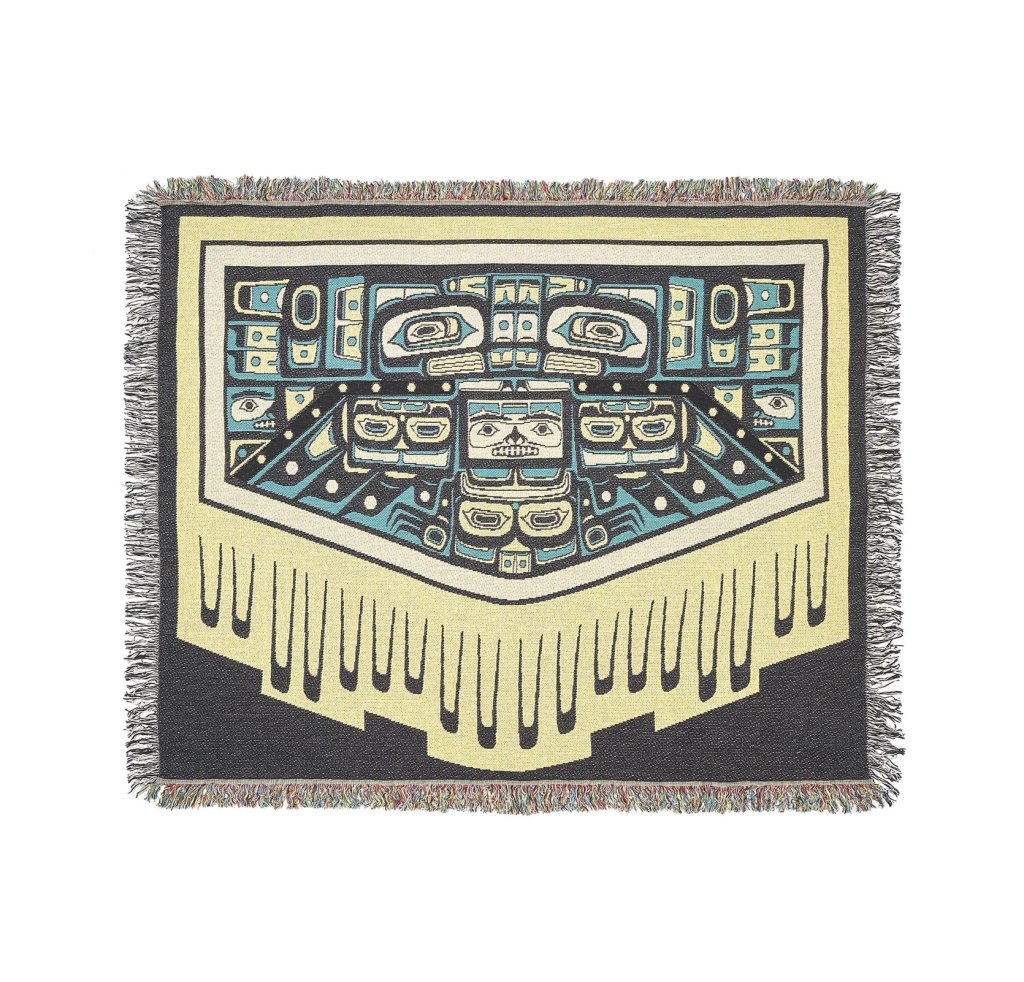
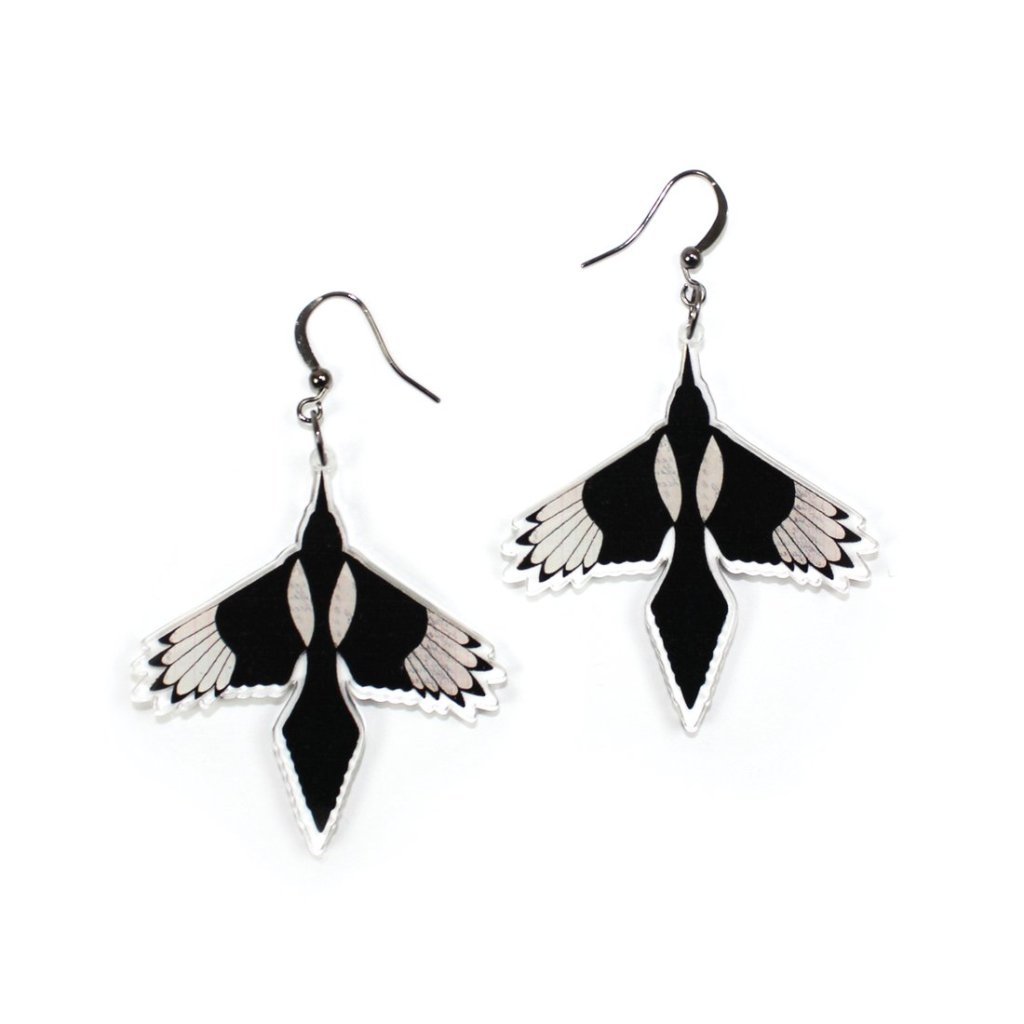
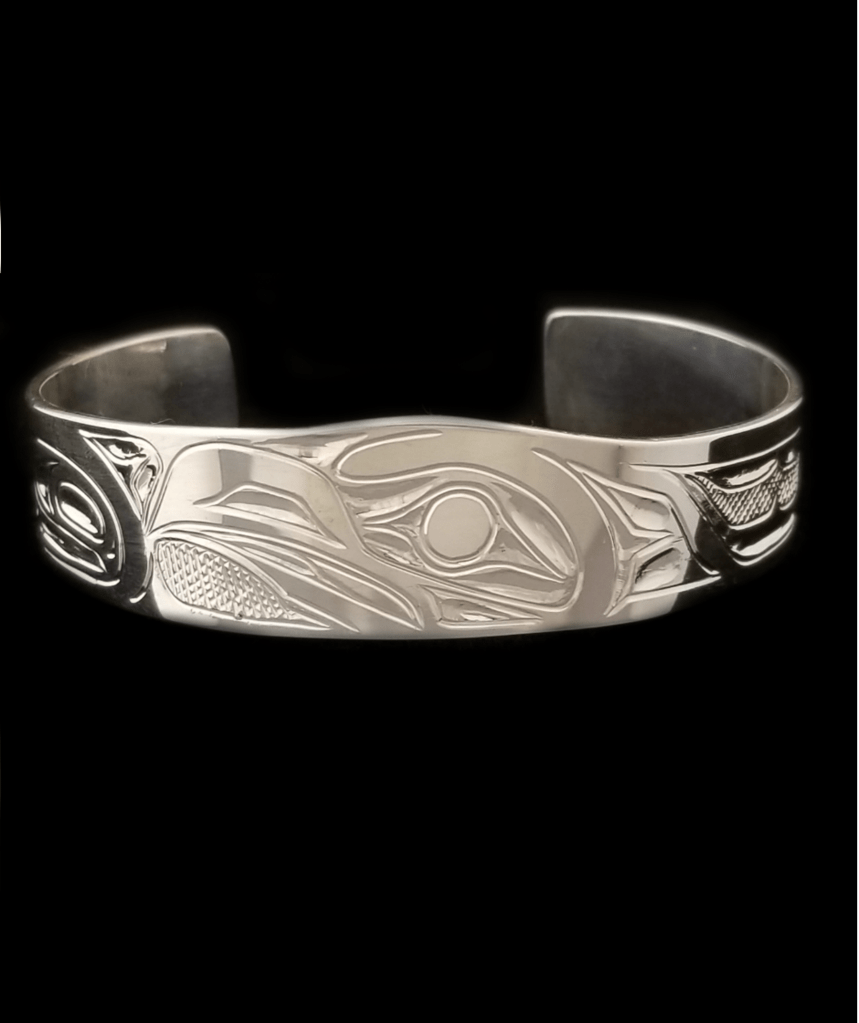
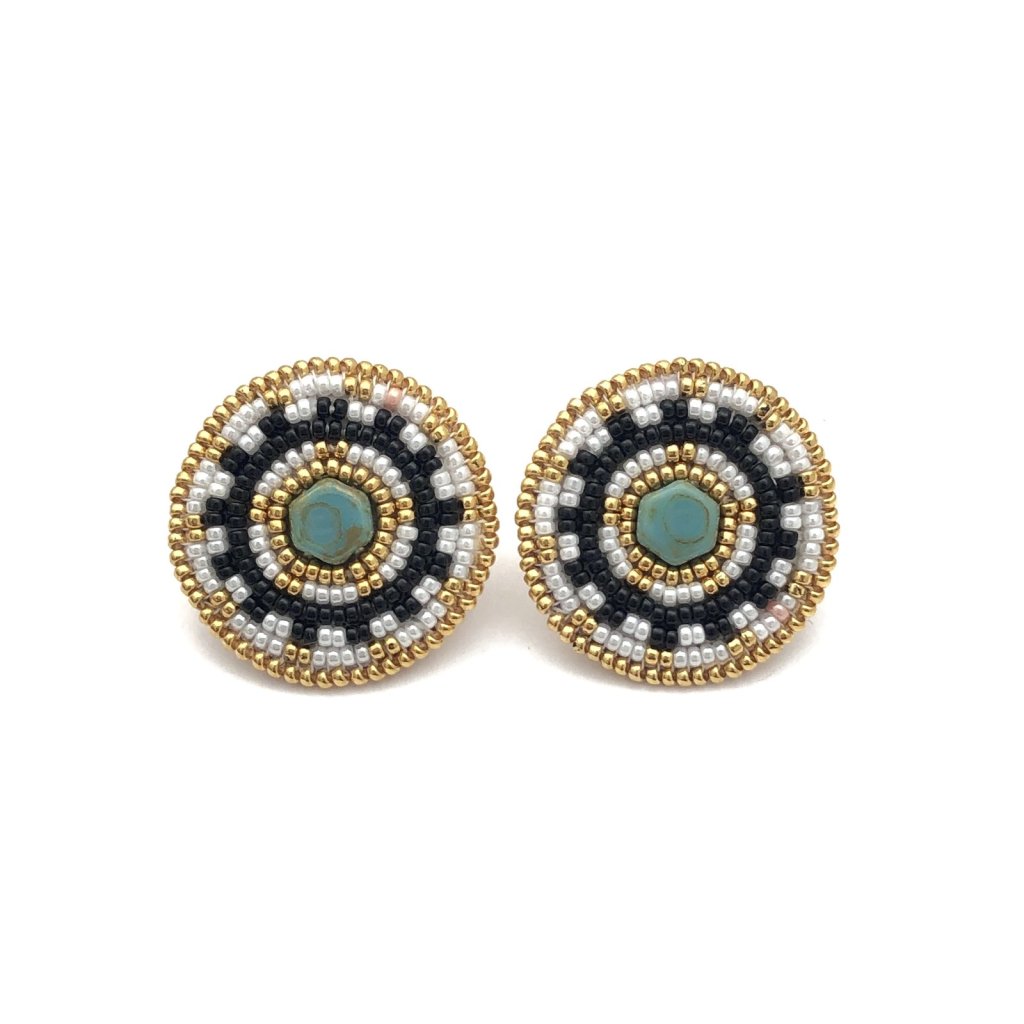
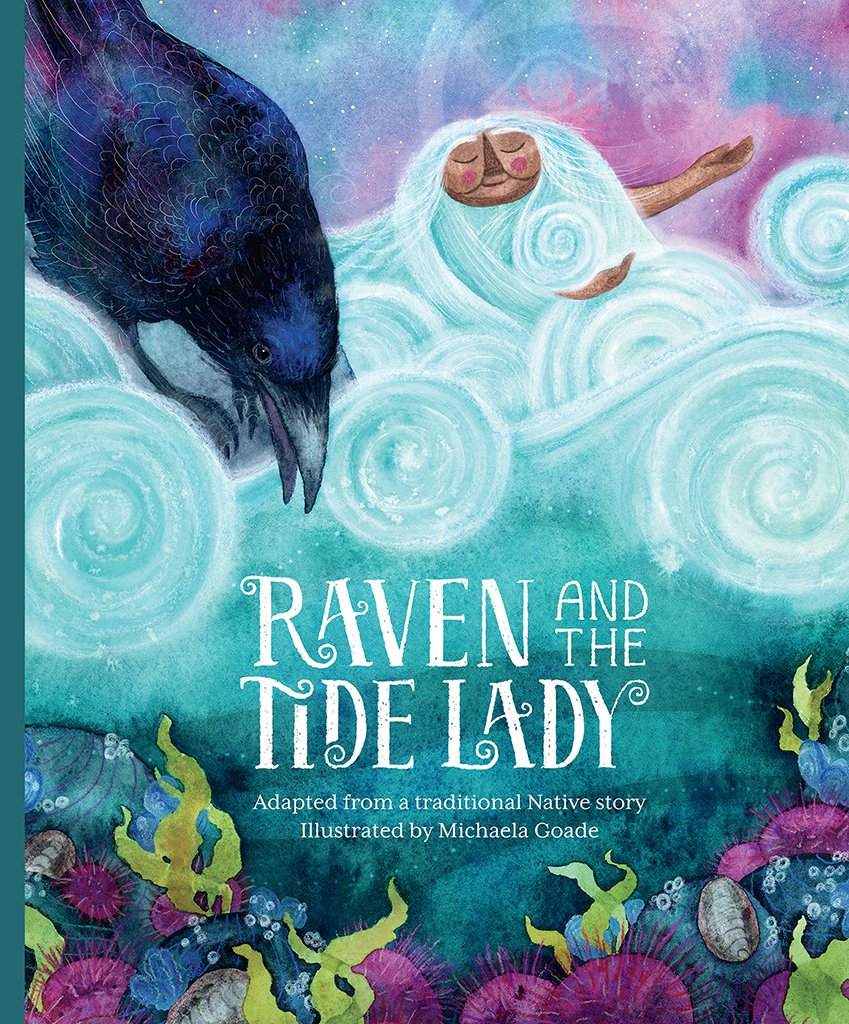
Be it from Navajo, Tlingit, or Haida origins, Indigenous depictions of corvids are unequivocally beautiful. It’s only natural that corvid lovers might wish to enjoy such artistry in jewelry, paintings, sculptures, or books. As long as it’s not in the pursuit of a costume or other forms of identity theft, purchasing and displaying Indigenous art is encouraged, especially when you can use it to draw more attention to the artist. Sadly though, the number of Indigenous creators are far out-numbered by non-Native people looking to profit off their culture. 

For example, the Alaska Department of Commerce and Development estimates that 75-80% of what is branded as Native art, was not actually made by Alaska Natives, resulting in the redirection of millions of dollars away from Alaska Native communities.3  So before swiping that credit card, make sure that the creator of that piece has the cultural heritage to claim ownership of it. As the Indigenous led Eighth Generation collective puts it, make sure it was created by “inspired Natives” and was not “Native-inspired.” Don’t be afraid to ask shop owners or gallery curators this question directly. That’s not only an easy way to find out, but it signals to that purveyor that sourcing directly from Indigenous creators is something their customers require. Buying directly from Indigenous artists is an even better option. 

Here are a few Indigenous creators and collectives and a slideshow of their products: 
Eighth Generation
I-Hos Gallery
B. Yellowtail
Warren Steven Scott
The Shortridge Collection
Seaalaska Heritage Library

As always when buying from artists, expect the price to reflect that the piece supports a livelihood and don’t attempt to barter. The goal shouldn’t be to simply obtain a beautiful object, but to celebrate and support the person who took great care to craft a sharable piece of their identity. 

Reconciling the ongoing pain caused by centuries of brutality, land theft, and cultural erasure will not be an easy process. It’s uncomfortable, for example, to realize that while your intent was simply to love on corvids, something you’ve done or said is being called out as anti-Indigenous. But it’s essential that we are willing to engage with that discomfort because it’s through that process that we learn and initiate positive change. Inviting Indigenous voices into your spaces is the most important way to start or continue that effort. Please look for the following individuals who are but a drop in the list of fantastic people you can find. And if you appreciated this article, please consider making a donation to one of the individuals or organizations listed below.

Twitter
Vincent Schilling (@vinceschilling)
Delores Schilling (@DelSchilling)
Jesse Wente (@jessewente)
Mari Kurisato (@wordglass)
Katherine Crocker (@cricketcrocker)
Chief Lady Bird (@chiefladybird)
Daniel Heath Justice (@justicedanielh)
Jay Odjick (@JayOdjick)
Kat Milligan-Myhre (@Napaaqtuk)
Alethea Arnaquq Baril‏ (@Alethea_Aggiuq)
Ruth Hopkins (@Ruth_HHopkins)
Nick Estes (@nickestes)
Kim Tallbear (@KimTallbear)
Kyle White (@kylepowyswhyte)
Ō’m”kaistaaw”kaa•kii (@mariahgladstone)
Indigenous folks in STEM
Plus everyone on this list

Instagram
Indigenous Rising (@indigenousrising)
Corinne Rice (@misscorinne86)
Ryan Young (@Indigenousvengeance)
Indigenous Women Who Hike (@Indigenouswomenhike)
Calina Lawrence (@calinalawrence)
Adrienne Keen (@nativeapprops)
Winona LaDuke (@winonaladuke)
Indian Country Today (@indiancountrytoday)
Tanaya Winder (@Tanayawinder)
Sarain Fox (@sarainfox)
Decolonize Myself (@decolonizemyself)

Organizations/Resources
Reclaim Indigenous Arts
Native Women in the Arts
Coalition to Stop Violence Against Native Women
Native American Heritage Association
Kituwah Preservation and Education Program
American Indian College Fund
Indigenous Environmental Network
Two-Spirit Resource Directory
Cultural Survival

Many thanks to Liz Landefeld, David Craig, and Vince Schilling for leaving their fingerprints on this article.

Literature cited
1 Cultural Appropriation (2020). In Oxford Online Dictionary https://www.oxfordlearnersdictionaries.com/us/definition/english/cultural-appropriation?q=cultural+appropriation

2 Williams, Maria. How Raven Stole the Sun (Tales of the People). Abbeville Press, 11/20/2000

3 Howell-Zimmer J. 12/2000. Intellectual Property Protection For Alaska Native Arts. Cultural Survival Quarterly Magazine. https://www.culturalsurvival.org/publications/cultural-survival-quarterly/intellectual-property-protection-alaska-native-arts

37 Comments

Filed under Anti-racism, Birding, Corvid mythology, Crows and humans, Wildlife

Bill overhang in corvids

I hardly notice it when I’m in the field because the bird is either too far or too fussy for me to examine the finer details of its beak, but looking at pictures like this I can’t help but notice that little extra bit of bill that sweeps over this raven’s bottom mandible like an awning. It leaves me wondering, what is this overhang for? A why is it more noticeable on some individuals than others?

When we think of birds with curved upper mandibles we are most primed to think of raptors, which have the most conspicuously curved overbite of any group of birds. This shape give them the tearing power they need to breakdown and consume their prey. But upon closer inspection we can see that actually most birds, even some hummingbirds, have a slight* overbite known as maxillary overhang. Among corvids, common ravens have one of the most noticeable overhangs, though they can be quite visible in crows as well. Unlike raptors though, for most other birds this overbite has less to do with food consumption and more to do with hygiene.1

While they can be good at hiding it under those sleek feathers, wild birds are constantly contending with a suite of exterior parasites like gnats, feather lice, and mites. The presence of these parasites, and the speed at which they can cause real harm if left unchecked, is part of the reason birds dedicate so much time and energy into preening. To remove and kill these pinhead sized parasites, birds carefully comb through their feathers, individually plucking up offenders with their bill tip. Even a small (1-2mm) overhang has been show to provide a significant advantage to birds by providing a backdrop against which the lower mandible can pin and damage parasites. Without such an overhang, parasite loads can be as much as 4x higher. By contrast, the overhang doesn’t seem to play any measurable role in foraging success or efficiency.1

Given the largely carrion based diet of common ravens, it’s possible their more visible overhang provides some advantage when it comes to digging into a carcass. Since it hasn’t been tested, however, I can only guess that if some feeding advantage does exist here, it’s slight. This is supported by looking at other carrion specialized corvids, which don’t seem to show a particular bias in longer overhangs relative to their omnivorous or seed eating corvid cousins, and the fact that even within common ravens overhang length is variable.

This common raven doesn’t have a particularly big overhang

To an extent, the longer the overhang the more effective it can be. As anyone who has tried to maintain naturally long nails can attest though, long keratin based appendages are prone to damage and breakage. Bill tips are no different, which explains why there can be so much variation between and within species. The overhang is playing an evolutionary balancing act to arrive at the length that is the most effective and the least vulnerable to damage. That means that not only will some species have shorter or longer overhangs, but individuals within species may, at any point, exhibit more or less obvious tips as due to recent damage. As a result of this variability, I don’t recommend looking to the level of bill overhang as a diagnostic tool for identifying ravens. While it’s certainly useful for crushing bugs, you can’t bank on it being useful for winning that next round of #CrowOrNo.

•••

* Some corvids have more than simply a slight overbite. Unusually long or misshapen bill tips can be the result of a viral infection called avian keratin disorder. Check here to learn more about AKD in crows.

Literature cited

  1. Clayton DH, Moyer BR, Bush SE, Jones TG, Gardiner DW, Rhodes BB, and Goller F. 2005. Adaptive significance of avain beak morphology for ectoparasite control. Proc. R. Soc. B 272: 811-817

11 Comments

Filed under Corvid health, Crow curiosities, Diversity, Ravens

Crows are watching your language, literally

That crows can recognize humans faces (and other physical attributes) has been a staple of our experiences with them for thousands of years.  It’s part of what has allowed them to take such a prominent place within our cultures, and it’s what keeps us refilling our pockets with peanuts or kibble, anxious for the chance to be recognized, to be seen by a wild animal. If, like me, you’ve been committed to such a relationship, you probably found yourself wondering about what it is they’re saying all the time. Although we still have more questions than answers, it’s not for lack of trying; in fact parsing crow “language” is still a hot topic in corvidology.  But for all our efforts to understand what crows are so often going on about, have you ever thought much about what they make of what we’re saying?

DSC_1974

Calling American crow

Ask any crow feeder about their ritual and there’s a good chance that it starts with more than just making themselves visible. To get “their” bird’s attention, about half of crow feeders start with some kind of auditory cue, like a whistle or gentle name calling.¹ Given that American crows (Corvus brachyrhynchos) can be individually distinguished by their calls, and many corvids—including the large-billed crows (Corvus macrorhynchos)—can recognize familiar conspecific* calls, this strategy seems far from superstitious.2,3 In fact, previous work has demonstrated that crows can discriminate human voices.

When presented with playback of their caretakers or unfamiliar speakers saying, “hey,”  hand-reared carrions crows (Corvus corone) showed significantly more responsiveness towards unfamiliar speakers.4 That their response is different is what suggests that they can discriminate, but it’s hard to not do a double take at the fact that the thing they seem more interested in is the person they don’t know.  Shouldn’t they be more interested in the folks that generally come bearing gifts? While we still don’t have a super satisfying answer to this question, it’s possible this comes from the fact that novel humans are less predictable, and therefore more threatening, than a familiar caretaker who can be safely ignored. Likewise, a new study out suggests that it’s not just individual people crows can hear the difference between, but entire languages.

In a newly released study conducted by Schalz and Izawa (2020), eight wild large-billed crows were captured in major cities around Japan and subsequently housed in aviaries at Keio University where they were cared for by fluent Japanese speakers.5  Given both their life histories and their time in the aviary, it’s safe to assume these birds had listened to a tremendous amount of Japanese throughout their lives. So, it stands to reason they might be able to actually recognize this language as familiar, but to date no one had looked at crows’ ability to discriminate between languages.  To test this question the researchers used playback to present recordings from multiple unfamiliar Dutch or Japanese speakers.  As with the carrion crow study, when these crows were presented with playback of a more familiar acoustic style—in this case a Japanese speaker—they didn’t show a strong reaction. Play them what was likely a completely unfamiliar language—Dutch—and the crows were rapt. Or at least they acted more vigilant and positioned themselves closer to the speaker. In other words, large-billed crows were able to discriminate between human languages without any prior training!

junlge crow

Large-billed crow (Corvus macrorhynchos) Photo: Anne Kurasawa

The next most obvious question is, well, why? What purpose would it serve to discriminate between different languages among unfamiliar speakers? One possibility is that it’s just an artifact of the auditory perceptual skills they need to successfully be a crow.  As I mentioned earlier, there’s a lot of information encoded in their calls, including individual identity, so being attentive to rhythmic classes may be important.  Another reason that’s worth pursuing, though, is that it may help tip them off to tourists, who may be more inclined to share or easier to take advantage of, than locals.  Fortunately the lead author on this study, Sabrina Schalz, will be starting her PhD on this topic in the coming fall. You can find her on twitter at @Sabrinaschalz, where she’s promised to keep us abreast of her future discoveries.

So the next time you’re hanging out in Japan, don’t forget to literally watch your language around the local crows. And to be safe, I wouldn’t divulge any secrets to them either.  They’re not called large-billed crows for nothing.

*conspecific=member of the same species

Literature cited
1. Marzluff JM, & Miller M. (2014). Crows and crow feeders: Observations on interspecific semiotics.  In: Witzany, G. ed., Biocommunication of Animals.  New York: Springer Science+Business Media Dordrecht. pp 191-211.

2. Mates EA, Tarter RR, Ha JC, Clark AB & McGowan KJ. (2015). Acoustic profiling in a complexly social species, the American crow: caws encode information on caller sex, identity and behavioural context, Bioacoustics, 24:1, 63-80, DOI: 10.1080/09524622.2014.933446

3. Kondo N, Izawa EI, & Watanabe S. (2010). Perceptual mechanism for vocal individual recognition in jungle crows (Corvus macrorhynchos): contact call signature and discrimination. Behaviour 147: 1051–1072.

4. Washer CAF, Szipka G, Boeckle M, and Wilkinson A. 2012. You sounds familiar: carrion crows differentiate between the calls of known and unknown heterospecifics. Anim Cogn 15: 1015-1019.

5. Schalz S. & Izawa E. (2020). Language Discrimination by Large-Billed Crows. In Ravignani, A., Barbieri, C., Martins, M., Flaherty, M., Jadoul, Y., Lattenkamp, E., Little, H., Mudd, K. & Verhoef, T. (Eds.): The Evolution of Language: Proceedings of the 13th International Conference (EvoLang13). doi:10.17617/2.3190925.

33 Comments

Filed under Crow behavior, Crows and humans, New Research, Science

The definitive guide for distinguishing American crows & common ravens

For two birds that are surprisingly far apart on the family tree, American crows (Corvus brachyrhynchos) and common ravens (Corvus corax) can be awfully hard to distinguish, especially if you rarely see both together.  But with the right tools and a little practice you can most certainly develop the skill.  Fortunately, there are many different types of clues you can use to tell one from the other, so feel free to use the links to skip around to what interests you.

Physical Differences

Although crows and ravens are superficially quite similar, there are variety of features that can be used to tell one from the other. Overall size can be a good place to start.  This especially helpful if you live in an area where they overlap, but even if you don’t, I find that people who are used to seeing crows take notice when they see a raven in person because it feels ~aggressively~ large.  That’s because ravens, by mass, are about twice the size of an American crow.

IMG_3600

A common raven specimen (top) with an American crow specimen (bottom). On average, ravens are about twice as big as crows, but individually there are certainly large crows and diminutive ravens.

This size difference becomes most obvious is when you look at their face.  Raven’s are much more adapted for consuming carrion than crows are (crows cannot break through the skin of a squirrel) and their bills give the distinct impression that they could, in fact, pluck your eyes from your face with little effort. So if your sense of things is that you’re looking at a bill with a bird attached, then you’re probably looking at a raven, not a crow.

IMG_3603

With practice, judging the proportion of crows’ and ravens’ features, like bill size, becomes easier.

Crow vs. raven measuremntsWith practice, judging relative size becomes easier and more reliable, but for a beginner it may not be useful because it’s so subjective.  Instead, it’s easier to look at the field marks (birder speak for distinctive features) which provide more objective clues.

When looking at perched birds, the most helpful attribute is to look at the throat.  Ravens have elongated throat feathers called hackles, which they can articulate for a variety of behavioral displays.  Crows meanwhile have smooth, almost hair like throat feathers typical of other songbirds.

Crow v raven

Even when the feathers are relaxed, the textural differences between the two species throat feathers are apparent. Note that in this photo, the crown feathers of the crow are erect, while the raven’s is not.  The difference in crown shape should not therefor be judged in this comparison.

DSC_0079

When vocalizing or displaying the raven’s hackles become especially obvious.

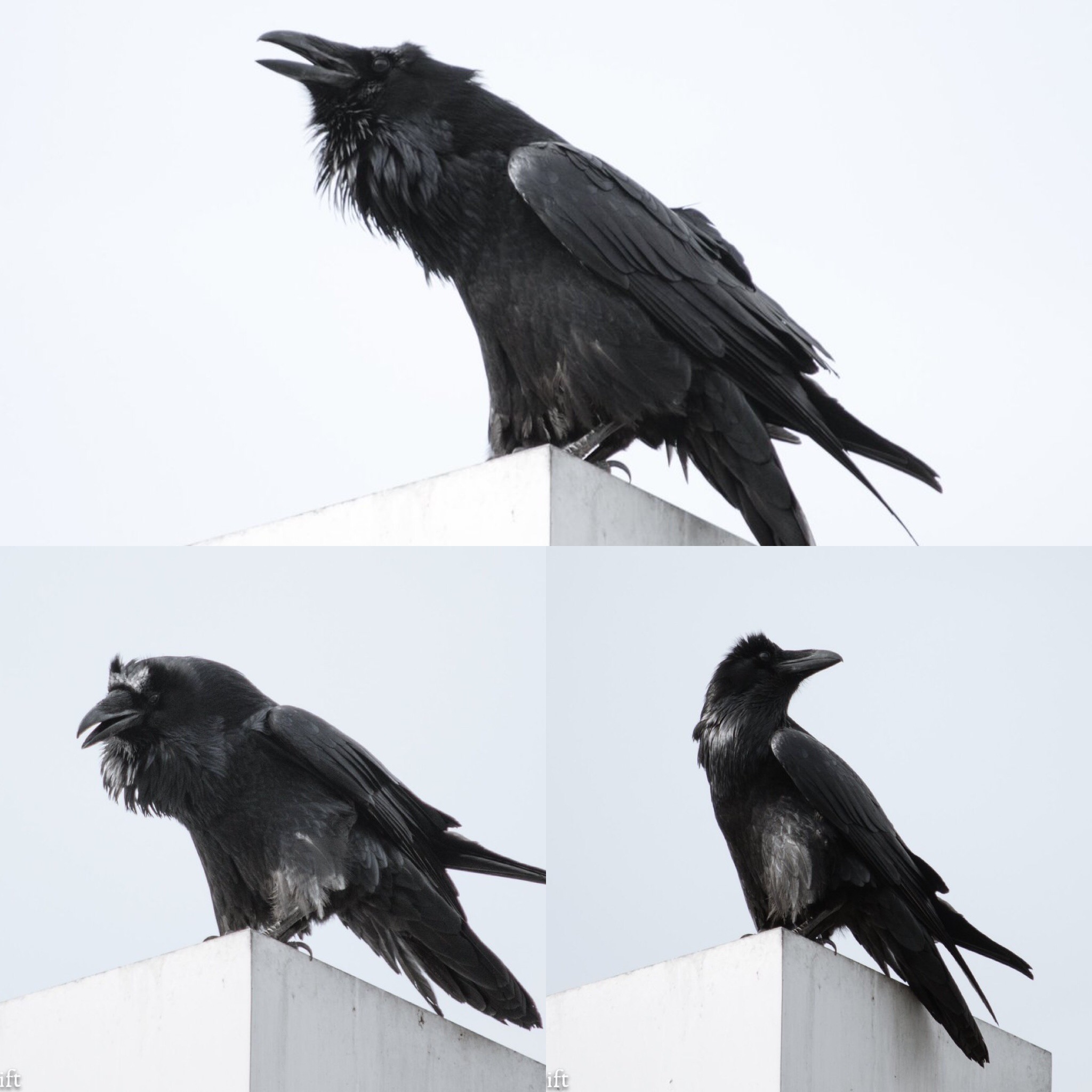
In addition to the hackles, ravens can also articulate some of their other facial feathers in way crows cannot.  During threat displays for example, ravens will fluff out both the throat hackles and their “ear” tufts.
868AA791-9936-4AD1-BEC7-F7952F0B254F

For birds in flight, however, it’s often difficult—if not impossible—to clearly see the throat feathers.  Fortunately, the tail offers a reliable field mark in this case.  Whereas crows have a more squared or rounded tail (depending on how much they’ve fanned the feathers) a raven’s tail will have a distinct wedge shape. Additionally, although they are a bit more subtle, there are also some differences in the primary wing feathers.  While both birds have 10 primary feathers, in flight, ravens will look like they have four main “finger” feathers while crows will appear to have five. Ravens also have more slender, pointed primaries relative to crows.

crow vs raven

Vocal differences

With a little practice American crows and common ravens can easily be distinguished by their calls.  The call of a raven can be best described as a deep, hollow croak.  Crows on the other hand, caw.  Of course, they can both make at dozens of other sounds including rattles, knocks, coos, clicks, and imitations. With practice even these can be recognized by species, but that level of detail is not necessary for most identification purposes.

Juvenile common raven yell (Recording by Antonio Xeira-Chippewa County, Michigan)
Common raven water sound (Recording by Niels Krabbe-Galley Bay, British Columbia)
American crow call (Recording by David Vander Pluym-King County, Wasington)
American crow juvenile begging call (Recording by Jonathon Jongsma Minneapolis, Minnesota)
American crow rattle (Recording by Thomas Magarian-Portland, Oregon)
American crow wow call (Recording by Loma Pendergraft King County, Washington)
American crow scolding (Recording by Kaeli Swift-King County Washington)

Geographic/habitat differences

While both American crows and common ravens have wide distributions across North America, there are some key differences in where you are likely to find them.  The most notable difference is that ravens are absent throughout most of the midwest and the southeast.  Crows on the other hand, occupy most American states with the exception of the southwestern part of the country.  The below maps from Cornell’s All About Birds website offer more specific breakdowns (hover over the images to see the caption). Comparing them globally, common ravens range throughout the northern hemisphere, whereas American crows are limited to the North American continent.

With respect to habitat, both birds are considered generalists, with ravens erring more towards what one might describe as an “extreme generalist”. Ravens can be found along the coast, grasslands, mountains (even high altitude mountains), forests, deserts, Arctic ice floes, and human settlements including agricultural areas, small rural towns, urban cities (particularly in California) and near campgrounds, roads, highways and transfer stations. Crows meanwhile are more firm in their requirement of a combo of open feeding areas, scattered trees, and forest edges.  They generally avoid continuous forest, preferring to remain close to human settlements including rural and agricultural areas, cities, suburbs, transfer stations, and golf courses.  In cases where roads or rivers provide access, however, they can be found at high elevation campgrounds.

Behavioral differences

There are books that could be (and have been) written on this subject alone, so we will limit ourselves to what is likely to be most essential for identification purposes.

Migration
While common ravens are residents wherever they are found, American crows are what’s called a “partially migratory species” because some populations migrate while others do not.  Most notably, the northern populations of crows that occupy central Canada during the summer breeding season, travel south to the interior United States once the snow-pack precludes typical feeding behaviors

Breeding
Although trios of ravens are not uncommon, and there have been observations of young from previous years remaining at the nest, ravens are not considered cooperative breeders. Crows are considered cooperative breeders across their entire range (though specific rates vary across populations and not much is known about migratory populations).  If helpers are present they typically have between 1-3. So if a nest is very busy with more than two birds contributing to nest construction, feeding nestlings, or nest defense, it’s more than likely a crow’s nest, not a raven’s.
IMG_5408 2

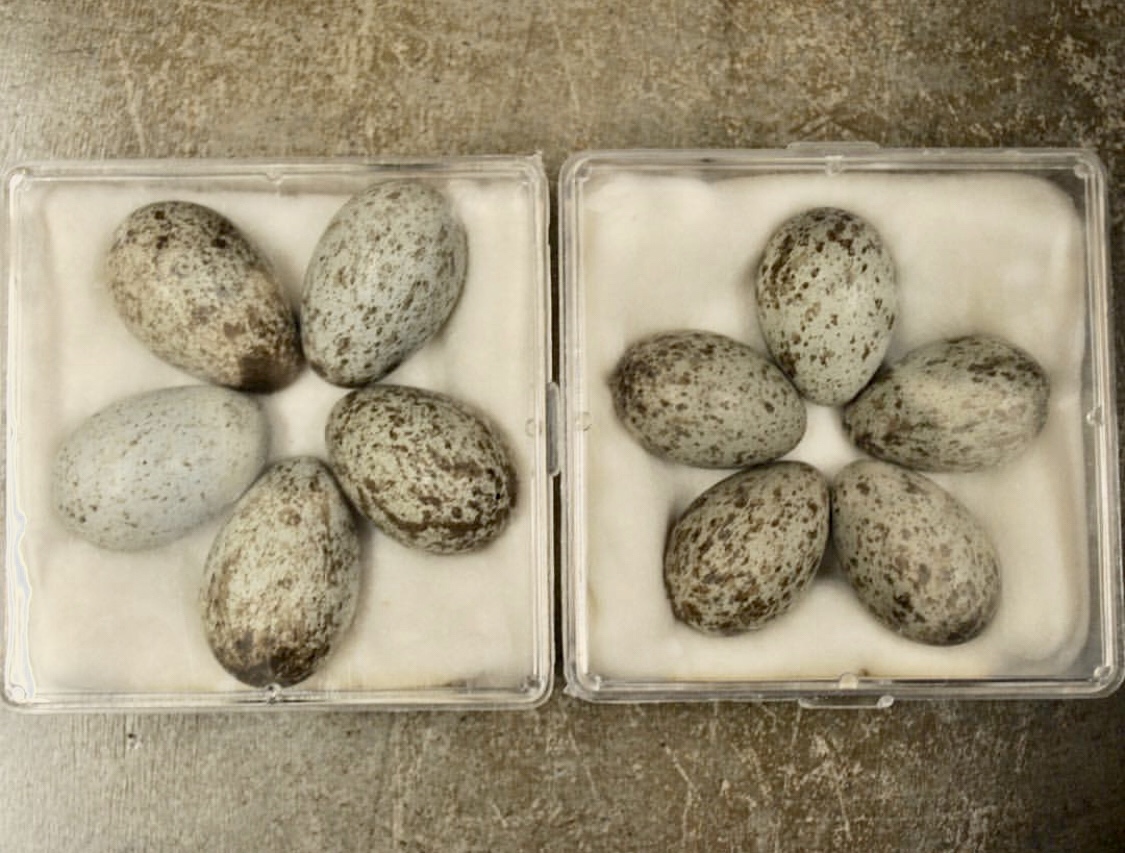
Common raven eggs left | American crow eggs right

Diet
Although both species consume a host of invertebrates, crows consume a larger proportion of inverts and garbage relative to ravens.  Mammals, especially from carrion, meanwhile make up the largest proportion of a raven’s diet across surveyed populations.  Access to refuse and population location, however, can dramatically shift the dietary preferences of both these omnivores.

Flight
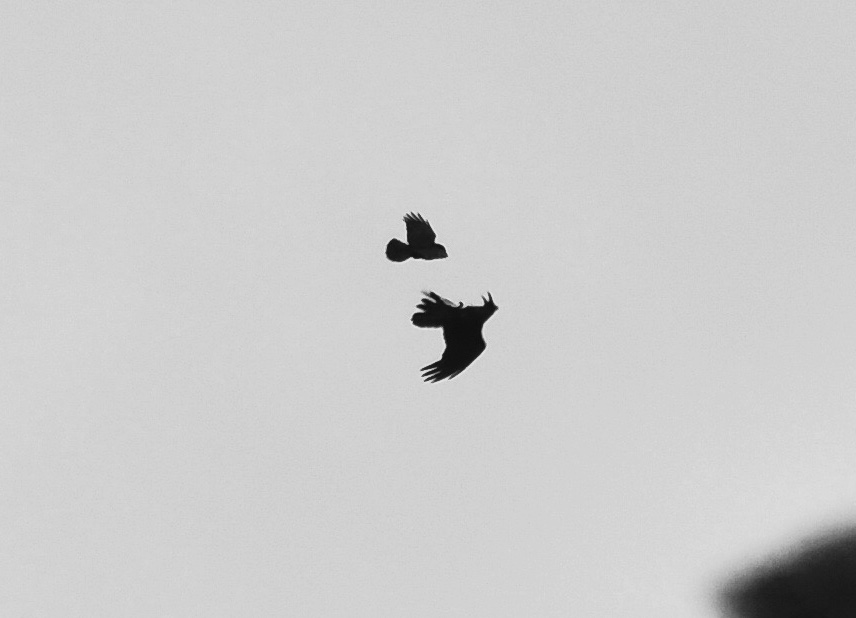
Because ravens consume a lot more carrion, which is unpredictable in its availability and location, they spend a great deal more soaring than crows do.  So if you see a black bird cruising the sky for more than a few seconds, it’s most likely a raven.  Ravens are also unique from crows in that they barrel roll to advertise their territory.  So if you see a  barrel rolling bird, there’s a better chance it’s a raven.

Interactions
In places where they do overlap, interactions between the two are often antagonistic, with crows acting as the primary aggressors in conflicts.  Ravens will depredate crow nests if given the chance.
DSC_0675 (2)

A raven defends itself from a crow by rolling upside down.  Someday I’ll get a better photograph…

Genetic differences

Throughout most of our history, we have used external cues like appearance, voice and behavior, to sort one kind of animal from another.  Now that we have access to a plethora of genetic tools, however, we can ask a new level of the question “what’s the difference between an American crow and a common raven.”

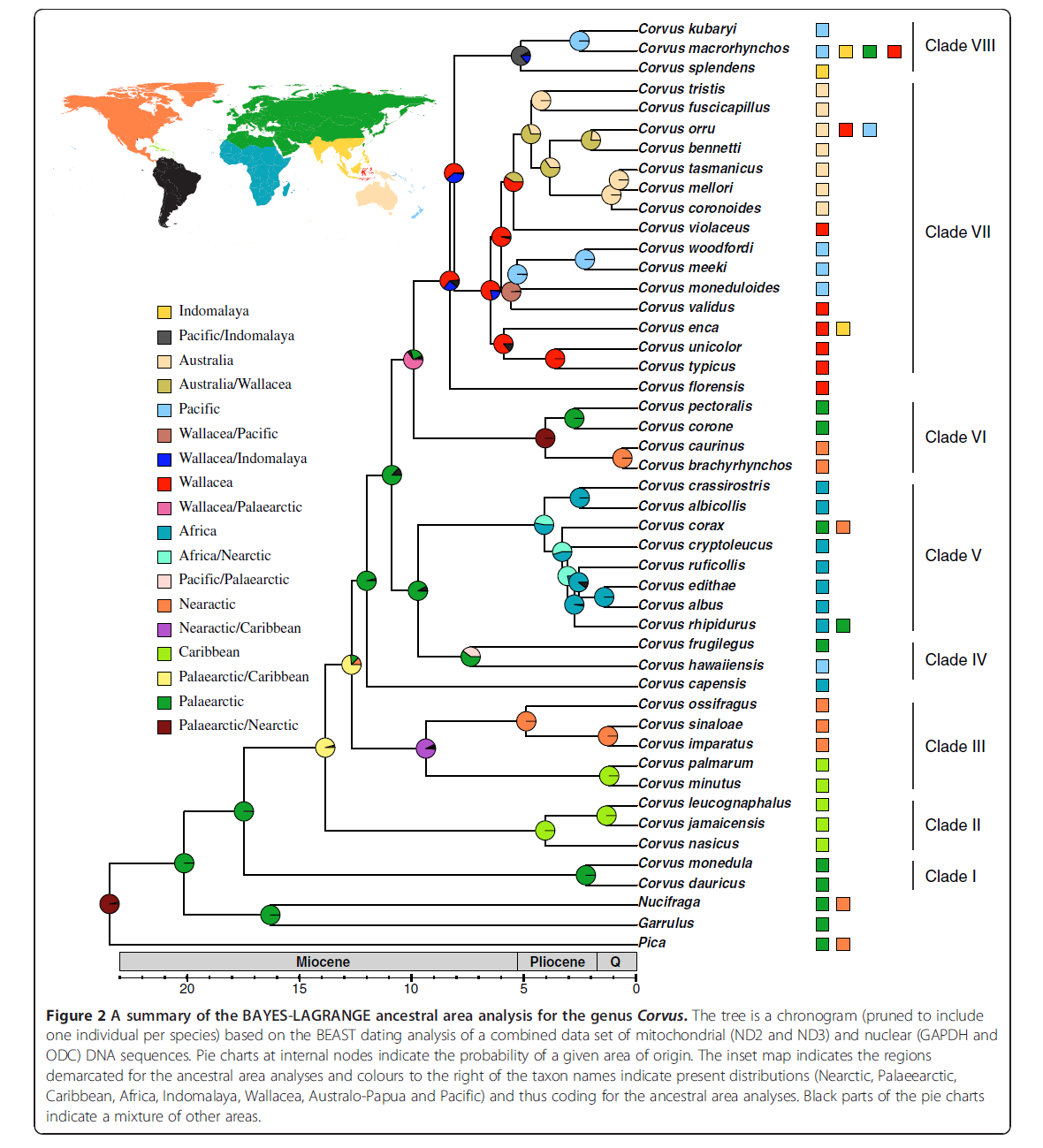
To put it simply, American crows (Corvus brachyrhynchos) and common ravens (Corvus corax) are different species in the same genus, just like lions (Panthera leo) and tigers (Panthera tigris).  Species and genus refer to different levels of the taxonomic tree, where species represents the smallest whole unit we classify organisms.  The issue of species can get complicated quickly, however, so I’ll direct you here if you want to learn what a mess it really is.  Most important thing to appreciate now, is that if you want a quick, back of the envelope way to evaluate if two animals are closely related, look at the first part of their latin binomial (scientific) name.  If they share that part then they’re in the same genus (ex: crows and ravens belong to the genus Corvus).  If they don’t (ex: American crow is Corvus brachyrhynchos and the Steller’s jay is Cyanocitta stelleri) then they are more distantly related. 

Within the Corvus genus, however, there is still a ton of evolutionary space available.  In fact, to find the closest shared relative of common ravens and American crows you’d need to go back approximately 7 millions years.  Although they are more visually distinct and don’t overlap geographically, American crows are more closely related to the collard crows of China, or the carrion crows of Europe, than they are to common ravens.
Crow phylogeny

Image from Jønsson et al. 2012

Laws and protections

US laws
In the United States, both American crows and common ravens are protected under the Migratory Bird Treaty Act.  This means that, like with nearly all native birds species, you cannot kill, possess, sell, purchase, barter, transport, or export these birds, or their parts, eggs, and nests, except under the terms of a valid Federal permit. It is this law that prohibits the average person from keeping these birds as pets, and requires that rescued crows be turned over to a licensed professional.  The MBTA also prohibits the civilian hunting of ravens under any circumstance.  Under 50 CFR 20.133, however states are granted an exception for crows, wherein with some restrictions, states can designate regulated hunting seasons.

In addition, under 50 CFR 21.43 of the Migratory Bird Treaty Act, you can also kill crows without a license and outside of the regulated hunting season if they are in the act of depredating crops, endangered species, or causing a variety of other destructive issues.  You can obtain the specifics of the Depredation Order here.  Such lethal control must be reported to Fish and Wildlife to remain within the law. No such depredation exceptions exist for ravens. 

Canadian laws
In contrast to the US, no corvids receive federal protections in Canada.  Crows and ravens may receive provincial protections, however.

Concluding thoughts

Before we pack it up, I want to leave you with one last useful piece of information.  This whole article was dedicated to the question of how American crows are different from common ravens.  Hopefully, you’re walking a way with a solid understanding that these animals are in fact different morphologically, behaviorally, and genetically. Asking if American crows are different from common ravens is a different question, though, than asking if “crows” are different than “ravens”.  Because while that first answer is a hard, “yes,” there is no one thing that initially classifies a bird as either a type of raven or a type of crow.  Generally ravens are bigger and have those elongated throat feathers, but there are plenty of crow named birds that could have been named raven and vice versa. So proceed cautiously and consider the specific types of birds the question’s author is referring to before offering specific answers.

If you want to continue to hone your skills I invite you to play #CrowOrNo with me every week on twitter, Instragram and facebook, all at the @corvidresearch handle.  While it’s not to quite this level of detail, I promise it will help advance your ID skills and introduce to to more of the world’s fantastic corvids. For a head start, keep this charming and informative guide illustrated by Rosemary Mosco of Bird and Moon comics handy!

raven vs crow

Reference literature
Jønsson K.A., Fabre P.H., and Irestedt, M. (2012).  Brains, tools innovations and biogeography in crows and ravens.  BCM Evolutionary Biology 12
https://bmcevolbiol.biomedcentral.com/articles/10.1186/1471-2148-12-72

Freeman B.G. and Miller, E.T. (2018).  Why do crows attack ravens? The roles of predation threat, resource competition, and social behavior.  The Auk 135: 857-867

Verbeek, N. A. and C. Caffrey (2020). American Crow (Corvus brachyrhynchos), version 1.0. In Birds of the World (A. F. Poole and F. B. Gill, Editors). Cornell Lab of Ornithology, Ithaca, NY, USA.

Boarman, W. I. and B. Heinrich (2020). Common Raven (Corvus corax), version 1.0. In Birds of the World (S. M. Billerman, Editor). Cornell Lab of Ornithology, Ithaca, NY, USA.

50 Comments

Filed under Birding, Corvid diversity, Crow behavior, Crow curiosities, Raven behavior, Ravens, Taxonomy, Vocalizations, Wildlife

A tale of two crows: northwestern vs. American

If you search nearly anywhere along the west coast from California to southern Alaska, you will find our most persistent avian neighbors: crows.  Cloaked in their Gothic outfits and uttering that all too familiar harsh caw, most people—even many experts—might not register that the neighbors in the north are not exactly like their counterparts in the south.  While it’s the American crows (Corvus brachyrhynchos) that have staked their claim to the contiguous states, it’s the northwestern crow (Corvus caurinus) that calls the coast home from British Columbia to southern Alaska. That is, at least as far as the field guides have been telling us since northwestern crows were first described scientifically in the mid 19th century.  Despite this early recognition that one of these things was not like the other, however, differentiating American crows from northwestern crows on the basis of phenotypic features like size, voice, and behavior has since proven to an almost impossible challenge; especially in places like Washington where the two ranges meet.  This has resulted in questionable hand waving by people like me about what those crows in Seattle really are.  I’ve always called them American crows without any qualifiers, but are they really? Might they be northwestern crows? Or something in between?  Fortunately, a new study by Slager et al. (2020) lays bare the reticulated evolutionary histories of the two crows of the Pacific Northwest.

IMG_5392

By examining differences in both nuclear DNA from 62 specimens and mitochondrial ND2 markers from 259 specimens collected across North America, the team was able to evaluate when these two likely initiated speciation, the process of becoming distinct species from a shared ancestor. What they found is that American and northwestern crows likely split some 440,000 years ago when late Pleistocene glaciers really made mess of things by geographically separating formally intact populations.  Isolated in their respective pockets of livable habitat (called glacial refugia) the formally united species did what all organisms do in the face of new selective pressure: they changed, and from one species emerged two.  Well, kind of.

Eventually of course, the Pleistocene ice ages came to a close and the glaciers that had divided their ancestors receded away.  Although their time apart made a lasting impression on their genome, it did not appear to make a lasting impression on their taste in sexual partners.  The team found extensive genomic admixture (the presence of DNA in an individual that originated from a separate population or species), suggesting pretty pervasive hybridization between the two species.  In fact, along their shared 900 km range from coastal Washington to British Columbia they found not one “pure” individual.  For just how long American and northwestern crows have been hybridizing remains unknown, but the evidence suggests that it’s been happening since well before colonial landscape changes.

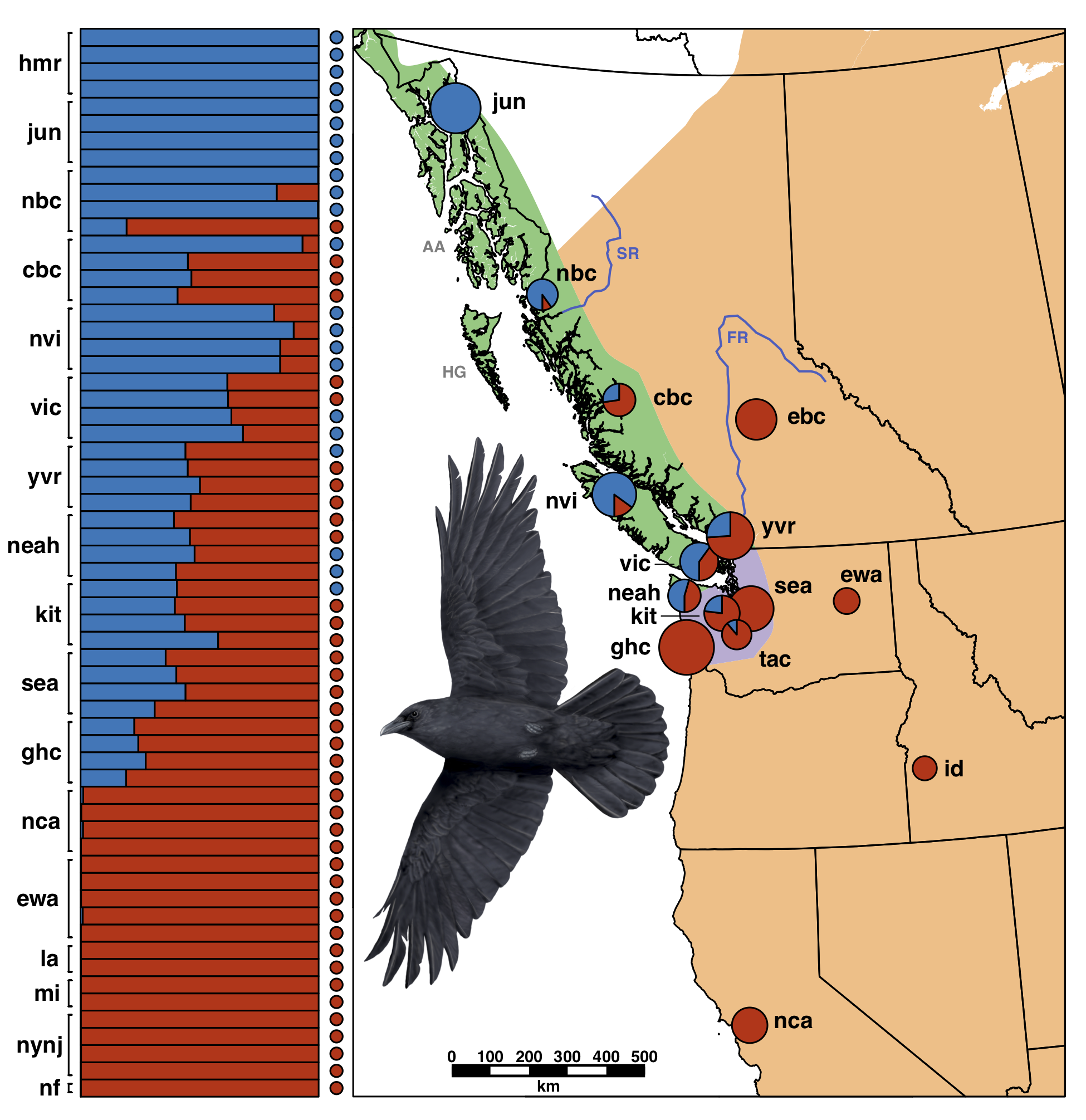
These revelations beg two important and contradictory questions.  The first is the answer to just what the hell crows in Seattle are.  The answer appears to be option C: a hybridized mix of American and northwestern crow, but with slightly more all-American genes.  That seems to be true throughout the Washington coast.  Once you hit Oregon though, you’re getting almost all ancestral American crow.  The opposite pattern is true moving from British Columbia north: what starts as hybrids with a stronger northwestern crow bias, are “pure” northwestern crows once you hit Juneau.

SLager

Figure shows the extent of hybridization between American crows (red) and Northwestern crows (blue) along the PNW coast. Image from Slager et al. (2020).

The second question, however, is whether those distinctions are really of any biological value. After all, what appears to have happened is that while these two “species” may have gotten started on a path to different destinies, a changing climate brought them back together before any firm reproductive isolating mechanisms (i.e. physical features, behaviors, or physiology that prevent different species from breeding with one another) could take hold. While that kind of genetic evidence is already pretty damning, the phenotypic evidence that they might be different has likewise eroded.  When closely examined, the features that appeared to be diagnostic in the 19th century like the northwestern crow’s smaller size and intertidal habitat use, and a difference in vocalizations, seem to simply be reflections of local adaptions and individual differences present in both species. So, while the guidebooks might still call them different things, the fact that neither the crows themselves nor the ornithologists can really tell them apart warrants serious consideration of whether northwestern crows should be officially absorbed into the American crow.

As it happens, the authority on such things, the American Ornithological Society’s North and Middle America Classification Committee, is currently examining that very proposal as apart of the 2020 Proposal Set C.  Expect an official ruling soon.  While I don’t know for sure what they will decide, the evidence out of this current study does not bode well for the continued recognition of Corvus caurinus as a speciesSo if you want to see a northwestern crow, my advice is to do it sooner rather than later.

Literature cited

Slager DL, Epperly KL, Ha RR, Rohwer S, Wood C, Van Hemert C, and Klicka J. 2020. Cryptic and extensive hybridization between ancient lineages of American crows. Molecular Ecology doi: 10.1111/mec.15377


14 Comments

Filed under Corvid diversity, Crow life history, Diversity, New Research, Science, Taxonomy