Category Archives: Crow behavior

Crow curiosities: Do crows collect shiny objects?

The notion that corvids, especially magpies, have a special affinity for shiny object has been around for more than a century.  In fact to refer to someone as a magpie is to describe them as someone who ‘compulsively collects or hoards small objects’.   This idea is so old hat that it can feel a bit frivolous to even wonder if it’s true.  The trouble with this bit of corvid whimsy, however, is that when we do investigate it, and scientists have, we find there’s no empirical evidence to support it.
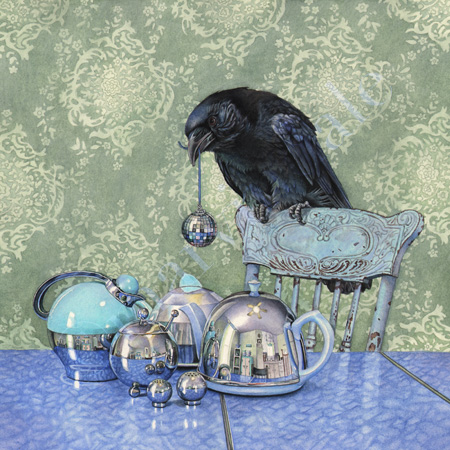
'Crow Collects' by Cori Lee Marvin.

‘Crow Collects’ by Cori Lee Marvin.

For instance, one study presented both captive and free-living magpies piles of blue or shiny silver screws, rings, and pieces of tin foil near piles of food to which they had been previously habituated.1  They found that, rather than thieving and subsequently caching the gleaming objects, the birds were actually more nervous to take food than they had been previously.  In the 64 conducted tests, only two instances of contact between a bird and an object were recorded.

trial

Experimental set-up for magpie study.

Cornell crow expert Kevin McGowen, elaborates on this general conclusion, suggesting that perhaps the origin of this folklore is pet crows who are attracted to the objects of obvious value to their owner like coins, keys or jewelry.  Speaking personally as someone who has spent countless hours observing hundreds of individual crows in the field, I can also attest to the fact I have never witnessed anything resembling this behavior.  So there you have it, corvids do not, according to the best empirical evidence, show an attraction to, or are otherwise known to collect shiny objects.

And yet…

And yet I still hear anecdotes about this behavior that peak my curiosity.  For instance, once or twice a year I’ll see a headline about crows thieving shiny stones at the expense of bereft family members.  In Jewish culture, it’s tradition to leave a small stone atop a gravestone, as a way to honor the deceased and indicate that they’ve been visited.  For whatever reason, particularly across Ireland, these stones occasionally go for joy rides in the mouths of crows.  In Omagh, Patsy Kerlin who mounts headstones in his town’s graveyard recently told a local reporter that “It seems to be only the black shiny ones they take and a lot of them go missing.”  Even in my own neck of the woods at the University of Washington one of the gardeners at the Urban Horticulture Center regaled John Marzluff and I with his story of how the crows regularly steal the shiny metal placards that identify the center’s plants.

In science, we often like to say “the plural of anecdote is not data”.  This is unequivocally true.  But just because they’re not data doesn’t mean they’re meaningless either.  I’m inclined to believe there’s more to these stories than random chance and I think they are worth exploring.  Perhaps these stories emerge out of confirmation bias, meaning people tend to report theft with respect to shiny things more often because they’re looking to confirm a suspicion they already had.  If so, it would be yet another fascinating example of the extent to which corvids have infiltrated our culture.  Or perhaps this is the work of curious juveniles as has been suggested by my crow colleague Dr. Jennifer Cambell-Smith.  If so, teasing out any evidence of discrimination or bias juveniles are using when selecting objects to explore could give us insight into how they learn about the world, or how our garbage is modifying that behavior.  Or perhaps crows do like to carry off with glossy objects, but for textural, rather than visual reasons.  At least some corvid species swallow small stones to aid in digestion and these stones are most often partially smoothed.2  These ‘grit stones’, however, are considerably smaller (on average only 2.9 mm) than I imagine grave stones are, so perhaps this behavior is evidence of poor grit stone selection among naive birds.
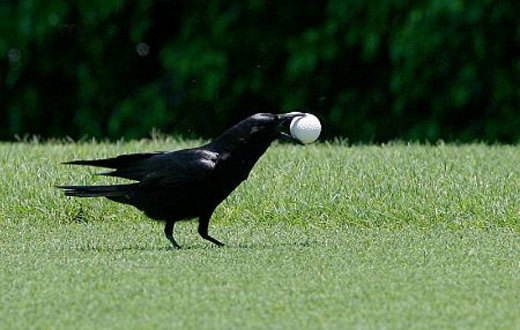
Or maybe it’s none of the above, we simply cannot say.  Which, for me, is exactly why I find these anecdotes so interesting.  While we can rule out that this behavior isn’t a manifestation of corvids’ love for bling, we can’t exactly explain this behavior either.   It’s yet another item on the shelf along with thieving golf balls and wiper blades where we can’t do much more than offer an educated guess.  So while I’m quick to clarify that crows are not attracted to shiny objects, I’m not dismissive of these anecdotes either.  My friend and colleague David Craig likes to say that every bird has a story, and citizen science is part of sharing that story.  In my book, the story of corvids and their light fingered behavior seems an ideal project for the crow minded bird nerd.

  1.  Shepard, T. V, Lea, S. E. G., and Hempel de Ibarra, N.  2014.  Thieving magpie’?  No evidence for attraction to shiny objects.  Animal Cognition 18: 393-397.
  2. Gionfriddo, J.P., and Best, L. B. 1996.  Grit-use patterns in North American birds: The influence of diet, body size and gender.  The Wilson Bulletin 108: 685-696
39 Comments

Filed under Corvid mythology, Crow behavior, crow conflicts, Crow curiosities, Crow life history, Crows and humans, In the news

The science of crows and death

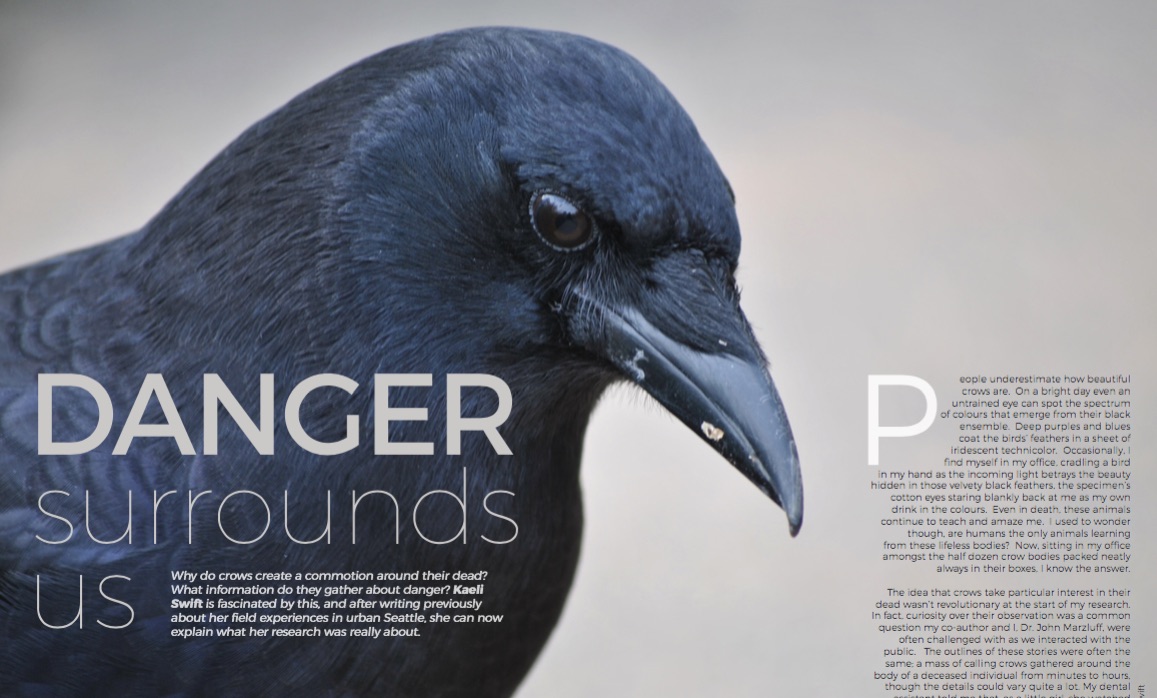
Curious to read my popular science take on our recent publication on how crows behave around their dead?  Check out my latest article for Biosphere.  Then check out all the other awesome authors and contributors to my favorite popular science publication.  You won’t regret it.  (And congrats to GO for making the article cover!  She’s such a gorgeous bird…)

Read the full article here

Biosphere

6 Comments

Filed under Crow behavior, Kaeli in the media, New Research, women in science

The facts about crows and West Nile virus

Ah fall, the changing colors, the arrival of mushrooming season, and the gratuitous consumption of hot drinks makes this season a favorite of mine.  But if you live in a temperate zone like the PNW, there’s one drawback to fall; West Nile virus (WNV).  Make no mistake, since its first appearance in the US in 1999, cases of WNV have been documented year round.  Outbreaks, however, typically peak in late summer and early fall which is why you often start to see increasing media attention directed towards the discovery of crow corpses.  Such is the case with a recent die-off in Spokane which inspired a fleet of recent articles.  My favorite was a post from an otherwise predominately car-focused site called The News Wheel which included the following passage:

“In either case, authorities are telling residents that, should they find a dead or dying crow in the street, that they should under no circumstances handle them…In the mean time, it may be a good idea to replace your car’s windshield cleaning fluid with holy water (just in case).”

I suspect some sarcasm was at work there but, in truth, people can get very worked up about WNV.  So here are some FAQs about crows and WNV intended to keep you safe and informed.

What is WNV?
WNV is an arthropod-borne virus which can cause febrile illness, encephalitis (inflammation of the brain) or meningitis (inflammation of the lining of the brain and spinal cord).  It was first documented in the US in 1999, and exists across most of the world (sigh; the costs of globalization)1.

Why are crows associated with WNV?
No, this isn’t unfair prejudice at work, corvids really do have it rough when it comes to this disease.  In all the documented cases of WNV 80% of them have affected corvids, despite its presence in 300 other species of bird2.  The connection between WNV and climate change means that corvids could be in big trouble which you can read about in a previous post here.

What does a bird sick with WNV look like?
Most birds who contract WNV will survive, but for the many crows and other corvids what won’t, symptoms include trouble with balance both at rest and while mobile, and lethargy.  There won’t be any way to tell if a dead crow is infected simply by looking at it2.

Can I get WNV from touching a crow?
According to the CDC, there is no evidence that a person can be infected by direct contact with infected birds, dead or alive3. That being said, always use gloves when handling wildlife.

Can people get WNV?
Yes, though keep in mind that the virus really doesn’t want to be in you.  Humans and other mammals are considered ‘dead-end’ hosts meaning we generally don’t develop a big viral load and the virus cannot be transmitted from you to other humans via mosquitoes1.

How is it spread?
Mosquitoes, mosquitoes, mosquitoes.  They bite the infected bird and then bite you.   And very, very rarely through blood or organ transfusions, and from mother to baby during pregnancy or by breast feeding1.

transmission cycle

How worried should I be?
I’m not a doctor so let’s let the numbers speak for themselves on this one.  Here are the key stats you should know c/o the CDC1:

  • 80% of infected humans will not develop any symptoms.
  • Of the 20% that show symptoms, most will look like the flu.  It will suck, but you’ll recover just fine.
  • Only 1% of infected individuals develop life threatening symptoms.
  • As of September 22, 877 people have tested positive for WNV in 2015.  Of those 43 have died. That’s about half the number that will probably be killed by bee stings and twice as many as will be killed by cows4.
  • For a look at the average annual WNV incidence by state from 1999-2014, check out this map from the CDC.  Suffice it to say, in most states the incidence per every 100,000 people is less than 1.  As a reference point, about 5-20% of the population gets the flu every year and about 36,000 die as a result5.

How can I protect myself?
The CDC recommends an integrated management plan that includes:

  • Mosquito surveillance (are there lots around, how often are you getting bitten, are illnesses being reported etc.).
  • Reduction of breeding sits (i.e eliminate standing water around your home).
  • The use of chemical and biological mosquito control.
  • And finally, education (which by reading this you’re already doing!).

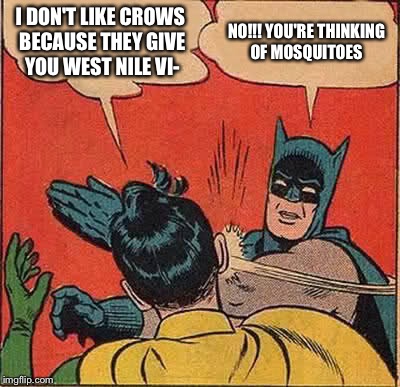
So, does a dead crow in your yard mean it’s time to break out the hazmat suit? Definitely no, but do Fish and Wildlife a favor and report your crow carcasses.  And if any of your neighbors start to panic, calmly and gently give them the facts.  Or just send them this meme I made you:

IMG_2711(1)

Literature cited

  1. http://www.cdc.gov/westnile/faq/genquestions.html
  2. http://www.seattleaudubon.org/sas/LearnAboutBirds/SeasonalFacts/WestNileVirus.aspx
  3. http://www.cdc.gov/westnile/faq/deadbirds.html
  4. http://wnyyradio.com/news/25-shocking-things-more-likely-to-kill-you-than-a-shark/
  5. http://www.cdc.gov/flu/about/qa/disease.htm

2 Comments

Filed under Crow behavior, crow conflicts, Crow disease, Crows and humans

Corvid of the Month: How abundant food may be killing the Mariana crow

For most of us, it’s hard to imagine crows being anything but ubiquitous.  Here in Seattle, American crows can nest so densely, I once found myself within 50 m of three different active nests.  Such is the case for many other parts of the world too, where house crows, jungle crows, or hooded crows are an almost inescapable part of the landscape.  Given these species’ success, it might be tempting to assume that all crows welcome human presence and habitat modification.  Rules don’t exist without exceptions however, (especially in nature!) as our Corvid of the Month, the Mariana crow, tragically illustrates.

A female Aga and fledgling do some exploring. Photo: Matt Henschen

A female Aga and fledgling do some exploring. Photo: Matt Henschen

The Mariana crow, or Aga, is endemic to Guam and Rota and is the only corvid native to Micronesia1.  In appearance, they bear a striking resemblance to the American crow, only they’re 40% smaller (cue adoring sound effects).  Across their range they’re considered critically endangered and as of today, all of Guam’s birds have been extirpated by the invasive brown tree snake, and only about 46 breeding pairs remain on Rota.  If that wasn’t alarming enough, their numbers continue to dwindle and researchers at the University of Washington project they could be extinct within the next 75 years2.  Unlike Guam, however, there are no brown tree snakes on Rota.  So what is causing the drastic decline of this island crow?   As my colleague and Mariana crow researcher, Sarah Faegre, is beginning to tease out, the answer may lie in the delicate nature of island food webs, and the unanticipated butterfly effect that started with a few errant snails.

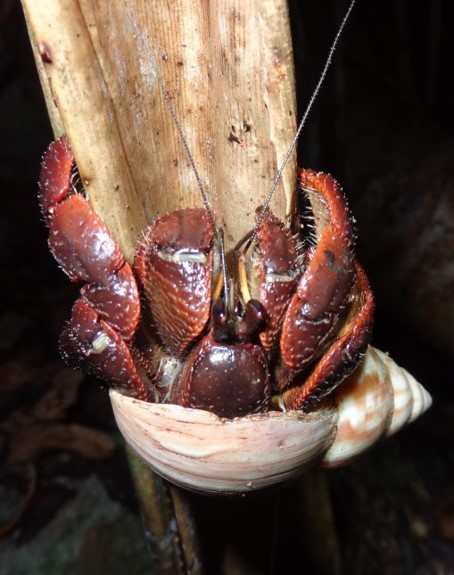
Like our American crows, Mariana crows are generalists and eat a wide variety of foods from insects, to geckos, to fruits and seeds.  But adult Mariana crows have one other food source they’ve come to specialize on: the humble hermit crab. Despite the presence of hermit crabs near other species of corvus, the Mariana crow’s frequent predation on them is unique, especially when you look at how they extract them.  Unlike most coastal or inland living crows that drop tough objects like clams or nuts onto hard surfaces to open them, the Mariana crow actually uses its bill to peck and break the shell at the seams to extract the vulnerable crab, a process that takes place entirely on the ground and is only shared by two other known bird species in the world (one of which is now extinct).  So what does this have to do with wanderlusting snails?  As it turns out, everything.

What's crackin' crabby? Photo: C. Brevimanus

What’s crackin’ crabby? Photo: Sarah Faegre

Rota is home to several species of native land and sea snail, though hermit crabs only utilize the larger shell of the sea snail.  Critically, these shells are extra hard and apparently impenetrable to even the most determined crow.  In the late 1930’s, however, humans introduced the Giant African Land snail which quickly invaded the island.  Two major differences between the native and invasive snails are 1) that the invasive snails have thinner shells, and 2) people were anxious to get rid of them.  So, naturally, we introduced  yet another invasive species (a predatory flatworm) and…it actually worked.  By the 1970’s the island was brimming with large, thin, empty shells, ready and waiting to be filled with hermit crabs.  Gradually, the crows learned that these shells were possible to peck open and now hermit crabs are an important staple for Rota’s crows.

Photo: Matt Henschen

Photo: Phil Hannon

On its surface, this seems like the making of an ecological disaster turned into a conservation blessing.  After all, we successfully controlled an invasive species while simultaneously creating a new food source for a threatened bird.  But in our tangled web of introduced species and ecological fallout we must considering the one remaining player: cats.  Although further study is needed, Sarah’s work3 suggests that all that extra time adult crows now spend on the ground cracking open hermit crabs may be making them more susceptible to predation by cats.

Couple the effect of cats with habitat destruction and persecution by people and the results project a bleak outlook for crow recovery.  But conservationists and researchers like Sarah are working tirelessly to better understand the threats facing this bird and how to solve them.  In fact Sarah and her husband, Phil Hannon, recently started a non-profit called Luta Bird Conservation to help raise awareness and conservation funds to better protect this unique crow.  At the top of their priorities is funding initiatives that would bring the science of crow conservation to the classrooms of local people, helping to raise both pride and awareness for the plight of this endemic species.

So the next time you look at a crow and experience a slight feeling of fatigue at such a ubiquitous bird remember; not all corvid species welcome the consequences of people and some have suffered greatly from them.  Aldo Leopold once said “to keep every cog and wheel is the first precaution of intelligent tinkering.” The lesson from Rota, and so many others, is that the same can be said of not adding any either.

If you wish to contribute directly to Mariana crow conservation, I encourage you to send Luta Bird Conservation Inc. a check at:

Luta Bird Conservation Inc. c/o Aron Faegre
520 SW Yamhill Street, Roofgarden 1
Portland, OR 97204
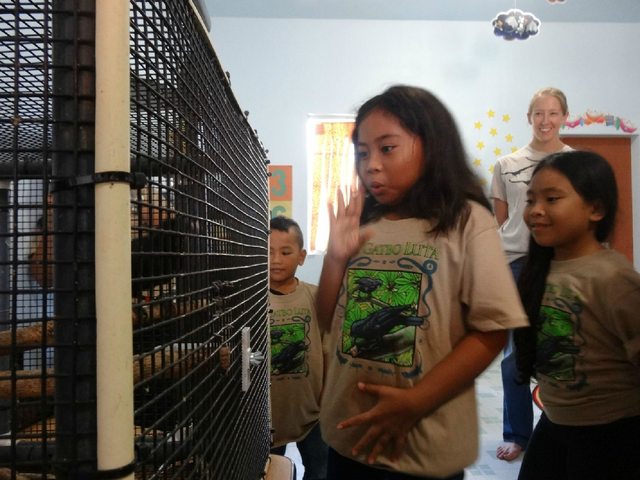
Sunny, Luta's educational Mariana crow captivates the students in a local school

Sunny the captive Aga on an ambassadorial trip to a local classroom with Luta Bird Conservation Inc.

Literature cited:

  1. http://www.fws.gov/pacificislands/fauna/marianacrow.html
  2. http://www.washington.edu/news/2010/12/20/without-intervention-mariana-crow-to-become-extinct-in-75-years-2/
  3. Faegre, S. (2014) Age-related differences in diet and foraging behavior of the critically endangered Mariana Crow (Corvus kubaryi) (Masters thesis; University of Washington).  https://digital.lib.washington.edu/researchworks/handle/1773/27571?show=full

1 Comment

Filed under Corvid of the month, Crow behavior, crow conflicts, Crow life history, Crows and humans, Graduate Research, New Research, women in science

Meet the environmentalist crow

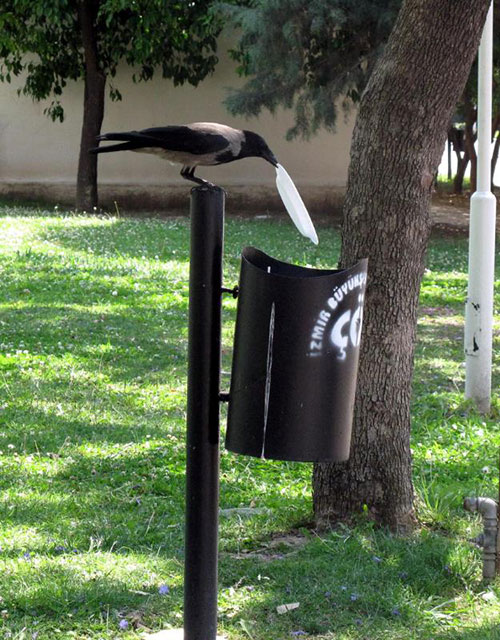
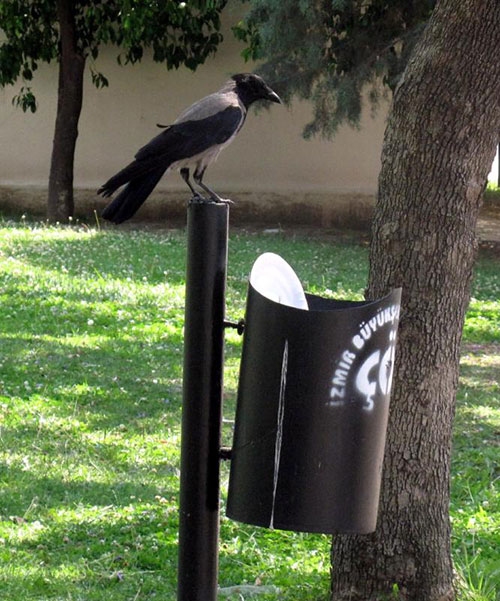
Having grown tired of being referred to as dirty and messy, one hooded crow in Izmir, Turkey took matters into its own beak to help make its park a little cleaner.

fft22_mf4893229

fft22_mf4893230

fft22_mf4893231

For anyone that can read Turkish you can find the original story here

According to the Turkish Newspaper, Radikal, after eating the leftover rice the crow flew over and dropped the used plate in the garbage bin.  What could explain this amazing act of social and environmental prowess?  I often see crows take food wrappers or packages up to a perch and then drop them once they’ve fished out all the crumbs.  Could be that this crow was simply in the right place at the right time to turn this typical behavior into something extraordinary.  Then again ¯\_(ツ)_/¯ .  We’ll never be able to say for sure what this crow was thinking, maybe it just got tired of all those litterbug people mucking up its park!

6 Comments

Filed under Crow behavior, crow intelligence, Crows and humans, Just for fun

Jays do those sassy peanut moves for good reason

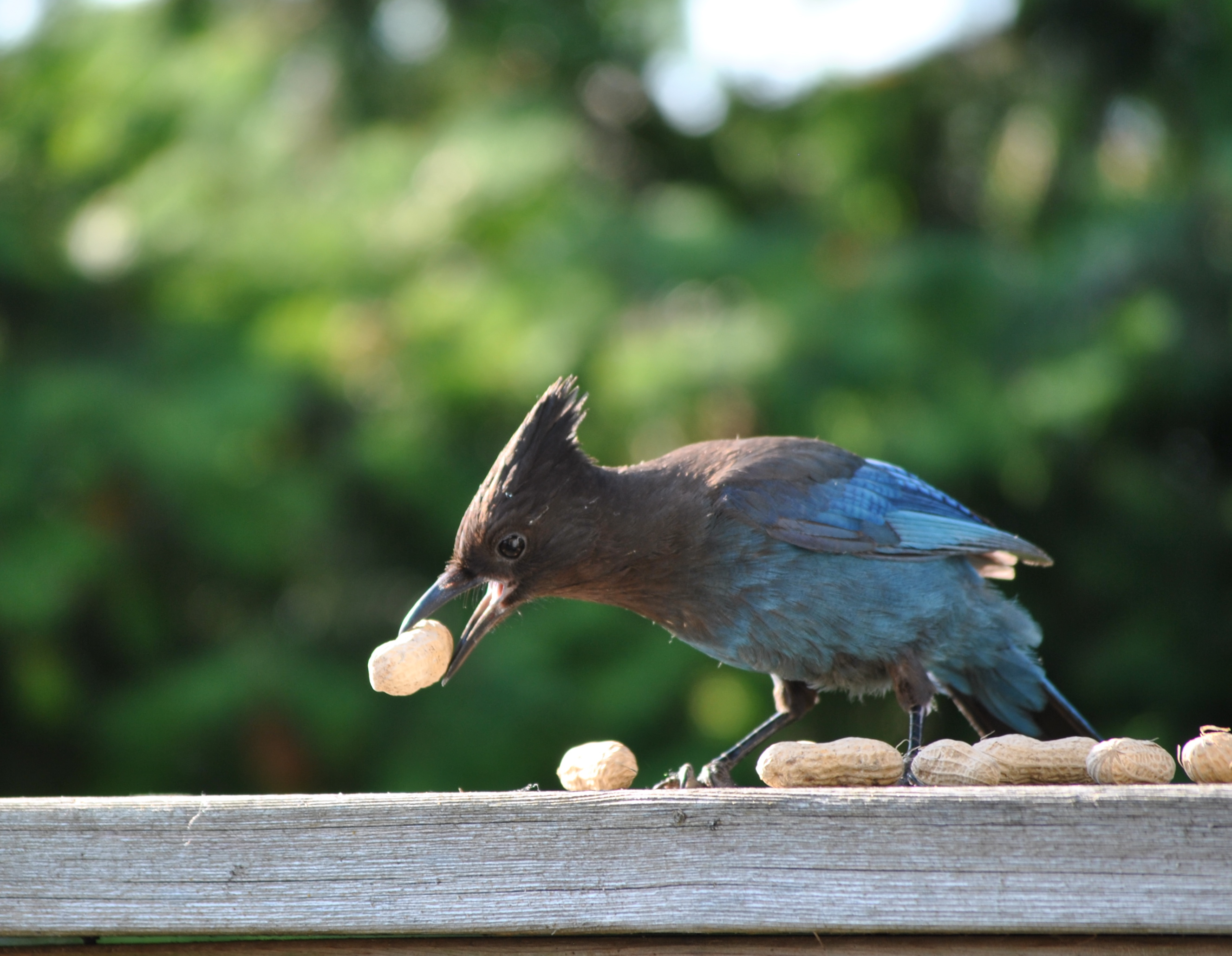
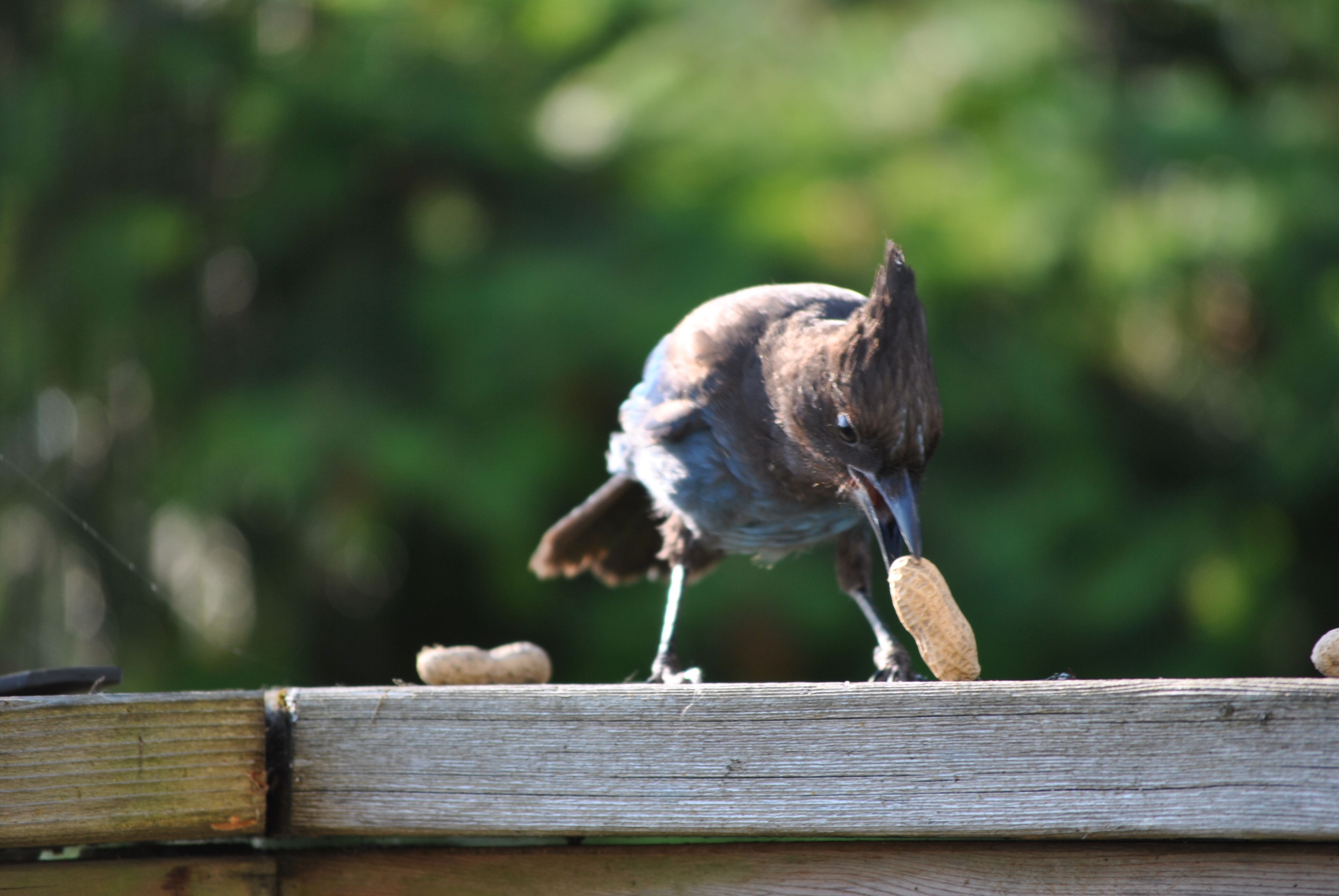
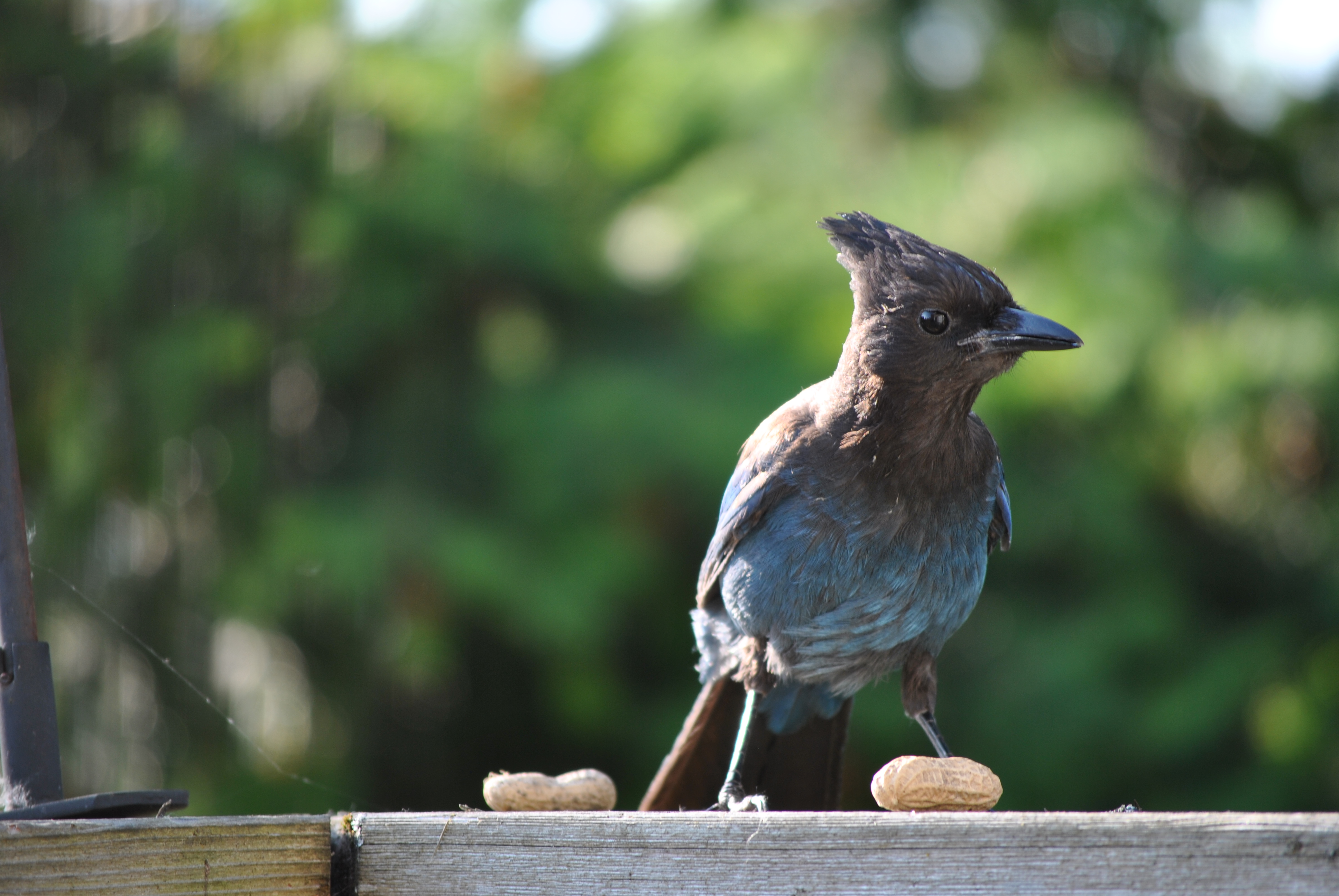
After I lay down my handful of un-shelled peanuts it’s only a matter of minutes before I can hear the “thwap!” as the steller’s jay hits the cable wire that runs above my balcony’s railing.  It balances there for a moment before descending onto the pile I’ve offered it.  Quickly, and with obvious purpose, it springs down the railing and picks up a nut.  Its mohawk feathers bounce as it snaps and cocks its head around in various direction.  After only a few seconds, I hear the sound of rejection; the distinct hollow tap as the nut is returned to the railing.   The jay repeats the same process with two more nuts before abruptly flying off with one that, to my eyes, appeared identical to the first two.

DSC_0730

Certainly most manner of corvids engage in some kind of choosy behavior though I don’t think any of them go about it with as much frenetic spunk as jays do.  So the questions arise: Why are they being so picky?  What do they know about the rejected nuts that my eyes can’t see?

DSC_0735

According to a new study1, Mexican jays are actually ‘weighing’ nuts during this process.  By using specialized slow motion cameras, researchers showed that those snappy head movements are actually a way for the birds to get a tactile feel for the the nut’s weight and listen to the sound the peanuts makes as it rattles in its shell.  By providing nuts that were visually similar but different in mass, the researchers were able to show that jays could consistently select nuts with the most nutmeat density.  A further test showed that large shells that were altered to contain only one nut were typically selected first, only be be rejected, while single nut shells were accepted.  This suggests that jays either have a sense for how much nut should weigh (and thus reject nuts that contain less than they should) or that the correlation between hollow sounds and nut density lead to the ability to choose denser nuts.

So the next time your visiting jay delights you with its sassy head snaps remember; it may simply be amusing to you but for jays, it’s an impressive product of evolution that helps keep them alive.

DSC_0736

Literature cited:

1) Piotr G. Jablonski, Sang-im Lee, Elzbieta Fuszara, Maciej Fuszara, Choongwon Jeong, Won Young Lee. Proximate mechanisms of detecting nut properties in a wild population of Mexican Jays (Aphelocoma ultramarina). Journal of Ornithology, 2015


6 Comments

Filed under Crow behavior, Crow life history, Jay behavior, New Research

Help, I’ve found a baby crow!

You’re walking down the sidewalk when suddenly you notice a waddling little mass of black feathers trying awkwardly to hide under a bush or car.  When you begin to approach the young crow, it simply stares up at you or perhaps continues on its poorly planned waddle down the sidewalk or worse, into traffic. Clearly this baby crow cannot fly and has a habit of making bad decisions.  Your instinct (and perhaps the opportunity to interact with a baby animal) are tempting you to intervene and “save” this young crow who seems ill prepared to be out of the nest.  What should you do?

DSC_0715

The bright blue eyes and pink bill tell you right away that this is a baby crow. Within about a week the bill will turn black like and adults’ but the eyes and mouth corners with remain blue and pink respectively.

The answer, almost always, is to ignore your instincts and good intentions.  I have many friends and colleagues who are either licensed wildlife rehabbers or who spent summers volunteering with their local rehab facilities, that can attest to the dozens of animals that get brought in during the spring and summer by well intentioned folks who assumed that finding a baby meant it needed help.  In many of these cases, these animals did not need help and now they’ve been separated from their parents or mother and stand a much lower chance of surviving once they’re released.  So how do you avoid making the same error?

First, understand that corvid babies (and many other open-cup nesting songbirds) very often leave the nest before they are completely flighted.  For crows, this early departure can be on the order of 7-10 days before they can fly.  Although this strategy is risky and leads to lower fledgling survival rates than for species that wait until the babies are fully flighted, the alternative is quite literally an “all your eggs in one basket” situation where the longer the kids stay in the nest the more chance they stand of being discovered by a predator who will then wipe out the whole brood.1  By pushing kids out sooner, the less developed ones may get caught by a predator or killed by some other means, but the stronger individuals stand a better chance of escaping. It’s not a great compromise, but its continued selection suggests it’s the one that works best.

DSC_0772.jpg

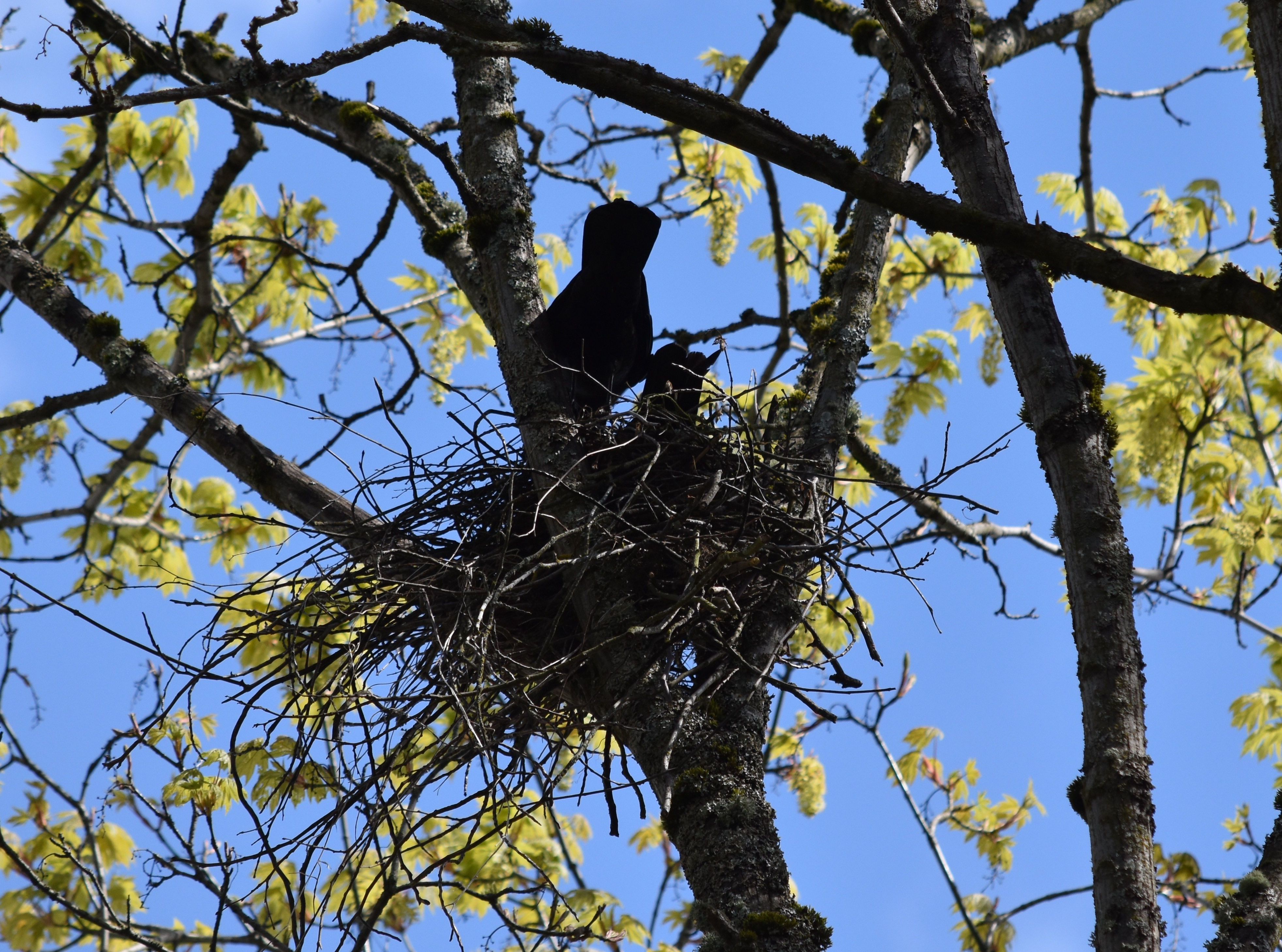
A crow’s nest is an example of an “open-cup” style nest, where the top is exposed, making them easier to spot and access by predators.  Other styles include cavity nests, which are made in holes, and pendant nests which are sock shaped nests.

During this vunerable time, the young are still in the care of their parents who will continue to feed and defend them until they reach independance. So finding a flightless baby crow or jay is totally normal between late May and July and does not imply that it has been abandoned or fallen out of the nest.

DSC_0710

This is the stage of development that most babies will be at when they leave the nest.  If your fledgling looks like this then it is okay.

Simply knowing this piece of corvid biology will lay to rest the concerns for most situations you may find yourself in this summer.  For babies that are naked, bleeding, have drooping wings, or are within reach of a dog or cat, etc., the following flow chart is excellent and will help navigate the situation (I’ve thrown in the mammal one too just for good measure).

Help, I’ve found a baby bird
Help, I’ve found a baby mammal

The main thing to remember is; as long as the baby is mostly feathered and being attended by its parents, it’s just where it needs to be.  Only if it’s trapped in a storm drain, naked, injured, cornered by a cat, or after several hours has not been visited by its parents is it appropriate to intervene.  Even in most of those cases, simply creating a makeshift nest out of a basket and securing it to a tree, or placing the baby in a bush and leaving the area, is much better than taking it away to a facility.  So use your best judgment this summer and remember; if you feel your situation is unique and has not been addressed by the flow charts provided, give a rehab facility a call and let them help you decide if an animal needs to be removed before you make the mistake of taking babies away from their parents.

DSC_0726

This baby has left the nest earlier than most of its peers. See how much more of its legs are exposed and how much shorter the wing feathers are in contrast to the other babies in this post? It will be quite a long time before it can fly. Still, this little one will be cared for and fed by its parents making it a good candidate for a makeshift nest secured to a high branch. If it jumps out right away then wish it luck and leave it be.

Literature cited

81 Comments

Filed under Crow behavior, Crow life history

Corvid of the month: The large-billed crow

If there’s one corvid that’s most notorious for getting into trouble, it’s probably the large-billed crow (sp: Corvus macrorhynchos* ).  A dubious reputation perhaps, but it’s one that’s been well earned through this corvid’s knack for exploiting humans and the opportunities we create.

Physical description: While large-billed crows aren’t much bigger than an American crow, their square head and heavy bill gives them a more raven-like appearance.  To me, they look like what I might expect if a common raven tangoed with Rick Moranis’s contraption from Honey I Shrunk the Kids.

Photo: Anne Kurasawa Photo: Anne Kurasawa

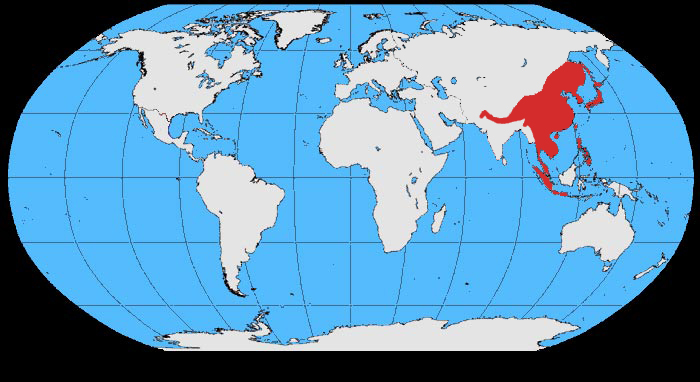
Range: They are found throughout the northeastern Asian seaboard to Afghanistan and eastern Iran in the west, through South and Southeast Asia, to the Lesser Sundas and Cambodia in the southeast.  Although in India the eastern jungle crow and large-billed crow behave has two distinct species, in northern parts of Asia their distinction is less clear and colloquially the two are often analogous.

Conservation status: Given their large range, it may come as no surprise that their populations are abundant and are considered a species of least concern by the IUCN.  In fact, since the 1980’s the number of jungle crows in Tokyo has quadrupled1.

“Corvus macrohynchos map”. Licensed under CC BY-SA 3.0 via Wikimedia Commons

So what accounts for their bad reputation you ask?  Where to begin…how about vandalizing cemeteries1.  In Japan, food is left at the burial sites of loved ones as an offering.  Although in some cultures these offerings are meant to be eaten by animals, that is not the case here, and the crows’ stealing of food interrupts the intention of the ritual.  Historically, this probably wasn’t a conflict since jungle crow populations were much smaller than they are now.

Photo: Anne Kurasawa Photo: Anne Kurasawa

As if that wasn’t enough to get people fired up, jungle crows also have a bad habit of, well, firing things up.  People were stumped how field fires near the Fushimi-Inari shrine in Kyoto were starting until someone thought to watch the crows.  There are 10,000 candle holders that line the walkways of the shrine and on busy days they may contain thousands of individual burning candles.  With some diligent watching, researchers discovered that crows were eating the melted candle wax (which is often made with tallow) and in some cases taking the burning candles out of the holders and flying off with them.  Although they never witnessed it, researchers suggested that crows’ attempts to cache burning candles may have been the cause of the mysterious fires.2Photo: H. Higuchi The crows appeared to show no fear of the flames according to the paper’s author. Photo: H. Higuchi

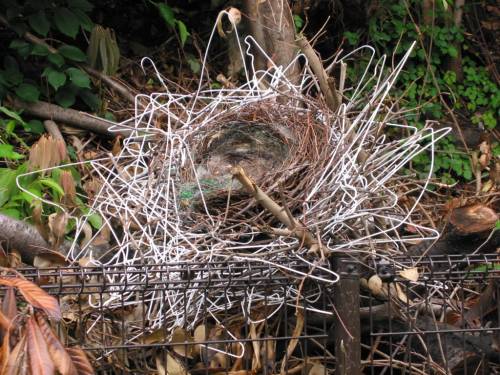
To top it all off, large-billed crows seem to be just as good at turning out the lights as there are at lighting them up! Unlike American crows, which predominately use sticks to build their nests, large-billed crows have developed a fascinating (and immensely frustrating for the Japanese government) habit of using clothes hangers to construct nests.  Mixing wire hangers with power lines is a recipe for disaster and in the summer time large-billed crows are responsible for massive blackouts.  The Tokyo government spends millions of yen, and employs full time crews, to search for and destroy hanger nests in an effort to prevent such black-outs.1Photo: Götz Maybe Joan Crawford had just spent too much time around jungle crows…  Photo: Götz

It’s not all bad press for these resourceful crows, however.  One of the more spectacular things they are known for is using cars to crack open otherwise inaccessible nuts.  Not only that, but they also appear to be sensitive to crosswalk signals and know when it’s safe to collect the exposed nuts and when it’s not.3So while large-billed crows make their fair share of trouble stealing food, candles and hangers, there are still plenty of people who adore these animals for their cleverness and ingenuity.  For those that don’t, well, some aren’t shy to take control measures into their own hands.  Or should I say mouths…

IMG_1922*The jungle crow was formally Corvus macrorhynchos, but the species was split into the large-billed crow Corvus macrorhynchos, the eastern jungle crow Corvus levaillantii, and the Indian jungle crow, Corvid culminatus.

Literature cited:

1Marzluff, J.M. & Angell, T.  2005 In the company of crows and ravens.  Yale University Press

2Higuchi, H. Crows causing fire. (2003). Manuscript from The University of Tokyo

3Marzluff J.M & Angell, T. 2012. Gifts of the crow.  Free Press

14 Comments

Filed under Corvid of the month, Crow behavior, crow conflicts, crow intelligence, Crows and humans

Crow curiosities: who is begging in April?

Right now, in early spring, you may have noticed a crow or two fluttering their wings and making the classic “waaah, waaahhh” sound that roughly translates to “feed me, feed me”!  Although it’s tempting to think these are young crows, it’s far too early in the breeding season for fledglings to be on the loose.  So who are these juvie doppelgangers? Adult female crows.

DSC_4002

Begging juveniles like this one won’t be roaming around the PNW until mid June and later.

During the nest building stage you may hear females making these sounds just while on the ground foraging with their mate or while perched near the nest like this female was.  Why do they do it?  It’s essentially a way to prime the pump and remind their mate that they’re going to need to be fed once they’re saddled to the nest and can’t forage as much for themselves.  Once they are actively incubating, they’ll continue to beg only now it’s really a demand for the food they need and can’t get for themselves without risking their eggs getting too cool.  Although males will take a turn on the nest, they do not have a formal brood patch and can’t do much more than temporarily keep the eggs insulated.

Although it’s tempting, hopefully now you won’t be fooled by this April trick!

DSC_0084

A male returns to the nest with a bill-load of peanuts for his hungry mate.

7 Comments

Filed under Crow behavior, Crow curiosities

Best books for corvid lovers

This post was prompted by someone on my twitter feed who asked that I put together a reading list for people who want to learn more about corvids; a totally kick-ass idea if I say so myself.  The following are all the books I have read and can speak personally to, however, I’m sure there are others and I encourage folks to add them in the comments section.  As a preface, I’ll remind readers that John Marzluff is my graduate adviser, nevertheless, I assure you that I genuinely believe he is a fantastic writer and my review of his books are not inflated in the hopes of getting approval on my dissertation. 🙂  So without much further adieu, here’s a list of all the corvid books I’ve read with a brief synopsis of the material and my recommendation.

index

In the Company of Crows and Ravens by John Marzluff and Tony Angell
If watching, feeding or rehabilitating corvids is something you do in your free time, consider this your crow bible.  Curious how long crows live?  What they do as juveniles?  The sounds they make?  The ways the interact with people?  It’s all in there.  This book remains my go-to guide for general crow knowledge.  Yet, despite the fact its backbone is rigorous science, it’s written in a way that feels very easy to digest.  John and Tony wrote it with the intent that it would be for a wide audience and I think they achieved that beautifully.  After reading this book, I have no doubt you’ll have a deeper understanding for these birds, not to mention a new admiration for Tony’s artwork.  I even used one of his drawings for the book on the invitations for my wedding (with permission, of course).

raven

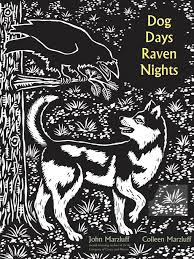
Dog Days Raven Nights by John and Colleen Marzluff
This is the book I most often recommend to my own friends and family.  Not because it offers superior or more easily read  information on corvids, but because this book gives you the best insight into what it really means to do fieldwork.  Nearly the entirety of the book focuses on the period of time after John and Colleen had finished their graduate work in Arizona, and were conducting a post-doctoral study on ravens with Bernd Heinrich in remote Maine.  It’s organized as a back and forth between John and Colleen, which means you get two perspectives on the raven work and Colleen’s development as a dog sledder and trainer.  As a reader, you experience what it means to completely dedicate every moment, piece of sanity, and dime you have on conducting a field experiment and you walk away with a much deeper appreciation for how difficult it is to answer questions of animal behavior.  If the human dimension of science isn’t your interest, however, fear not.  The book is still loaded with fascinating information on ravens including, in my opinion, one of John’s most important contributions which is information sharing among ravens.  An excellent read for sure.

gifts

Gifts of the Crow by John Marzluff and Tony Angell
For those looking for a more scientifically dense reading on crow behavior and neurology this is the book for you.  It doesn’t make for the lighthearted Sunday reading that ITCOCR does, but it still satisfies the trademark Marzluff style of mixing rigorous science with the anecdotal stories of crow behavior that makes us love them.  If you’ve been fascinated by the story of Gabi Mann, the little girl who feeds and gets gifts from crows, then this is the scientific background you need to see the whole picture.

mind

Mind of the Raven by Bernd Heinrich
Long before John Marzluff started writing books, his post-doc adviser, Bernd Heinrich, was already an expert at the game.  Heinrich has a reputation for being one of the most eloquent and engrossing natural history writers and it’s a reputation that’s been well earned.  Mind of the Raven is actually what initially peaked my interest in corvids, so in many ways I have this book to thank for the work I am doing now.  For anyone who lives with ravens, or simply has a fascination for them, I can’t recommend it enough.  Bernd’s writing will nurture your passion and give you the science to back up what you already know: ravens are badass, awesome animals.

planet

Crow Planet by Lyanda Lynn Haupt
Crow Planet it a book best characterized by Haupt’s journey to find curiosity and loveliness in an increasingly urban landscape where the natural world can feel further and further away.  Crows therefore, offered the perfect vehicle for looking at and appreciating what remains when the forests retreat and box stores and neighborhoods take their place.   By the author’s own admission her journey through writing Crow Planet made Haupt appreciate, “but not quite love”, crows.   Despite this, she manages to write about them with grace, and her stories will make even the biggest skeptic take another look at these animals.  Although Haupt’s background is not in science, she doesn’t omit the scientific facts, though she does take more artistic liberty when describing their antics than John or Heinrich do.  All that being said, this is an excellent book for the urban naturalist or crow watcher.

crow

Crow by Boria Sax
If you’re interested in crow mythology this is the book for you.  Sax takes you through time and space to explore the role of corvids in human myth, religion and art.    His thoroughness is without compare, but if anthropology is not your interest this book will prove taxing.  It’s one I happily keep on hand, but not one that I’ve ever had the patience to read all the way through.  Nevertheless, I probably should, since it’s chalk full of information and historical context that I would be better off knowing.

Bird brain

Bird Brain: An exploration of avian intelligence by Nathan Emery
Although not exclusively dedicated to corvids, Bird Brain, written by corvid cognition expert Dr. Nathan Emery, offers an incredible look at the minds of your favorite birds.  Although his book tackles some of the more difficult concepts of avian cognition, it feels and reads more like a coffee table book, complete with beautiful artwork, some of which was done by Emery himself.  Each chapter is themed around a particular aspect of cognition (communication, spatial memory, etc.) and walks the reader through the fundamental biological principals and samples the most interesting studies that have been done on the topic.  The book is rich with the kinds of analogies and descriptions that break through the barriers of dry scientific writing.  Perfect for the budding young scientist or the long time corvid fan.

9780231182829

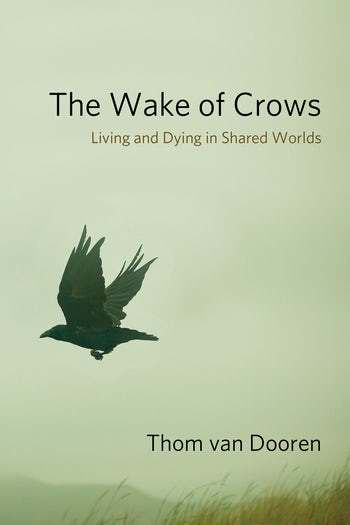
The wake of crows: Living and dying in shared worlds by Thom van Dooren
“Crows are among our most familiar and charismatic animals and as such there is a body of literature dedicated to them for which few other wildlife species compare. While each contributor takes a distinct perspective and harnesses different stories or features of their biology, there is perhaps nothing as unique in the body of work dedicated to crows as this book. It is neither a classic natural history book, nor a memoir of being connected to the natural world through crows. Instead, van Dooren has used crows as a loom on which to weave science and humanities together, producing a thesis of what it means to exist in our contemporary world. Central to this thesis is the question of “What else is possible?” For the traditional science and natural history reader his exploration of this seemingly familiar question will be anything but familiar. While by now, for example, we may be used to being asked to reconsider the crow as pest or bad omen, here we are asked to reconsider them systemically, and in ways that ultimately inform the reader’s ethic….It’s a unique and powerful look at what it means to live in a shared world, and asks that we reconsider our ethics in doing so. It is far from a light read, but it is one that grants the experience of expansion that curious people crave.” 

This section is apart of a larger review I wrote of The wake of crows for a contribution has been accepted for publication and will appear in a revised form (subject to input from the journal’s editor) in a book review for Oryx—The International Journal of Conservation.

***

I’m sure there are many others I haven’t read which subsequently didn’t make this list.  Feel free to make recommendations in the comments section!

17 Comments

Filed under Crow behavior, Crow curiosities, Crows and humans, Raven behavior, Raven intelligence