Author Archives: corvidresearch

10 corvids who don’t give a damn about your rules

Time to take my scientist hat off and have some very anthropomorphic fun*.  These are the best GIFs from around the internet proving that corvids are nature’s most hilarious rule-beakers.  What’s not to love?

1.  Yeah I read the tortoise and the hare, and then I came over here to steal Stumpy’s lunch because things with longer legs beat things with shorter legs and that fable is dumb.

RCejcfB


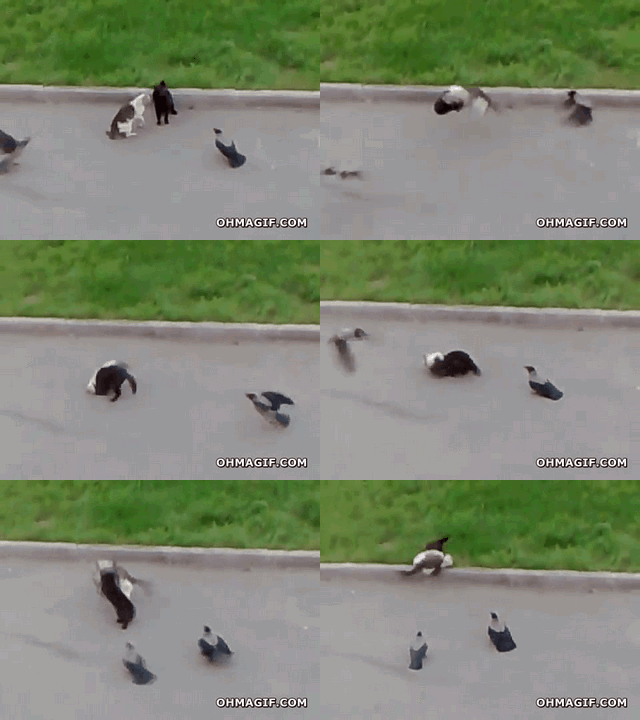
2.  We know how to be the CATalyst for a fight

crow-enjoying-catfight


3. I’m not breaking a rule, I’m enforcing the will of the fashion police.

raven_tail_pull


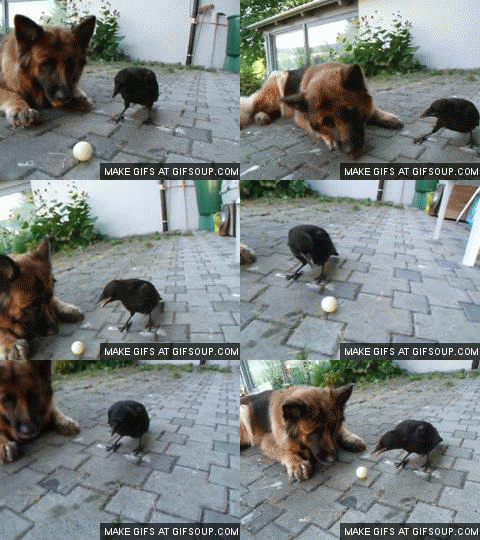
4.  Just when you started to think we always have it out for dogs…#NoRulz!

Play gif.gif

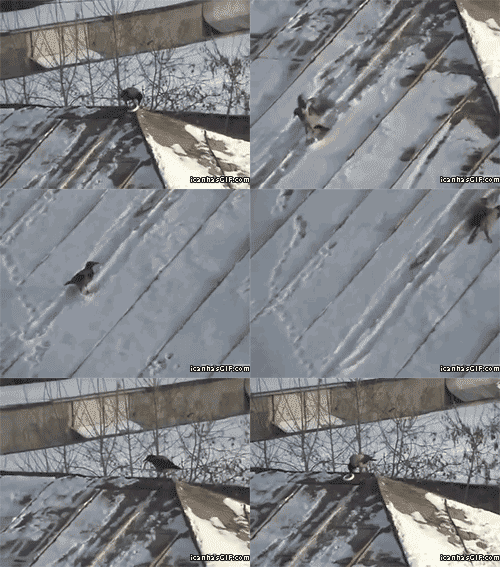
5.  Nothing is off limits to my board, not even your roof.

funny-crow-snow-house-roof


6.  I don’t care what they say, I will be America’s next Top Chef!  Wait for me Padma!

crow_pan


7. “Primates are the only species that make tools” Lol, nope

Tool.gif

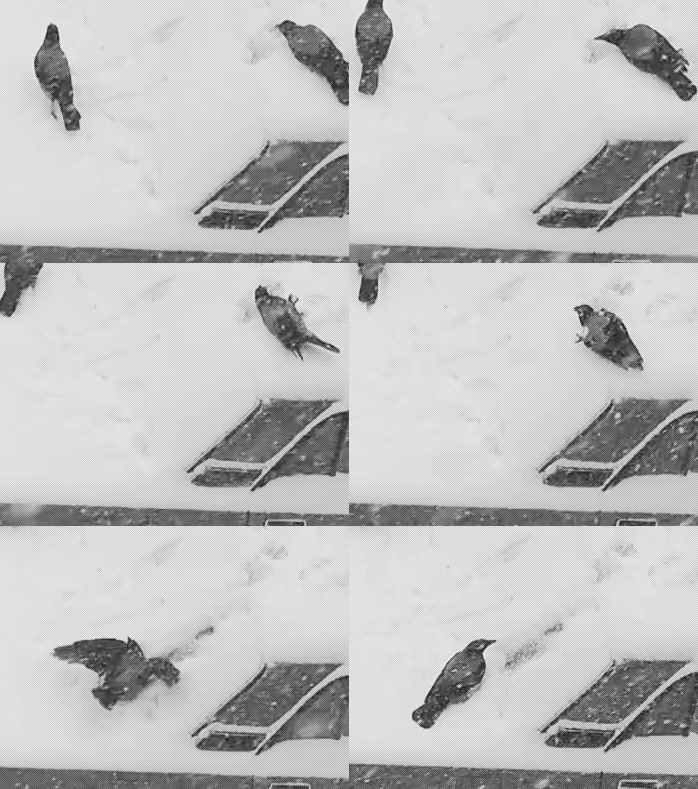
8.  Just because they left it out of your ornithology textbook, doesn’t mean rolling isn’t a primary mode of avian transportation.

rolling


9.  What do you mean birds are only supposed to make music with our songs?

piano


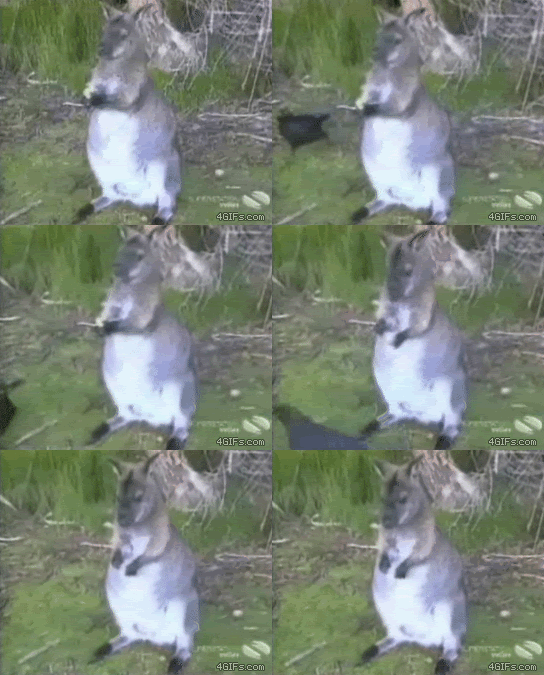
10.  Big bear? Don’t care.  I need this for my nest.

panda.gif

*This post has been edited from a previous version due to both some initial inaccuracies and some scientific updates.

4 Comments

Filed under Uncategorized

Meet the environmentalist crow

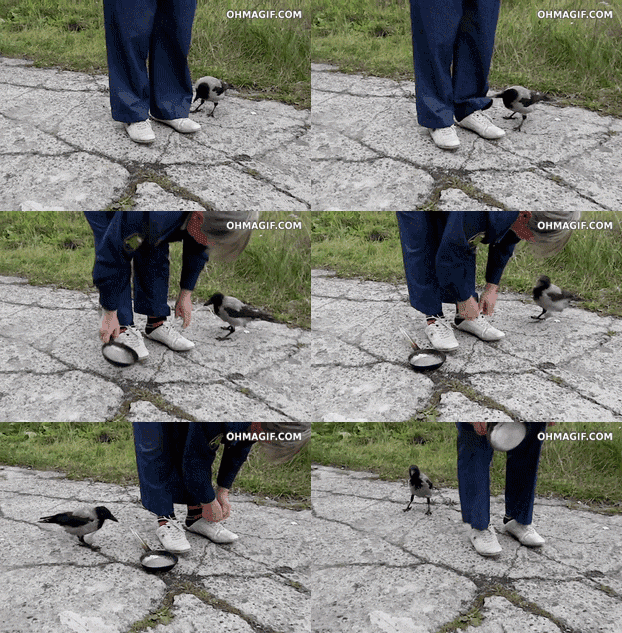
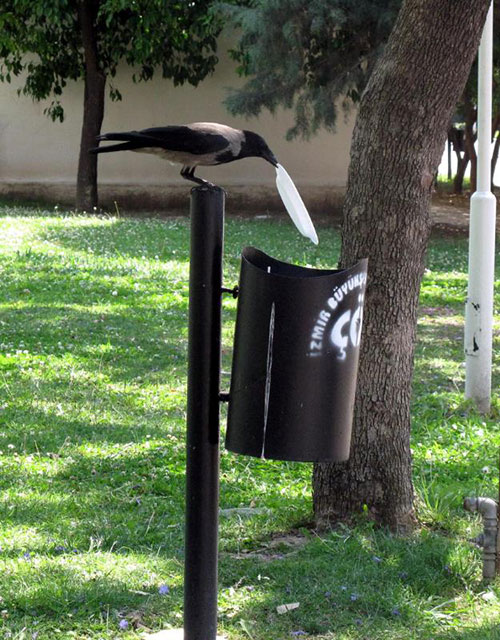
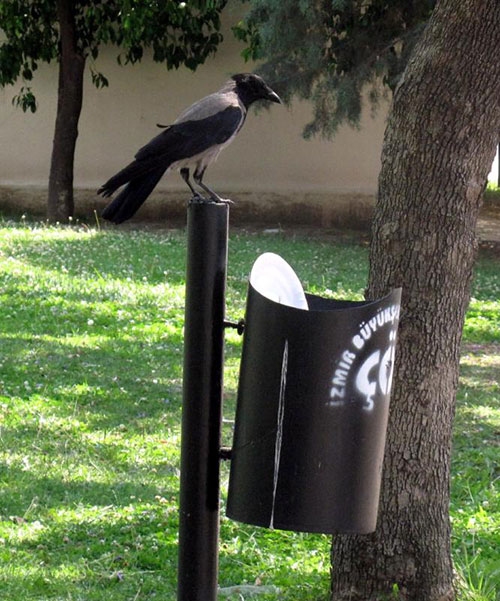
Having grown tired of being referred to as dirty and messy, one hooded crow in Izmir, Turkey took matters into its own beak to help make its park a little cleaner.

fft22_mf4893229

fft22_mf4893230

fft22_mf4893231

For anyone that can read Turkish you can find the original story here

According to the Turkish Newspaper, Radikal, after eating the leftover rice the crow flew over and dropped the used plate in the garbage bin.  What could explain this amazing act of social and environmental prowess?  I often see crows take food wrappers or packages up to a perch and then drop them once they’ve fished out all the crumbs.  Could be that this crow was simply in the right place at the right time to turn this typical behavior into something extraordinary.  Then again ¯\_(ツ)_/¯ .  We’ll never be able to say for sure what this crow was thinking, maybe it just got tired of all those litterbug people mucking up its park!

6 Comments

Filed under Crow behavior, crow intelligence, Crows and humans, Just for fun

Counting abilities of crows

Breaking news: Crows probably have sense of numerical competency (a.k.a. they can count)!  Ok, so this isn’t breaking news, and it’s not exactly true, but it makes for a nice headline as evidenced by the number of articles that have shown up in my inbox this week regarding a new study.  As early as 1950, Otto Koehler, a German animal behaviorist, showed that captive Western jackdaws would only turn over enough boxes to obtain the corresponding number of treats they saw him hide (up to around six).  Parrots too, have  shown that they can solve problems requiring the ability to count to around six1.  So what makes this new study so special?  It’s not so much that researchers showed that crows can discriminate quantities but how.

By presenting trained carrion crows with computer screens that showed two quantities of either matched, or mismatched dots, researchers were able to demonstrate that the birds could correctly indicate if the quantities were the same or different, despite the dots being of different sizes and arrangements2.  While that’s in and of itself cool and of value, the main finding what that it’s actually individual neurons that are recognizing and responding to these different quantities.

Photo: Andreas Neider

Photo: Andreas Neider

Why is that so cool?  Because that’s basically how our own brains begin to understand numbers too, despite our brains being, in some ways, really different.  Take that in for a minute: Our human brain, and a crow (a bird!), process numbers in a very similar way.  For a scientist,  the neon sign illuminating “convergent evolution” immediately lights up.  The researchers did not show, however, that that they could count in a strict sense like us, meaning the neurons were responding to numbers relative to each other and not to stand alone values. So perhaps jackdaws or carrion crows are different in this respect, or Koehler’s experiments were testing a different kind of problem solving ability that better teased this out.  Still, crows prove once again what magnificent animals they are and their relevance in understanding our own evolution as humans.

1) Pepperberg, I.M. (1999) The Alex studies: Cognitive and communicative abilities of Grey Parrots.  Cambridge, MA: Harvard University Press.

2) Helen M. D. & Andreas N. (2015) Neurons selective to the number of visual items in the corvid songbird endbrain. PNAS  DOI: 10.1073/pnas.1504245112

Leave a comment

Filed under crow intelligence, Crows and humans, New Research

Jays do those sassy peanut moves for good reason

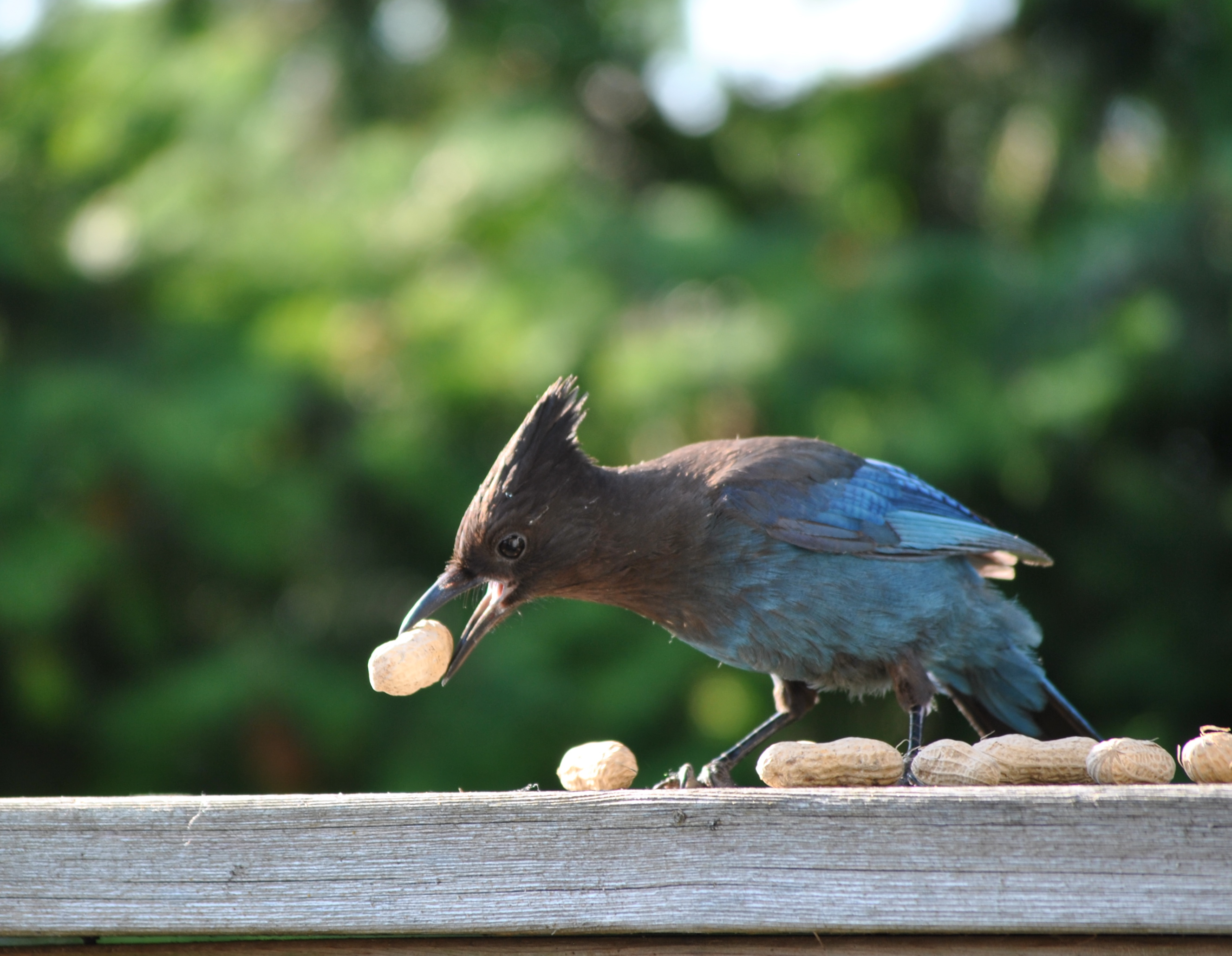
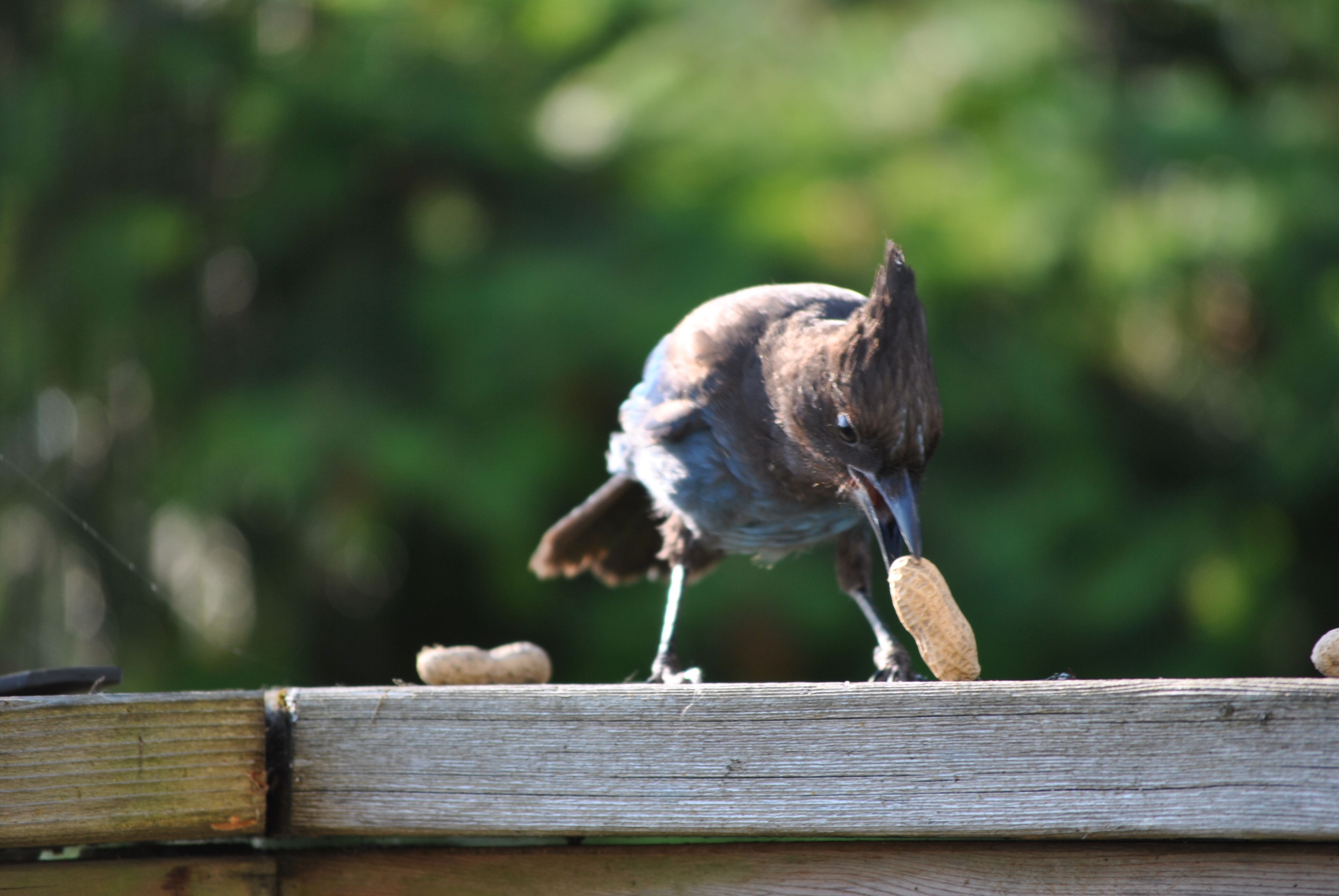
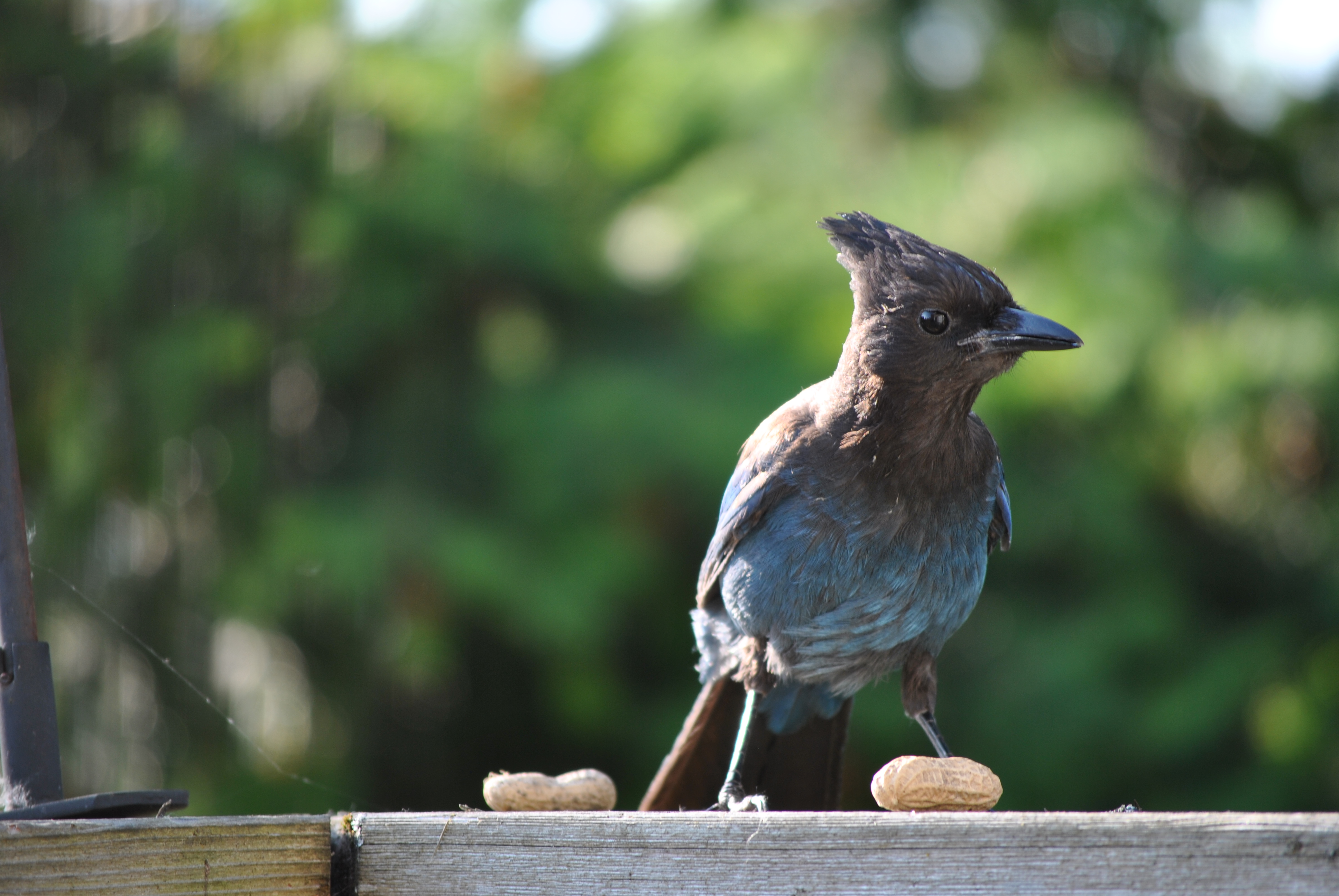
After I lay down my handful of un-shelled peanuts it’s only a matter of minutes before I can hear the “thwap!” as the steller’s jay hits the cable wire that runs above my balcony’s railing.  It balances there for a moment before descending onto the pile I’ve offered it.  Quickly, and with obvious purpose, it springs down the railing and picks up a nut.  Its mohawk feathers bounce as it snaps and cocks its head around in various direction.  After only a few seconds, I hear the sound of rejection; the distinct hollow tap as the nut is returned to the railing.   The jay repeats the same process with two more nuts before abruptly flying off with one that, to my eyes, appeared identical to the first two.

DSC_0730

Certainly most manner of corvids engage in some kind of choosy behavior though I don’t think any of them go about it with as much frenetic spunk as jays do.  So the questions arise: Why are they being so picky?  What do they know about the rejected nuts that my eyes can’t see?

DSC_0735

According to a new study1, Mexican jays are actually ‘weighing’ nuts during this process.  By using specialized slow motion cameras, researchers showed that those snappy head movements are actually a way for the birds to get a tactile feel for the the nut’s weight and listen to the sound the peanuts makes as it rattles in its shell.  By providing nuts that were visually similar but different in mass, the researchers were able to show that jays could consistently select nuts with the most nutmeat density.  A further test showed that large shells that were altered to contain only one nut were typically selected first, only be be rejected, while single nut shells were accepted.  This suggests that jays either have a sense for how much nut should weigh (and thus reject nuts that contain less than they should) or that the correlation between hollow sounds and nut density lead to the ability to choose denser nuts.

So the next time your visiting jay delights you with its sassy head snaps remember; it may simply be amusing to you but for jays, it’s an impressive product of evolution that helps keep them alive.

DSC_0736

Literature cited:

1) Piotr G. Jablonski, Sang-im Lee, Elzbieta Fuszara, Maciej Fuszara, Choongwon Jeong, Won Young Lee. Proximate mechanisms of detecting nut properties in a wild population of Mexican Jays (Aphelocoma ultramarina). Journal of Ornithology, 2015


6 Comments

Filed under Crow behavior, Crow life history, Jay behavior, New Research

Help, I’ve found a baby crow!

You’re walking down the sidewalk when suddenly you notice a waddling little mass of black feathers trying awkwardly to hide under a bush or car.  When you begin to approach the young crow, it simply stares up at you or perhaps continues on its poorly planned waddle down the sidewalk or worse, into traffic. Clearly this baby crow cannot fly and has a habit of making bad decisions.  Your instinct (and perhaps the opportunity to interact with a baby animal) are tempting you to intervene and “save” this young crow who seems ill prepared to be out of the nest.  What should you do?

DSC_0715

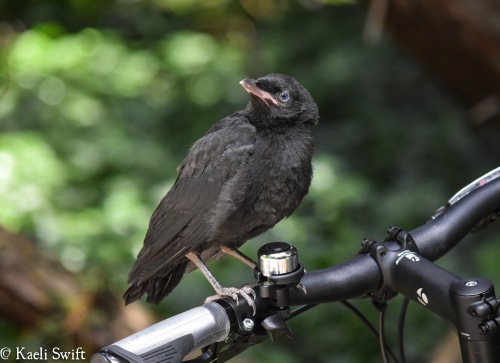
The bright blue eyes and pink bill tell you right away that this is a baby crow. Within about a week the bill will turn black like and adults’ but the eyes and mouth corners with remain blue and pink respectively.

The answer, almost always, is to ignore your instincts and good intentions.  I have many friends and colleagues who are either licensed wildlife rehabbers or who spent summers volunteering with their local rehab facilities, that can attest to the dozens of animals that get brought in during the spring and summer by well intentioned folks who assumed that finding a baby meant it needed help.  In many of these cases, these animals did not need help and now they’ve been separated from their parents or mother and stand a much lower chance of surviving once they’re released.  So how do you avoid making the same error?

First, understand that corvid babies (and many other open-cup nesting songbirds) very often leave the nest before they are completely flighted.  For crows, this early departure can be on the order of 7-10 days before they can fly.  Although this strategy is risky and leads to lower fledgling survival rates than for species that wait until the babies are fully flighted, the alternative is quite literally an “all your eggs in one basket” situation where the longer the kids stay in the nest the more chance they stand of being discovered by a predator who will then wipe out the whole brood.1  By pushing kids out sooner, the less developed ones may get caught by a predator or killed by some other means, but the stronger individuals stand a better chance of escaping. It’s not a great compromise, but its continued selection suggests it’s the one that works best.

DSC_0772.jpg

A crow’s nest is an example of an “open-cup” style nest, where the top is exposed, making them easier to spot and access by predators.  Other styles include cavity nests, which are made in holes, and pendant nests which are sock shaped nests.

During this vunerable time, the young are still in the care of their parents who will continue to feed and defend them until they reach independance. So finding a flightless baby crow or jay is totally normal between late May and July and does not imply that it has been abandoned or fallen out of the nest.

DSC_0710

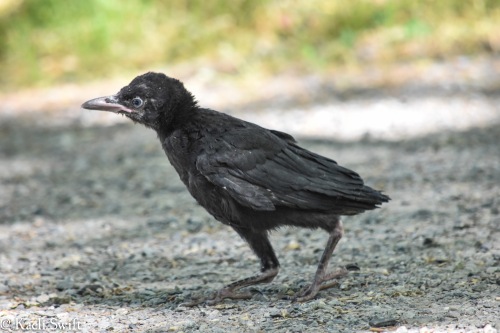
This is the stage of development that most babies will be at when they leave the nest.  If your fledgling looks like this then it is okay.

Simply knowing this piece of corvid biology will lay to rest the concerns for most situations you may find yourself in this summer.  For babies that are naked, bleeding, have drooping wings, or are within reach of a dog or cat, etc., the following flow chart is excellent and will help navigate the situation (I’ve thrown in the mammal one too just for good measure).

Help, I’ve found a baby bird
Help, I’ve found a baby mammal

The main thing to remember is; as long as the baby is mostly feathered and being attended by its parents, it’s just where it needs to be.  Only if it’s trapped in a storm drain, naked, injured, cornered by a cat, or after several hours has not been visited by its parents is it appropriate to intervene.  Even in most of those cases, simply creating a makeshift nest out of a basket and securing it to a tree, or placing the baby in a bush and leaving the area, is much better than taking it away to a facility.  So use your best judgment this summer and remember; if you feel your situation is unique and has not been addressed by the flow charts provided, give a rehab facility a call and let them help you decide if an animal needs to be removed before you make the mistake of taking babies away from their parents.

DSC_0726

This baby has left the nest earlier than most of its peers. See how much more of its legs are exposed and how much shorter the wing feathers are in contrast to the other babies in this post? It will be quite a long time before it can fly. Still, this little one will be cared for and fed by its parents making it a good candidate for a makeshift nest secured to a high branch. If it jumps out right away then wish it luck and leave it be.

Literature cited

81 Comments

Filed under Crow behavior, Crow life history

Raven nest provides tasty meal for Alberta bear

I’ve talked before about how the claim that crows (and ravens) are “destroying the ecosystem and songbird populations” is mostly unsupported by science.  Breeding plovers and desert tortoises are among the handful of exceptions1,2.  Nevertheless I still see, even in the comment threads of this very blog, people claiming that corvids are out of control and have no predators.  If it wasn’t such a misguided and ultimately dangerous sentiment I might just ¯\_(ツ)_/¯ whenever folks claimed that crows and ravens have no natural predators because those of us who spend even a small amount of time observing them in the summer will know this is anything but true.

Eggs and baby birds are a key summer food source for lots of animals and, while seeing a downy little gosling in the mouth of an arctic fox makes me cringe a little, knowing a healthy population of breeding birds is helping to sustain a community of predators is the kind of ecological balance that, in the long run, makes my heart sing.

Stillframe from Planet Earth

Stillframe from Planet Earth

Corvids are part of this system too, which means their babies are also getting eaten.  Usually it’s by things like hawks, eagles, owl and racoons but a recent video taken in Alberta shows yet another predator we can bear in mind.  It’s never gonna be fun to see the birds I care about taking a hit like this, but knowing that corvid babies are helping to sustain top predators only deepens my love and appreciation for them.  Predators and prey make the world go round and corvids have the badass role of being both.

Photo: Linda Powell

Photo: Linda Powell

Literature cited:

1. Johnson, M. and Oring, L.W. 2002.  Are nest enclosures and effective tool in plover conservation? Waterbirds 25: 184-190

2. Kristin, W.B. and Boarman, W.I. 2003.  Spatial pattern of risk of common raven predation on desert tortoises.  Ecology 84:2432–2443

6 Comments

Filed under Ecosystem, Raven behavior

Corvid trivia quiz!

How much trivia do you know about our favorite family of birds?  Head on over to Buzzfeed where I’ve created a quiz to test your knowledge.  When you’re done, feel free to come back to this page and scroll past the corvid photos for more information, citations/links, and to post your score in the comments section.  Can anyone get 100%???

TAKE ME TO THE QUIZ

peeking
ready crow
congrats

1.  Were you surprised to learn that they are songbirds?  Indeed, corvids have impressive vocal repertoires and are among the minority of songbirds that can learn new sounds throughout their lives1.

2.  I’ve railed (get it?!) about this in a previous post but until this image stops circulating my Facebook feed I’ll take every opportunity show folks what real baby crows look like.

3.  The life span of different crow species (Fish, American, Hawaiian and Northwestern) is similar and generally they top out at between 14-24 years.  Ravens on the other hand, usually only make it to 13, though in captivity they can live 40-80 years1.

4.  It’s a common misconception that humans can get WNV  from touching a crow, but there’s no evidence for it according to the CDC.  It’s an understandable rumor, however, considering that corvids are an ideal host for this virus, something I’ve talk about in a previous post.  Humans on the other hand, are considered dead-end hosts, meaning the virus can’t proliferate in our bodies (though that doesn’t preclude it from making some of us very sick).  The real transmission culprits are mosquitoes.

5.  Learn more about the ‘Alala at American Bird Conservancy.

6.  Currently there are actually 7, not 6, ravens at the Tower (you know how those Brits are about their spares!).  According to Historic Royal Palaces they eat 170 g of raw meat a day, plus bird biscuits soaked in blood.   Yum!

7.  Originally, I was going to make the whole quiz just a corvid ID quiz, but I decided that might get old quickly.  Still wanted to get at least one question in there!

8.  Again, ‘murder’ and ‘unkindness’ are not words you’ll typically see in scientific writing (apart from, perhaps, as a means to a pithy article title).  But they make good trivia questions nonetheless.  Fun fact: Company is the term for parrots and deceit is for lapwings.

9.  John Marzluff discusses nearly all these behaviors in his books, so I’ll make thing easy and simply refer you to In the Company of Crows and Ravens.

10. New Caledonian crows are well know for their puzzle solving prowess, but I’m sure ‘007’ completing this task had his researchers especially delighted.  To see footage of 007 at work check out this video.

11. Keeping crows, like hunting them, is regulated under both federal and state laws.  To learn more about the rules regulating crows read my previous post on the Portland crow poisoning.

12. I recently acquired Crows and Jays by Madge and Burn, and recommend it to anyone who wants to become more familiar with all 120 species.

13.  See above.

14.  Part of why I wanted to create a trivia quiz is because I thought it would be a fun excuse to go hunting for a thing or two I didn’t know myself.  Jimmy’s story was exactly the kind of discovery I was hoping for.  Perhaps I’ll do a bit more digging and dedicate a whole post to it.

15.  It’s with good reason that John’s motto about crows is that “they’re little flying monkeys”.  I love this study2 and sharing its findings never gets old!  This kind of equity perception is something that’s been rarely documented outside of primates and underscores the impressive convergent evolve that’s occurred between corvids and primates.

Literature cited

1. Marzluff, J.M. and Angell, T. 2005.  In the company of crows and ravens.  Yale University Press

2. Wascher, C. F.  and Bugnyar, T. 2013.  Behavioral responses to inequity in reward distribution and working effort in crows and ravens.  Plos One: DOI: 10.1371/journal.pone.0056885

5 Comments

Filed under Corvid trivia, Just for fun

Corvid of the month: The large-billed crow

If there’s one corvid that’s most notorious for getting into trouble, it’s probably the large-billed crow (sp: Corvus macrorhynchos* ).  A dubious reputation perhaps, but it’s one that’s been well earned through this corvid’s knack for exploiting humans and the opportunities we create.

Physical description: While large-billed crows aren’t much bigger than an American crow, their square head and heavy bill gives them a more raven-like appearance.  To me, they look like what I might expect if a common raven tangoed with Rick Moranis’s contraption from Honey I Shrunk the Kids.

Photo: Anne Kurasawa Photo: Anne Kurasawa

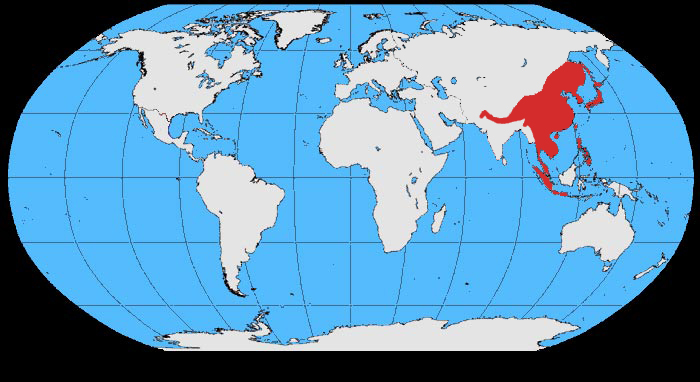
Range: They are found throughout the northeastern Asian seaboard to Afghanistan and eastern Iran in the west, through South and Southeast Asia, to the Lesser Sundas and Cambodia in the southeast.  Although in India the eastern jungle crow and large-billed crow behave has two distinct species, in northern parts of Asia their distinction is less clear and colloquially the two are often analogous.

Conservation status: Given their large range, it may come as no surprise that their populations are abundant and are considered a species of least concern by the IUCN.  In fact, since the 1980’s the number of jungle crows in Tokyo has quadrupled1.

“Corvus macrohynchos map”. Licensed under CC BY-SA 3.0 via Wikimedia Commons

So what accounts for their bad reputation you ask?  Where to begin…how about vandalizing cemeteries1.  In Japan, food is left at the burial sites of loved ones as an offering.  Although in some cultures these offerings are meant to be eaten by animals, that is not the case here, and the crows’ stealing of food interrupts the intention of the ritual.  Historically, this probably wasn’t a conflict since jungle crow populations were much smaller than they are now.

Photo: Anne Kurasawa Photo: Anne Kurasawa

As if that wasn’t enough to get people fired up, jungle crows also have a bad habit of, well, firing things up.  People were stumped how field fires near the Fushimi-Inari shrine in Kyoto were starting until someone thought to watch the crows.  There are 10,000 candle holders that line the walkways of the shrine and on busy days they may contain thousands of individual burning candles.  With some diligent watching, researchers discovered that crows were eating the melted candle wax (which is often made with tallow) and in some cases taking the burning candles out of the holders and flying off with them.  Although they never witnessed it, researchers suggested that crows’ attempts to cache burning candles may have been the cause of the mysterious fires.2Photo: H. Higuchi The crows appeared to show no fear of the flames according to the paper’s author. Photo: H. Higuchi

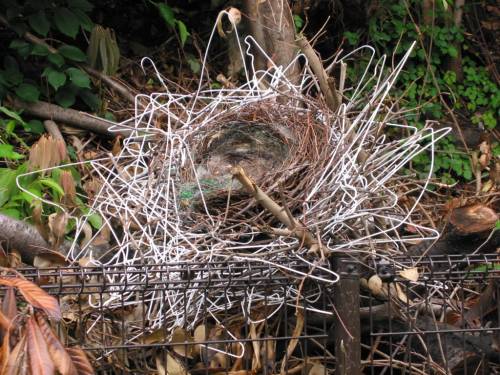
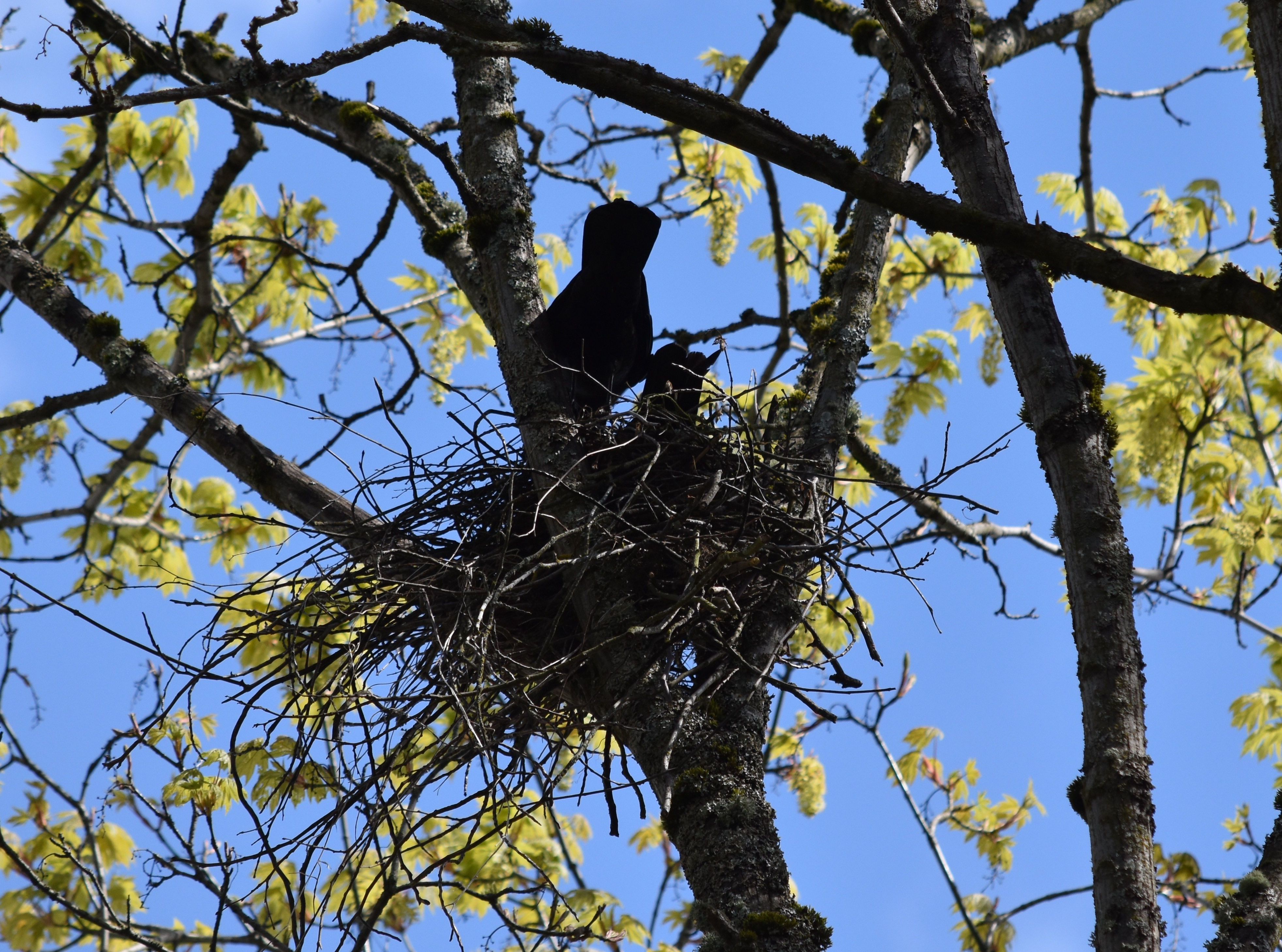
To top it all off, large-billed crows seem to be just as good at turning out the lights as there are at lighting them up! Unlike American crows, which predominately use sticks to build their nests, large-billed crows have developed a fascinating (and immensely frustrating for the Japanese government) habit of using clothes hangers to construct nests.  Mixing wire hangers with power lines is a recipe for disaster and in the summer time large-billed crows are responsible for massive blackouts.  The Tokyo government spends millions of yen, and employs full time crews, to search for and destroy hanger nests in an effort to prevent such black-outs.1Photo: Götz Maybe Joan Crawford had just spent too much time around jungle crows…  Photo: Götz

It’s not all bad press for these resourceful crows, however.  One of the more spectacular things they are known for is using cars to crack open otherwise inaccessible nuts.  Not only that, but they also appear to be sensitive to crosswalk signals and know when it’s safe to collect the exposed nuts and when it’s not.3So while large-billed crows make their fair share of trouble stealing food, candles and hangers, there are still plenty of people who adore these animals for their cleverness and ingenuity.  For those that don’t, well, some aren’t shy to take control measures into their own hands.  Or should I say mouths…

IMG_1922*The jungle crow was formally Corvus macrorhynchos, but the species was split into the large-billed crow Corvus macrorhynchos, the eastern jungle crow Corvus levaillantii, and the Indian jungle crow, Corvid culminatus.

Literature cited:

1Marzluff, J.M. & Angell, T.  2005 In the company of crows and ravens.  Yale University Press

2Higuchi, H. Crows causing fire. (2003). Manuscript from The University of Tokyo

3Marzluff J.M & Angell, T. 2012. Gifts of the crow.  Free Press

14 Comments

Filed under Corvid of the month, Crow behavior, crow conflicts, crow intelligence, Crows and humans

Crow curiosities: who is begging in April?

Right now, in early spring, you may have noticed a crow or two fluttering their wings and making the classic “waaah, waaahhh” sound that roughly translates to “feed me, feed me”!  Although it’s tempting to think these are young crows, it’s far too early in the breeding season for fledglings to be on the loose.  So who are these juvie doppelgangers? Adult female crows.

DSC_4002

Begging juveniles like this one won’t be roaming around the PNW until mid June and later.

During the nest building stage you may hear females making these sounds just while on the ground foraging with their mate or while perched near the nest like this female was.  Why do they do it?  It’s essentially a way to prime the pump and remind their mate that they’re going to need to be fed once they’re saddled to the nest and can’t forage as much for themselves.  Once they are actively incubating, they’ll continue to beg only now it’s really a demand for the food they need and can’t get for themselves without risking their eggs getting too cool.  Although males will take a turn on the nest, they do not have a formal brood patch and can’t do much more than temporarily keep the eggs insulated.

Although it’s tempting, hopefully now you won’t be fooled by this April trick!

DSC_0084

A male returns to the nest with a bill-load of peanuts for his hungry mate.

7 Comments

Filed under Crow behavior, Crow curiosities

Best books for corvid lovers

This post was prompted by someone on my twitter feed who asked that I put together a reading list for people who want to learn more about corvids; a totally kick-ass idea if I say so myself.  The following are all the books I have read and can speak personally to, however, I’m sure there are others and I encourage folks to add them in the comments section.  As a preface, I’ll remind readers that John Marzluff is my graduate adviser, nevertheless, I assure you that I genuinely believe he is a fantastic writer and my review of his books are not inflated in the hopes of getting approval on my dissertation. 🙂  So without much further adieu, here’s a list of all the corvid books I’ve read with a brief synopsis of the material and my recommendation.
index

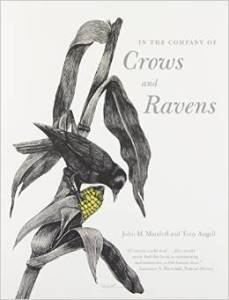
In the Company of Crows and Ravens by John Marzluff and Tony Angell
If watching, feeding or rehabilitating corvids is something you do in your free time, consider this your crow bible.  Curious how long crows live?  What they do as juveniles?  The sounds they make?  The ways the interact with people?  It’s all in there.  This book remains my go-to guide for general crow knowledge.  Yet, despite the fact its backbone is rigorous science, it’s written in a way that feels very easy to digest.  John and Tony wrote it with the intent that it would be for a wide audience and I think they achieved that beautifully.  After reading this book, I have no doubt you’ll have a deeper understanding for these birds, not to mention a new admiration for Tony’s artwork.  I even used one of his drawings for the book on the invitations for my wedding (with permission, of course).
raven

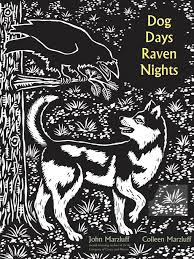
Dog Days Raven Nights by John and Colleen Marzluff
This is the book I most often recommend to my own friends and family.  Not because it offers superior or more easily read  information on corvids, but because this book gives you the best insight into what it really means to do fieldwork.  Nearly the entirety of the book focuses on the period of time after John and Colleen had finished their graduate work in Arizona, and were conducting a post-doctoral study on ravens with Bernd Heinrich in remote Maine.  It’s organized as a back and forth between John and Colleen, which means you get two perspectives on the raven work and Colleen’s development as a dog sledder and trainer.  As a reader, you experience what it means to completely dedicate every moment, piece of sanity, and dime you have on conducting a field experiment and you walk away with a much deeper appreciation for how difficult it is to answer questions of animal behavior.  If the human dimension of science isn’t your interest, however, fear not.  The book is still loaded with fascinating information on ravens including, in my opinion, one of John’s most important contributions which is information sharing among ravens.  An excellent read for sure.

gifts

Gifts of the Crow by John Marzluff and Tony Angell
For those looking for a more scientifically dense reading on crow behavior and neurology this is the book for you.  It doesn’t make for the lighthearted Sunday reading that ITCOCR does, but it still satisfies the trademark Marzluff style of mixing rigorous science with the anecdotal stories of crow behavior that makes us love them.  If you’ve been fascinated by the story of Gabi Mann, the little girl who feeds and gets gifts from crows, then this is the scientific background you need to see the whole picture.

mind

Mind of the Raven by Bernd Heinrich
Long before John Marzluff started writing books, his post-doc adviser, Bernd Heinrich, was already an expert at the game.  Heinrich has a reputation for being one of the most eloquent and engrossing natural history writers and it’s a reputation that’s been well earned.  Mind of the Raven is actually what initially peaked my interest in corvids, so in many ways I have this book to thank for the work I am doing now.  For anyone who lives with ravens, or simply has a fascination for them, I can’t recommend it enough.  Bernd’s writing will nurture your passion and give you the science to back up what you already know: ravens are badass, awesome animals.

planet

Crow Planet by Lyanda Lynn Haupt
Crow Planet it a book best characterized by Haupt’s journey to find curiosity and loveliness in an increasingly urban landscape where the natural world can feel further and further away.  Crows therefore, offered the perfect vehicle for looking at and appreciating what remains when the forests retreat and box stores and neighborhoods take their place.   By the author’s own admission her journey through writing Crow Planet made Haupt appreciate, “but not quite love”, crows.   Despite this, she manages to write about them with grace, and her stories will make even the biggest skeptic take another look at these animals.  Although Haupt’s background is not in science, she doesn’t omit the scientific facts, though she does take more artistic liberty when describing their antics than John or Heinrich do.  All that being said, this is an excellent book for the urban naturalist or crow watcher.

crow

Crow by Boria Sax
If you’re interested in crow mythology this is the book for you.  Sax takes you through time and space to explore the role of corvids in human myth, religion and art.    His thoroughness is without compare, but if anthropology is not your interest this book will prove taxing.  It’s one I happily keep on hand, but not one that I’ve ever had the patience to read all the way through.  Nevertheless, I probably should, since it’s chalk full of information and historical context that I would be better off knowing.

Bird brain

Bird Brain: An exploration of avian intelligence by Nathan Emery
Although not exclusively dedicated to corvids, Bird Brain, written by corvid cognition expert Dr. Nathan Emery, offers an incredible look at the minds of your favorite birds.  Although his book tackles some of the more difficult concepts of avian cognition, it feels and reads more like a coffee table book, complete with beautiful artwork, some of which was done by Emery himself.  Each chapter is themed around a particular aspect of cognition (communication, spatial memory, etc.) and walks the reader through the fundamental biological principals and samples the most interesting studies that have been done on the topic.  The book is rich with the kinds of analogies and descriptions that break through the barriers of dry scientific writing.  Perfect for the budding young scientist or the long time corvid fan.
9780231182829

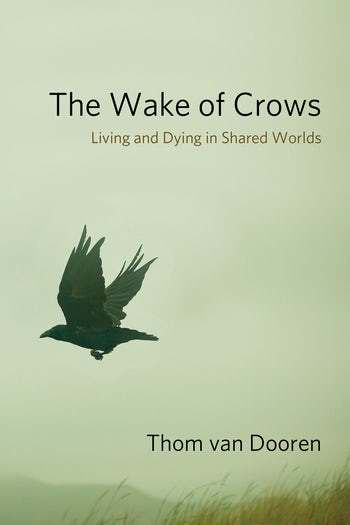
The wake of crows: Living and dying in shared worlds by Thom van Dooren
“Crows are among our most familiar and charismatic animals and as such there is a body of literature dedicated to them for which few other wildlife species compare. While each contributor takes a distinct perspective and harnesses different stories or features of their biology, there is perhaps nothing as unique in the body of work dedicated to crows as this book. It is neither a classic natural history book, nor a memoir of being connected to the natural world through crows. Instead, van Dooren has used crows as a loom on which to weave science and humanities together, producing a thesis of what it means to exist in our contemporary world. Central to this thesis is the question of “What else is possible?” For the traditional science and natural history reader his exploration of this seemingly familiar question will be anything but familiar. While by now, for example, we may be used to being asked to reconsider the crow as pest or bad omen, here we are asked to reconsider them systemically, and in ways that ultimately inform the reader’s ethic….It’s a unique and powerful look at what it means to live in a shared world, and asks that we reconsider our ethics in doing so. It is far from a light read, but it is one that grants the experience of expansion that curious people crave.” 

This section is apart of a larger review I wrote of The wake of crows for a contribution has been accepted for publication and will appear in a revised form (subject to input from the journal’s editor) in a book review for Oryx—The International Journal of Conservation.

***

I’m sure there are many others I haven’t read which subsequently didn’t make this list.  Feel free to make recommendations in the comments section!

17 Comments

Filed under Crow behavior, Crow curiosities, Crows and humans, Raven behavior, Raven intelligence