Look, I’m a reasonable person. I know what you’re thinking.
“Literally never has it occurred to me I might know too little about jay spit.”
But here’s the thing: it’s actually super interesting and you really can’t understand Canada jays without knowing about their saliva. It would be like trying to understand the internet without cat videos-you just can’t do it. So trust me when I tell you this is the information you didn’t know you needed.
In the early 1960’s Walter Brock was examining Canada jay corpses when he discovered that they have massive salivary glands on par with the ones found in woodpeckers.1 Such generously sized glands are found in no other songbird. Furthermore, like the woodpeckers, it’s not just that Canada jays make a lot of saliva, but they make a lot of sticky saliva. At the time this discovery was made, it was already known that the enlarged glands of woodpeckers served to allow for a foraging tactic called “tongue probing” where, like anteaters, the birds use their long sticky tongues to extract food from narrow crevices. Although Canada jays don’t have especially long tongues, the ability to tongue probe seemed the most parsimonious explanation for this strange adaptation, and Brock suggested that this strategy may actually be the key to the jays’ winter survival. A study a few years later examining their foraging behavior revealed that they don’t feed in this manner, however. They feed more or less the same way the other corvids do.2 It seems instead, that it’s what they do with the food after that’s different.
Rather than using their copious amounts of weird, sticky spit for acquiring food, it’s used for depositing it. If you watch a jay closely after it’s got a bit of food you’ll notice it seems to have missed Emily Post’s memo about chewing with your mouth closed. Over the course of a few seconds you’ll see the food peek out from the bill as the bird moves it around inside its mouth.
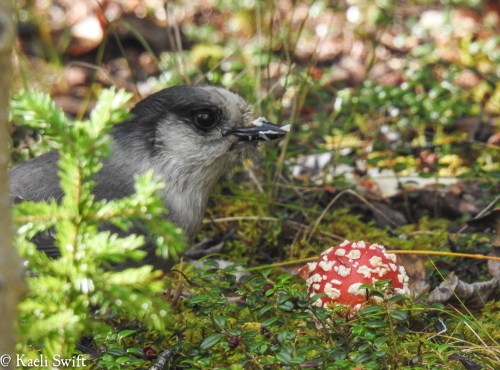
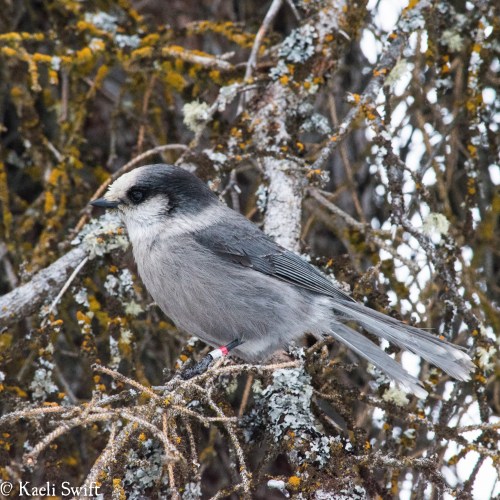
This jay picked up this bit of food about 60sec before this photo was taken. Now it’s working it around with its tongue, coating it in sticky saliva.
Once sufficiently spit coated, the bird will deposit the food blob (called a bolus) onto the foliage or trunk of a tree. No matter the material or angle, once the spit dries the food is safely secured come hell or high-water. Because these caches are pretty small there’s little fear that many will be found. More importantly, by stashing food high in the trees instead of burying them into the ground like many other cache-dependent corvids do, Canada jays can thrive in areas that receive much heavier snowfall, allowing them the title of the most northern residing jay in North America.
A cached cranberry
A cached blueberry
Look at all that spit!
A cached grub
Here’s where it all really comes together though. If you’ve seen me write about Canada jays before you’ll have noticed that it’s almost inevitable that I’ll use the phrase “Cute little faces” at some point to describe them. But have you ever wondered why? Why do they have such cute little faces? While jays do feed more or less in the same way as other corvids the one exception is that they don’t hammer at objects. If you’re ever given a crow or a Steller’s an unshelled peanut you’ll know exactly the motion I mean. Without the need the hammer objects, or dig holes for burying food, Canada jays don’t need the heavy bills their cousins do.2 Instead they have the blunt little bill that helps give them their characteristic baby-faced look. So not only is their spit responsible for their ability to tough it out in some of the harshest winter environments this continent offers, but it also means they get to look super cute while doing it.
So like I said, you don’t really know Canada jays until you know a thing or two about their spit.
Literature cited
Brock WJ. (1961). Salivary glands in the gray jay (Perisoreus). The Auk 78: 355-365
Dow DD. (1965). The role of saliva i food storage by the gray jay. The Auk 82: 139-154
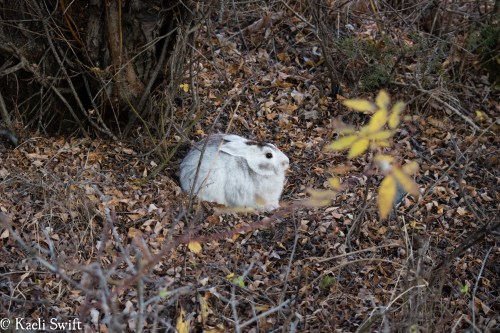
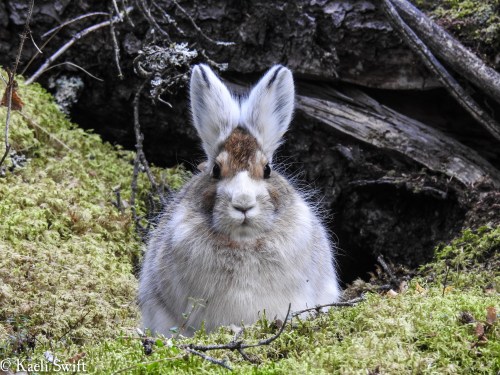
Up until the last few weeks, spotting snowshoe hares before they darted out from the adjacent vegetation was something I considered myself fairly lucky to do. After all, it’s literally a matter of life and death for them to remain as undetected as possible. As September came to a close, however, I found myself spotting them more often and from further away than I had previously, and not just from weeks of practice. Their concealment was being betrayed by the very mechanisms designed to keep them safe.
There aren’t a lot of animals that call Denali home all year long, but those that do need effective strategies for staying alive during the essentially 8 months long winter. For Denali’s snowshoe hares, one of these strategies is to adapt in an entirely new winter outfit, something only 20 other animals in the northern hemisphere do.1 While in the summer they are a mottled reddish brown, starting around late September the hares grow in their nearly all white coats. The ears are typically the first to change, with the rest of the body following suit shortly thereafter.
This transformation is mediated by changes in the photoperiod that affect melanin production. Although the full explanation is quite complex, the core mechanism is that the shorter day length increases the hormone melatonin, which suppress the melanin producing hormone prolactin.1
While this strategy is good one for long winters blanketed in snow, changes in snow regimes are making this transition more precarious. Camouflage mismatch–which is generally considered when more than 60% of the coat is different from the surrounding environment–can result either from winter coats that have come in too early, before the snow arrives, or because the snow pack lingers inconsistently. This year, the lower elevations of the park have yet to see so much as a flake of snow, though you wouldn’t know that by looking at the hares. As I have already experienced, such mismatch makes hares considerably easier to detect, a big problem for basically everyone’s favorite winter meal.2
Although hares can adjust the timing of their molts to a small extent, it won’t be enough to keep them in sync with the more dramatic shifts climate change has in store for the future. This is especially problematic because hares don’t seem to be very aware of their mismatch and attempt to compensate behaviorally by say, hiding behind vegetation or choosing resting spots that more closely match their color.3 Other animals, particularly birds, seem better at this. Rock ptarmigan for example will actually dirty themselves to more closely match patchy snow.4
Given the immense selection pressure on these animals to match their environment and the high variation in the traits responsible for such color changes, it’s possible that hares will be able to keep pace with an already changing arctic landscape, but we don’t know for sure. The alternative will be to add hares to the growing list of once common animals that now require invasive management strategies to stay afloat in the anthroproscene.
Literature cited
1. Zimova M, Hackländer K, Good JM, Melo-Ferreira J, Alves PC, Mills SL. (2018). Function and underlying mechanisms of seasonal colour moulting in mammals and birds: what keeps them changing in a warming world? Biol. Rev. 93: 1478 – 1498.1478 doi: 10.1111/brv.12405
2. Pedersen S, Odden M, Pedersen HC. (2017). Climate change induced molting mismatch? Mountain hare abundance reduced by duration of snow cover and predator abundance. Ecosphere 8: 01722
3. Zimova M, Mills SL, Lukacs PM, Mitchell MS. (2014). Snowshoe hares display limited phenotypic plasticity to mismatch in seasonal camouflage. Proc. R. Soc. B2014 281 20140029; DOI: 10.1098/rspb.2014.0029
4. Montgomerie R, Lyon B, Holder K. (2001) Dirty ptarmigan: behavioral modification of conspicuous male plumage, Behavioral Ecology 12: 429–438.
I know, I know, it looks so much like that’s what’s happening. The mouse is clearly interested; the crow walks the direction the mouse exited to, drops food, and leaves. But rather than sharing, this is simply a coincidental intersection of two animals trying to claim what they can.
First, a little bit of background information: In animal behavior, food sharing is defined as the transfer of a defendable food item from one individual to another, or the joint use of a monopolized item.1 Obviously these definitions are both broad and somewhat subjective. Because of this, you’ll see a range in how different papers describe how common this behavior is. Some might say it occurs frequently, while others say it is rare depending on if they’re including tolerated theft, food transfers during courtship, etc. Among corvids, evidence of food sharing has been suggested in ravens, rooks, scrub-jays and northwestern crows, but it’s been most formally studied in jackdaws.
Studies on jackdaws show that donor initiated sharing is a more common behavior for that species than it is in primates (though more rare than recipient initiated sharing), sharing decreases as the birds get older, and that patterns of food sharing support both the altruism hypothesis (tit for tat) and the harassment hypothesis (take this and leave me alone!). A key thing among all these studies is that food sharing is taking place within social groups, not with strangers and not with other species.
Given the rarity and circumstances with which this behavior has been observed, even within corvid social groups, it is exceedingly unlikely that this crow is so generously sharing with a mouse. So how else could we explain it?
The crucial moment of truth comes at the 0:58s mark. Crows, like many other corvids, hide food for later consumption. If you’ve ever shared enough food with a crow that it constituted multiple morsels, you might have noticed this behavior. The crow will walk or fly to a location not generally too far away and tuck the food into a tree branch, under the soil, into your gutters, etc. Then, like clockwork, they will use some nearby debris to cover it. In the most adorable, “Damn why don’t I have my camera!?,” moments, I’ve seen them pick pansies to cover and hide their treats. At the 0:58sec mark you can see the crow pick up some sidewalk detritus and do exactly this. That’s not a signal of sharing, that’s caching loud and clear.
Some of you might be wondering why, given how smart crows are, it did such a poor job, considering the mouse was so clearly watching and ready to lift it as soon as the crow walked away. Crows are smart, and very good at some tasks, but as I’ve said before, the ability of an animal to excel at a cognitive task requires that that task in some way relates to their natural history. American crows are not good at, or perhaps even capable of, making hook tools because, unlike New Caledonian crows, there was no available food niche which selected this behavior. Likewise, American crows aren’t very cache protective because they don’t really need to be. There is so much food in the urban ecosystem that most crow caches will go uncollected anyway. On the other hand, the corvids that rely more on their caches are quite sensitive to onlookers. As for why it picked that particular spot to begin with, that was probably the closest cache location, and since the crow probably couldn’t see the mouse, there wasn’t any reason not to cache there.
One of the more elaborate explanations I’ve read falls decidedly in the opposite direction, however. The idea is that instead of sharing, the crow is actually baiting the mouse and the sprinkling of detritus on top was meant to slow the mouse down and facilitate the kill. While there are some birds, such as green herons, that do use bait to catch prey, this is not a consistent feature of crows’ hunting repertoire. That said, you can find the occasional video of crows using bait much like the herons. We can also rule out this explanation because 1) a leaf on top of a piece of bread will slow the mouse down for approximately 1/100 of a second and 2) the crow very clearly wandered away from, and lacked the focus on the food that would be required to actually catch the mouse.
So consider the food sharing crow video officially debunked. And don’t worry, there are still plenty of videos out there that are as exactly pure and wonderful as they seem. I’m not coming for your golden retriever.
Literature cited
De Kort, S.R., Emery, N.J, and Clayton, N.S. (2005). Food sharing in jackdaws Corvus monedula: what, why and with whom? Animal Behaviour 72: 297-304. (scroll down to see PDF of paper)
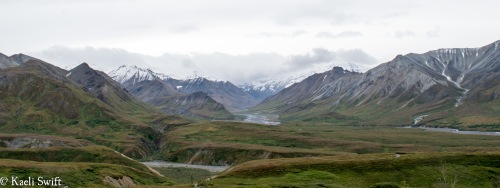
Working in Denali, there’s never a day when I get bored with the scenery or dismiss my great fortune in being able to do research here. Certainly though, some field days are better than others either because the jays were particularly cooperative or because of some other wildlife highlight. Today was one of those latter days. The jays weren’t especially busy, and I’ve grown increasingly concerned that one of our females has died, but the park pulled through in delighting us in other ways.
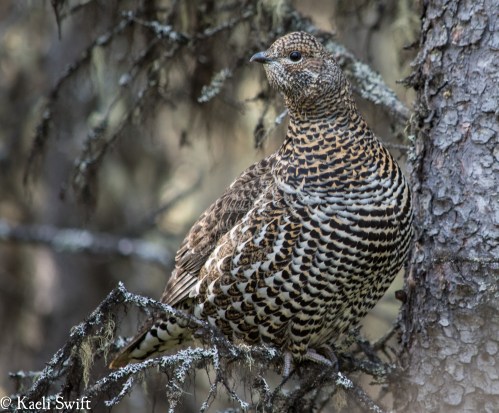
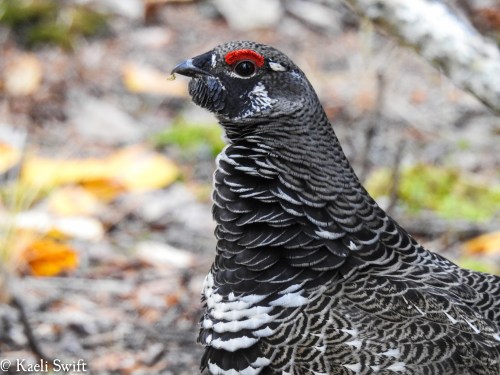
Spruce grouse are such a daily occurrence that it’s borderline obnoxious, but only because of their habit of waiting until the very last minute to flush and then nosily flying into your face like some kind of helicopter poltergeist. If you can manage to detect them before their fun little game of surprise though, watching them play statue can be quite comical. It’s hard not to imagine them sitting there, praying they don’t get noticed and wishing they were still velociraptors.
A female spruce grouse
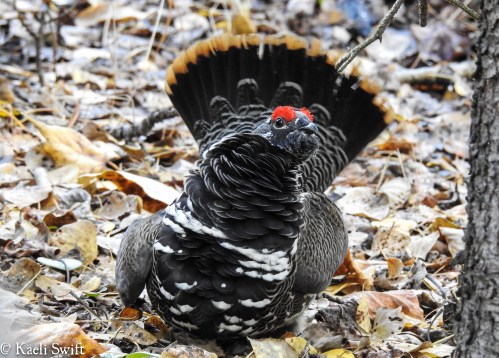
Today offered a very different kind of behavior outside of their usual repertoire, however. I spied a male strutting about the undergrowth and couldn’t help but notice he was rather marvelous looking. The red comb over his eye was looking rather sharp, and his breast and tail feathers were fully erect.
At first I wondered if he was perhaps trying to intimidate me, but I quickly discovered that I was not the lady he was trying to impress.
Given that spruce grouse don’t start breeding until April, I can’t really imagine what this female made of the whole situation. Evidently though, nonbreeding season courtship displays are not uncommon in grouse, prairie chickens or other galliformes (heavy-bodied ground birds). Most of what I’ve heard suggests that these displays are the work of young males, eager to practice their skills for next year. I did come across one paper that suggested such early season displays in black grouse are actually important for securing territories, and confer higher reproductive success.1 In any case while I can’t speak for her, I’ll tell you I was 100% feeling his moves.
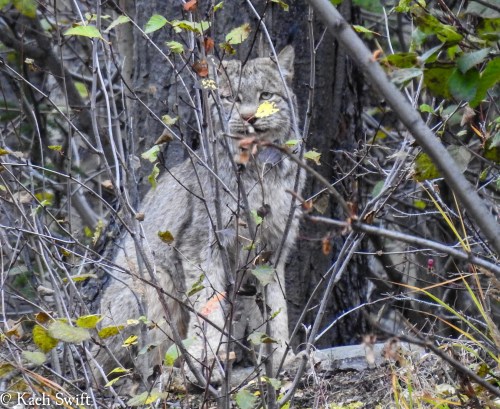
Our second encounter was substantially shorter but by far more thrilling. I barely captured even one rather derpy photo but I don’t think you need much more to understand my excitement.
This was my first wild feline ever. I hope it’s not my last lynx of the season, but either way I’m not complaining.
***
Literature cited
Rintamaki, P.T., Karvonen E., Alatalo, R. V., and Lundberg A. (1999). Why do male black grouse perform on lek sites outside of the breeding season? Journal of Avian Biology 30: 359-366.
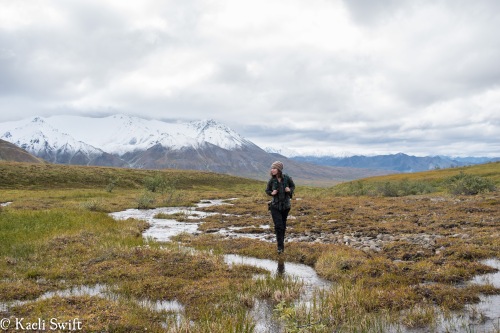
My first trip into the park, the Ranger warned us that we would fall in love with Denali. I could tell her sincerity wasn’t manufactured, it was that kind of genuine love for something that can make cynical people feel a bit embarrassed, but I was careful to temper my expectations nonetheless. By the end of the trip (who am I kidding, more like after about 20min), however, I was ready to write my own effusive love note. Denali is unlike any place I’ve ever been, and I hope I can share a small fraction of what seeing it in real life is really like, and offer a few tips for anyone planning their own trip.
View from Eielson visitor center
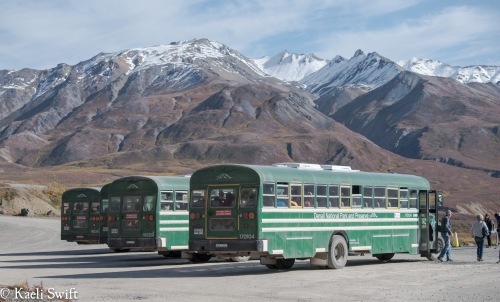
The first thing to understand about the park is that it is managed quite differently than most other national parks in the country. Unlike say Yellowstone where private vehicles, service vehicles, and tour buses clog the roads, in Denali private vehicles are only allowed for the first 15 miles of the park. To see the other 77 miles you’ll need to take a bus. Buses come in three forms: Private tour buses offered by the hotels and resorts at the road’s end in Kantishna, NPS tan buses that offer interpretive, structured tours, or the NPS green buses that function like city transit buses.
There are four possible destinations you can bus to in the park: Toklat at mile 53, Eielson at mile 66, Wonder Lake at mile 85 and Kantishna at mile 92. Out of my four separate trips into the park, I traveled as far as Eielson (8 hour round trip) twice and Wonder Lake (11 hour round trip) the other two times.
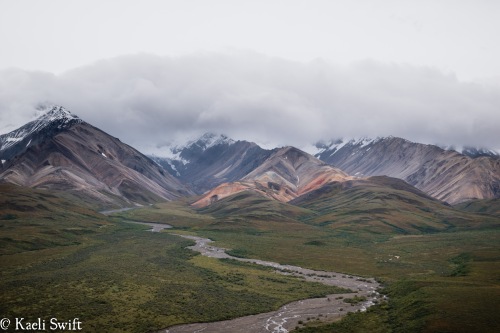
No matter which destination you select, you’ll stop at one of Denali’s prettiest look-outs, Polychrome Pass.
Things can change a lot at the end of the season. This is Polychrome Pass only a week after the above photo was taken.
Choosing which destination you want to go to is a matter of price, travel time, and priorities. My experience was that although Wonder Lake is beautiful, unless you can camp overnight, or have additional trips into the park planned, it wasn’t worth the full day trip. Instead, I would suggest spending more time off the bus at an earlier stop like Eielson. The only exception would be if the weather is completely clear and your goal is to get phenomenal views of Mt. Denali, in which case continuing on to Wonder Lake is absolutely worth it.
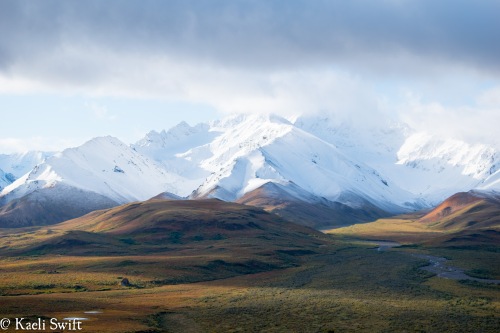
Mountain views on the way from Eielson to Wonder Lake.
Less than 30% of visitors get to see even a section of Mt. Denali. We were exceptionally lucky to get an end of season full view.
If you’re balking at the idea of being stuck on a bus, I hear you, and based on the feedback I’ve already gotten I know that a “terrible bus ride” is a lot of people’s impression of what visiting Denali is like. But there are three reasons to embrace the bus. The first is the whole reason for their existence: keeping people on buses rather than personal vehicles keeps wildlife safer. Look no further than they annual stories out of places like Yellowstone to appreciate how necessary this is. Second is that with more eyes you’re much more likely to spot wildlife, especially small or cryptic wildlife. And lastly, and this is the real beauty of Denali, when I said that the green buses function like city transit buses I should have included “but better” because you can request to get off anywhere outside of Sable Pass which is a wildlife protection area.
In Denali what do you do when you see a spectacular view and want to go experience it yourself? You get off the bus and go to there.
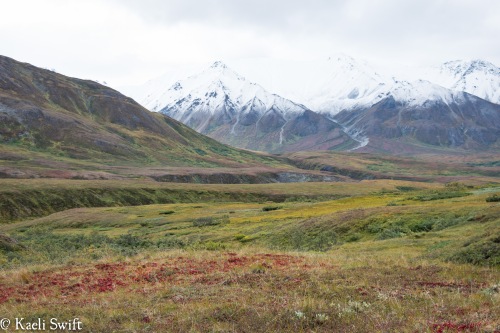
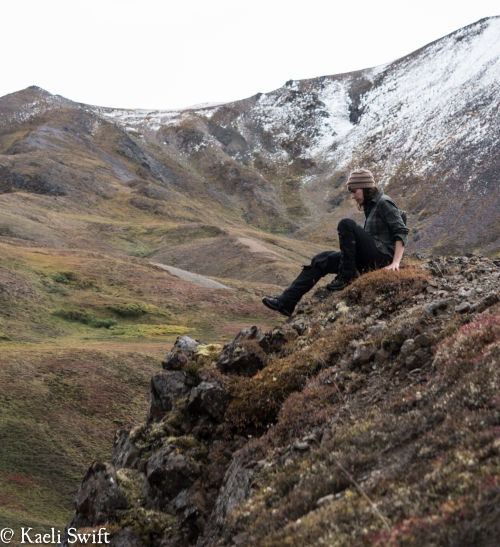
Coming from Washington, it was a bit hard to understand why my Denali-based colleagues couldn’t offer very specific hiking suggestions. My entire outdoor life has been ruled the the trail, so I was baffled when inquires about trail names were met with blank stares. It wasn’t until I actually got onto the tundra that I appreciated the possibility of a trail-less adventure. Of being able to shout “Stop!” at the first beautiful area that struck me and having the driver pull over to let me off. If the brush is high you can walk the road, taking in the scenery at your own pace. If it’s low, as it is between Toklat and Eielson, you can easily range off road and as deep into the park as you like. With 6 millions acres at your feet, it would take nearly a lifetime to explore everything.
Once you’re done, you head back to the road and flag down any green bus. If you’re heading out of the park, there’s no need to even show them your ticket. Alternatively, you can get on a bus heading to your ticketed destination if you want to maximize your wildlife mileage as I did on a number of occasions. As long as you’re attentive to the bus schedule and prepared to wait for an empty bus, you ping-pong back and forth like this as many time as you can fit into the day. Although it adds up to a lot of driving, it can be one of the best ways to see wildlife because you’ll hit the park at different times of day and you can get a lot closer than you can on foot.
With so much flexibility to explore such a beautiful area, it’s no mystery why people fall in love with this place so easily. And we haven’t even gotten to the wildlife yet. For that you’ll need to stay tuned for Part II…
For the past six years, my life has been dedicated to the “funerals” of birds perpetually dressed for the occasion. This pursuit has provided some of the highlights of my life and lodged crows so deep in my heart I suspect they might show up on an ultrasound. The still vastly untapped world of comparative thanatology (the study of animal death) is one I have every hope of returning to, but I’d be fooling myself if I didn’t admit I was ready for a change. There is much more wildlife and natural history to be had in the urban jungle than people realize, but as a fieldsite it can start to grate on your mind and spirit. The suspicious onlookers, inattentive texters, cranky homeowners, fastidious leaf blowers, relentless piles of dog shit, and generous helpings of stuff you couldn’t even imagine, like the truck that blew bubbles as it drove around the block and always seemed to drive by just as I started the experiment. After so many years, this work left me yearning for a new set of challenges and maybe the opportunity to scrub earth from my feet, rather than the film of carbon, copper, and zink that peels invisibly off the passing cars.
You can imagine my great delight then, when I was offered the opportunity to conduct a year long PostDoc position in Denali National Park, studying the foraging behavior of Canada jays; adorable corvid cousins to my beloved crows. The project is a collaboration between the University of Washington’s John Marzluff and the National Parks Service. Apart from its brief duration, the project is everything I wanted. A complete change of scenery, a new and challenging study question, loyalty to my favorite family of birds, and limited field seasons that would not require me to uproot my family. Needless to say I jumped at the opportunity.
At mile 66 of the park road, the Eielson visitor center offers spectacular views.
In a nutshell, the big picture question we are after is: are rising and fluctuating temperatures reducing the shelf life of the food jays store to survive the winter? The worry is that without a deep freeze to keep the perishable things that jays cache like mushrooms, meat scraps, and berries well preserved, their food is going bad earlier in the winter than in years past. Since they start breeding well before the spring food flush, this would be a major problem.
Although toxic to humans, the jays are happy to dine on the iconic amanita mushroom.
Answering this question will take years of study, so don’t expect any headlines from me. Instead, my research will help fill the existing knowledge gaps and create a foundation on which future studies can build. Namely our goal is to document what and where Denali’s jays are caching. To accomplish this I, along with a tech, are spending 6-8 weeks in the park this fall to document the kinds of foods they cache and where they stash them. Then returning in “spring” (March, but there’s still 6ft of snow on the ground) to watch them retrieve caches. To the great relief of my parents, this fieldwork will not take place in the more predator rich back country of the park, but rather the front country near park headquarters, where over the past two years the park’s avian ecologists have been working to identify and color-band the existing pairs.
Documenting these activities is a textbook example of “Easier said than done”. The birds move quickly and can disappear out of sight with magician-like talent. There is often dense foliage blocking my view, and what they are eating is typically small. Seeing what/if/where in terms of foraging and caching can sometimes be done in the field with binoculars, but the main way we are accruing data is by using a video camera with a powerful zoom to film the behaviors we see, and then rewatching it in slow motion to try and tease out details we missed in the field. Attempting to get this stuff on film comes with its own set of challenges though, and the majority of our film clips are well, see for yourself…(NSFW language).
Out of the dozens of bad clips we get each day though, there are enough containing some actual data to start seeing a meaningful picture of what’s happening (like the one below), and to keep us pressing forward. We’ve already documented food items that have surprised the more senior jay scientists we are collaborating with, and I’m starting to envision what kinds of questions future researchers could ask based on my work here.
Needless to say, I am tremendously excited for this new, albeit short-lived chapter of my life. It’s a delight to be challenged by a new set of questions and contribute to something with more direct conservation implications. And the new office isn’t half bad either.
It even comes with the usual cast of colorful office characters. There’s the chatterbox:
Pine squirrel
And the prankster that thinks it’s funny to hide around corners and jump out at you, damn near scaring you out of your skin:
Spruce grouse are slow to flush, preferring to wait until the last possible moment before exploding out of the shrubbery.
And of course, there’s that one grumpy gus that is constantly paranoid someone is going to steal her lunch despite labeling her food like a dozen times. “No one wants your crappy squirrel, Brenda!”
Northern hawk owls are among the few daytime hunting owls.
Plus everyone else that’s just trying to mind their p’s and q’s and make it through the day.
So, while I miss my crows a great deal (did I mention there aren’t crows in Denali at all?) I think this new gray look is suiting me quite well.
This feels like a simple enough question but answering it requires a check on how scientists define ‘species,’ a look at the phylogeny of crows and ravens (that’s the study of the evolutionary development and diversification of species i.e. the study of the tree of life), as well as an understanding of how their biology determines whether “Can they hybridize?” turns into “Do they hybridize?”
A rather curious question indeed.
For decades, the textbook standard for defining the term ‘species’ in introductory biology classes has been the biological species concept. First coined in 1942 by ornithologist Ernst Mayr, this is the idea that a species is a population of animals that share a gene pool, and can successfully mate with each other, but not with animals outside their gene pool. Almost always, the pudding offered as proof is a mule; the sterile offspring of a breeding attempt between a horse and an ass. “See,” your teacher would say, “The offspring are sterile because it’s the result of two different species,” and then they would slap their hands together like a satisfied chef. But of course, nature is rarely so inclined to follow such rules.
In fact, lots of animals we consider distinct species can and do interbreed. Possibly even more problematic is that there are plenty of living things that don’t reproduce sexually at all. So how do you define them under this concept? These issues have left scientists jaded and unsatisfied with the biological species concept and given rise to new classification schemes that don’t consider sex. One of the most robust rivals to the biological concept is the phylogenetic species concept, where species are defined by their evolutionary histories. The problem with this concept though is that sometimes the amount of hair splitting that goes on divides formally unified species beyond what is perhaps biologically appropriate. Meaning, if two species have a distinct evolutionary history, but fulfill the same ecological role, look the same, and freely interbreed, are they really distinct species? Without going too far further down this rabbit hole suffice it to say that there still remains no universally accepted scientific definition of a species, and that more than likely the most comprehensive approach is one that takes into consideration an each organism’s unique situation and leans on multiple concepts as appropriate.
This is relevant to American crows and common ravens because knowing that they are two different species might incline some people to believe that the answer to the question “Can they interbreed?” is, by definition, “No.” However, hopefully now it’s clear that such dogmatism will only hamper our understanding of the situation. To advance further on this question, we instead need turn our attention to the tree of life.
For animals to freely interbreed, they generally need to share a very recent relative. Given their geographical overlap and how similar American crows and common ravens look, it might be tempting to assume they must be quite closely related, but of course by now you know what assuming will get you. As you can see from the phylogentic tree below, you need to go back four ancestors (or about 7 million years) to find the relative shared by both birds.1 American crows are actually more closely related to the collared crows of China than they are to common ravens. So, while we haven’t ruled on our original question one way or another just yet, this suggests it shouldn’t happen extremely freely.
Jønsson et al. 2012
For the last piece we need to consider the real life, biological relationship between these birds. Most crucially, we need to ask if, when in close proximity, they generally tolerate each other and socialize.
A paper out earlier this year by Freeman and Miller answers this question with a resounding, “No.”2 Thanks to thousands of observations provided by citizen scientists, the authors were able to show that most interactions between the two are aggressive, and that crows are almost always the aggressor, particularly during the reproductive period. This is thanks in no small part to the fact that ravens will depredate crow nests. Therefore, come breeding time, crows will be most anxious to evict ravens, not bed them.
A crow attempts to chase a raven out of its territory
With all this in mind, it seems we can finally conclude that the most informed answer would be, “Ravens and crows do not hybridize…
…most of the time.”
Ok time for me to come clean. The truth is that I’ve buried the lead a little bit here, because in fact we know the answer to the question “can they hybridize.” In the 1990’s Beth Jefferson documented a successful breeding attempt between a wild American crow and common raven in Toronto, Canada.3 In 1990, the single raven started showing up in the area; a surprise to the local birders since they didn’t usually encounter ravens for another 145km north. Over the course of the next three years, the raven appeared to be buddying up to a crow in the area. It wasn’t until 1993, however, that Beth and other locals were able to document the pair nest building, attending to nestlings, and successfully fledgling two young.
One of the hybrid young documented by Beth Jefferson
So why on earth did I drag this out so much? Because your take home message should not be that crows and ravens are going buck wild making little cravens. Just as one swallow does not a summer make, one or two craven babies does not a habit make. By and large, American crows and common ravens are reproductively isolated and do not hybridize. But under the strangest of circumstances there’s no questioning that…
Freeman B.G. and Miller, E.T. 2018. Why do crows attack ravens? The roles of predation threat, resource competition, and social behavior. The Auk 135: 857-867 http://www.bioone.org/doi/full/10.1642/AUK-18-36.1
First off, hello! It’s been a minute since you last heard from me, huh? Well in that time there have been three major changes which warrant special announcements. Most significantly is announcement #1: I finished my PhD!
I wish I had been in a better place to discuss the process and even invite you to my defense, but it just didn’t go down that way. It was a chaotic sprint to the finish that had me pulling my hair out up until the very last moment. Why you ask? Well because of announcement #2. I was in an unusual time crunch to finish because I had a PostDoc waiting for me only a few days after the end of summer quarter (i.e my cutoff to graduate). As we speak I am writing from my desk in Denali National Park where I am beginning my 1-year long study on Canada jays!
Yes, I am mighty sad to say goodbye to the crows (though I’ll never really say goodbye), but I am so excited about working with this delightful species, particularly because of the broad conservation implications of this work. You can read more about the specifics here and expect a dedicated post very soon.
This bring us to announcement #3: the whole blog got an overhaul and a facebook page! With a new title and research project under my belt, I thought it was only fair the blog got some new life too. I reached out to a former crow field tech turned full time natural history illustrator Madison Mayfield to design a logo for the blog, and boy, did she do a flippin fantastic job. I’ve also updated all of the pages and given the blog an official homepage. Please poke around and see what’s new.
I’ve been a bit reticent about creating a facebook page because I already do so much science communication between here, twitter and Instagram (both @corvidresearch) that I worry a facebook page may spread me too thin. But I recognize that a good number of my followers here are not active on those other platforms, and I’d like to offer some of the scicomm work I do in those other places to those folks, including the ability to play #CrowOrNo. In addition, I felt a real need for an official community space where you can more easily connect with one another to share photos, videos and stories. Although comments on the Corvid Research facebook page are closed, I’ve created a connected Corivd Research group meant as a way for my followers to connect with each other (since you already have plenty of ways of connecting with me). I will moderate the group insofar as membership requests and issues with trolling or abuse, but do not plan on being especially active there myself. That is a space meant for you. All that said, I want to be clear that the blog will always be the primary place I produce articles. If anything these changes mean things will be more busy here, not less!
Phew, this has been a lot of updates! Please check everything out and give me your feedback, particularly as far as the facebook stuff goes. Maybe you don’t really want or need that space and if that’s the case I may get rid of it. And shoot me your Canada jay questions so I can incorporate the answers into the upcoming post!
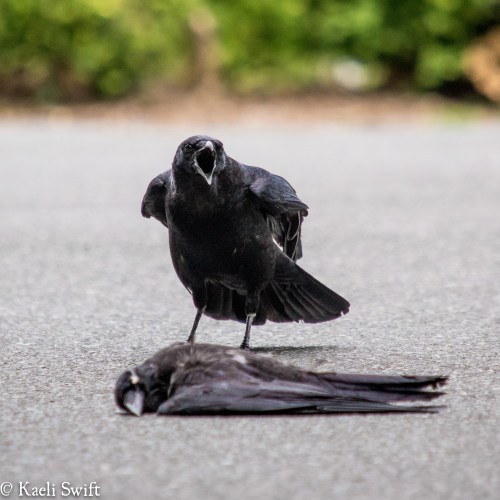
It’s early April 2015, and John Marzluff and I are standing with a film crew attempting to capture some footage of a crow funeral to compliment a story they are working on about Gabi Mann. I’ve already set the dead crow on the ground, it’s placed just out from a cherry tree resplendent in springtime blossoms. After only a few moments of waiting, the first crow arrives and alights on the tree, its head cocking around to get a better look at the lifeless black feathers beneath it. I hold my breath for the first alarm call, ready for the explosion of sound and the swarm of birds that will follow it. But it doesn’t come. Instead, the bird descends to the ground and approaches the dead body. My brow knits together in surprise but, ah well, I think, the shots of it getting so close and then alarm calling will make good footage. The audience will have no questions about what it is responding to. To my continued surprise, however, the silence persists; only now the crow has drooped its wings, erected its tail, and is approaching in full strut. No, no, this can’t be, I think. But then it happens. A quick hop, and the live crow mounts our dead one, thrashing in that unmistakable manner. “Is it giving it CPR?” someone asks earnestly. Still in disbelief, John and I exchange glances before shaking our heads and leaving the word “copulation” to hang awkwardly in the air. After a few seconds another bird arrives to the cherry tree and explodes in alarm calls, sending our first bird into its own fit of alarm, followed by a more typical mobbing scene. The details of what I’ve just witnessed as still washing over me when I hear John lean over to me…”You need to start your field season tomorrow.”
***
What crows do around dead crows is something I’ve dedicated much of my academic life to understanding. In the course of my first study, my findings made for a nice clear narrative: crows alarm call and gather around dead crows as a way of learning about dangerous places and new predators. Although there are other hypotheses we can’t rule out, certainly danger avoidance is at least partially driving this behavior. An important detail of that original study though, is that because of the way it was designed, with a dangerous entity always near the dead crow, our live crows were never in a position to ever get very close to our dead stimulus. So the possibility that they do other things around dead crows, like touching them, couldn’t be explored.
It’s been 3 years since that day in April and during that time it has taken every ounce of my power to remain tight lipped when journalists would ask “what’s the most interesting thing you’ve learned from your studies?” Because until we were able to scientifically vet the prevalence of this behavior, I wasn’t willing to say much about it for fear of making necrophilia mountains out of mole hills. But with our findings now officially available in the journal Philosophical TransactionsB, I am delighted to finally share what has been the most curious secret of my PhD: crows sometimes touch, attack, and even copulate with dead crows.
Although this statement is jarring in its own right, what really gives it power is that we know this not just from that first fateful day with the film crew, but through an experimental study testing the response of hundreds of birds over several years. That’s important because it allows us to say not just what they’re doing but possibly why they’re doing it (and at least why they’re not doing it). So how did we conduct this experiment?
First, I dove into the literature to try and see if there was any precedent for this kind of behavior in other animals. Although there have been no systematic studies, repeated observations of animals touching, harming, even copulating with their dead occur in dolphins, elephants, whales, and many kinds of primates, among some other animals. Based on this, we hypothesized that this behavior may arise from: attempts to eat it, attempts to learn from it, or a misuse of an adaptive response (like territoriality, care taking, mate guarding, etc.). To test these ideas I searched the neighborhoods of Seattle until I found a breeding adult pair and (while they weren’t looking) presented one of four stimulus options: An unfamiliar dead adult crow, an unfamiliar dead juvenile crow, a dead pigeon or a dead squirrel. The latter two stimuli being key in helping us determine if the behavior was food motivated, whereas the nature and prevalence of the interactions themselves (common, uncommon, exploratory, aggressive, sexual) helped us address the other hypotheses. In all, I tested 309 individual pairs of crows; or in other words, once again I freaked out a lot of Seattle residents wondering why there was a woman with a camera, binoculars, and some dead animals loitering in front of their house for long periods of time.
Our main findings are that crows touched the animals we would expect them to eat (pigeons and squirrels) more than the dead crows, and although crows sometimes make contact with dead crows, it’s not a characteristic way they respond. Because this behavior is risky, this seems to back up previous studies in crows that suggest that they are primarily interested in dead crows as a way of self preservation and avoiding danger.
A crow tentatively pokes at one of our dead crows
That said, in nearly a quarter of cases, crows did make some kind of contact with dead crows. Like with mammals, we saw that these behavior could be exploratory, aggressive and in rare cases even sexual (about 4% of crow presentations resulted in attempted copulations), with the latter two behaviors being biased towards the beginning of the breeding season. Importantly, the latter two categories of interactions were rarely expressed independently, and it was often a mixture of the first two; in rare cases, all three. In the most dramatic examples, a crow would approach the dead crow while alarm calling, copulate with it, be joined in the sexual frenzy by its presumed mate, and then rip it into absolute shreds. I must have gone through a dozen dead crows over the course of the study, with some specimens only lasting through a single trial. It was an issue that may have been insurmountable if not for the donations of dead crows by local rehab facilities and the hard work of my long time crow tech turned taxidermist, Joel Williams.
It’s hard to witness this behavior without wondering if maybe the crows somehow don’t recognize that it’s dead and are instead responding like they might to a living intruder or to a potential mate. So we tested that idea too, by conducting a second experiment where we presented either a dead crow or a life-like crow mount. The differences in their response was clear. They dive bombed the “live” crows and less often formed mobs, just like we would expect them to do for an intruder. They also attempted to mate with the “live” birds but in these cases it was never paired with alarm calling or aggression. So the issue doesn’t seem to be that they think it’s alive.
The fact that this behavior was rare, and often a mix of contradictory behaviors like aggression and sex, seems to suggest that none of those hypotheses I outlined earlier are a good fit for this behavior. Instead, what we think happens is that during the breeding season, some birds simply can’t mediate a stimulus (the dead crow) that triggers different behaviors, so instead they respond with all of them. This may be because the crow is less experienced, or more aggressive, or has some neurological issue with suppressing inappropriate responses. Only more experiments will help us determine what makes this minority of birds unique, and whether expressing these seemingly dangerous behaviors are the mark of the bird that is more, or less reproductively successful in the long haul.
So while there’s still much more left to be explore here, I can finally say that this is without a doubt some of the most interesting behavior in crows I’ve ever witnessed. I hope you will check out the publication here, and seek out all the other amazing work being reported in this special thanatology (death science) themed issue.
Around this time last year I was both delighted and intrigued when a reader emailed me about a very usual crow showing up in her yard. Unlike its flock mates this crow was not black, but white and brown, like the kind of milked-down coffee that inspires the comment “would you like some coffee with your cream?”. Understanding what would cause such a unique coloration in her crow sent me down a most unexpected rabbit hole where the science of what I call ‘caramel crows’ turned out to be somewhat subject to mystery.
Within months of publishing that article, I couldn’t believe my luck to encounter a caramel crow of my own named Blondie. Whereas the science of their pigmentation may be up for debate, their beauty most certainty is not and I considered myself exceptionally lucky to lay eyes on one in person.
Photos of Blondie from 2017
Now, it seems my perception of their rarity may not have been quite justified as I have since discovered yet a second caramel crow, who I call Ferdinand, in a completely different part of the city. Unlike Blondie, who lives exclusively in a residential area, Ferdinand’s haunts include a public park. I won’t give his or her precise location, but if you’re a Seattle native I encourage you to use the clues provided in the text and photos of this post to see if you can find Ferdinand. If you do use the hashtag #FoundFerdinand to update us on its activities but remember not to give away its precisely location. This is both to encourage people to get outside and explore on their own, and to protect Ferdinand’s safety. If seeming him in person is not possible I hope these photos will suffice. As a last bit of fun feel free to let me know in the comments who you think wore it better, Ferdinand or Blondie.




















 corvidresearch.blog