
Generally speaking, I don’t write posts advertising specific stories or news articles about my work. I figure anything going in those stories is all stuff you can get firsthand here, and of course I link to all of them on my ‘In the Media’ page so they’re never far out of reach anyway. But I wanted to put out a special post about Vicki Croke’s article for the WBUR’s The Wild Life blog. Most of the time when people write about me, the blog is a footnote, a way to learn more if you wish, but not something mentioned specifically. As a follower of this blog, I imagine you have some idea how much time and effort I put into it (as much a grad student’s life allows for it, anyway) so I was extremely flattered and honored when Vicki made the blog a focal point of the article. Given the supportive community we have built here together, I thought you especially would enjoy reading this piece. Let me know what you think of it in the comments and thank you for your continued presence here and passion for crows.
Author Archives: corvidresearch
My first caramel crow
A few months ago I was both bewildered and delighted when someone emailed me some photographs of a brown crow that regularly visited them. I had never seen such a bird myself, and was eager to arrive at an explanation for the crow’s strange caramel-colored appearance. If you follow the blog, you know that I came to realize there was little to offer by way of explanation. Instead, this color abnormality presents a rather fascinating mystery of conflicting opinions and an overall dearth of science.
So, after penning my answer I tucked this bird away in the back of my mind and moved forward with the science more relevant to my PhD. Namely, testing how different crows across the Seattle area respond to dead crows.
To this aim, I spend my days wandering the neighborhoods of Seattle looking for crow families to use for my experiments. Since I need lots of data points it means I encounter lots (think hundreds) of individual crows. And wouldn’t you know it. Sometimes the twain shall meet.
Its mate first caught my eye because, of course, I was looking for black things, not blond things. Even after I registered the bird, I instinctively thought pigeon. But then it called, and I realized what was happening.

At 60m away with my naked eye, I first mistook Blondie for a friendly pigeon.
I FOUND A CARAMEL CROW! And not just a caramel crow, but a caramel crow with a mate and three fledglings. A black mate and three black fledglings. Which suggests that whatever is going on is either recessive or not genetic. It also shows that, for at least this one caramel bird, the color abnormality did not prohibit it from successfully reaching sexual maturity or finding a mate. After speaking with the neighbors, it appears “Blondie,” as they call it, has been in the neighborhood for several years and it’s possible she’s not the only caramel crow, though I never confirmed any others. Outside of that, I can’t say much more from a scientist’s standpoint that I haven’t said before. So I’ll simply finish the post with a photo story of Blondie. Enjoy!

Meet Blondie


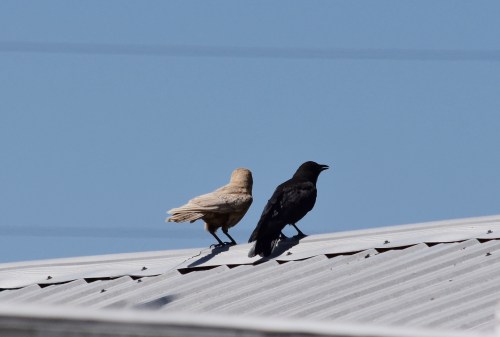
Blondie and its mate. Since I discovered this bird after its nestlings had already fledged, I have no way of determining its sex.

So beautiful in this juniper tree!

Blondie’s fledglings were typical looking crow kiddos.
The next batch of images are probably one of the most hilarious bits of fledgling dramatics I’ve ever seen. It is a scene familiar to many parents I’m sure. Forgive me for taking my scientist hat off, but I couldn’t help but add some anthropomorphic captions.
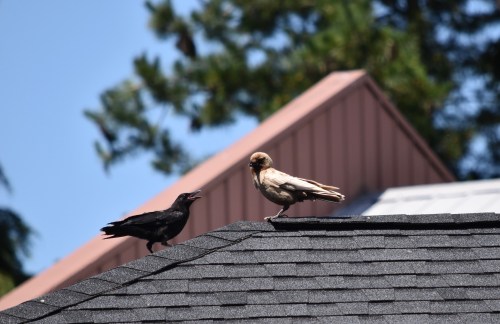
Hello parent I am hungry.

DID YOU HEAR ME, I SAID I’M HUNGRY.
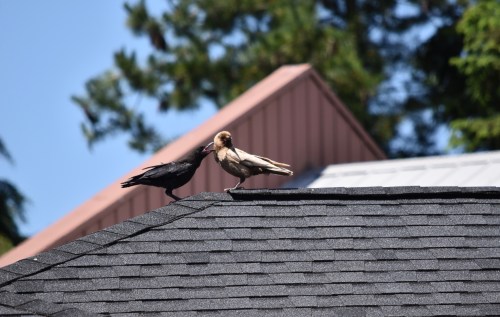
(whispering) help, parent, I need sustenance for my growing body.

(muffled whispering) please, have mercy, it’s been over 15 minutes since I was last fed.

MAYBE I’VE ALREADY DIED AND NOW I’M A GHOST IS THAT WHY YOU AREN’T LISTING TO ME???

I’m sorry. I’m just hangry. I love you.


Cheers to yet another beautiful crow. Goodbye for now!
Filed under Birding, Crow curiosities, Just for fun
Crow curiosities: Why was I attacked by a crow?
You’re minding your own business when seemingly from out of nowhere you are, or very nearly are, struck in the back of the head by crow. It’s frightening, embarrassing, and in rare cases even painful. So what prompted this unprovoked attack?
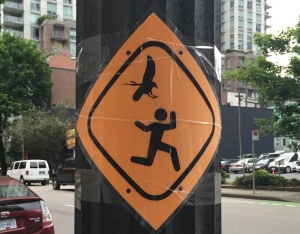
If you were to gauge the answer based on newspaper headlines you might believe that it’s because crows are evil, vicious or otherwise hellbent on tormenting us humans. This choice of words communicates that crows are behaving as they are because they lack moral decency, which is both anthropomorphic and grossly misrepresents the biological cause of their behavior.
Rather than being a reflection of their species’ character, or The Birds come to life, crows are increasingly behaving this way right now because young crows are starting to venture out of the nest. As I’ve talked about before, it’s not unusual for baby crows (and other birds) to leave the nest while still unable to fly. Although their parents will continue to care for them after this for many months, these first couple weeks out of the nest are a particularly vulnerable time for young crows. Their parents are therefore keen to protect their offspring, and are willing to come to blows with potential predators if necessary. You may have no intention of harming or even coming near their offspring, but of course the crows have no way of assessing your intentions. You are simply a big, powerful animal that is encroaching on their young, and they are driven to scare you away. They are simply being protective parents.
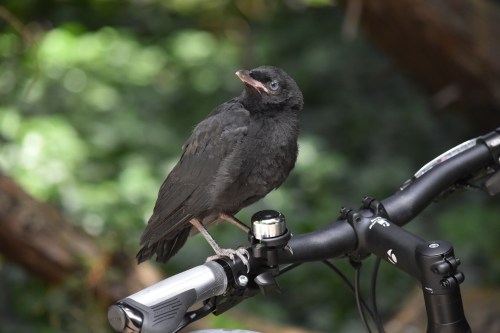
If you were my parents you’d want to keep me safe from big mammal-monsters too
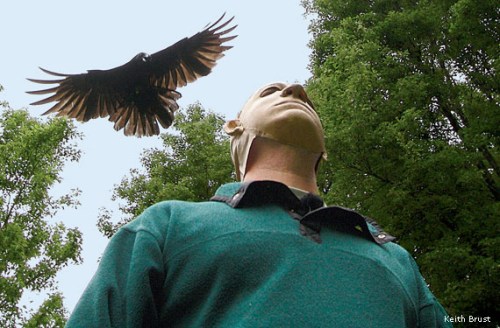
Although crows will dive bomb people who have wronged them in the past, during the summer the most likely explanation for attacks is defense of offspring.
Filed under Uncategorized
RAVENous for crow eggs
Given their similarities, it might surprise folks to see crows occasionally harassing and chasing ravens. After all, birds of a feather right? Not in this case. Rather than being in cahoots, the relationship between crows and ravens is most often competitive, though it can also be predatory.

A raven barrel rolls to scold an attacking crow.
To date, however, there are no accounts of crows engaging in this behavior, though there is one documented observation of a nestling being deposited into a nest from which it did not originate.2 Again, utterly fascinating, but not helpful here.
Later, a more detailed account from Ty made mention of the size of the intruding birds, which quickly led me to the story’s true explanation. Shortly after my ‘ah ha’ moment, to the dismay of he and his colleagues the nest raiders returned, and this time were caught on video by one of Ty’s colleagues (who you can follow on twitter, @namnam). Rather than being crows, these literal homewreckers were common ravens.
Instead of being something out of the ordinary, Ty had witnessed a typical breeding season interaction between crows and ravens. It’s no wonder then, that crows can be so hostilie when ravens enter their territory.

Crows (top) mobbing a raven (bottom) in Kent, WA
Literature cited
- Trost CH and CL Webb. 1986. Egg moving by two species of corvid. Animal Behaviour 34: 294-295.
- Schaefer JM and Dinsmore JJ. 1992. Movement of a nestling between American crow nests. The Wilson Bulletin 104: 185-187
Filed under Birding, Breeding, Crow behavior, Raven behavior
What’s in a (corvid) name?
Most people know various corvid species by their common names but have you ever wondered what etymologies inform their scientific names? Turns out it’s a pretty fun little exercise to find out!

Before we get to breaking down individual corvids though, a quick word on scientific names more generally. Scientific names always have the format: Genus species. Meaning, the first word in the name tells you what genus the plant/animal belongs to and the second tells you the species name specific to that organism. So for example crows, rooks, jackdaws and ravens are all in the same genus so their scientific names will all start with the same word: Corvus. The second word, however, will be unique to each species. This system of binomial nomenclature was first developed by Carl Linnaeus in the 1700’s. By looking up the roots of an animal’s scientific name we can learn a thing or two about what he, (or whoever named it) was trying to highlight. Then again, sometimes they’re just fans of Beyoncé or Jonny Cash.
One more note: although scientific names are often referred to, informally, as Latin names, their roots may actually pull from many languages. Though by far the most common languages are Latin and Greek.
As it happens, I have an old book of root words I inherited from my late grandfather, Richard Swift. Something about having that book in my hands begged for this exploration in a way that having the breadth of the Internet at my fingertips never did. What can I say, a childhood spent in the library of my grandfather’s office has made me a sucker for old, smelly books. So let’s get started!
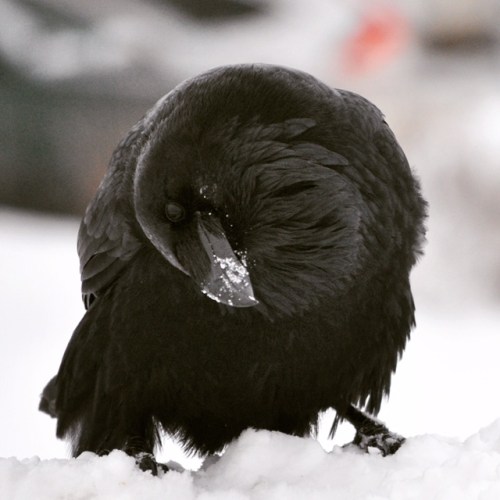
Common raven: Corvus corax
Common ravens are the biggest of the corvids (and in fact, the biggest of all the songbirds) so it makes sense their name might be the yardstick by which other corvids are measured. Cora literally translates to “crow, raven” so the common raven’s scientific name essentially just means raven.

GO, the American crow
American crow: Corvus brachyrhynchos
Turning to American crows, we can see that yardstick I mentioned coming into play. Brachy means “short” and rhynch means “a beak or snout.” So the American crow’s full scientific name basically translates to the “short-beaked crow.”
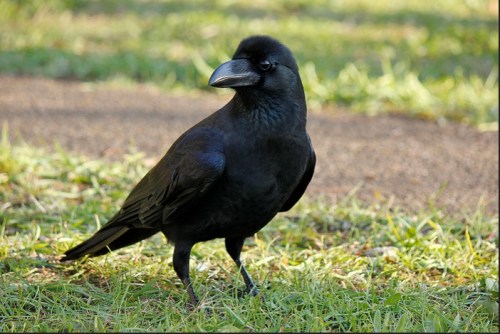
Jungle crow, photo c/o Anne Kurasawa
Jungle crow: Corvus macrorhynchos
At this point, the meaning of the jungle crow’s name probably needs no explanation. The bird looks essentially like an American crow but with a more pronounced bill. Macr rhynch = large beak.

Pied crow, photo c/o Frank Vassen
Pied crow: Corvus albus
Alb means “white.” No mystery here.

House crow, photo c/o Benjamint444
House crow: Corvus splendens
Splen means “a badge or patch.” With grey sweater they sport, it’s likely the person who named them was trying to highlight this physical distinction.

Thick billed raven, photo: Ignacio Yufera
Thick-billed raven: Corvus crassirostris
Sometimes, scientific names are precisely their common names. Such is the case here. Crass means “thick” and rostr means “beak.” This is a good example of where we see different languages influencing the names. In this case, thick-billed ravens got the Latin root, whereas American and jungle crows got the Greek root for beak.

Rook, photo c/o Pam P.
Rook: Corvus frugilegus
This one is less clear to me. Frugi means “useful, fit” and legus means “lie down; choose; or collect” depending on what language you pull from. My guess is it’s supposed to be ‘collect’ and the name refers to the more specialized bill they have for collecting insects.
Finally,

The grey or bare-faced crow, photo c/o B.J Coates
The grey crow: Corvus tristis
Trist means “mournful; sad.” I have a feeling I know the backstory for this one but I’ll leave it to my readers to see if they can figure it out. Leave me your best explanation (made up or researched) in the comments!
Filed under Birding, Corvid trivia, Crow curiosities, Uncategorized
The science behind caramel crows
Generally, when I receive emails with the subject line “interesting crow” it’s because the author noted some peculiar or amusing crow behavior they want to share, or because they spotted an unusual looking crow due to AKD, leucism or avian pox. Rarely, it’s for none of these reasons and is truly a horse of a different color. Or in this case, crow.


Meet Al, a hatch year American crow whose natal territory overlaps with Tara Chafe’s property. According to Tara, Al is the second bird born in the last 5 years with this kind of color abnormality. The bird that she reports is its mother is leucistic, but as you can see below, she’s not a particularly dramatic case with maybe only one or a couple more white feathers.
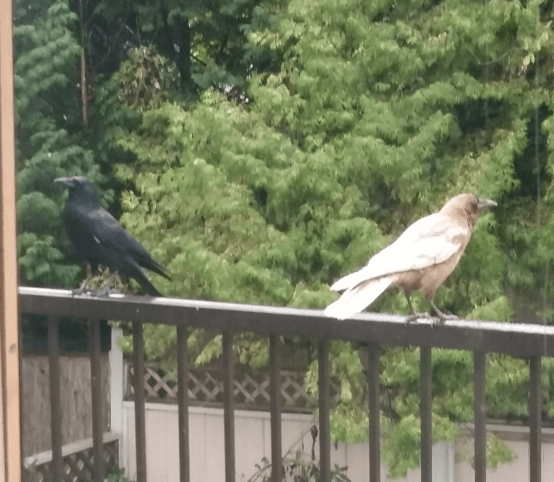
Without having observed Al myself I can’t confirm any of Tara’s observations, but from her perspective, Al appears to interact normally with the other crows, and doesn’t exhibit any other health issues. In fact, the first caramel crow that Tara encountered has gone on to mate and establish a territory in a nearby neighborhood and she still occasionally encounters it.
Understandably, Tara’s question to me was “what is going on here?” and initially, though I am by no means an expert in pigmentation, I didn’t expect it would be too much work to provide her an answer. And with that my descent began.
It’s helpful to start by understanding what controls pigmentation in birds. There are three different groups at play: melanins, carotenoids, and porphyrines.1 Melanin is probably the most familiar term, after all we possess a lot of it ourselves and the skin cancer melanoma is named for the melanin producing cells where it occurs. In fact, there are three kinds of melanin: eumelanin, which controls dark browns and blacks, pheomelanin, which controls reddish hues, and neuromelanin which occurs only in the brain. Carotenoids, on the other hand, are derived from plants and produce the red of a cardinal or the yellow of an American goldfinch. Porphyrines, which are modified amino acids, can produce a wide variety of colors from pink to green, as observed in some of the more colorful corvids such as the Bornean green magpie and ceylon magpie. Lastly, the structure of the feather also plays a role in color, particularly with respect to the color blue and iridescence, but I’ll save that for another post. Of most concern to us in this case is melanin, since that’s what’s controlling coloration in American crows.


Knowing this is an issue of melanin, I next wanted to identify how we might characterize this color aberration. Older birders will describe this bird as leucistic, and historically that convention was considered accurate. Contemporary semantics among pigmentation papers, however, have clarified leucism as a condition that “results from a complete lack of melanin from all or parts of the plumage”.2,3 In other words, crows that are leucistic would be completely white in one or more feathers, which this crow is clearly not. Without yet knowing exactly what’s going on here the more appropriate terms might be: “Schizochroism” meaning a lack of a single pigment, or “dilution” meaning an overall decrease in pigmention deposition.2 A color mutation known as “brown,” meaning a qualitative reduction of melanin, has also been proposed.3
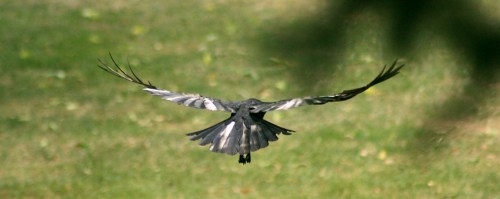
A leucistic crow in flight
With this much information at hand, we might begin to think that this reddish/caramel colored bird has some issue with its eumelanin production that is giving way to more visible pheomelanin. The trouble is, by all accounts crows do not produce pheomelanin.3,4,5 So if crows do not produce pheomelanin what is going on here?

Fellow crow expert, Dr. Jennifer Campbell-Smith, sees there being a few possible explanations. The first is simply that we haven’t studied pigmentation across Corvus species thoroughly enough to say that crows such as American crows don’t produce pheomelanin. After all, some Corvus species, such as the brown necked raven, certainly appear to express pheomelanin produced colors. Perhaps American crows do produce a modest amount that has so far been difficult to detect, but is revealed in cases like this. Alternatively, Jennifer suggests that even if American crows don’t typically produce pheomelanin they may still possess all the infrastructure for doing so. Perhaps in cases such as Al’s, the genes that regulate such production have been turned on. As an especially interesting side note, pheomelanin is a particularly energy intensive pigment to produce, and as such, there’s evidence of a correlation between larger brain sizes (including Corvus species) and low to undetectable levels of pheomelanin6.

Brown necked raven (Corvus ruficollis) photo c/o Peter Nash
Another publication suggested that cases like Al’s are caused by incomplete oxidation of eumelanin3, but I am dubious of this paper because they claimed that corvids as a family do not produce pheomelanin, which blatantly untrue at worst or, if they meant Corvus, an egregious typo at best.
Ultimately, what I found was that rather than being a matter of a quick trip to the virtual library, an explanation for Al’s condition is currently unresolved by science. Which is probably my favorite genera of science. After all, what’s better as a scientist than embarking on the unknown or poorly understood?
Many thanks to Tara for a truly interesting crow, and for agreeing to let me share Al’s story here.
- https://academy.allaboutbirds.org/how-birds-make-colorful-feathers/
- Guay, P.J., Potvin, D.A., and Robinson, R.W. 2012. Aberrations in plumage coloration in birds. Australian Field Ornithology 29: 23-30
- van Grouw, H. 2013. What colour is that bird? The causes and recognition of common colour aberrations in birds. British birds 106: 17-29
- Lee E, Tanaka H, Wakamatsu K, Sugita S. 2009. Melanin-based iridecent feather color in the jungle crow. Journal of Veterinary Medical Science 71: 1261-1263.
- http://www.sibleyguides.com/2011/08/abnormal-coloration-in-birds-melanin-reduction/
- Galvan I, Moller AP. 2011. Brain size and the expression of pheomalanin-based colour in birds. Journal of Evolutionary Biology 24: 999-1006. DOI:10.1111/j.1420-9101.2011.02232.x
Filed under Uncategorized
Corvid of the month: Rooks
In honor of last week’s #CrowOrNo photo, I wanted to spend some more time spotlighting a corvid perhaps less well known to my fellow North Americans, the rook (Corvus frugilegus).
Photo c/o Pam P.


(Hover over tiled photos for captions)
Of course, what made last week’s #CrowOrNo submission such a challenge was that the photo was not of an adult, but rather a first year bird. With their nasal hairs intact, first-year rooks look something like a crow/raven hybrid. Although bill shape is, I think, the best tell, one other field marker to look for are their notoriously shaggy “pants” (belly and leg feathers) in contrast to crows and ravens.
The transition to bare-faced adult occurs during the bird’s first complete body molt when they’re around 10-15 months old. This process can take as little as 25 days but for most birds occurs over the course of several months1. The evolutionary reason for this loss may have something to do with their foraging habits, which consists largely of probing for worms, though this remains unclear.


Unlike many Corvus species which are more general with respect to their diet, rooks are fairly specialized to feed on the small worms that live among the roots of plants. One consequence of this diet is that there are distinct boom and bust seasons. In April and November, wet conditions make worms plentiful, but in other times of years drier conditions drive worms deeper and out of reach. Since access to food can be precarious, rooks have adopted a rather unusual incubation strategy compared to most birds. Rather that commencing incubation when the entire clutch is laid, which promotes the same hatch date, rooks start incubating the first egg as soon as it is laid. This chick is born earliest, giving it a clear advantage over its future siblings. If food becomes sparse only this chick will survive. If food remains abundant, the parents can provision enough to supply the larger, more dominant chick, and its younger siblings.2

Photo c/o Danny Chapman
Cognitively, rooks demonstrate many of the same skills that have brought some of their peers into the global spotlight. For example, when in the care of humans, rooks have demonstrated an astounding alacrity for tool use, though they are not known for manufacturing tools in the wild. For example, captive rooks have been shown to bend wire into hooks to extract food out of a tube like New Caledonian crows, or work together to solve problems like chimps (though unlike chimps, they do not appear to understand when cooperation is necessary or how it works).4,5
Taken together, these snippets of their biology and behavior demonstrate what unique members rooks are to the Corvus genus. I envy my counterparts across the Atlantic and Pacific and encourage them to take a second look at the rook whenever opportunities present themselves.

Photo c/o Paul Wilson
1. Dunnet GM, Fordham RA, Patterson IJ. (1969). Ecological studies of the rook (Corvus frugilegus) in North-East Scotland. Proportion and distribution of young in the population. British Ecological Society 6: 459-473
2.Green P. (1996). The communal crow. BBC Wildlife 14: 30-34
3. Coombs CJF. (1960). Observations of the rook Corvus frugilegus in southwest Cornwall Ibis 102: 394-419
4. Bird CD, and Emery NJ. (2009). Insightful problem solving and creative tool modification by captive nontool-using rooks. PNAS 106: 10370-10375
5. Bugnyar T. (2008). Rooks team up to solve a problem. Current Biology 18: R530–R532
Filed under Birding, Corvid diversity, Corvid of the month, Diversity, Uncategorized
Sometimes I’m wrong too.
A few months ago I started a new Twitter/IG game called #CrowOrNo. This was, in part, simply a response to the awesome wave of science games across social media and wanting to be apart of that science communication effort. But I also started it because discerning these birds is just genuinely hard. Case in point, I’ve had more practice than most but even I get fooled sometimes.
One of my most popular posts is “10 corvids that don’t give a damn about your rules” which, while intentionally lacking any scientific credibility was at least supposed to be an accurate collection of corvid gifs. Turns out I goofed. Not once but twice. The original post contained these two gifs neither of which are of corvids. It took the help of an Australian birder, and a fellow corvid expert, Jennifer Campbell-Smith, for me to notice my error.


As a grad student/scientist/blogger/science communicator this is my nightmare. That I’ve put out information, even if it was supposed to be fairly non-sciencey in nature, that’s wrong. But I did.
Being a catastrophist, my first reaction is “You blew it. No one will take you seriously now. It’s over.” Needless to say, this is not a motivating feeling. It’s a ‘crawl under the covers and stop trying’ feeling, which is about the least helpful way to react to making a mistake and a reaction I would discourage in anyone else. So I’m going to take my own advice and remember that I’m a person before I’m a scientist. I’ve made, and will continue to make mistakes. The only thing I can promise is that I will be forthright in my mistakes and keep learning.
So the next time you error in #CrowOrNo, know you’re in good company. Sometimes I’m wrong too 🙂
Filed under Uncategorized
Crow curiosities: Why their feet don’t freeze
With a peanut visible in my gloved hand, we square off. The crow eyes me from its snow covered perch, weary of such gifts offered by strangers. Above us a raven castes a disinterested look, croaks, and flies away. I toss the nut into an empty parking space and the crow descends to quickly collect its prize. The space between us must be widened before it will comfortably eat however, so I decide to leave the crow to its snack and return to my car.

Scrunching my feet in my shoes, I’m relieved for the excuse to retreat. It’s about 10˚F outside and despite the wool socks and insulated boots between my skin and the snow I can tell that my feet are numb from the cold. Even stashed in my pocket, my gloved hands are having trouble articulating to their full range. How is it that my extremities lose function even with so much coddling and yet the crows can continue using their bare toes to steady and manipulate food in such cold weather?
To be clear, birds are endothermic, or warm blooded, just like mammals. In fact, on average, birds run a little hotter than mammals. And their feet, like ours, requires warm blood both to function and to prevent the tissues from outright freezing and causing cell death. Yet despite these needs birds can comfortably walk, stand, or even sleep on ice.

Glassy ice makes cold footing!
To do so, they can take advantage of two important adaptations. The first is that the size of the arteries carrying blood into the legs and feet is exceedingly small. Given this high surface to volume ratio, the blood has already lost most of its heat by the time it reaches the feat, and can’t lose much more to the outside world. The second is that they employ what’s called a counter current heat exchange system. Essentially, warm blood traveling away from the core and towards the feet via the arteries comes into close contact with colder blood traveling away from the feet and towards the core via the veins. At this point of contact, heat from arterial blood is transferred to blood traveling in the veins. This heat exchange system allows for the tissues in the feet receive just enough heat to prevent cell death, and can reduce heat loss by up to 90%1.
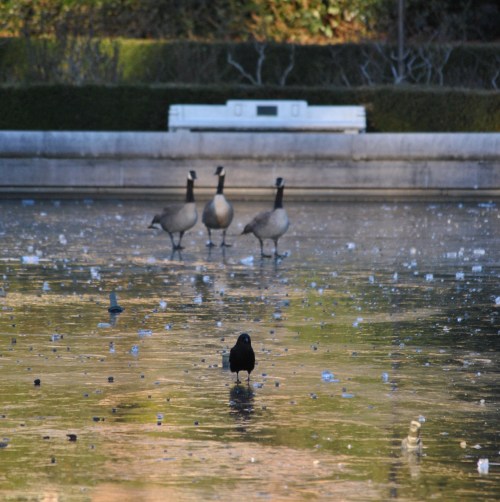
A crow wades out across a frozen Drumheller Fountain in search of scraps
As an additional strategy, you’ll see them protecting their exposed legs under their body feathers, as if they’re incubating them. This is the same reason you often see winter birds standing on one leg. By switching back and forth, birds can minimize overall heat loss by reducing the exposure to only a single leg.

A crow covers its feet while it waits (hopes) for a handout
So while I need special clothing to keep my extremities at a similar temperature range to my core, the physiology of most birds is adapted to simply allowing extremities to exist at near ambient temperatures with no tissue damage. In other words, rather than crows’ feet not getting cold, their feet simply are cold. That said, frostbite is still a possibility even in birds, particularly for: nonnative species, birds in wire cages, birds with metal legbands, and birds in unseasonably cold conditions. If frost bite occurs, early treatment at a rehab facility can prevent long term damage2.
Still, the idea that cold-adapted birds can keep their hearts beating away at around 105˚F even while their feet are exposed to freezing temperatures is marvel of adaptation and thermoregulation!

Literature cited:
- Elphick C, Dunning JB Jr., Sibley DA (eds). (2001) The Sibley guide to bird life and behavior. New York: Alfred A. Knopf
- Wellehan JFX. (2003). Frostbite in birds: Pathophysiology and treatment. Compendium 25: 776-781
Filed under Corvid health, Crow behavior, Crow curiosities
Saving the rarest crow
It can be hard to imagine crows as anything but ubiquitous. During winter across the country, dusk marks the time where some cities see their skies turn black with thousands, even hundreds of thousands of American crows converging to roost. These crows have taken nearly all that people have thrown at them: deforestation, mass waste, and the urban sprawl that simplifies previously complex ecosystems, and uses it to their advantage. Not all species of crow have thrived in the Anthropocene, however.

Thousands of gather accumulate in the skies above UW’s Bothell campus in the winter
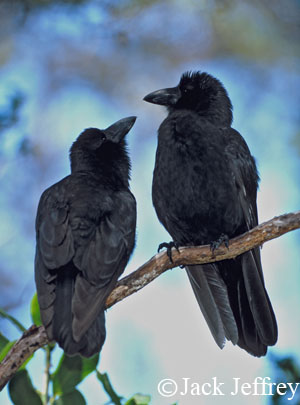
Photo c/o the Alala Restoration Project
Unlike their generalist, continental counterparts, the ‘Alalā is more specialized to feed on understory fruits and nuts and in fact were key seed distributors for many of Hawaii’s native plants. Island living also fostered a similar behavior seen in only one other species of crow: tool use. Like the New Caledonian crow, the ‘Alalā is a dexterous tool user, though the two species are only distantly related. Scientists believe this example of convergent evolution is fostered by aspects typical of islands, namely low predation and low competition for embedded food5.
Unfortunately, limited distributions and higher specialization also meant their population was more fragile than that of continental crows. Logging, agricultural development, loss of native pollinators, and alterations by non-native ungulates challenged both food acquisition and breeding habitat. Introduced diseases such as avian pox, malaria and the Toxoplasma gondii parasite carried by cats further weakened an already ailing population6,7. Invasive predators including rats, mongoose and cats consumed eggs, nestlings and fledglings. Finally, humans continued their tradition of persecution, particularly feral pig hunters who would shoot the birds before they could alarm call and scare off their prey2.
Together, these threats set into motion a decline in population we failed to recover despite some increases in research and management starting in the 1970’s. The last known wild egg was laid in 1996, and the last wild pair was seen in 20022,3. Some people did recognize the urgency of their decline prior to 2002, however, and a captive breeding population was started successfully rearing over 90 birds8. Although such a small number of breeders may raise red flags with respect to inbreeding and genetic depression, this is rarely as big of an issue as is commonly perceived. Unfortunately, light management and depredation by the also endangered Hawaiian hawk (‘io), decimated the released population and reintroduction efforts were halted in 1999 until a larger captive population and better management strategy could be devised.
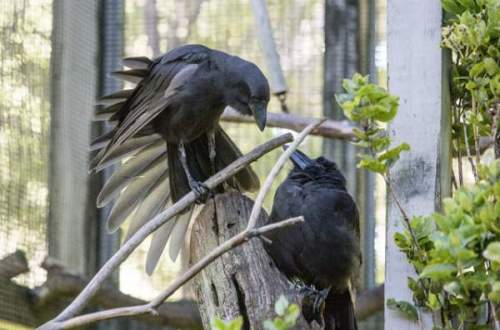
Photo c/o Holly N Johnson/Tribune-Herald
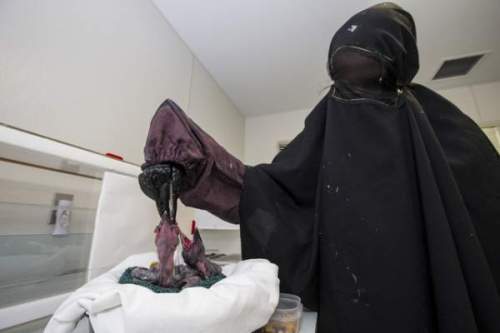
A human dressed as an ‘Alala feeds captive reared nestlings. Photo c/o San Diego Zoo Global
While clearly disheartening, early hiccups in a release effort like this are not unusual and conservationists and biologists are not losing hope that success is still possible. Part of ensuring such success, however, is undoubtedly public support particularly with respect to maintaining the strength of the Endangered Species Act and support of the ‘Alalā Restoration Project. The perception that all crows are alike or that generous populations of American crows means protections for other corvus species is unwarranted or redundant will be a disaster for these rare birds. So make your voice heard when funding for conversations efforts come under fire, and share your passion for endangered corvus species with friends and family. The fate of the world’s rarest crow quite literally depends on it.

Two newly released ‘Alalas peer around their new surrounding in the Pu’u Maka’ala Natural Area Reserve. Photo c/o the San Diego Zoo Global
- https://www.fws.gov/pacificislands/fauna/alala.html
- Faike, E. 2006. Wild voices in captivity: the date of the ‘Alala. Birding 38: 64-67.
- Banko, P. C.; Burgett, J.; Conry, P. J.; David, R.; Derrickson, S.; Fitzpatrick, J.;
- National Research Council (US) Committee on Scientific Issues in the Endangered Species Act. Science and the Endangered Species Act. Washington (DC): National Academies Press (US); 1995. 2, Species Extinctions. Available from: https://www.ncbi.nlm.nih.gov/books/NBK232371/
- Rutz C, Klump BC, Komarczyk L, Leighton R, Kramer J, Wischnewski S, Sugasawa S, Morrissey MB, James R, St Clair JJH, Switzer RA, and Masuda BM. (2016).
Discovery of species-wide tool use in the Hawaiian crow. Nature 537: 403-407 doi:10.1038/nature19103
- Maxfield, B. 1998. Wild ‘Alala population suffers major setback. ‘Elepaio 58: 51.
- Liebermann, A.; Nelson, J. T.; Simmons, P.; Unger, K.; Vitousek, P. M. 2003. Draft revised recovery plan for the Alala (Corvus Hawaiiensis. US Fish and Wildlife Service, Portland, OR, USA.
- Lieberman, A. C., Kuehler, C. M. 2009. Captive propagation. In: Pratt, T. K.; Atkinson, C. T.; Banko, P. C.; Jacobi, J. D.; Woodworth, B. L. (ed.), Conservation Biology of Hawaiian Forest Birds: Implications for Island Avifauna, pp. 448-469. Yale University Press, New Haven.
- Valutis LL, and Marzluff JM. (1999). The appropriateness of puppet-rearing birds for reintroduction. Conservation Biology 13: 584-591
 corvidresearch.blog